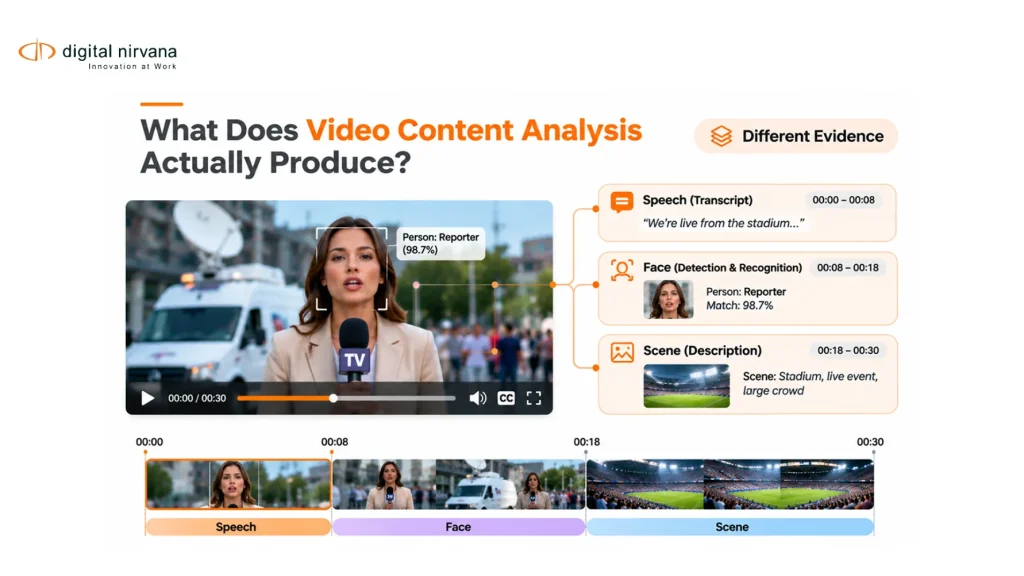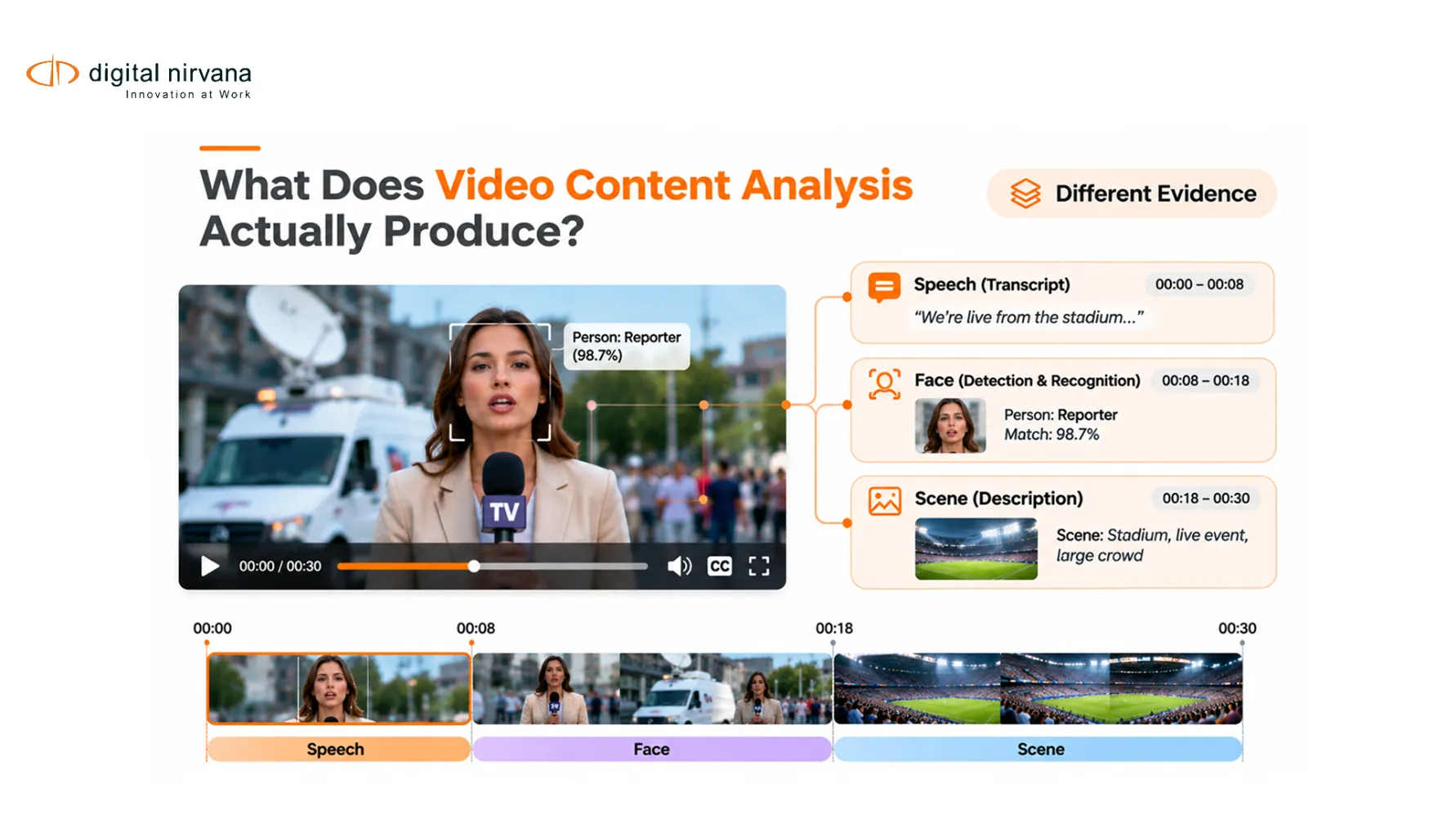
A platform labels a clip “stadium,” transcribes a player’s name, and describes a winning celebration. Those outputs may refer to different moments, and the celebration may follow a replay. Video content analysis becomes useful when you can connect each observation to its source, time range, processing method, and review status.
For media teams, the goal is searchable, reviewable information about what appears and is said in the footage. AI does not produce a single, equally reliable understanding of every signal. Speech recognition, visual detection, text extraction, and generated descriptions answer different questions and need different checks.
Key Takeaways
- Combine analysis outputs through shared asset identity and timing, rather than assuming nearby labels describe the same event.
- Distinguish face detection, speaker separation, and verified identity before building people-based search.
- Preserve original observations alongside corrected labels and generated descriptions.
- Test missed events and plausible false matches as well as successful examples.
- Choose packaged enrichment or modular services according to who will operate the integration and review workflow.
Table of Contents
- What Does Video Content Analysis Actually Produce?
- How Does Speech Become Searchable Evidence?
- What Can Face and Object Analysis Tell You?
- How Do OCR, Shots, and Scene Descriptions Differ?
- How Should AI Microservices Work Together?
- Which Failure Modes Need Human Review?
- How Should You Evaluate Analysis Quality?
- Where Do Digital Nirvana’s Products Fit?
- FAQs
- Conclusion
What Does Video Content Analysis Actually Produce?
Video content analysis produces observations and interpretations that can be attached to media. Some outputs report a detected item or recognized word; others summarize or describe a broader sequence. Keep that distinction visible in the data model.
The Google Cloud Video Intelligence API reference documents separate capabilities for tasks such as object detection, scene changes, and speech transcription. A buyer should ask which capabilities a specific product combines and which require additional services.
| Analysis Layer | Useful Output | Interpretation to Avoid |
| Speech recognition | Words associated with audio ranges | Every proper name is correct |
| Face detection | A face occurs in a visual range | The person’s identity is established |
| Object analysis | A candidate object label and location | The action or story is proven |
| OCR | Text visible in an image | The text is accurate or authoritative |
| Scene description | A generated account of visible content | Every inferred relationship is factual |
This distinction supports better procurement questions than asking whether a platform “understands video.” Ask what evidence it returns and how users can challenge it.
How Does Speech Become Searchable Evidence?
Automatic speech recognition converts the audio into text that can be indexed and associated with media ranges. The practical value depends on whether users can return from a search hit to the correct speech in the original recording.
Keep speaker labels, language, and transcription provenance alongside the text when available. Speaker separation does not by itself identify a person. A label such as “speaker one” needs verification before it becomes a searchable identity.
Test names, abbreviations, overlapping voices, music, and material with no intelligible speech. A system that guesses words during silence can add false evidence to an archive. An incorrect negation can change the meaning of a quotation even if most other words are right.
Digital Nirvana’s existing guide to transcript-based archive indexing covers that downstream workflow. Keep transcription evaluation distinct from evaluating whether a generated summary faithfully represents the recording.
What Can Face and Object Analysis Tell You?
Face and object analysis can locate visual candidates, but the meaning of each output depends on the capability used. Detection identifies a category or occurrence; identification adds a claim about which entity it is.
The Google documentation for face detection describes finding faces in video. Do not treat that as proof that the service has named every person. Ask suppliers to demonstrate the exact identity workflow, reference material, and correction process they propose.
Object outputs can support discovery of vehicles, equipment, logos, or other relevant visual elements. Context still matters. A jersey number may be obscured, a sponsor mark may be distorted, and a player may appear in archival footage inside a current program.
Store uncertain identity as uncertain. Reusing an unverified name across the archive can turn one error into many confident-looking search results. For consequential uses, require a reviewer to inspect the source and supporting identification evidence.
How Do OCR, Shots, and Scene Descriptions Differ?
Optical character recognition extracts visible text, shot detection identifies visual boundaries, and scene description generates a textual account of content. They complement one another but do not establish the same facts.
A lower-third may help locate an interview, yet it may describe a person who has already left the frame. A scoreboard may show a score while commentary discusses an earlier play. A camera transition may split one action across several shots.
Keep the original recognized text and its visual location where your service supports them. Treat a generated scene description as a candidate interpretation, especially when it infers an emotion, cause, or relationship. Preserve a route back to the footage.
Digital Nirvana’s object detection guidance for media metadata provides related context for visual indexing. Build the workflow around what users need to find, then select which analysis layers are worth processing and reviewing.
How Should AI Microservices Work Together?
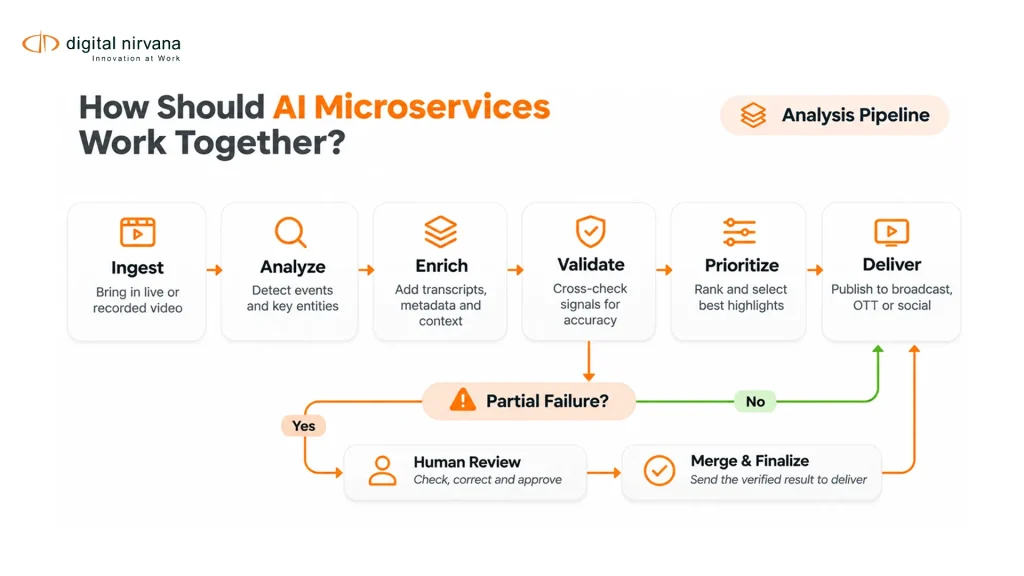
AI video content analysis services should exchange explicit records with shared identity, declared timing, and independent status. Merely running several models on the same file does not align their results.
Use this proposed orchestration sequence:
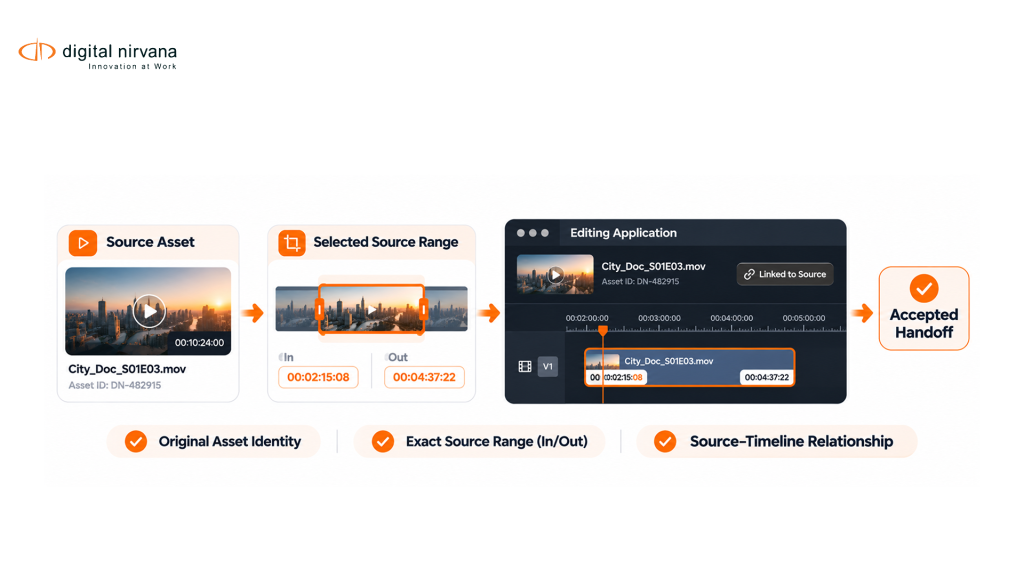
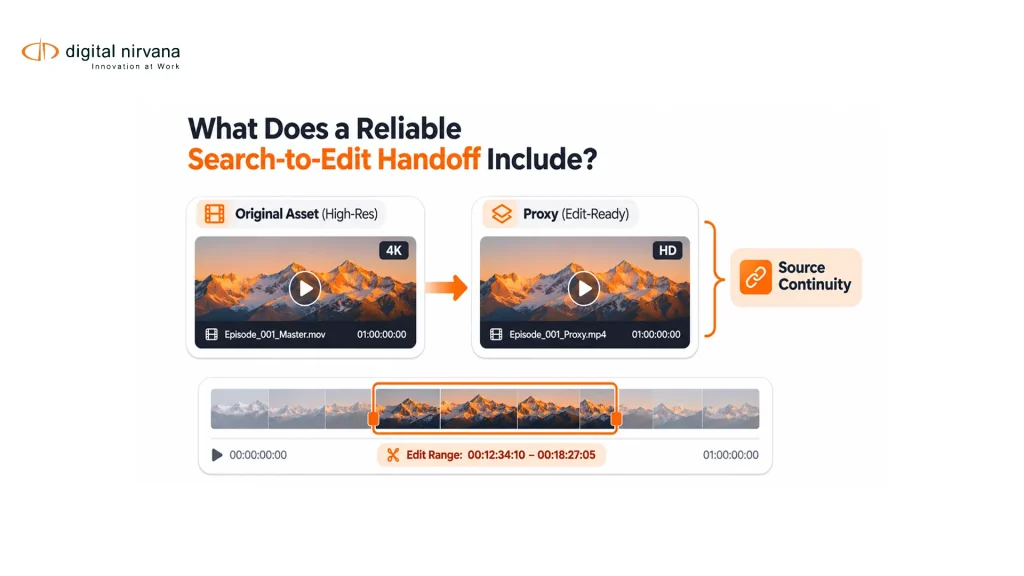
- Register the original asset and analysis rendition.
- Declare audio selection, language assumptions, and time interpretation.
- Submit only the capabilities needed for the workflow.
- Retain the provider, configuration, job identity, and returned ranges.
- Normalize outputs into fields your receiving system understands.
- Review consequential disagreements before promoting them to approved metadata.
Separate failed, pending, empty, and completed results. If OCR fails while transcription succeeds, the asset has partial coverage. A retry should not erase an accepted correction or create a second unrelated record.
This is an operating design, not a claim that every product exposes all these controls. Require a supplier or integration team to show how equivalent safeguards work in the proposed implementation.
Which Failure Modes Need Human Review?
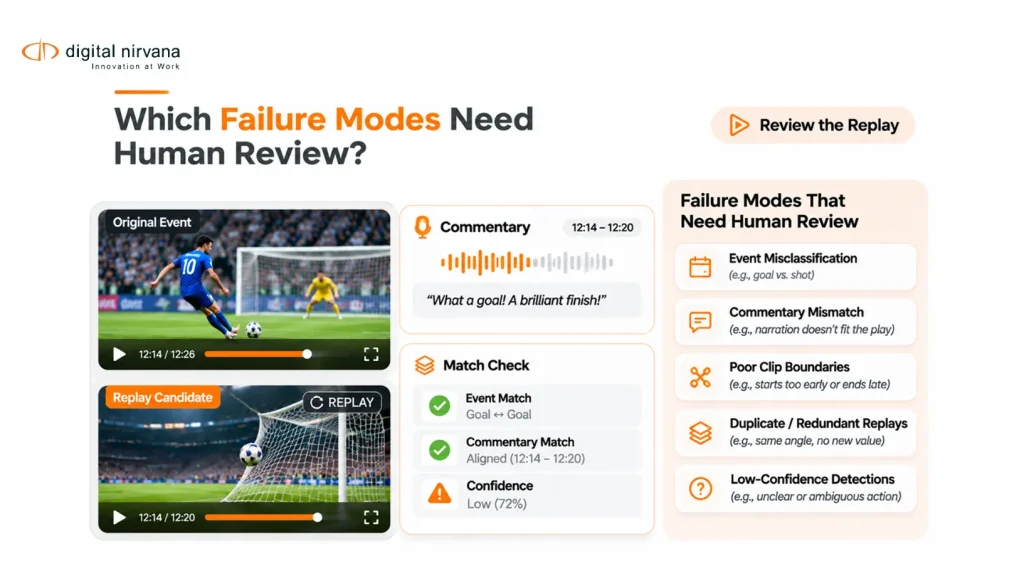
Prioritize errors that could misidentify a person, misquote speech, misrepresent an event, or authorize an inappropriate downstream action. Cosmetic label errors and consequential factual errors should not share the same review priority.
An illustrative sports clip shows why. Commentary names an athlete while a replay shows someone else. Face analysis finds a person, OCR reads a score, and a description calls it the winning play. Each output may look plausible alone; combining them without checking the timeline creates a false event record.
Give reviewers the original range, surrounding context, analysis evidence, and the proposed normalized value. Record what they accepted or changed. Keep the machine observation available so later model changes can be investigated.
Rights decisions deserve a separate control. A detector finding a logo, person, or music cue does not establish a license or clearance. Route those questions to the responsible team instead of interpreting recognition as permission.
How Should You Evaluate Analysis Quality?
Evaluate each analysis task against representative reference material, then evaluate whether the combined outputs support the intended user task. A single platform-wide accuracy percentage hides different error types.
Create reviewed examples with expected words, objects, people, ranges, and deliberately absent events. Include difficult conditions that appear in your archive. Keep the reference set separate from examples used to adjust settings or prompts.
Measure missed relevant items, incorrect returned items, range usability, reviewer effort, and failed processing. Choose acceptable tolerances according to the decision being supported. A broad discovery tag can be useful while remaining unsuitable as evidence for a named-person assertion.
Repeat the test when the model, configuration, media mix, or receiving workflow changes. Retain previous results so a faster analysis run cannot conceal poorer retrieval or additional correction work. Label pilot findings as findings from your own sample, not universal product performance.
Where Do Digital Nirvana’s Products Fit?
Digital Nirvana offers different routes for packaged media enrichment and composable analysis. MediaServicesIQ’s modular video intelligence capabilities provide a relevant starting point for teams integrating analysis into custom workflows.
MetadataIQ addresses enrichment and indexing around established media management environments. Keep that product role separate from a modular service architecture, even when similar underlying tasks appear in both discussions. MonitorIQ serves monitoring and recording requirements rather than acting as a substitute for every content-analysis workflow.
Start a technical evaluation with a sample input, the required output record, a receiving-system map, and an example that should fail review. Ask which features are supported in the proposed configuration and which require custom implementation.
Once those requirements are documented, discuss the analysis workflow with Digital Nirvana. The useful demonstration follows a result into the receiving system and shows how an incorrect interpretation is corrected.
FAQs
Video content analysis extracts information from video, audio, and associated signals for tasks such as search, classification, and review. Different capabilities produce different kinds of evidence, so the output must retain its source and context.
Facial detection finds a face, while identification makes a further claim about who the person is. Confirm the product’s identity capability and review process instead of treating any face box as a verified name.
Speech recognition captures spoken content but does not fully describe silent action, visual context, or editorial meaning. Combine relevant signals when the user task requires them, while checking whether the signals refer to the same moment.
No system should be assumed to detect every event across all sports and feed types. Evaluate the particular sport, event definitions, camera conditions, and correction workflow included in the proposed configuration.
Generated descriptions should not automatically overwrite authoritative metadata or accepted human corrections. Store them with provenance and review status so they can aid discovery without erasing verified information.
A pilot should deliver reviewed outputs, task-level results, failure examples, integration findings, and operating requirements. Its purpose is to show whether the workflow is useful and controllable on representative material.
Conclusion
Define the media question first, choose the analysis layers that can provide evidence, and test how their outputs combine. Keep identity, timing, and uncertainty visible until an accountable reviewer or rule accepts the result. A useful analysis workflow makes both discovery and correction easier.