Introduction
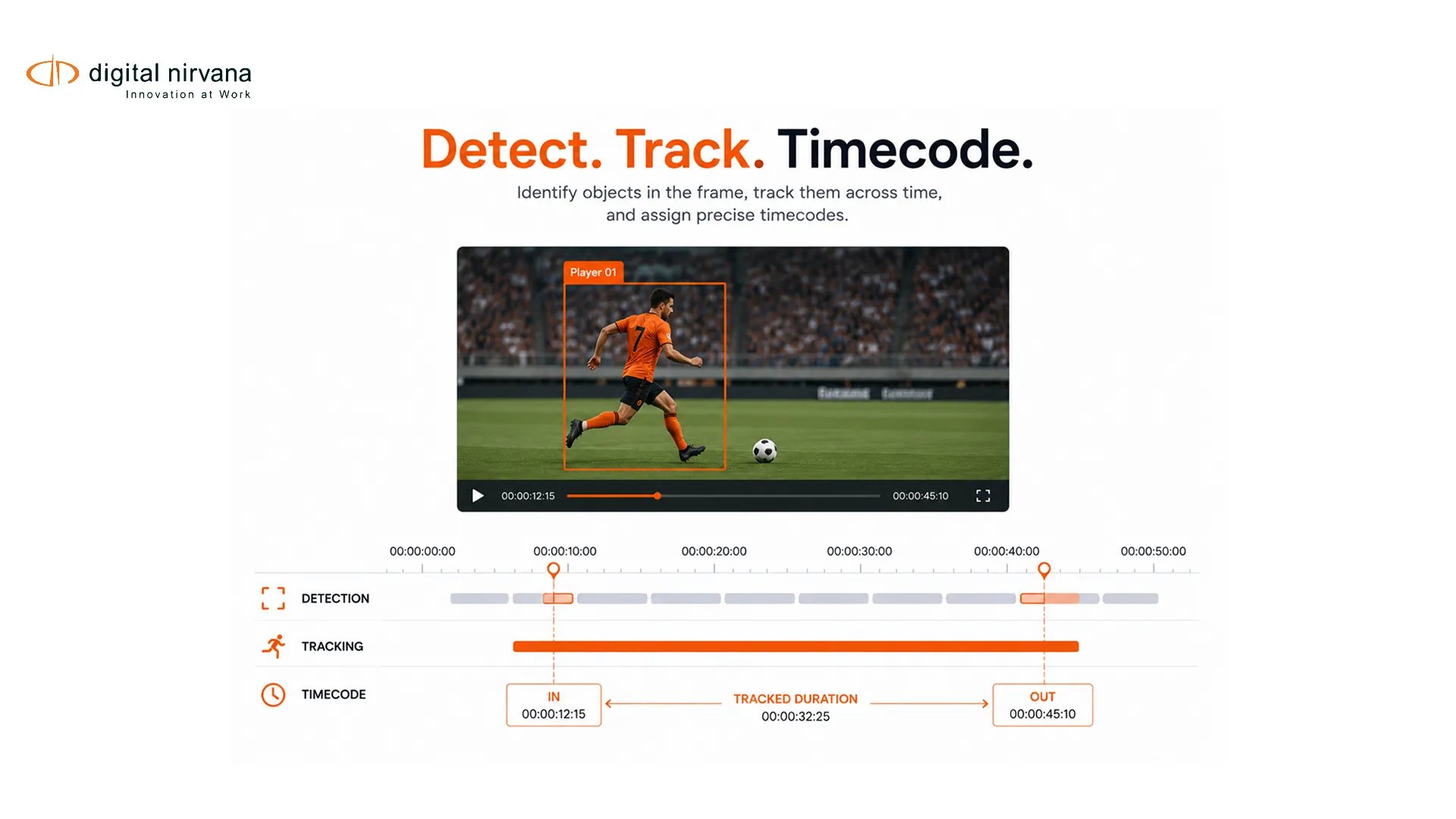
Video object detection identifies visible items and attaches their locations to frames or time ranges. For a media team, the useful result is not a box around a vehicle, microphone or ball. It is timecoded metadata that helps a producer find a shot, supports a review task or combines with other signals to describe what happened.
Object detection can expand discovery beyond filenames and transcripts, but it also produces false positives, broad labels and repeated observations. A production workflow needs filtering, normalization and a clear answer to who will use each label.
Key Takeaways
- Object detection can locate and track visible items over time.
- Searchable metadata requires timecodes, normalized labels and asset identifiers.
- Teams should test precision, recall, track stability and reviewer effort.
- Detection does not prove context, identity, ownership or policy compliance.
- API capabilities and metadata workflow products solve different layers of the problem.
Table Of Contents
- What object detection produces
- Media use cases
- From detection to metadata
- Quality testing
- Product and workflow boundaries
- FAQs
What Does Video Object Detection Produce?
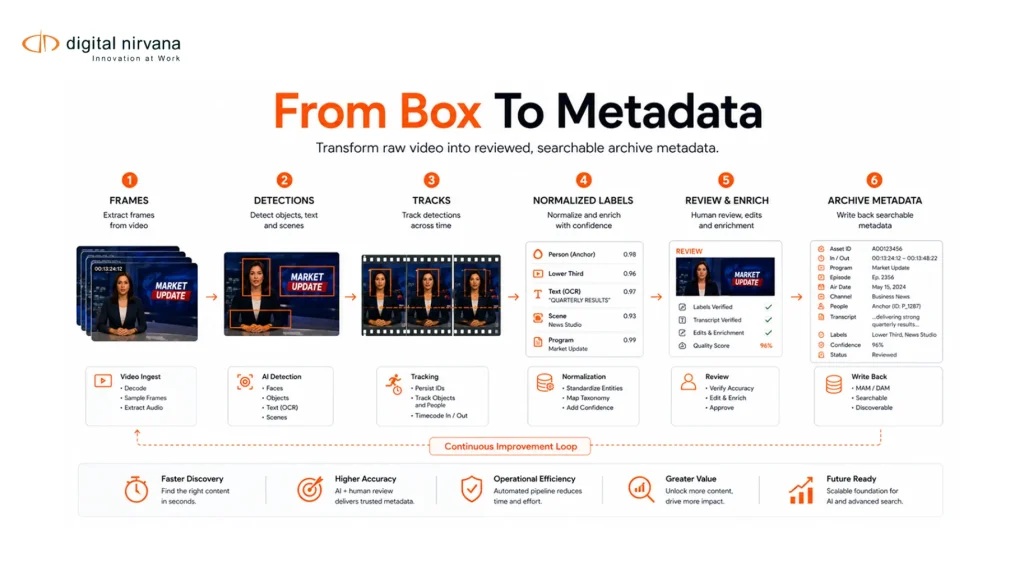
An object detector commonly returns a label, confidence value, bounding region and timestamp. Tracking can associate detections across successive frames so the result represents one moving object rather than a separate event in every frame. Google Cloud’s object-tracking documentation provides an example of time-offset and bounding-box output.
The label describes a model category, not necessarily the exact meaning a media organization needs. “Vehicle” may be too broad for a motorsport archive. “Microphone” may be useful for a production search but does not identify the speaker. A taxonomy layer can map model labels to approved archive terms, while review handles uncertain or high-impact cases.
Where Media Teams Can Use Object Metadata
| Workflow | Useful Detection | Required Context |
| Archive discovery | Vehicles, landmarks, products, equipment | Program, date, rights and time range |
| Sports clipping | Ball, goal, racket, scoreboard region | Game clock, teams, event type |
| News research | Podium, microphone, emergency vehicle | Transcript, person, place, source |
| Brand review | Logo or product category | Brand identity, placement rules, duration |
| Production logging | Camera, prop, scene element | Shot boundary, take or project metadata |
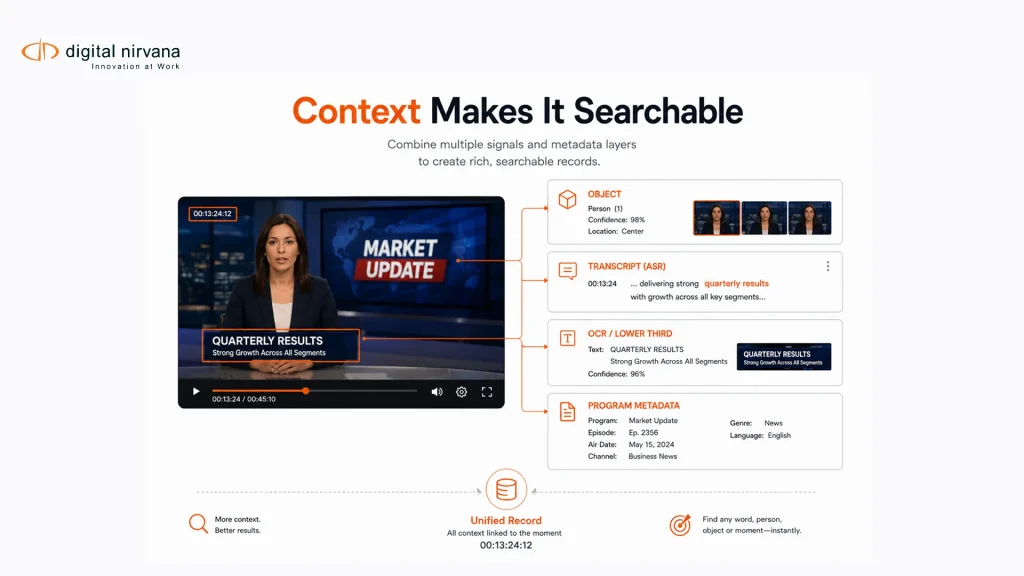
These examples show why object detection is rarely sufficient alone. A sports ball on screen does not prove a scoring event. An emergency vehicle does not establish where or why an event occurred. Combining objects with speech, visible text, scenes and existing program metadata creates a more useful search record.
Digital Nirvana’s article on logo detection and timecoded brand safety covers a more specific visual-recognition workflow in which identity and duration matter.
How Detections Become Searchable Metadata
The process starts with a stable asset identifier and a selected analysis copy. The detector returns frame-level or segment-level observations. Tracking consolidates repeated boxes into time ranges. Rules then remove short-lived noise, map synonyms and set confidence thresholds.
The workflow can write approved labels and timecodes into a separate search index or into fields supported by the asset system. It should preserve the original result and model version for diagnosis. If a label is corrected, the audit trail needs to distinguish a human decision from the original machine output.
For archive search, detections often work best as supporting evidence. A query can require an object plus a program, date or transcript term. That reduces irrelevant results and makes the system less dependent on one model.
The Azure Video Indexer insights overview illustrates how object-related signals can sit beside transcripts, OCR, faces, topics and other timed insights.
How To Test Object Detection Quality
Build a labeled sample from the content genres in scope. Include small objects, partial occlusion, camera motion, low light, graphics and rapid cuts. Score whether the target object is found, how many incorrect labels appear and whether its time range is useful.
Precision measures how often returned detections are relevant. Recall measures how many known objects were found. Tracking stability assesses whether one object is fragmented into many short tracks. Time overlap shows whether the returned range aligns with the reference.
Operational testing should add reviewer time and metadata volume. A model can have acceptable aggregate accuracy but still create too many low-value labels. Set acceptance criteria around the intended query, not around every object the model can recognize.
API Capability And Metadata Workflow Boundaries
MediaServicesIQ is the Digital Nirvana product family for composable video-analysis capabilities, including visual analysis services. An organization can call such capabilities from its own orchestration and decide how to store the response.
MetadataIQ addresses the packaged indexing and enrichment workflow around a MAM, PAM or DAM. It is not a replacement for those systems. The distinction matters during procurement: one requirement may be for a callable analysis service, while another is for normalization, review and searchable media metadata.
FAQs
It is a computer-vision task that identifies categories of visible objects and locates them in frames. Tracking can connect those detections across time.
Classification assigns labels to an image or segment as a whole. Object detection also estimates where each detected item appears within the frame.
Not by default. Generic object labels differ from logo recognition, face matching or identity verification. Each requires its own model, references and governance.
Store the normalized label, asset ID, time range, confidence, source model and review state. Keep bounding regions when a downstream workflow needs spatial evidence.
Use representative training or evaluation data, confidence rules, minimum duration, allowed vocabularies, signal combinations and human review for higher-impact uses.
It can reduce repetitive description work, but human judgment remains useful for context, names, sensitive classifications and final editorial decisions.
Conclusion
Video object detection becomes valuable when its output answers a real media question. Timecodes, controlled labels, signal combinations and measured review rules turn raw detections into metadata that users can search and assess.
To discuss visual-analysis APIs or an enrichment workflow around existing media systems, contact Digital Nirvana.