Your demonstration finds a clip instantly. Your assistant editor still cannot reconnect it to the original, and your archive manager cannot tell which version is cleared for reuse. An effective media asset management system must connect discovery to usable media, controlled decisions, and dependable handoffs across the broadcast workflow.
Evaluate those outcomes before comparing feature counts. The strongest purchasing evidence is a completed task using your material: ingest a difficult asset, find the intended moment, open it in production, and return an approved version without losing its identity or restrictions.
Key Takeaways
- Evaluate a MAM against complete broadcast tasks rather than an isolated search demonstration.
- Separate core asset management requirements from optional AI enrichment capabilities.
- Make source identity, permissions, and metadata portability acceptance conditions.
- Include recovery, migration, and exit costs in the purchasing decision.
- Test with operational users and receiving systems before treating an integration as proven.
Table of Contents
- What Should a Media Asset Management System Own?
- Which Broadcast Requirements Should Be Non-Negotiable?
- How Do You Evaluate Search Beyond a Fast Demo?
- What Must an Editing Integration Preserve?
- How Should Rights, Security, and Governance Be Tested?
- What Should Migration and Exit Planning Cover?
- How Do You Compare Total Operating Cost?
- Where Does MetadataIQ Fit in the Decision?
- FAQs
- Conclusion
What Should a Media Asset Management System Own?
A MAM should provide an authoritative way to organize media and its relationships across the activities it supports. Define that ownership around your architecture instead of assuming every product includes the same production, archive, and distribution functions.
The AWS account of MAM capabilities covers organization, retrieval, processing, and distribution. Treat that as category context, then ask each supplier which components its proposed configuration actually provides.
Separate asset management from intelligence generated about an asset. Storage references, versions, access controls, and lifecycle actions have different responsibilities from a transcript or scene label. Either may be delivered through connected systems.
Digital Nirvana’s explanation of MAM, DAM, and PAM roles can help establish these boundaries. A requirements document should name the system of record for each field and decision, including where authoritative corrections are made.
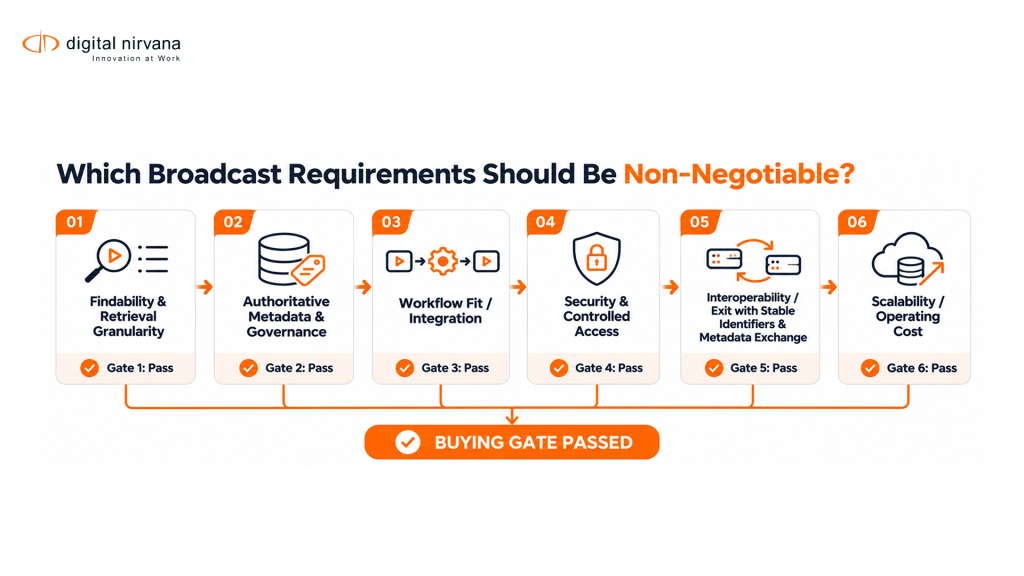
Which Broadcast Requirements Should Be Non-Negotiable?
Non-negotiable requirements are the conditions without which your team cannot safely complete its normal work. Establish them before assigning weighted scores to attractive optional features.
Use this proposed acceptance matrix to turn broad purchasing language into observable evidence.
| Requirement | Demonstration to Request | Reject or Resolve If |
| Media identity | Follow original, proxy, and delivered version | Relationships rely only on filenames |
| Production handoff | Open a selected range in your editing environment | The receiving editor must rebuild it |
| Permissions | Repeat a task using a restricted account | Unauthorized material is exposed |
| Metadata continuity | Export and reimport representative records | Meanings or time ranges disappear |
| Recovery | Resume a deliberately interrupted operation | Work is lost or duplicated silently |
| Portability | Retrieve media and metadata for an exit sample | Important records cannot be extracted |
Set the pass condition with the person who owns the risk. Engineering may accept a connector technically, while editorial rejects the resulting sequence. Record both decisions; one does not substitute for the other.
How Do You Evaluate Search Beyond a Fast Demo?
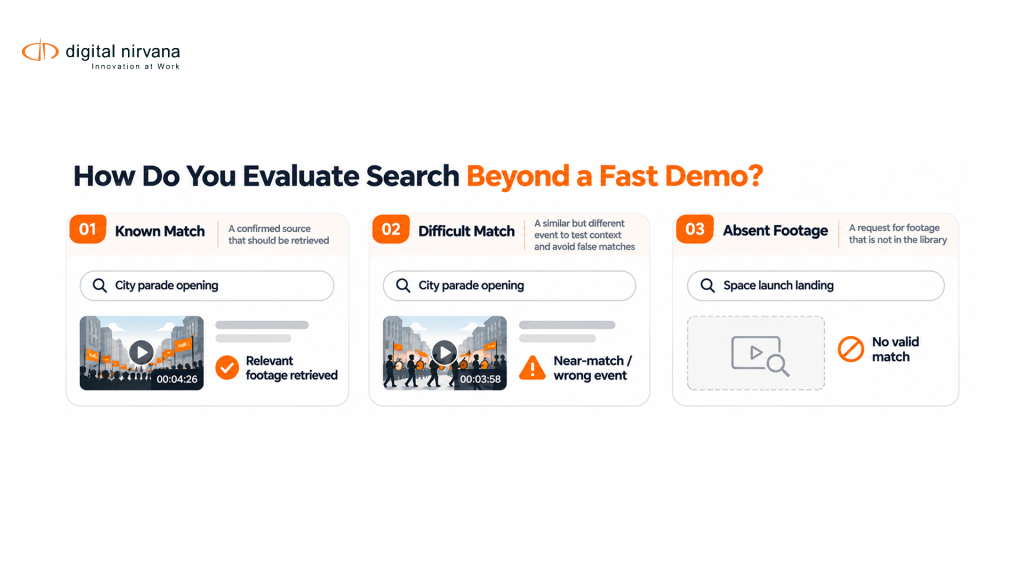
Evaluate search by whether it returns the correct usable material for representative requests. Response speed matters after you establish relevance, source accuracy, and the permissions governing the result.
Build a test set from work users actually perform. Include an exact quote, a person with a common name, an unlabeled visual action, an older asset, and a request for material known to be absent. Separate metadata filters, transcript matching, and meaning-based retrieval in the results.
For each request, record accepted results, important omissions, time spent checking candidates, and whether the source opens correctly. A similarity score should not become the acceptance criterion unless your team has established what it predicts for that task.
Keep the broader search context in Digital Nirvana’s archive discovery guidance. This purchasing test focuses on the whole task, rather than creating another general explanation of video search.
What Must an Editing Integration Preserve?
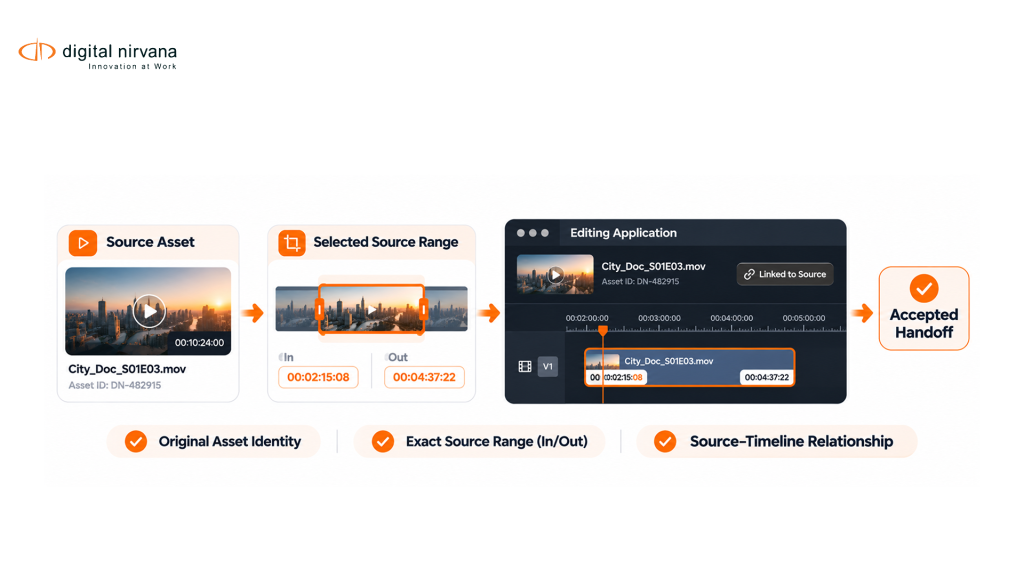
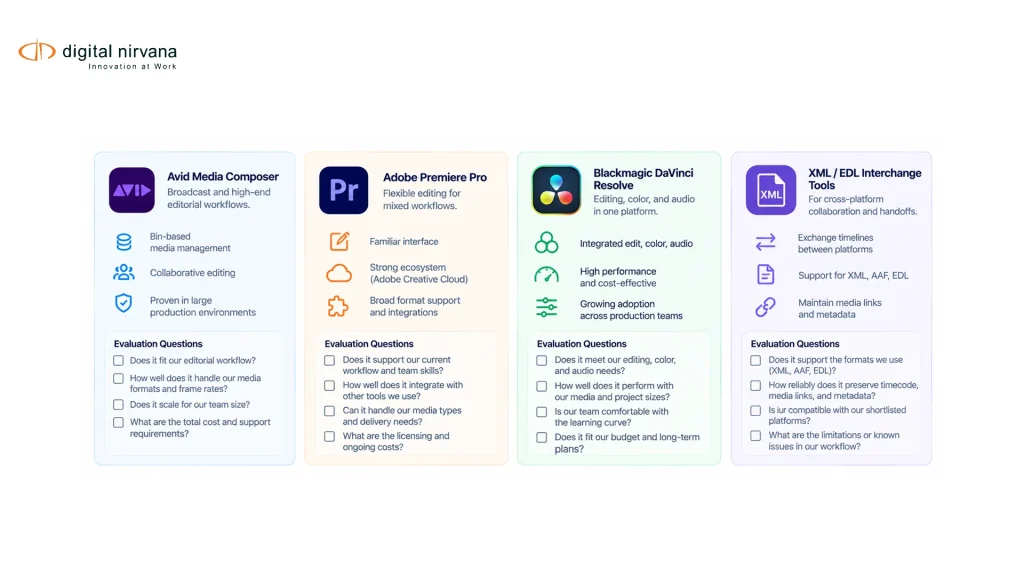
An editing integration must preserve the information required to locate and use the right source in your production environment. Verify it in the actual application versions and storage configuration included in the purchase.
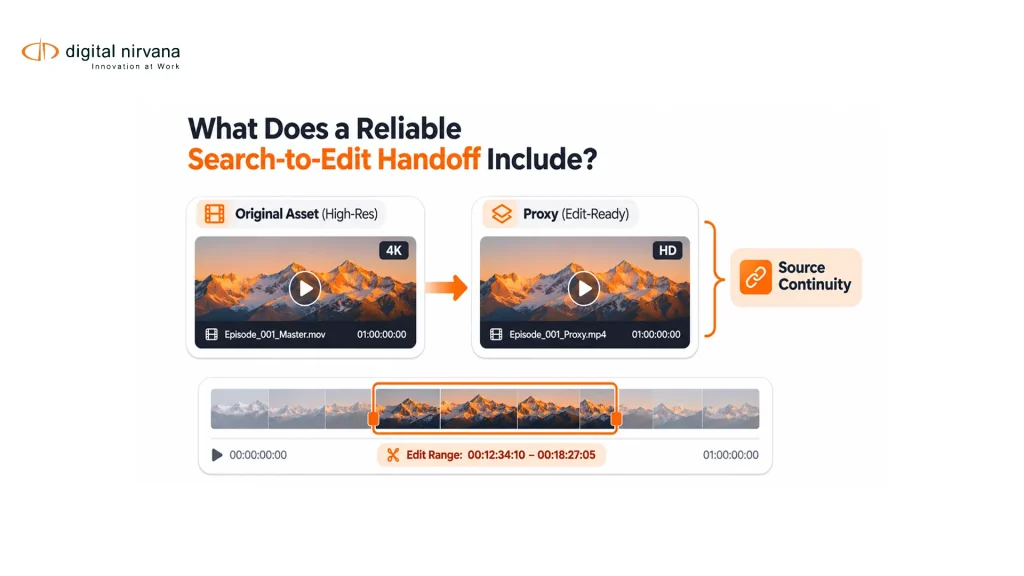
Ask the receiving editor to inspect asset identifiers, source ranges, audio selection, markers, and related restrictions. Compare the imported result with a reference preview. Then make a small revision and confirm that the workflow still points to the intended source.
Time values need a declared meaning. Elapsed offsets, source timecode, and program clock time are not interchangeable. PBCore’s timing attributes specifically explain the importance of tying time references to a particular media instantiation.
Include older or unusual media in the trial. A connector passing on a recent, clean file does not prove it will handle every legacy source. Document the supported configuration and exception route so the integration promise becomes testable.
How Should Rights, Security, and Governance Be Tested?
Test governance by attempting actions that different users should and should not be able to perform. A statement that a platform supports roles is less useful than seeing your proposed role model work.
Use representative accounts for an editor, archivist, external collaborator, and administrator. Check discovery, preview, export, metadata correction, deletion, and sharing separately. Restricted material should remain appropriately protected even when a search or transcript contains related terms.
Ask how authoritative fields are changed, how conflicts are resolved, and which actions are recorded. Define who can approve a rights change and how that decision reaches downstream systems. Machine recognition cannot grant permission to reuse a recognizable person or copyrighted element.
Security and procurement teams should examine the proposed contract and architecture, including processing locations, retention, deletion, subprocessors, and model-training terms. These are questions to verify for the offer being purchased, not assumed characteristics of any named product.
What Should Migration and Exit Planning Cover?
Migration planning should preserve usable relationships, not merely transfer file and record counts. Include metadata meaning, identifiers, related assets, restrictions, and the references editors need after cutover.
Choose a migration sample that contains difficult records before committing to a full move. Map each old field to its new destination or record an explicit reason for retaining it elsewhere. Compare actual search tasks before and after the move.
Keep a rollback decision separate from the act of copying data. Define who can approve cutover, what failures stop it, and how ongoing production remains supported. Do not retire an old repository until its required media and records have been accepted.
Run an exit sample during procurement as well. Request the media, metadata, relationships, and relevant audit information needed to move away later. Discovering an export limitation after signing turns an implementation choice into a continuing dependency.
How Do You Compare Total Operating Cost?
Compare the cost of completing the workflow over its expected operating conditions. License price alone leaves out the work and infrastructure required to make the result usable.
Ask suppliers to price the same scenario, including ingest volume, working storage, archive retrieval, users, analysis services, transfer, support, and implementation. Identify which assumptions change the bill during peak events or large archive backfills.
Add internal effort for taxonomy design, training, correction, monitoring, and administration. If users have to repair source references or repeat metadata entry, include that effort in the comparison rather than treating it as a temporary inconvenience.
For an illustrative decision, a lower software quote may lose its advantage if a recurring handoff requires manual rebuilding. Do not assign an invented saving to that difference. Measure the task during the pilot and apply your own staffing costs and workload assumptions.
Where Does MetadataIQ Fit in the Decision?
MetadataIQ fits when an existing media environment needs richer, searchable information about its content. Digital Nirvana provides AI-assisted media indexing and enrichment around established MAM, PAM, and DAM workflows.
That distinction can change the scope of a project. If asset relationships, storage, permissions, and production handoffs already work, a searchability problem may justify evaluating enrichment before replacing the repository. If those foundations fail, richer tags alone will not repair them.
Compare packaged enrichment with custom analysis and with capabilities already included in your MAM contract. Require each option to complete the same retrieval and handoff tasks. Confirm exact integration behavior and supported outputs during technical evaluation.
Once your acceptance matrix identifies the gap, discuss the workflow with Digital Nirvana. Bring representative media, a receiving-system list, and the conditions that must pass so the demonstration answers a purchasing question.
FAQs
A media asset management system organizes rich media and its associated information so authorized users can find and use it. The particular production, archive, and distribution functions depend on the product and configuration.
A MAM does not necessarily analyze everything inside a video. Transcription, recognition, and semantic retrieval may be included, added through integrations, or absent from the proposed configuration.
A broadcaster should first determine whether enrichment can solve the retrieval gap within its existing environment. Replacement becomes a separate decision when the underlying management and integration requirements are also unmet.
Compare vendors using the same media, tasks, accounts, receiving tools, and acceptance conditions. Record unresolved configuration questions and avoid treating an untested feature as either proven or missing.
A MAM commonly supports media management across operations and reuse, while a PAM focuses on active production work. Their functions overlap, so assess actual workflow ownership rather than relying on the label alone.
Procurement should request the tested configuration, implementation responsibilities, operating assumptions, support terms, data handling commitments, and exit provisions. Attach accepted pilot results so the commercial agreement reflects what was evaluated.
Conclusion
Write down the tasks your broadcast team must complete, identify the conditions that cannot fail, and test those conditions with your own material. Use the results to decide whether the gap requires configuration, enrichment, integration work, or a different management platform. Make the contract describe the workflow you accepted.