A senator’s surname gets transcribed three different ways across one hour of live coverage. None of them match how the archive spells it.
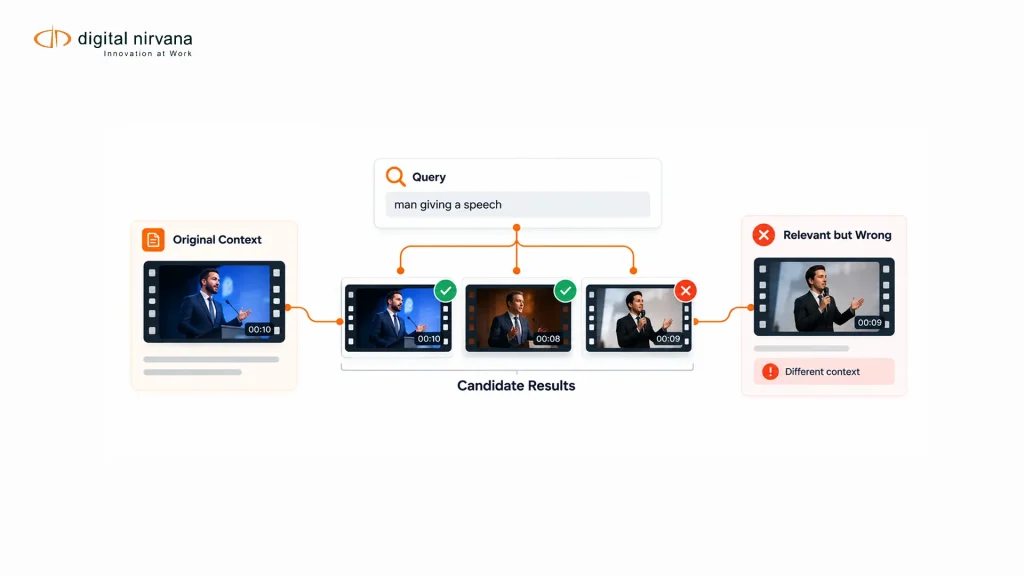
Six months later, a producer searches that name and gets nothing back. The footage exists. The transcript exists. The search still fails.
That is the gap most teams discover late. Speech to text software is not a transcription purchase. It is the layer your entire broadcast metadata strategy sits on, and it either holds the weight or it does not.

Why is broadcast the hardest environment for speech recognition?
Consumer speech recognition is benchmarked on clean audio. One speaker, close microphone, no background noise, ordinary vocabulary.
Broadcast is the opposite of that on every axis. Crowd noise in a stadium. Three panellists talking over each other. A remote guest on a poor line. Regional accents. Player names, drug names, ticker symbols, and show-specific jargon that appears in no general training corpus.
Then add the part that breaks most tools. It has to work while it is airing, not after.
An engine that scores well on a podcast will not necessarily hold up on a live news feed with an anchor, a reporter, and ambient sound competing for the same channel.
What turns a transcript into broadcast metadata?
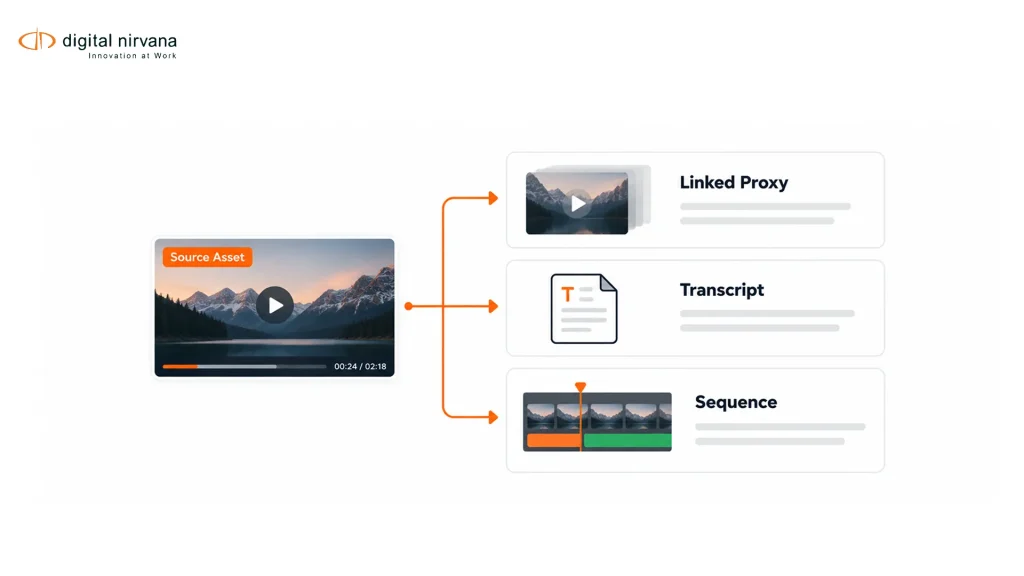
A transcript is a block of text. Broadcast metadata is structured, time-coded, machine-readable information about what is inside your content.
The transcript is the raw material. Four things get derived from it.
Timecode alignment. Every word is anchored to a frame, which is what makes a search result jump straight to the moment rather than the file.
Speaker separation. Diarization identifies who spoke, so you can search by person and not only by phrase.
Topic and classification data. Segmentation splits a two hour programme into subject blocks, and taxonomy tagging (IAB categories, for example) makes those blocks sortable across the library.
Compliance signals. Profanity, political mentions, sponsor references, and disclosure language get flagged where they occur.
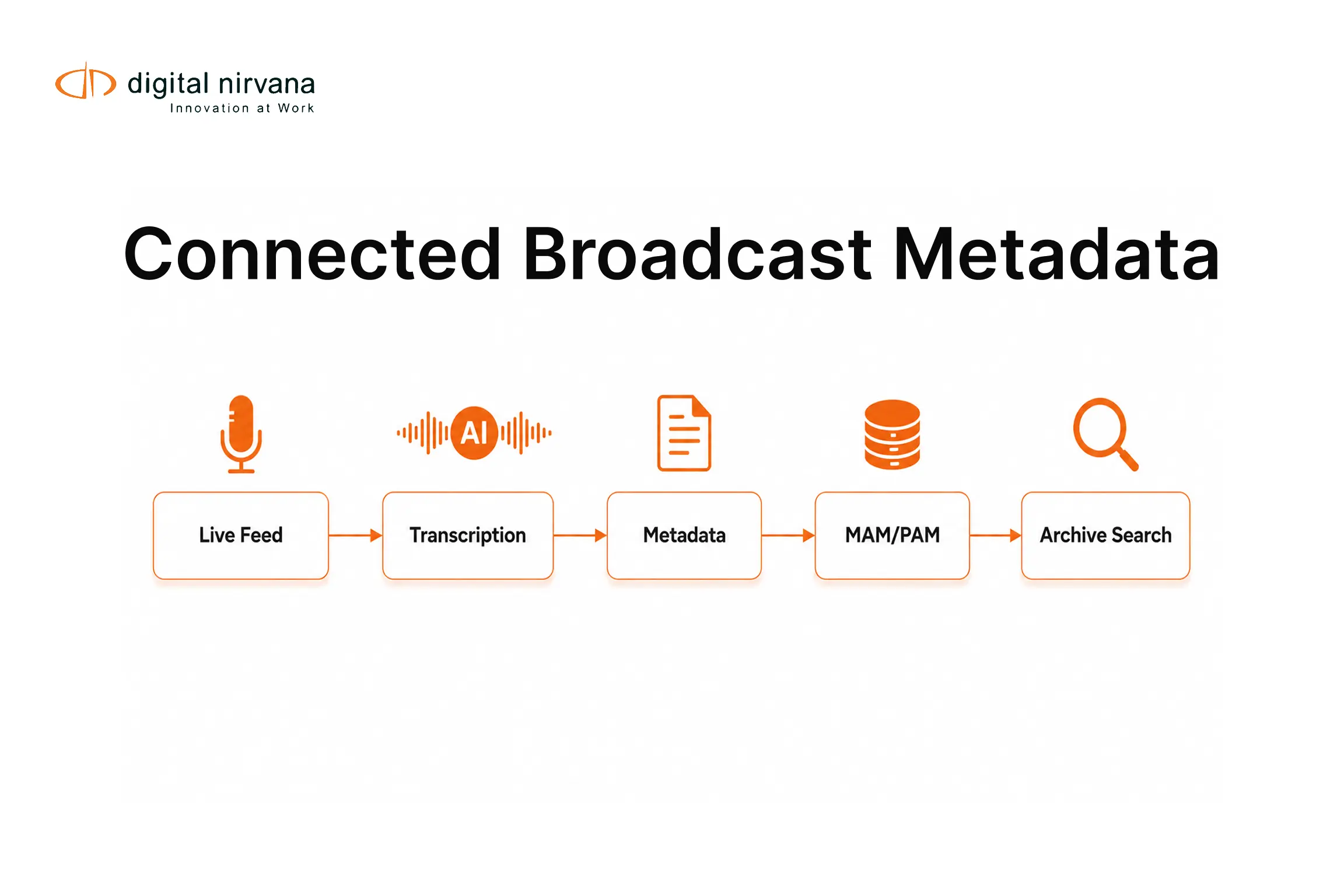
That derived layer is what automated media indexing and metadata tagging delivers into your MAM. Without it, you have a searchable document sitting next to an unsearchable video.
Why is word error rate a misleading benchmark on its own?
Word error rate is the standard accuracy measure, and it is worth tracking. It is also easy to misread.
WER treats every word equally. Getting “the” wrong and getting a brand name wrong count the same. Operationally, they do not come close.
| What WER counts | What actually costs you |
|---|---|
| A dropped article or filler word | Nothing measurable |
| A misheard common noun | Minor cleanup |
| A misspelled proper name | A permanently unfindable clip |
| A missed sponsor mention | A failed proof-of-performance report |
| Drifting timecode alignment | Every search result lands in the wrong place |
Ask vendors for accuracy on your content, not their benchmark set. A single hour of your own difficult audio tells you more than any published figure.
Which capabilities separate broadcast-grade tools from generic ASR?
| Capability | Why it matters in broadcast |
|---|---|
| Custom vocabulary and lexicons | Teaches the engine your names, teams, sponsors, and jargon |
| Speaker diarization | Enables search by person across panels and interviews |
| Frame-accurate timecode | Makes clip retrieval instant instead of approximate |
| Live stream processing | Supports clipping and compliance while content is still airing |
| Multilingual output | Feeds subtitling and localization from the same pass |
| Confidence scoring | Routes uncertain segments to human review automatically |
| Native MAM write-back | Puts metadata where editors already work |
Miss the first item and accuracy stays flat no matter how good the base model is. Miss the last and adoption quietly collapses, because nobody opens a second portal during a news cycle.
How do live and file-based workflows differ?
They are two different engineering problems, and vendors are rarely equally good at both.
File-based processing can take a second pass, apply full context, and optimise for accuracy. Batch archive work sits here, and so does most post-production captioning.
Live processing runs against latency. The engine has partial context and no chance to revise once output has gone downstream. Buffer strategy, streaming architecture, and failover behaviour matter more than raw model quality.
If your operation includes news, sports, or live events, test both paths separately. Strong file performance tells you very little about live behaviour.
Where do teams actually recover accuracy?
Two places, and neither is the model.
The first is vocabulary management. Load your show titles, recurring guests, roster names, sponsor brands, and internal shorthand before launch, then update per season or per event. This is the highest return work available and most teams skip it.
The second is targeted human review. Confidence scoring flags weak segments so reviewers correct the 5 percent that matters instead of reading everything. That hybrid model is the same principle behind human-in-the-loop AI operations and output governance, and it is why hybrid pipelines outperform both pure automation and pure manual work.
What should a pilot actually measure?
- Accuracy on your hardest audio, not clean studio material
- Proper noun accuracy tracked separately from overall WER
- Timecode drift across a full-length asset, not a three minute sample
- Live latency from spoken word to available metadata
- Behaviour on overlapping speakers and heavy accents
- Whether tags write back into your existing MAM without manual export
- Time from search query to usable clip, measured before and after
- Caption output conformance against your delivery specifications
Run the pilot on one real workflow. A single channel, one archive batch, or one recurring show gives cleaner signal than a broad rollout.
What about the common objections?
“Our editors will just fix errors as they go.” They will, at current volume. The problem is that corrections made in an edit bay rarely flow back into the archive, so the searchable record stays wrong forever.
“We only need captions, not metadata.” Captioning and metadata come from the same transcription pass. Running transcription, captioning, and subtitling without capturing the metadata layer means paying for the expensive step twice.
“We can build this on an open ASR model.” You can build the transcript. The cost sits in diarization tuning, timecode alignment, MAM connectors, governance, and the review workforce behind it.
Frequently asked questions
How accurate is speech to text software for broadcast? Accuracy depends far more on audio conditions and vocabulary tuning than on the base model. Broadcast-grade deployments pair a media-tuned engine with custom lexicons and human review on low confidence segments.
Can speech to text run on live broadcasts? Yes. Live streams can be transcribed and tagged as they air, which is what enables real-time clipping and in-flight compliance checks for news and sports.
Does it work on archived footage? Yes. Batch processing applies consistent transcripts and tags retroactively, which is usually the fastest route to making a legacy library searchable.
How is this different from broadcast monitoring? Speech to text describes what was said inside content. Compliance logging and signal monitoring records and proves what actually went to air. Most operations run both.
Do we need to replace our MAM? No. Well-designed systems write metadata into Avid, Grass Valley, or your existing DAM rather than asking teams to work somewhere new.
Where Digital Nirvana fits into this
Digital Nirvana treats speech to text as the entry point to a metadata pipeline, not as a standalone service. TranceIQ handles transcription, captioning, subtitles, and localization. MetadataIQ takes that output and turns it into governed, time-coded, compliance-tagged metadata inside Avid MediaCentral and Grass Valley environments.
Teams that want individual capabilities rather than a platform can call ASR, OCR, scene description, and recognition microservices directly through APIs. Managed review capacity is available through media enrichment services when volume spikes around events or seasons, and high-throughput deployments are supported by cloud engineering for media workloads.
Why the domain expertise matters here
Broadcast speech to text fails on specifics. Roster updates before a season. Caption placement rules. How a compliance flag differs from an editorial note. Which MAM field a topic tag belongs in.
Digital Nirvana has run these workflows inside large broadcast environments for years, including networks such as CBS, Fox, and Sinclair, across media and broadcasting AI operations. The customer success stories point at the same conclusion each time. The differentiator is workflow fit and review discipline, not model choice.
Conclusion
Speech to text software is the most consequential decision in your metadata stack, because everything downstream inherits its output.
Get it right and every asset arrives searchable, attributed, timecoded, and compliance-aware from the moment it lands. Get it wrong and you spend the next five years building an archive nobody can query.
Judge tools on your own audio, your own vocabulary, and your own integration path. Published benchmarks were not measured on your content.
Want to see how this performs against your hardest feed? Book a 15 minute workflow walkthrough and bring a sample nobody has cleaned up.
Key takeaways
- Speech to text is the foundation layer of broadcast metadata, not a standalone transcription purchase.
- Word error rate weights all errors equally. Track proper noun accuracy separately, because names are what people search.
- Custom vocabulary management delivers the largest accuracy gain available and is the step most teams skip.
- Live and file-based processing are different problems. Test both before signing anything.
- Confidence scoring plus targeted human review beats both full automation and full manual review.
- Native write-back into your existing MAM is the strongest predictor of whether the workflow gets used.
- Captions and metadata come from the same pass. Capture both or pay for the expensive step twice.