By Digital Nirvana, a company-led subject-matter contributor in media metadata, content workflows, and AI-assisted operations
A diarization demo can look convincing while hiding the errors that cost media teams time. Clean studio clips rarely represent a breaking-news package, a noisy sports desk, or a panel where people interrupt each other. The right way to evaluate speaker diarization is to test representative content against human-labeled reference files, calculate diarization error rate, inspect the error components, and measure the correction effort required by the real workflow.
Key Takeaways
- Speaker diarization answers “who spoke when,” while speaker identification connects a segment to a known name or role.
- Diarization error rate combines missed speech, false alarms, and speaker confusion relative to total reference speech.
- DER scores are comparable only when the evaluation rules, collar, overlap handling, and reference annotations are consistent.
- News, sports, and panel content need separate test groups because their acoustics and conversation patterns differ.
- Operational measures such as correction time, usable speaker labels, and timestamp reliability reveal costs that DER alone can miss.
- A small, representative gold set is more useful than a large collection of easy audio.
Table Of Contents
- What Speaker Diarization Measures
- How Diarization Error Rate Works
- How To Build A Representative Gold Set
- What To Test In News, Sports And Panel Content
- Which Metrics Belong On The Scorecard
- How To Run A Fair Vendor Evaluation
- When Human Review Is Still Necessary
- FAQs
What Does Speaker Diarization Measure?
Speaker diarization divides an audio recording into time ranges and groups those ranges by speaker. The output usually begins with anonymous labels such as Speaker 1 and Speaker 2. A separate recognition or editorial step may map those clusters to names or roles.
That distinction matters. A system may separate two voices correctly but assign the wrong names. It may also recognize a familiar anchor yet merge the anchor’s words with a guest. Test clustering, naming, transcription, and time alignment as separate capabilities.
For media operations, useful output should support more than readable paragraphs. Speaker turns may drive quote search, clip discovery, caption labels, compliance review, and archive metadata. Digital Nirvana’s MetadataIQ media indexing workflow includes speech-to-text and speaker identification as part of a broader metadata layer. Evaluation should therefore reflect how the result will be searched, reviewed, and written back to the media system.
How Does Diarization Error Rate Work?
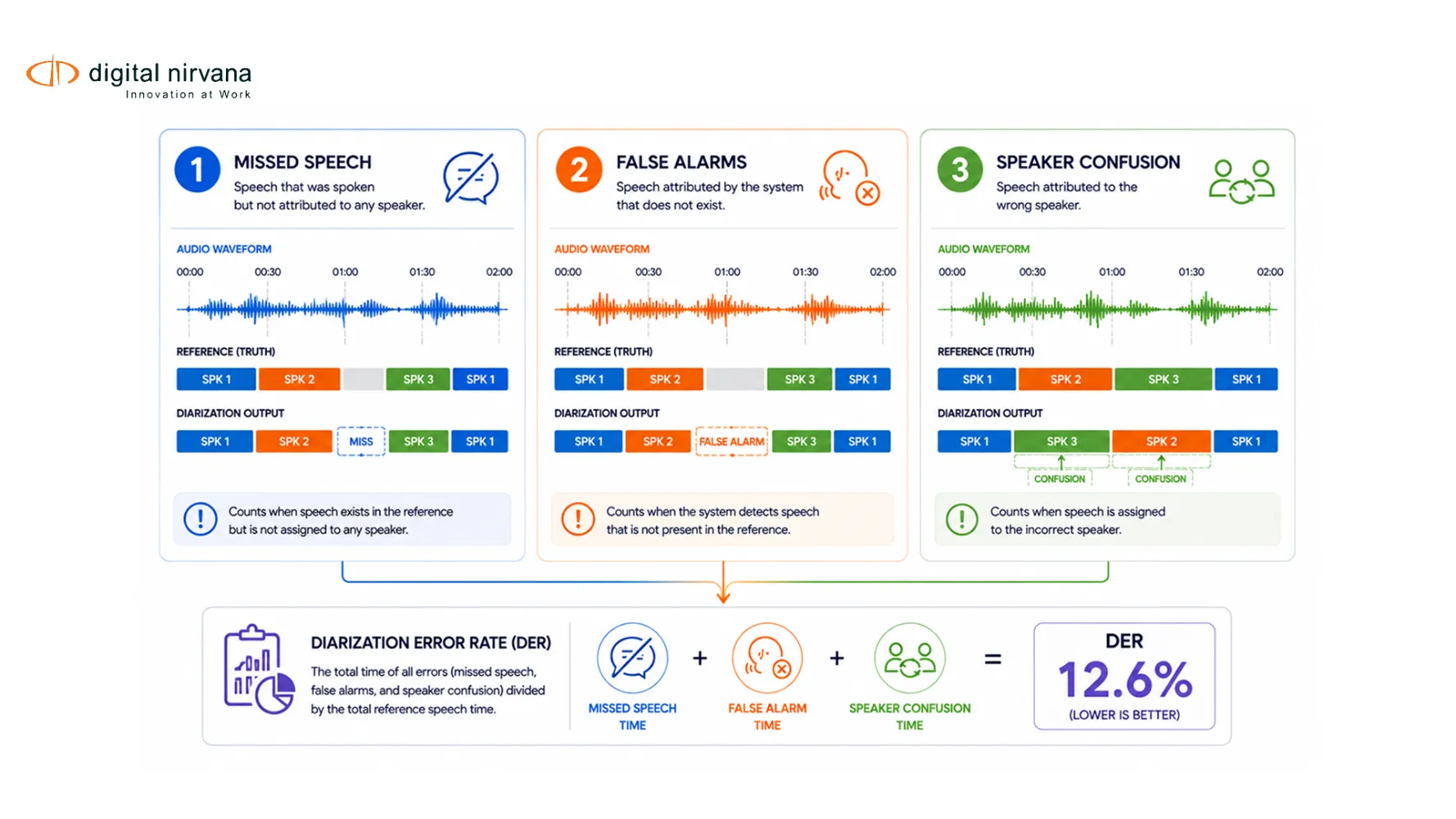
Diarization error rate, or DER, measures the share of reference speech time affected by missed speech, false alarms, or speaker confusion. In simple terms:
DER = missed speech + false-alarm speech + speaker-confusion time, divided by total reference speech time.
The pyannote.metrics documentation describes these three components. Missed speech occurs when the system fails to mark speech. A false alarm occurs when it marks non-speech as speech. Confusion occurs when speech is assigned to the wrong speaker.
DER is valuable, but the scoring setup changes the result. Document:
- Whether overlapping speakers are scored
- Whether a short boundary tolerance, often called a collar, is used
- Whether the number of speakers is supplied or estimated
- How unscored regions, music, applause, and inaudible speech are handled
- Which reference annotation rules and scoring software are used
The same hypothesis can receive different scores under different rules. Do not compare two vendor percentages unless both were calculated on the same files with the same reference and settings. NIST’s Rich Transcription evaluations helped establish “who spoke when” evaluation across broadcast, telephone, and meeting domains, reinforcing the need for defined test conditions.
How Do You Build A Representative Gold Set?
Build a gold set from the content the organization actually processes, then have trained reviewers mark speech boundaries and speaker identities consistently. The set should include common material and difficult but important cases.
Use a sampling matrix with:
- Program type: bulletin, field package, interview, studio debate, sports event, analysis desk, and remote contribution
- Audio path: isolated microphones, mixed program audio, phone, video call, venue feed, and archive recording
- Speaker pattern: monologue, rapid turns, interruptions, cross-talk, and off-mic speech
- Acoustic condition: clean studio, crowd, music bed, echo, compression, and low signal level
- Speaker mix: familiar and unfamiliar voices, similar voices, accents, and language changes
Keep development and final evaluation sets separate. Teams can use one group to tune thresholds or enroll recurring speakers, but the final score should come from files that were not used for tuning.
Reference annotations need their own quality check. Define when a speaker turn starts and ends, how overlap is labeled, and how fragments, breaths, laughter, and unintelligible speech are treated. Review disagreements before scoring because inconsistent ground truth can make a strong system look weak or a weak system look strong.
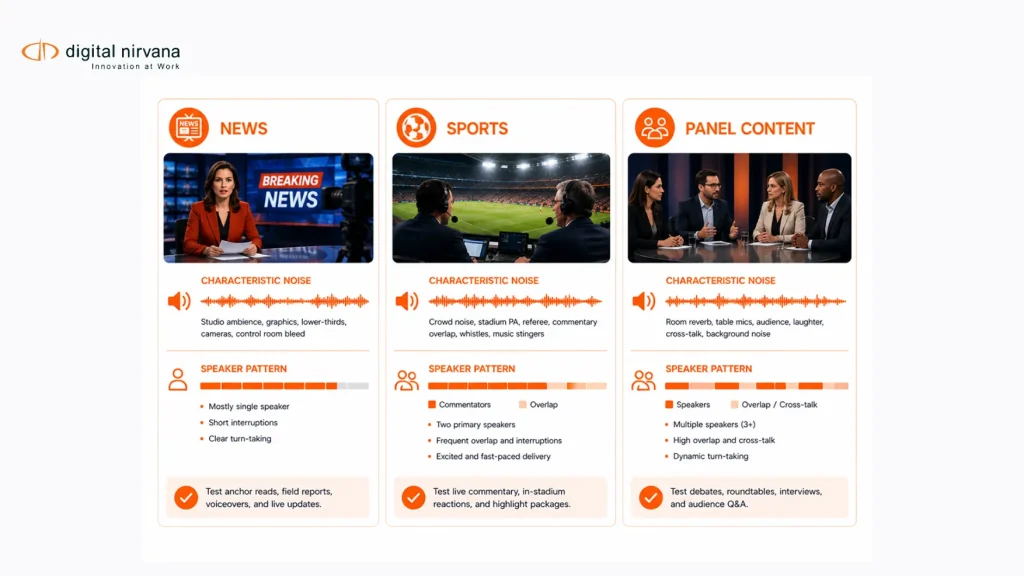
What Should You Test In News, Sports And Panel Content?
Each content type has a different failure profile, so report results by category instead of hiding them in one average.
News
News mixes clean anchor audio with field reports, phone interviews, archival clips, voice-over, and short quoted sources. Test whether the system:
- Preserves speaker changes across package edits
- Separates an anchor from a correspondent and quoted clip
- Handles music beds and ambient sound
- Keeps recurring presenters consistent across programs
- Produces timestamps precise enough for quote retrieval
Sports
Sports audio contains crowd noise, excited delivery, commentary pairs, public-address announcements, sideline reports, and replay clips. Test:
- Rapid exchanges between commentators
- Speech under crowd peaks and music
- A reporter joining remotely
- Short player or coach clips inside commentary
- Overlapping reactions during decisive moments
The earlier sports captioning guide explains why speed, accuracy, and speaker attribution must be managed together. Diarization testing should use the same noisy and fast-changing conditions that affect the live or near-live output.
Panels
Panels and debates create frequent interruption, similar microphone paths, short acknowledgements, and several speakers within seconds. Test:
- Cross-talk and overlapping speech
- Quick backchannels such as “yes” or “right”
- Speaker changes shorter than one second
- Similar-sounding voices
- Participants leaving and returning
Report the worst categories as well as the average. A system that performs well on anchor monologues but poorly on panel overlap may still be unsuitable for the intended archive or caption workflow.
Which Metrics Belong On A Diarization Scorecard?
Use DER as the core technical measure, then add metrics that show whether the output is usable.
A practical scorecard can include:
- Overall DER and its missed-speech, false-alarm, and confusion components
- DER by program type and acoustic condition
- Speaker-count accuracy
- Percentage of turns assigned to a usable name or role
- Speaker-attributed word accuracy when transcripts are required
- Timestamp hit rate within the workflow’s acceptable tolerance
- Number of speaker merges and splits
- Human correction minutes per hour of content
- Percentage of files passing without escalation
Word error rate and DER answer different questions. WER assesses the transcript text. DER assesses speaker timing and assignment. A file can have accurate words but unusable speaker labels, or correct speaker turns with poor transcription. Digital Nirvana’s guide to automatic transcription for noisy live content recommends representative sampling and treating diarization as a layer to validate.
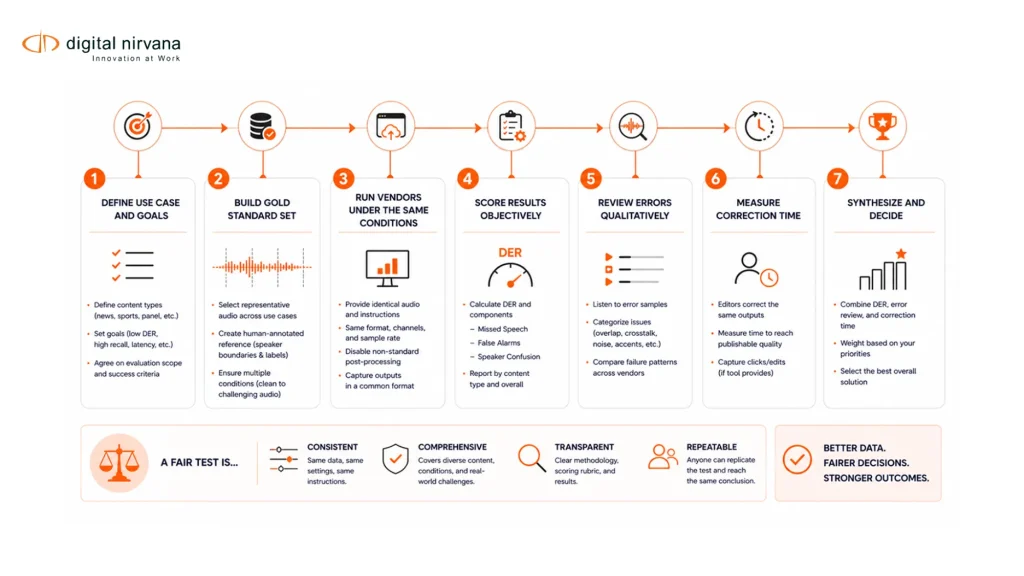
How Do You Run A Fair Vendor Evaluation?
Give every system the same source files, configuration constraints, reference annotations, and scoring rules. Avoid letting one test use clean isolated channels while another receives the mixed program feed.
Run the evaluation in seven steps:
- Define the operational use case and pass criteria.
- Freeze the gold set and annotation guide.
- Record permitted inputs, including known speaker count or enrolled voices.
- Process identical files without manual correction.
- Score every output with the same tool and parameters.
- Review errors by content category and severity.
- Measure correction time inside the intended production or archive workflow.
Also evaluate repeatability, output format, confidence fields, timecodes, identity management, and exception handling. Ask whether staff can correct a merged speaker, split a cluster, rename a person, and preserve those edits downstream.
Do not set a universal DER threshold without context. The acceptable result depends on content, scoring rules, review capacity, and the consequence of a wrong label. A search index may tolerate more error than a published quote or accessibility file.
When Is Human Review Still Necessary?
Human review is necessary when attribution affects publication, accessibility, legal review, compliance, or high-value retrieval. Automation can prioritize the riskiest files by confidence, overlap, unknown speakers, and sudden speaker-count changes.
Reviewers should be able to:
- Listen around every uncertain boundary
- Merge or split speaker clusters
- Replace generic labels with approved names or roles
- Correct speaker-attributed transcript text
- Flag unresolved identity rather than guess
- Preserve an audit trail of automated and human changes
The goal is not to review every second equally. It is to direct attention to the errors with the greatest operational impact. A governed workflow should define who can approve identities, how recurring speaker profiles are maintained, and when an output is safe for search versus publication.
FAQs
Speaker diarization is the process of determining who spoke when in an audio recording. It separates speech into time-based speaker clusters, often using anonymous labels before names or roles are assigned.
Diarization error rate is the proportion of reference speech time affected by missed speech, false alarms, or speaker confusion. Lower is better, but scores are comparable only under consistent rules.
No. Diarization separates and groups speakers, while identification connects a group to a known person or role. A workflow may perform one without reliably performing the other.
Use enough audio to cover the real program types, acoustic conditions, and speaker patterns that matter. Representativeness is more important than choosing an arbitrary duration.
Yes, if overlap occurs in the target content. Record how the scoring tool treats simultaneous speakers because overlap handling can materially change DER.
No. WER measures transcription errors, while DER measures speech detection and speaker assignment over time. Use both when the workflow needs speaker-attributed transcripts.
Scores can differ because of datasets, audio domains, collars, overlap rules, speaker-count inputs, and annotation choices. Re-score systems on one controlled gold set.
A good result meets the workflow’s technical and operational acceptance criteria on representative content. Consider DER, error severity, correction time, and the consequence of wrong attribution.
Conclusion
Evaluate speaker diarization on the audio your teams actually handle. Build a trustworthy reference set, document the scoring rules, separate news, sports, and panel results, and connect DER to correction effort and downstream use.
Professional support becomes useful when media teams need speaker-aware metadata integrated with transcription, archive search, review, and established PAM or MAM workflows. The best next step is a bounded pilot with agreed pass criteria.