A verified signature does not prove that a video depicts the truth. It proves that specific provenance information was signed and has not been altered without detection. Content Credentials give broadcasters a standard way to carry verifiable information about where media came from and how it changed. A useful implementation verifies credentials at ingest, preserves them through editing and transcoding, adds publisher assertions under controlled signing identities, and shows audiences what the credentials mean without presenting them as a truth detector.
Key Takeaways
- C2PA Content Credentials provide tamper-evident provenance records, not a guarantee that the depicted event or editorial claim is true.
- Broadcasters should verify incoming credentials before editorial use and record the validation result separately from the asset itself.
- Editing, transcoding, graphics, clipping, and distribution can alter or remove manifests unless preservation is tested across the full toolchain.
- Signing keys, certificates, identities, and publishing permissions require ownership, rotation, revocation, and incident-response controls.
- Start with one bounded workflow, such as verified field footage or publication signing, before attempting end-to-end coverage.
- Provenance metadata should remain connected to searchable archive metadata, rights, versions, and editorial decisions.
Table Of Contents
- What Content Credentials And C2PA Mean
- What Content Credentials Prove And Do Not Prove
- Where C2PA Fits In A Broadcast Workflow
- What To Verify At Ingest
- How To Preserve Credentials Through Production
- How Broadcasters Should Sign Published Content
- What A Practical C2PA Pilot Should Test
- FAQs
What Are Content Credentials And C2PA?
Content Credentials are verifiable provenance information created using the C2PA technical standard. They can describe assertions about an asset’s origin, creator, editing actions, tools, and relationship to earlier versions.
The C2PA technical specification defines manifests containing claims, assertions, cryptographic signatures, and references to the asset. A verifier checks whether the signed data remains valid and whether the manifest can be connected to the content being examined.
The visible Content Credentials pin is the audience-facing entry point. The underlying manifest is the technical record. A broadcaster may encounter credentials from a camera, mobile device, wire service, freelancer, editing system, or another publisher.
This is different from ordinary descriptive metadata. A title or caption can be edited without cryptographic verification. C2PA adds signed provenance, while MetadataIQ’s media indexing workflow focuses on making the content inside video searchable and actionable. The two layers can complement each other but should not be confused.
What Do Content Credentials Prove And Not Prove?
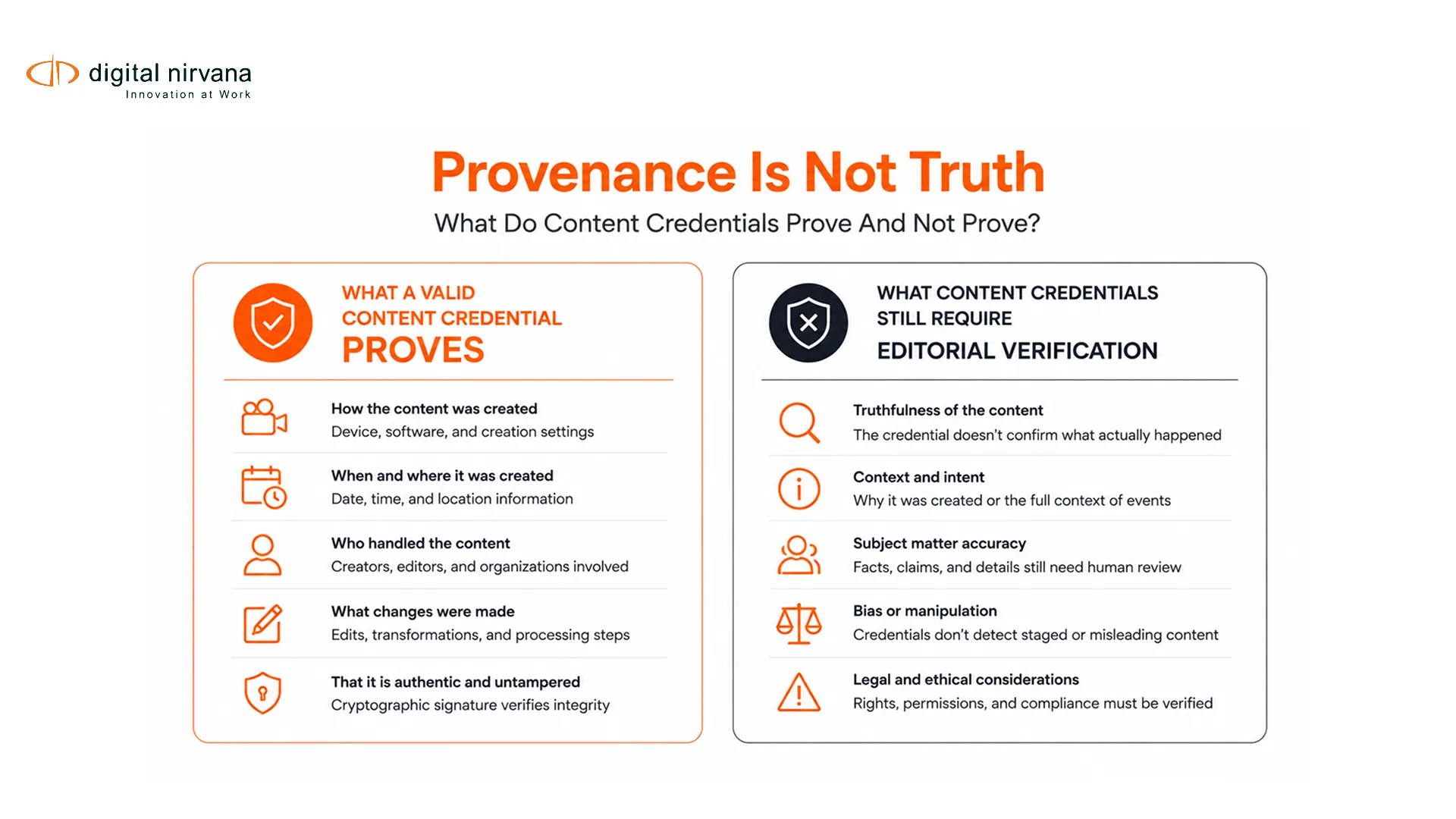
Valid Content Credentials prove integrity and provenance claims within a trust chain, not factual truth. A signed image may still be staged, miscaptioned, incomplete, or published by an identity the newsroom does not trust.
A verification result can help answer:
- Was the manifest cryptographically valid?
- Which identity or tool signed it?
- Which edits were declared?
- Does it reference an earlier asset?
- Has the signed data been changed?
- Is the signing certificate trusted, expired, or revoked?
It cannot independently answer:
- Did the depicted event actually happen?
- Is the editorial caption accurate?
- Was important context omitted outside the frame?
- Is the signer reliable?
- Was an unsiged earlier version manipulated before signing?
Treat credentials as one input to verification. Journalistic checks, source evaluation, geolocation, reverse search, rights review, and editorial judgment still apply.
Where Does C2PA Fit In A Broadcast Workflow?
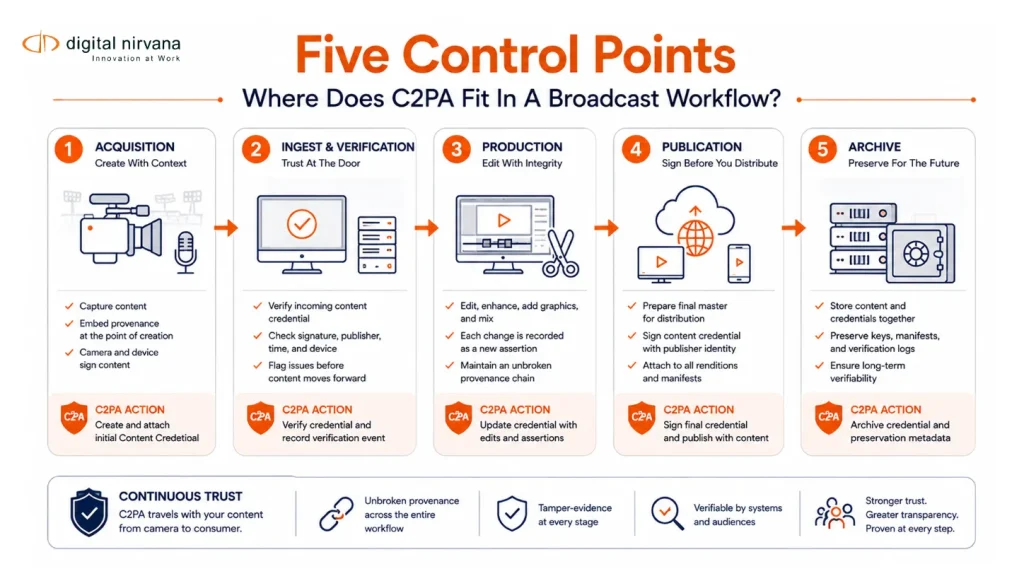
C2PA can enter at acquisition, verification, production, publication, or archive, but each stage has a different responsibility. The IPTC implementation guidance notes that media organizations may begin at any point, including adding publisher provenance at publication.
A practical workflow has five control points:
- Acquisition: receive the asset, manifest, source identity, and transfer evidence.
- Ingest verification: validate the manifest and certificate chain before editorial processing.
- Production: preserve or update provenance across edits, renders, clips, graphics, and format changes.
- Publication signing: add approved publisher assertions using controlled identities and policies.
- Archive: retain the asset, manifests, validation result, version relationships, and publication history.
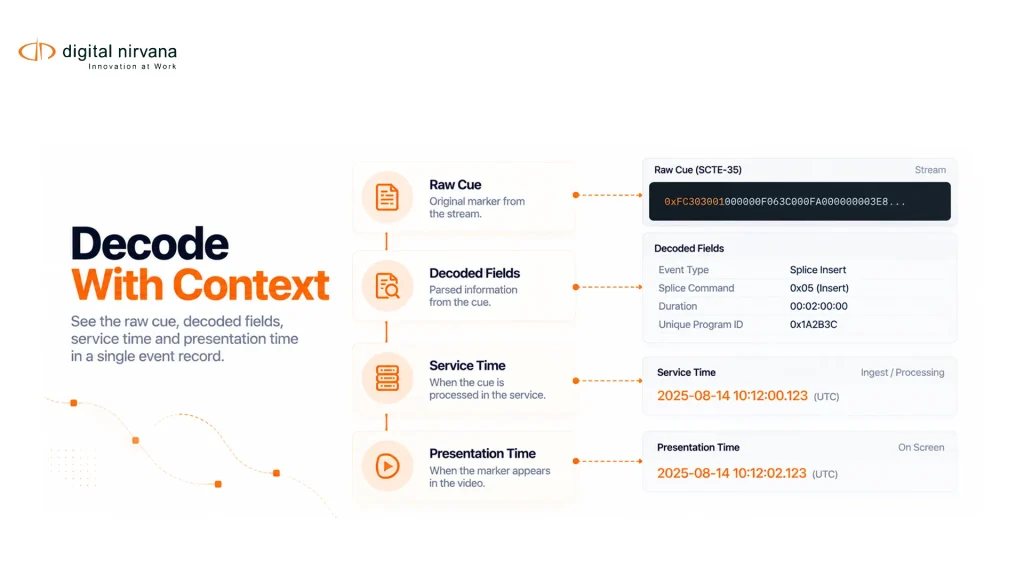
Do not rely on a single file flag such as “C2PA present.” Store the verification time, verifier version, trust result, certificate status, manifest references, and exception notes. These fields make provenance searchable and auditable alongside the archive’s other metadata.
What Should Broadcasters Verify At Ingest?
Ingest should separate technical validation from editorial trust decisions. A manifest can be technically valid while the signer or assertions remain unfamiliar.
Use this checklist:
- Detect whether a manifest is present or referenced remotely.
- Verify the asset binding and cryptographic signature.
- Validate the certificate chain and current trust status.
- Record the signer identity and signing tool.
- Extract declared actions and ingredient relationships.
- Compare timestamps with acquisition and assignment records.
- Flag missing, invalid, expired, revoked, or unsupported credentials.
- Preserve the original file and manifest before transformation.
- Route uncertain identities or material conflicts to editorial review.
The result should use explicit states such as valid and trusted, valid but untrusted, invalid, absent, unsupported, or review required. Collapsing these into “verified” hides important distinctions.
Integrate those states with the same review discipline described in metadata automation governance. Confidence and automation should route attention, not replace an accountable decision.
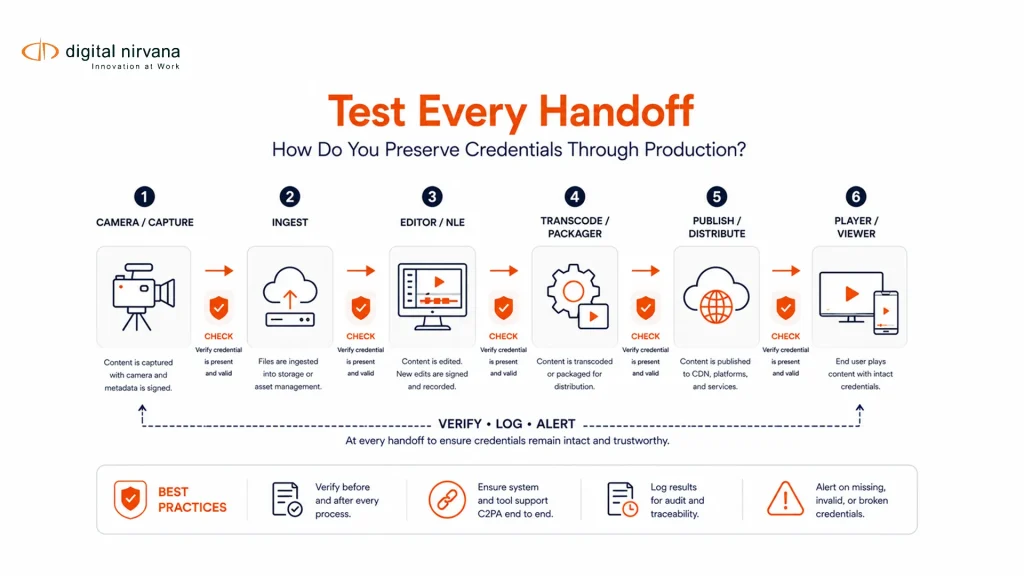
How Do You Preserve Credentials Through Production?
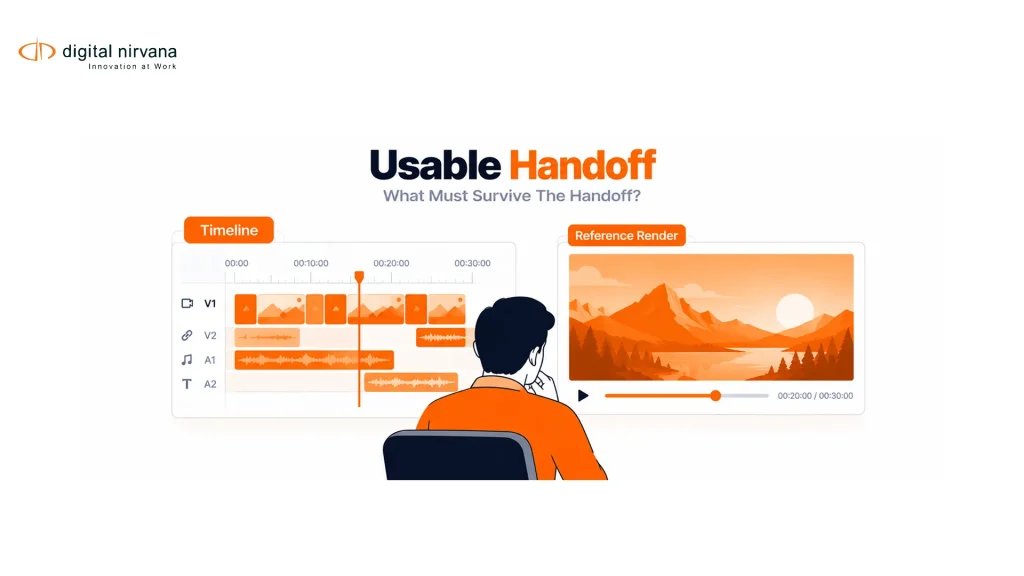
Test every operation that can strip, detach, invalidate, or replace provenance. Common risk points include proxy generation, transcoding, NLE export, graphics insertion, clipping, audio replacement, thumbnail creation, social publishing, CDN processing, and messaging-app transfer.
Build a toolchain test matrix. For each application and output:
- Begin with a known valid credential.
- Perform one defined operation.
- Export using the production setting.
- Verify the output.
- Record whether the original manifest survived, a new manifest was created, or provenance was lost.
- Repeat for the actual formats and endpoints used by the newsroom.
If a derivative cannot preserve the original manifest, it may still carry a new signed claim that references the source as an ingredient. The policy should define when that is acceptable and which source artifacts must remain in the archive.
Digital asset management systems should retain version and rights relationships as well as credentials. Digital Nirvana’s overview of digital asset management platforms explains the wider role of metadata, permissions, and versions in keeping approved assets usable.
How Should Broadcasters Sign Published Content?
Publication signing should use controlled organizational identities and documented assertion policies. Signing everything with one unrestricted key creates operational and security risk.
Define:
- Which legal or publishing identity appears
- Which systems and roles may request signing
- Which assertions are required, optional, or prohibited
- How edits and ingredients are described
- Where private keys are stored
- How certificates are issued, rotated, revoked, and monitored
- What happens after a suspected key compromise
- Which publication endpoints preserve credentials
Separate editorial approval from the technical act of signing. A successful signature should not bypass publish authorization.
C2PA announced in February 2026 that Content Credentials 2.3 enabled live video, extending the standard’s relevance to broadcast and streaming. Live use still requires testing for segment boundaries, latency, key management, manifest delivery, player support, and archive reconciliation.
What Should A Practical C2PA Pilot Test?
A pilot should test one real chain from acquisition to audience display, including failure conditions. Choose a workflow with clear ownership and repeatable assets.
Good starting points include:
- Field footage from approved capture devices
- Newsroom ingest verification for agency or contributor media
- Publisher signing for selected original video
- Verified still images used in broadcast and digital articles
- One live or near-live stream with controlled production tools
Test these outcomes:
- Credential detection and verification rate
- Trust decisions for known and unknown signers
- Preservation through every editing and delivery step
- Handling of absent, invalid, revoked, or detached manifests
- Search and retrieval of provenance fields in the archive
- Correct audience display on supported platforms
- Key rotation and compromise response
- Staff understanding of what the indicator means
Do not define success as “the pin appeared.” Success means the organization can explain the credential, preserve the evidence, respond to failure, and avoid overstating the result.
FAQs
Content Credentials are signed provenance records that can describe a digital asset’s origin, creator, tools, edits, and relationship to earlier versions. They are commonly implemented using the C2PA standard.
C2PA is an open technical standard for creating, signing, carrying, and verifying content provenance information. It supports an interoperable ecosystem of capture devices, editing tools, publishers, platforms, and verification interfaces.
No. Content Credentials can prove that specific provenance assertions were signed and remain intact, but they do not prove that the scene, caption, or editorial claim is true. Independent verification is still required.
Yes. C2PA 2.3 added support for live video applications, but broadcasters still need compatible capture, signing, delivery, verification, and player components. Operational testing is required across the intended stream.
The audience may lose access to the credential even though the broadcaster retains the signed source and validation record. Test every distribution endpoint and preserve source evidence in the archive.
Not automatically. Absence means provenance is unavailable through C2PA, not that the media is false. Apply the newsroom’s existing verification and source policies.
Store the original manifest or reference, validation status, signer, certificate result, actions, ingredients, timestamps, and version relationships alongside the asset. Preserve the original source before transformation.
C2PA carries signed provenance assertions, while a watermark usually embeds a visible or hidden signal in the media. They can coexist, but they serve different technical and communication purposes.
Conclusion
Broadcasters should begin with a narrow, controlled provenance workflow. Verify at ingest, preserve the original, test the production chain, sign under governed identities, and show the audience exactly what the credential supports.
Professional help is useful when several production tools, signers, certificates, live outputs, archives, and digital platforms must interoperate. The first decision is which workflow and trust claim the organization is prepared to own.