A media team has a digital asset management platform in place. Storage is centralized. Permissions are configured correctly. There’s a single source of truth for every asset the organization owns. By any operational checklist, the system is working exactly as intended.
And yet, people are still scrubbing through timelines looking for a specific clip. Editors are still renaming files by hand to make them findable. Producers under deadline are still asking a colleague, “Do you remember where that interview from last spring is?” On paper, everything looks right. In practice, the DAM isn’t actually solving the problem it was bought to solve.
The Bottleneck Isn’t the Storage System
This gap trips up a lot of media organizations because it’s counterintuitive. A DAM platform is infrastructure: it centralizes files, manages permissions, and gives a team a consistent place to store assets. That’s real value, and it’s not nothing.
But storage and discoverability are two different problems. A DAM tells you where an asset lives. It doesn’t automatically tell you what’s inside that asset, who appears in it, what was said, what scene it captures, or why it matters. Without that layer, a DAM is essentially a well-organized filing cabinet where every folder is still unlabeled on the inside.
The bottleneck almost every media team eventually runs into isn’t the platform they chose. It’s the metadata, or lack of it, that would actually make the platform searchable in the way people expect.
What Modern DAM Platforms Do Well
It’s worth being fair to what current-generation digital asset management platforms actually deliver, because the category has matured significantly.
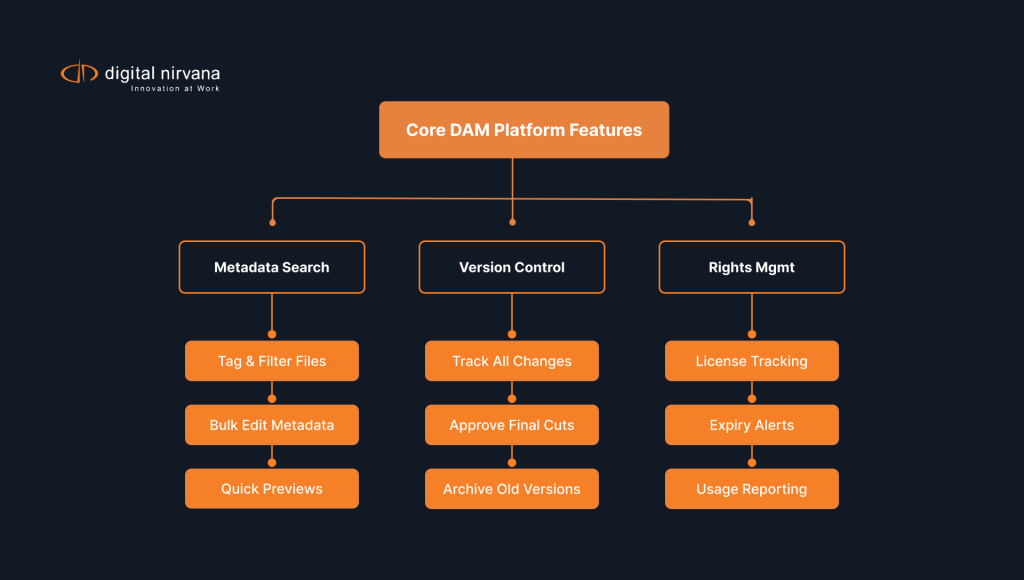
Centralized storage eliminates the chaos of files scattered across drives, personal folders, and disconnected systems. Permission and access controls keep sensitive content properly restricted while still letting the right people find what they need. Version control prevents the classic problem of five people editing five different copies of the same asset. And most modern platforms now support cloud-native architecture, letting distributed teams access the same library regardless of location.
These are meaningful capabilities. They just don’t solve the specific problem that costs media teams the most time day to day: finding the right clip, fast, based on what’s actually in it.
Where the Real Cost Hides
The cost of a DAM without strong metadata rarely shows up as a single dramatic failure. It shows up as a steady accumulation of small frictions that add up to real lost time and lost revenue.
| The Gap | What It Actually Costs |
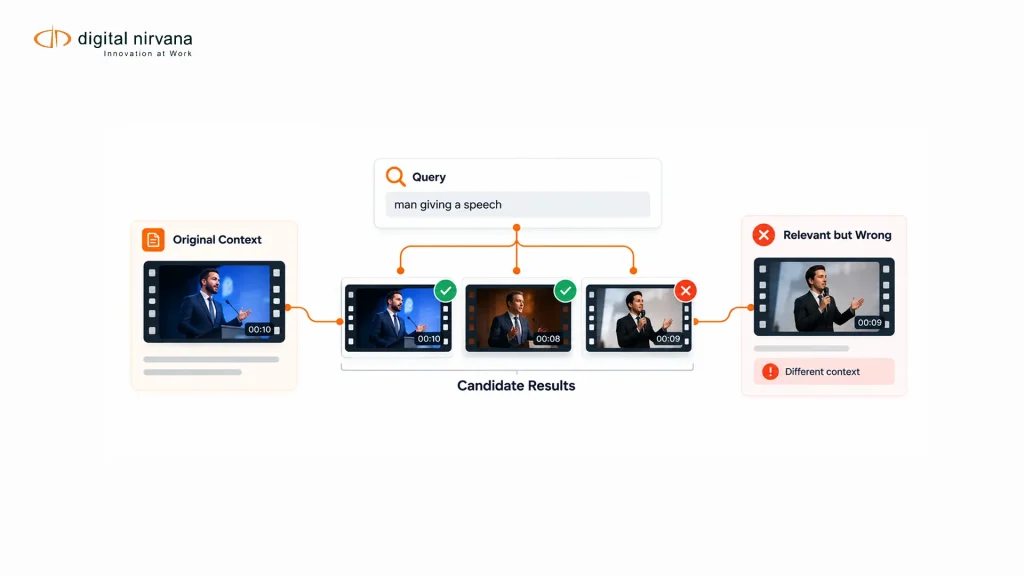
| Search relies on filenames, not content | Teams scrub full timelines instead of jumping to the right moment |
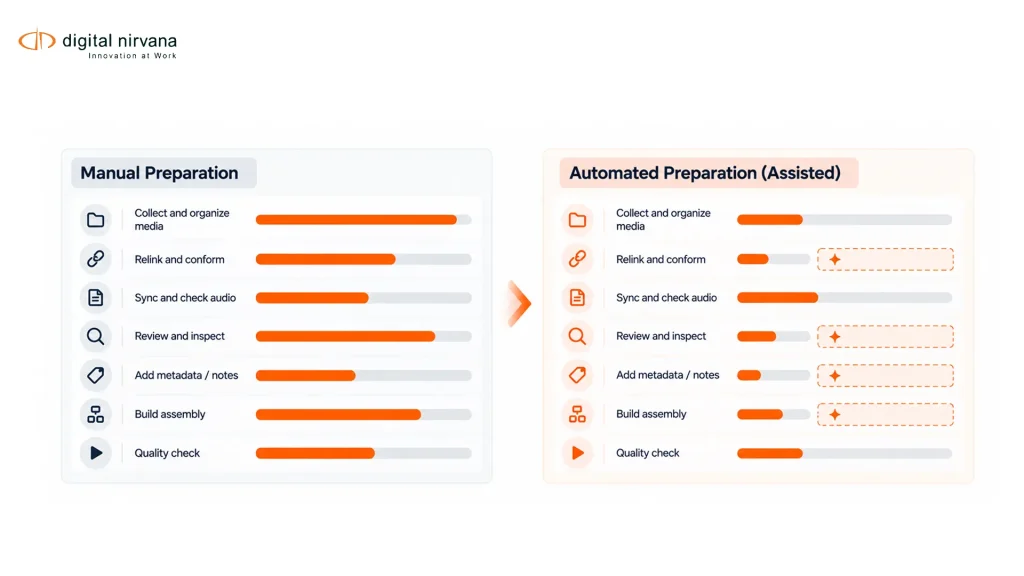
| Manual tagging after the fact | Backlogs of untagged content grow faster than teams can clear them |
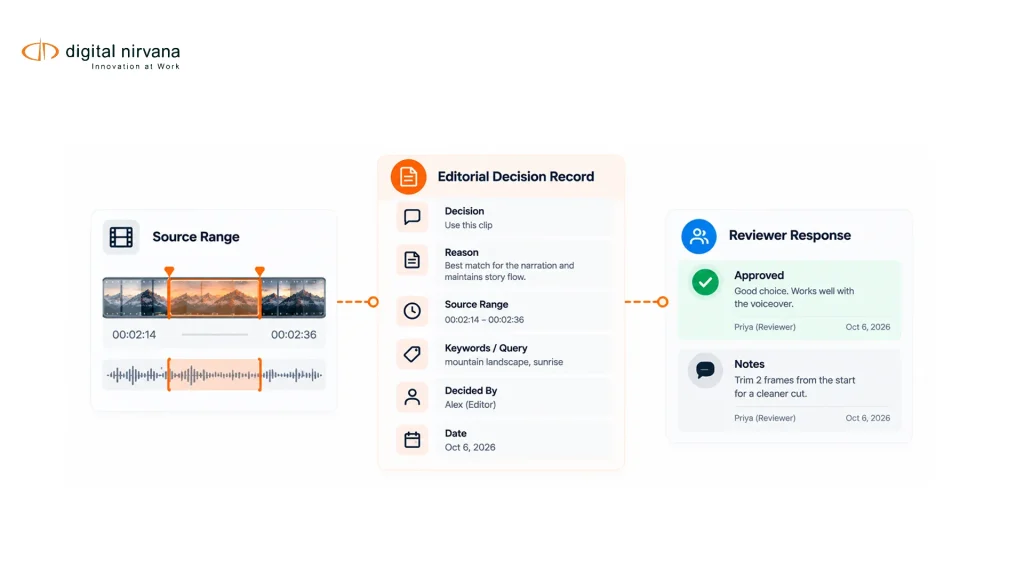
| No connection between metadata and timecode | Editors can’t jump directly to a specific line, face, or scene |
| Rights information lives outside the system | Licensing and compliance checks require manual cross-referencing |
| Archive content stays effectively invisible | Years of usable footage sits unmonetized and unreused |
None of these show up on a DAM vendor’s feature checklist, because they’re not really about the DAM. They’re about what’s missing around it.
Why Metadata Is the Layer That Actually Makes a DAM Work
Rich, structured metadata is what turns a stored asset into a findable one. It’s the difference between a system that knows a file exists and a system that knows what’s inside it.
When metadata is generated automatically as content enters the DAM, tagging speech, faces, on-screen text, objects, and scenes, search stops depending on someone remembering a filename or folder path. A producer can search by a person’s name, a spoken phrase, or a specific topic and get the exact moment inside the exact asset, rather than a list of files to manually scrub through.
This is precisely the layer where AI-driven metadata automation matters most, and it’s designed specifically to sit alongside an existing DAM rather than replace it, since the DAM’s storage and governance capabilities remain genuinely valuable once the discoverability gap is closed.
The Real Question to Ask Before Buying (or Blaming) a DAM
Teams frustrated with their current DAM often assume the fix is switching platforms. That’s rarely the actual answer. The better question is whether metadata is being generated at the point content enters the system, or whether it depends on someone tagging it manually after the fact, once the urgency has already passed.
A DAM with weak metadata will feel broken no matter how modern or well-reviewed the platform is. A DAM paired with strong, automated metadata generation can turn even an older or simpler storage system into something a team can actually search with confidence.

A Realistic Before-and-After Workflow
Before. A news archive team gets a request for footage of a specific press conference from eight months earlier. Nobody remembers the exact date. The archivist starts scrubbing through folders organized by month, opening files one at a time, hoping to recognize the right moment by sight.
After. The same archive, now with AI-generated metadata tied to speech, faces, and on-screen text, lets the archivist search the speaker’s name directly. The system returns the exact segment, timecoded, in seconds. The DAM didn’t change. What sits on top of it did.
Measurable Impact of Closing the Metadata Gap
Media organizations that pair their existing DAM with automated metadata generation typically see change in a few consistent places.
Search time for specific assets drops from hours to minutes, since teams search by content instead of scrubbing files or guessing folder locations. Archive content that was previously invisible becomes findable and reusable, unlocking value from footage that was technically stored but practically forgotten. And compliance or rights-related requests move faster, since structured metadata connects licensing and territorial information directly to each asset instead of requiring a separate manual lookup.
What to Evaluate Before Assuming Your DAM Needs Replacing
A few honest questions usually reveal whether the problem is really the DAM or the metadata layer around it.
Is metadata generated automatically when content enters the system, or does it depend on manual tagging that lags behind ingest volume? Can your team search by what’s actually inside an asset, speech, faces, on-screen text, rather than just filename or folder? Does rights and licensing information live as structured data tied to each asset, or does it sit separately in contracts nobody cross-references quickly? And does your DAM integrate with an AI metadata layer, or would adding one require ripping out the platform you already have?
Key Capabilities Worth Prioritizing
- AI-assisted metadata generation applied automatically at ingest, not as a manual afterthought
- Multi-signal tagging: speech, faces, on-screen text, objects, and scenes together
- Time-coded metadata tied precisely to source timecode for instant clip navigation
- Structured rights and licensing metadata attached directly to each asset
- Native integration with existing DAM, MAM, and PAM platforms rather than a forced migration
- Governance dashboards that flag missing or inconsistent metadata across the library
Addressing the Common Objections
“We just upgraded our DAM, this should already be solved.” A DAM upgrade improves storage, permissions, and version control. It doesn’t automatically generate rich, searchable metadata for existing or incoming content unless that capability was specifically built in or added alongside it.
“Adding a metadata layer sounds like more complexity, not less.” The strongest implementations integrate directly with the DAM a team already uses, adding searchability without requiring a platform switch or a disruptive migration.
“Our archive is too large to tag properly.” This is exactly the scenario AI-assisted batch metadata generation is built for. Manual tagging doesn’t scale to a large archive, but automated processing can work through volume that would take a human team years to complete by hand.
How Digital Nirvana Approaches This Gap
MetadataIQ is built specifically to close the gap between having a DAM and actually being able to search it, generating rich, time-coded metadata at ingest and connecting directly to the MAM, DAM, and PAM systems media teams already run.
For organizations also managing captioning and transcription alongside their asset library, TranceIQ shares the same underlying speech data that powers metadata search. Broadcasters layering compliance evidence into the same library often connect this work to MonitorIQ, while teams needing deeper visual detection extend into MediaServicesIQ for object, logo, and scene recognition.
Why This Matters Beyond Day-to-Day Search Convenience
A DAM without strong metadata doesn’t just slow down individual searches. It quietly caps how much value an organization can pull from content it has already paid to produce and store. Footage that can’t be found can’t be licensed, reused, or repurposed, no matter how technically well-organized the storage system underneath it is.
Media organizations that treat metadata as core infrastructure, not an optional add-on layered on top of storage, are the ones actually getting return on what their DAM investment was supposed to deliver in the first place. Digital Nirvana’s success stories show how broadcasters and media companies have closed this exact gap without abandoning the DAM platforms they’d already invested in.
Frequently Asked Questions
Do we need to replace our DAM to fix a discoverability problem? Usually not. The strongest metadata tools are built to integrate with an existing DAM, MAM, or PAM system rather than requiring a full platform replacement.
How is a DAM different from a MAM? DAM typically refers to broader digital asset management across marketing and brand use cases, while MAM usually describes systems built specifically for video-centric broadcast and production workflows. In modern platforms, the two increasingly overlap.
Can AI metadata generation handle an archive that was never properly tagged? Yes. AI-driven batch processing can generate metadata for legacy content retroactively, which is often where the most untapped value in an older archive actually sits.
Conclusion
Having a digital asset management platform and having a searchable one are two different accomplishments, and most media teams only discover the gap once they’re scrubbing a timeline under deadline pressure. Storage, permissions, and version control matter, but they don’t make content findable by what’s actually inside it. Closing that gap with rich, automated metadata is what turns a well-organized filing cabinet into a library a team can actually use.
Key Takeaways
- A DAM solves storage, permissions, and version control, but not content discoverability on its own
- Metadata is the layer that turns a stored asset into a searchable one, by speech, face, object, and scene
- The real cost of a metadata gap shows up as accumulated small frictions, not one dramatic failure
- AI-assisted metadata generation should apply automatically at ingest, not depend on manual tagging after the fact
- The right fix is usually adding a metadata layer to an existing DAM, not replacing the platform entirely
- Untagged archive content represents real, recoverable value once it becomes searchable again