A polished demo can hide an expensive handoff. The cut plays perfectly in a browser, but your finishing editor receives missing media, flattened audio, or notes that no longer match the sequence. AI video editing platforms should therefore be evaluated on the usable editorial handoff, including source traceability, correction effort, and compatibility with your production tools. Preview quality is only one part of the decision.
Start your evaluation at the receiving workstation. Ask the finishing editor to open the proposed output, reconnect the original media, and make a requested change. That exercise exposes requirements a feature checklist cannot.
Key Takeaways
- Evaluate an editable sequence and its source references before judging the quality of a rendered preview.
- Separate footage discovery, assembly, review, and finishing when deciding which AI capability your team needs.
- Use representative production material, including difficult footage, for the same test across vendors.
- Treat lost metadata, relinking work, and review time as operating costs in the buying decision.
- Keep editorial approval with an accountable person, even when software proposes the entire first cut.
Table Of Contents
- Which Kind Of Platform Does Your Team Need?
- How Should You Compare AI Video Editing Platforms?
- What Must Survive The Handoff?
- How Do You Test Search And Editorial Control?
- What Should Security And Procurement Ask?
- How Should You Run A Buying Pilot?
- FAQs
- Conclusion
Which Kind Of Platform Does Your Team Need?
Choose the category that addresses your actual bottleneck. A search tool helps an editor locate footage; an assembly tool proposes a sequence; a finishing application handles detailed creative work. A product may cover several stages, but that does not make the stages interchangeable.
Adobe documents transcript-based sequence editing, for example. That is a specific editing workflow, not evidence that every AI product can perform every production task.
Ask your team to identify where work waits. If producers spend the morning finding material, discovery may matter more than automatic transitions. If approved selects arrive promptly but the assembly queue grows, focus on the first editable sequence. If exports repeatedly fail, another search feature will not remove the constraint.
Digital Nirvana offers AI-assisted rough-cut preparation. Evaluate that role against your intake and assembly requirements, with finishing requirements defined separately.
How Should You Compare AI Video Editing Platforms?
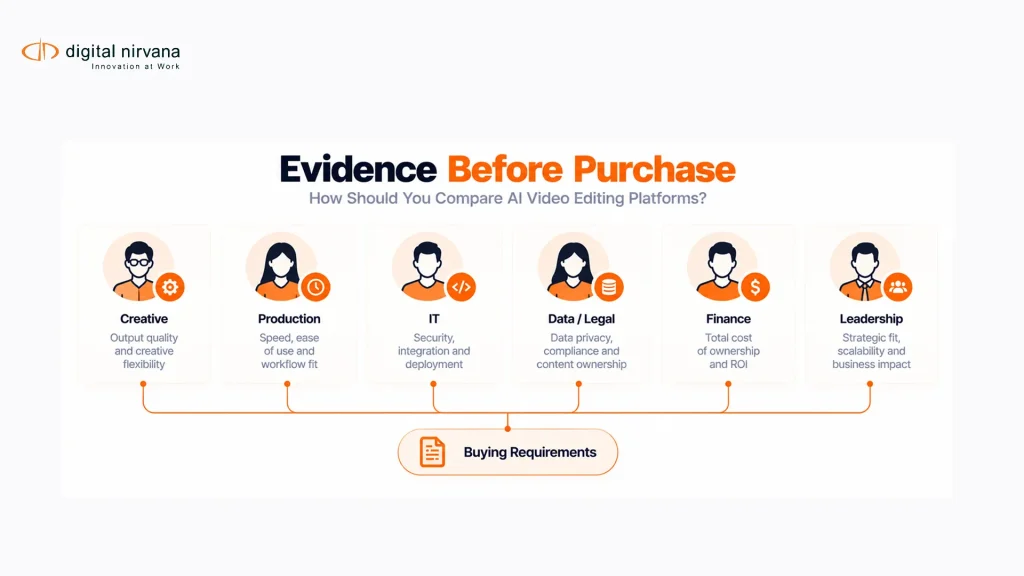
Compare observable work products instead of counting features. Use a requirements matrix with a named owner for each acceptance decision. The following is a proposed evaluation framework, not a product ranking or benchmark.
| Requirement | Evidence To Request | Acceptance Owner |
| Find relevant source material | Search results checked against known footage | Producer |
| Build an editable first assembly | Sequence opened and revised in the target editor | Finishing editor |
| Preserve source identity | Each selected shot traced to its original | Assistant editor |
| Support editorial review | Comments remain attached to the correct version | Supervising producer |
| Protect restricted material | Permission and deletion tests | Security lead |
| Control operating cost | Itemized pilot usage and support requirements | Operations lead |
Mark a requirement as unproven when the demonstration does not test it. A roadmap promise, screenshot, or verbal assurance should not become a confirmed capability in procurement notes.
Separate mandatory requirements from preferences before scoring. Attractive preview controls cannot compensate for a failed requirement to keep confidential material within an approved processing boundary.
What Must Survive The Handoff?
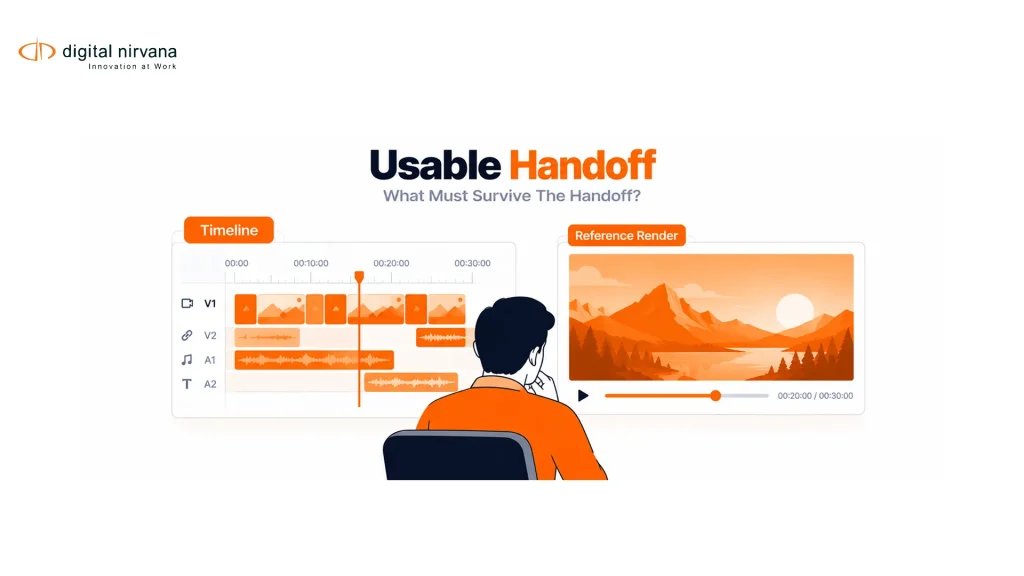
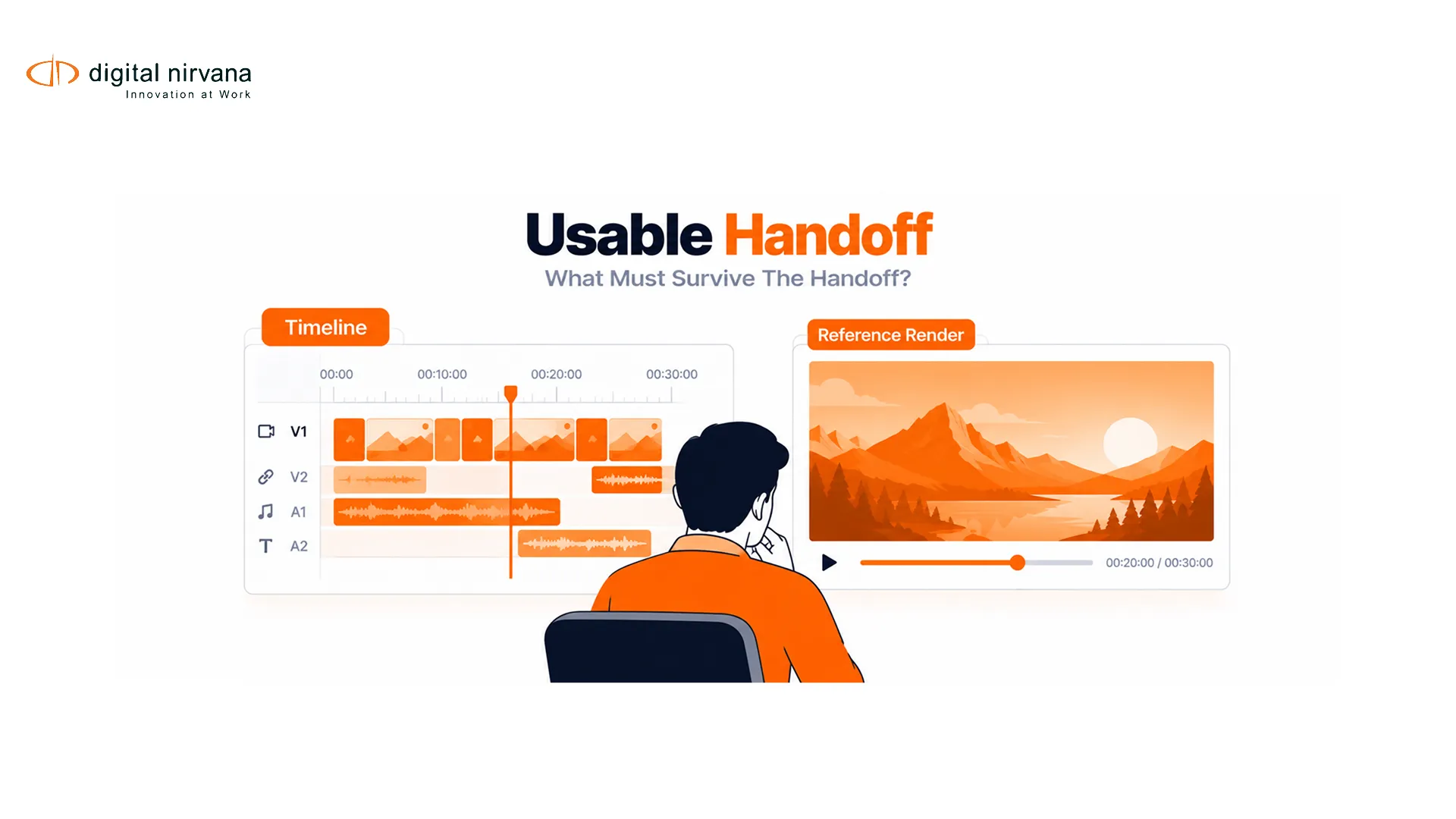
The receiving editor needs an editable structure and enough information to resolve each shot back to its source. Include media identity, source ranges, track layout, audio channel expectations, and a reference render in your acceptance package.
Interchange support is conditional. The OpenTimelineIO adapter feature matrix explicitly shows that adapters do not preserve every feature. A supported file extension is therefore the start of a compatibility test, not its conclusion.
Use a short diagnostic sequence containing your difficult cases: split audio, mixed source rates, a retime, a marker, and a nested section if your facility uses one. Record what survives and what needs rebuilding. This is a proposed facility test, not a claim that those elements fail in every product.
Your timecode indexing conventions also deserve a place in the handoff specification. A visually plausible shot is still wrong if it references the wrong source range.
How Do You Test Search And Editorial Control?
Test whether editors can find the right material, understand a proposed selection, and replace it without losing useful work. Search relevance and editorial suitability are separate judgments.
Use an illustrative request such as a celebration following a decisive sports moment. A result showing an excited crowd may fit the visual description while belonging to another event. Require reviewers to inspect the surrounding footage and event identity before accepting it.
Then ask the platform to revise the sequence while preserving an approved interview segment. Record whether that constraint survives, whether rejected shots reappear, and whether the editor can return to the previously approved version.
For a separate archive-discovery requirement, assess metadata enrichment within existing media systems. Avoid making one purchase solve every adjacent problem without demonstrating how the systems connect.
What Should Security And Procurement Ask?
Procurement needs a documented data path, not a general assurance that a platform is secure. Identify where originals, proxies, transcripts, search indexes, prompts, and exported sequences are processed and retained.
Ask who can access each item, which subprocessors receive it, how deletion works, and what happens when a contributor leaves. Request the applicable contract and configuration evidence. Do not assume that a deployment option mentioned on a website is included in the quoted package.
Commercial evaluation should also include ingest processing, storage, repeated analysis, user access, integration work, support, and exit costs. Require vendors to state which items are included and which depend on usage.
Finally, test export and retrieval when a project ends. An attractive subscription becomes less attractive if essential metadata or editorial history cannot be recovered in a usable form. Assign ownership of that exit test before signing.
How Should You Run A Buying Pilot?
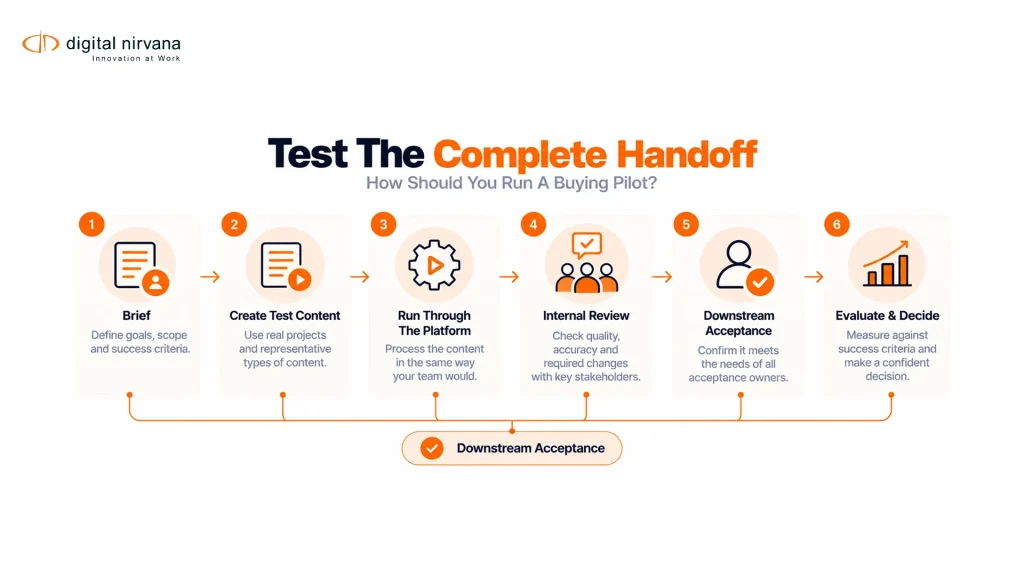
Run the same assignment through your current process and the proposed platform, using agreed quality gates. Track elapsed time separately from active staff time so unattended processing does not look like labor savings.
Use this sequence:
- Define a repeatable deliverable and the intended receiving editor.
- Select representative media and document exclusions.
- Capture the current workflow’s search, assembly, review, and repair effort.
- Repeat with AI assistance using equivalent editorial requirements.
- Open the output downstream and reconcile every required element.
- Decide whether the result meets quality, data-handling, and cost conditions.
Do not let a vendor’s best-case demonstration set your baseline. Include material your team finds difficult, and retain the failed cases in the final assessment. If the pilot succeeds only after extensive vendor intervention, record that support dependency in the implementation plan.
FAQs
AI video editing platforms use machine-assisted analysis or editing functions to support tasks such as discovery, assembly, and revision. Their scope differs, so compare the workflow each product actually performs.
It should not replace the person accountable for editorial meaning and approval. Automation can propose work, but someone must verify context, rights, pacing, and delivery requirements.
An MP4 can provide a viewing reference, but it does not by itself preserve an editable multitrack sequence. Specify both the viewing copy and the required editing deliverables.
Compare the full workflow cost, including processing, staff review, storage, integration, and repair. Subscription prices alone do not capture the resources needed to produce an accepted edit.
Use media representative of routine work and known problem cases. Include relevant audio conditions, frame rates, camera sources, and permission restrictions instead of relying solely on demonstration footage.
Time to an accepted, editable handoff is a useful primary metric. Pair it with quality failures and active review effort so faster output cannot hide downstream rework.
Conclusion
Write the receiving editor’s acceptance test before requesting demonstrations. It gives producers, engineering, and procurement a shared definition of success. Once those requirements are clear, discuss a pilot using your own footage and judge the complete handoff.