A single missing frame can create hours of confusion in a modern media workflow. Editors struggle to locate the right clip. Producers waste time reviewing footage manually. Compliance teams miss crucial broadcast moments. Archivists deal with incomplete metadata. In fast-moving media environments, even minor indexing gaps can significantly slow production timelines.
This is where SMPTE timecode becomes extremely necessary. Timecode Systems reported up to an 85% saving in post-production sync time when using automated timecode workflows instead of manually syncing non-timecoded footage. For broadcasters, streaming platforms, post-production teams, and media archives, frame-accurate indexing is no longer just a technical preference. It is the foundation of efficient content discovery, synchronization, compliance tracking, and asset management.
As media libraries continue to grow across multiple formats and platforms, organizations need reliable systems that can instantly identify, track, and retrieve exact frames. Combined with intelligent metadata workflows, SMPTE timecode helps media teams organize content with precision and speed.
Solutions like MetadataIQ Media Indexing and PAM/MAM Solutions by Digital Nirvana are helping media organizations improve discoverability, automate indexing workflows, and manage massive content libraries.
What is SMPTE Timecode and Why Do Media Teams Depend On It?
The Society of Motion Picture and Television Engineers developed SMPTE timecode. It is a universal standard that helps identify every individual frame in any video or audio content.
In simple terms, SMPTE timecode actually assigns a unique timestamp to every frame in your media file. The format is typically somewhat like:
HH:MM:SS:FF
Where:
- HH = Hours
- MM = Minutes
- SS = Seconds
- FF = Frames
This system actually helps editors, broadcasters, and even archivists to locate the exact frame during the editing, synchronization, and compliance monitoring processes.
Without any accurate SMPTE timecode, teams would eventually rely on just rough timestamps or manual searching. This becomes extremely impractical, especially when handling thousands of hours of content.
Modern production workflows depend heavily on frame-level precision for the following aspects:
- Video editing
- Multi-camera synchronization
- Broadcast logging
- Closed caption alignment
- Ad insertion
- Compliance review
- Media archiving
- AI-assisted metadata tagging
How Do Different SMPTE Timecode Formats Work in Media Production?
Different productions use different timecode format standards depending on frame rates, regional broadcast systems, and workflow requirements.
Some commonly used formats include:
- Non-Drop Frame Timecode
This format counts every frame sequentially. It is commonly used in film production and digital workflows where exact frame counts are critical.
Example: 01:15:20:12
- Drop Frame Timecode
Drop-frame timecode compensates for timing differences in NTSC video systems operating at 29.97 fps. Now, certain frame numbers are sometimes skipped periodically to maintain overall synchronization with real-world clock time.
Example: 01:15:20;12
- Linear Timecode (LTC)
Linear timecode is recorded as an audio signal and commonly used for synchronization between cameras, recorders, and playback systems.
- Vertical Interval Timecode (VITC)
VITC embeds timecode directly into video signals, allowing systems to read timecode even during paused playback.
Selecting the right timecode format is critical because mismatched formats can create synchronization errors, metadata inconsistencies, and editing complications across production pipelines.
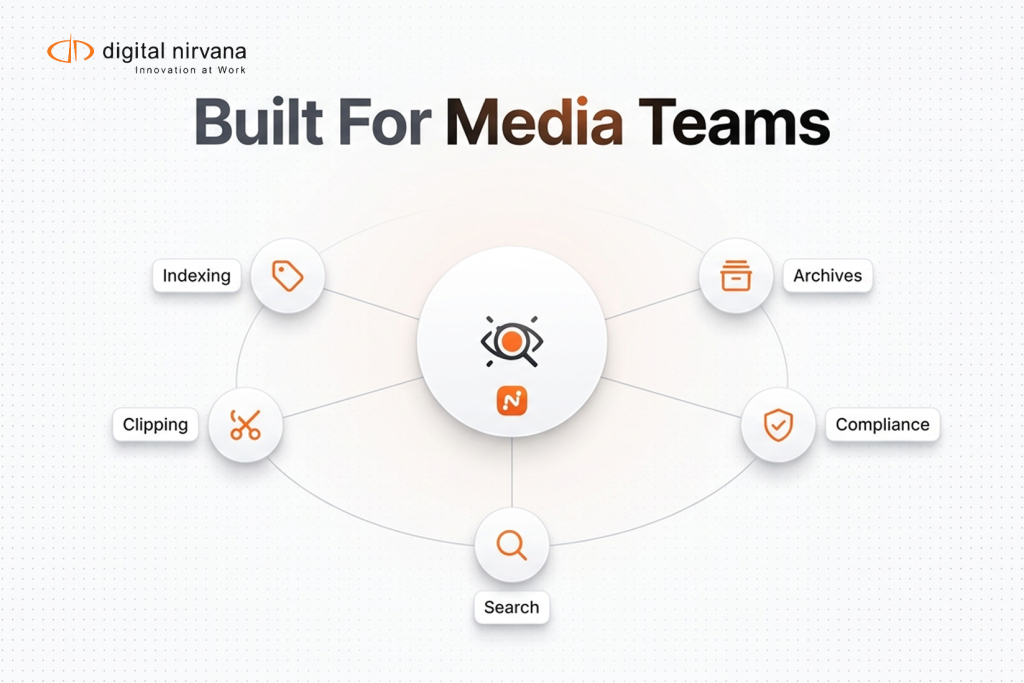
Why is Frame-Accurate Indexing Such a Big Deal in Modern Media Workflows?
Media teams are handling more content than ever before. Newsrooms, OTT platforms, sports broadcasters, production houses, and digital archives generate massive volumes of video daily. Without frame-accurate indexing, finding specific moments becomes slow and expensive.
Frame-accurate indexing allows systems to identify content precisely at the frame level rather than relying on broad clip-level markers. This improves operational efficiency across the entire media lifecycle.
- Faster Content Discovery
Editors and producers can instantly locate exact scenes, dialogue moments, or visual references without manually scrubbing through long footage files.
- Improved Collaboration
Multiple teams working across editing, compliance, legal review, and distribution can accurately reference identical frame positions.
- Better Compliance Monitoring
Broadcast compliance teams often need to quickly review specific segments. Accurate indexing simplifies content verification and regulatory auditing.
- Efficient Ad And Highlight Extraction
Sports broadcasters and digital publishers rely heavily on frame-level indexing to rapidly generate clips, highlights, and advertisements.
- Reduced Production Delays
When metadata and timecode remain synchronized, teams spend less time correcting asset mismatches or locating missing footage.
Modern media asset management systems increasingly prioritize frame-level metadata structures because they support scalable workflows more effectively.
What Happens When Metadata and Timecode Work Together?
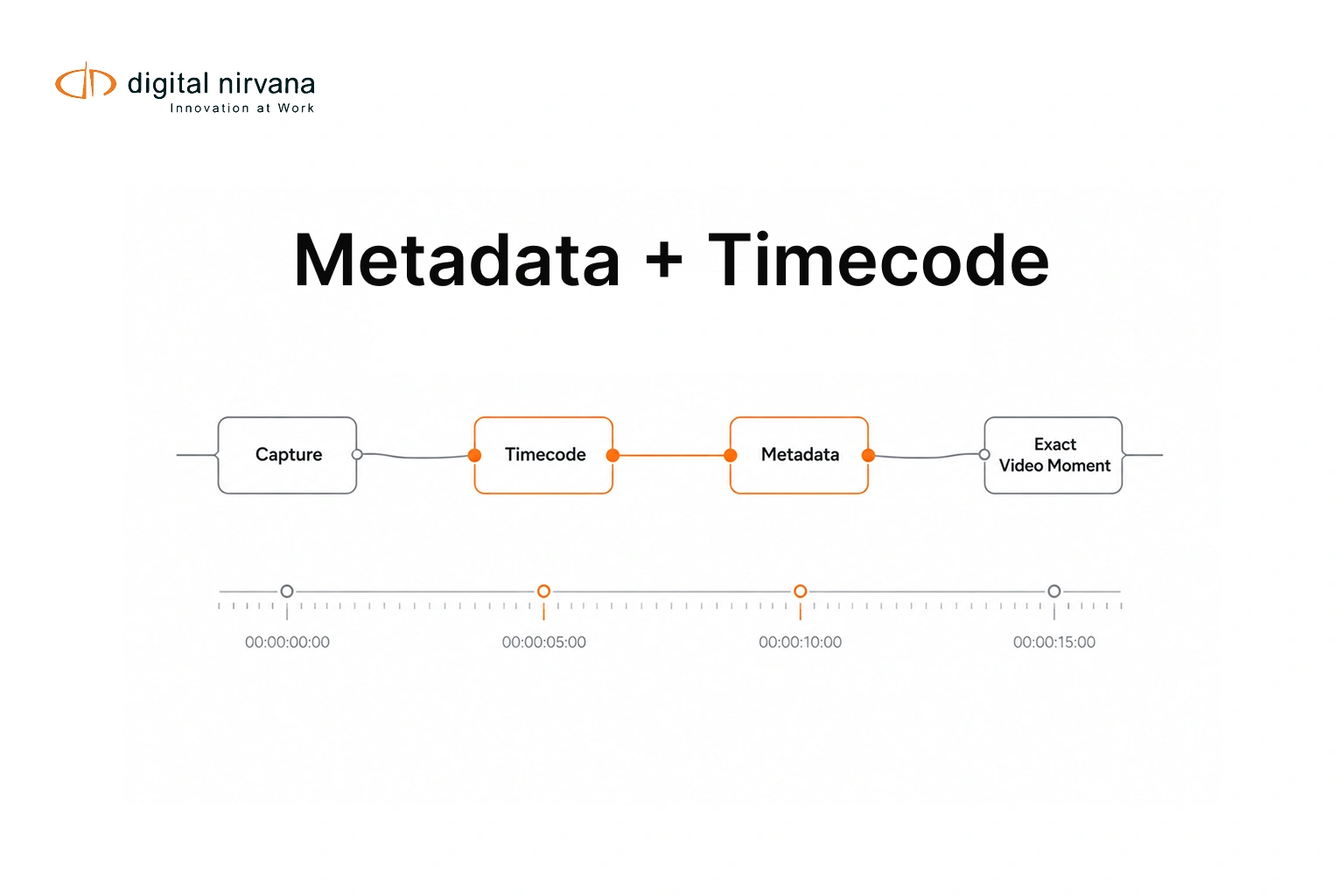
Metadata alone is useful. SMPTE timecode alone is useful. But together, they become far more powerful.
Metadata describes content information such as:
- Speaker names
- Topics
- Keywords
- Captions
- Locations
- Rights information
- Program categories
- Facial recognition tags
- Scene descriptions
Timecode connects this metadata to exact frames or segments.
For example:
- A news archive can identify the exact second a politician appears on screen.
- A sports network can locate every goal scored within a tournament instantly.
- A compliance officer can review a flagged advertisement at the exact frame in which it aired.
This combination creates highly searchable media environments in which content retrieval is fast, scalable, and reliable.
Platforms like Digital Nirvana’s MetadataIQ Solution support intelligent metadata indexing workflows designed for media organizations managing large video libraries.
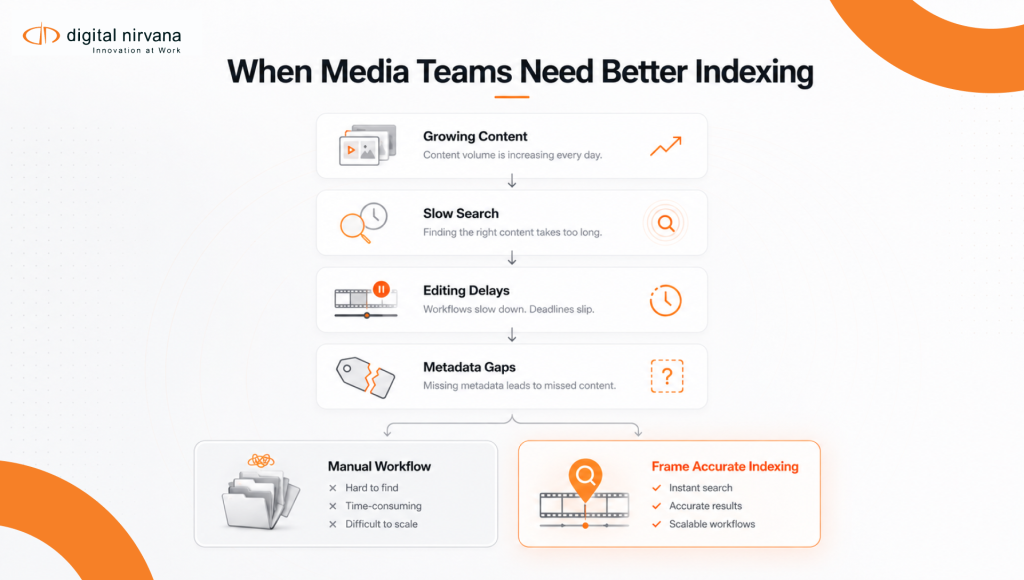
Which Media Indexing Problems Slow Teams Down the Most?
Even experienced media organizations face indexing and metadata challenges when workflows lack proper timecode alignment.
- Inconsistent Metadata Entry
Manual tagging often creates inconsistencies across departments and archives.
- Timecode Drift
When devices lose synchronization, audio and video timelines may drift apart, causing frame mismatches.
- Multi-Format Production Complexity
Modern teams work with multiple frame rates, codecs, and delivery standards simultaneously.
- Large Archive Management
Massive content libraries become difficult to search without structured metadata and frame-level indexing.
- Delayed Content Retrieval
Poor indexing workflows increase the time required to locate and repurpose media assets.
Frame-accurate indexing helps significantly reduce these operational bottlenecks.
What Do Media Teams Gain From Accurate Content Indexing?
Organizations investing in structured metadata and SMPTE timecode workflows gain long-term operational advantages.
- Improved Searchability
Teams can search using keywords, timestamps, captions, or visual metadata simultaneously.
- Better Content Reusability
Archived footage becomes easier to monetize and repurpose across future projects.
- Faster Editing Workflows
Editors spend less time locating source material and more time producing content.
- Stronger Archive Organization
Well-indexed archives improve long-term content preservation and accessibility.
- Enhanced AI Integration
AI-driven transcription, facial recognition, and scene detection systems rely heavily on synchronized metadata and accurate timecode references.
- Greater Workflow Automation
Modern PAM and MAM systems automate ingest, indexing, and retrieval better when metadata structures remain standardized.
Frame-level indexing is becoming increasingly important as broadcasters and streaming services adopt automation-heavy workflows.
How is SMPTE Timecode Used Inside PAM and MAM Workflows?
Today’s media operations depend heavily on PAM and MAM systems.
What Is PAM?
Production Asset Management focuses on managing active production workflows, including ingest, editing, collaboration, and review.
What Is MAM?
Media Asset Management focuses on long-term storage, organization, retrieval, and archive management.
SMPTE timecode plays a central role in both systems because it enables:
- Accurate media synchronization
- Segment-based indexing
- Frame-level search
- Metadata linking
- Automated clipping workflows
- Proxy editing alignment
- Compliance auditing
Modern solutions such as Digital Nirvana’s MetadataIQ Platform help organizations centralize metadata management while improving discoverability across large-scale content environments.
As cloud production and remote collaboration continue expanding, reliable timecode structures are becoming even more critical for distributed teams.
What Should Media Teams Do To Keep Indexing Workflows Organized?
Organizations looking to improve media indexing workflows should focus on consistency, automation, and standardization.
- Standardize Timecode Across Devices: Ensure cameras, recorders, and editing systems use synchronized SMPTE settings.
- Use Consistent Metadata Structures: Create organization-wide metadata standards for tagging, naming, and categorization.
- Automate Metadata Extraction: AI-assisted indexing tools can reduce manual workload while improving consistency.
- Verify Frame Rate Compatibility: Mismatched frame rates can create playback and synchronization issues later in production.
- Maintain Archive Hygiene: Regularly audit and update metadata records to keep media libraries searchable.
- Invest in Scalable MAM Solutions: Modern media operations require systems capable of handling growing archive volumes.
Organizations using structured media indexing frameworks often experience significant improvements in workflow speed and content accessibility.
How Does Digital Nirvana Support Frame-Accurate Media Workflows?
Handling so many hours of video content every day can become extremely overwhelming for media teams. Starting from managing old footage to managing live broadcasts and other aspects. There is so much to consider when building effective production workflows.
Digital Nirvana helps media companies organize, search, and manage content more effectively through its MetadataIQ Media Indexing and PAM/MAM Solutions.
Here’s how the platform supports everyday media operations:
- Makes it easier to find exact video moments using frame-accurate indexing and SMPTE timecode.
- Helps teams search large media libraries without spending hours manually reviewing footage.
- Keeps production, editing, compliance, and archive teams aligned with organized metadata.
- Reduces repetitive manual logging by automating content indexing workflows.
- Supports faster clipping, highlight creation, and content repurposing for digital publishing.
- Simplifies archive management for broadcasters and media organizations handling large volumes of content.
- Improves accessibility of stored media across PAM and MAM environments.
- Helps teams manage content workflows more smoothly during fast-paced production schedules.
For media organizations working with growing content libraries, structured indexing and reliable metadata management can make daily workflows far more manageable and efficient.
FAQs
SMPTE timecode is used to identify every individual frame in video and audio content. It supports synchronization, editing, indexing, and media asset management workflows.
Frame-accurate indexing allows teams to locate exact moments within media files quickly. This improves editing efficiency, compliance review, clipping, and archive management.
Drop frame timecode adjusts frame numbering to stay synchronized with real-world clock time in NTSC systems, while non-drop frame timecode counts frames sequentially without adjustments.
Metadata makes content searchable by adding descriptive information such as keywords, captions, speaker names, and scene details linked to exact timestamps.
A timecode format defines how timestamps are represented within media content, typically using hours, minutes, seconds, and frame numbers.
Yes. AI-powered indexing systems rely on accurate SMPTE timecode references to align transcripts, enable scene detection, support facial recognition, and automate tagging workflows.
PAM and MAM platforms use SMPTE timecode for synchronization, frame-level indexing, metadata mapping, asset retrieval, and workflow automation across production pipelines.
Conclusion
SPTE timecode plays an extremely crucial role in overall media operations in this industry. Now, without accurate frame indexing, media teams’ productivity slows and becomes far less efficient.
Thus, modern media teams now rely on MetadataIQ Media Indexing Solutions by Digital Nirvana. The right set of technologies can have a massive impact on efficiency across domains such as editing, compliance, archiving, and overall distribution workflows.
Key Takeaways:
- SMPTE timecode helps media teams locate exact frames quickly without manually searching through long hours of footage. This saves valuable production time and keeps editing workflows more organized.
- Frame-accurate indexing improves collaboration between editors, producers, compliance teams, and archivists. Everyone can work from the same reference points without confusion or delays.
- A well-structured timecode format makes content synchronization smoother across cameras, audio systems, and editing platforms. It also reduces the chances of mismatched clips and timeline errors during production.
- Metadata becomes far more useful when it is connected to precise timecode references. Teams can search, retrieve, and repurpose content faster across large media libraries.
- Solutions like Digital Nirvana’s MetadataIQ help media organizations manage growing archives better. Better indexing and searchable workflows make day-to-day media operations easier to handle.