Sports captioning fails in moments, not averages. A correct caption that appears after the play, attributes a quote to the wrong commentator, or misspells the deciding athlete’s name can still leave viewers behind. Effective sports captioning balances low delay, accurate text, clear speaker identification, complete audio context, and readable placement throughout the event. The workflow should prepare terminology before air, monitor quality during the feed, and create a corrected VOD caption file after the event.
Key Takeaways
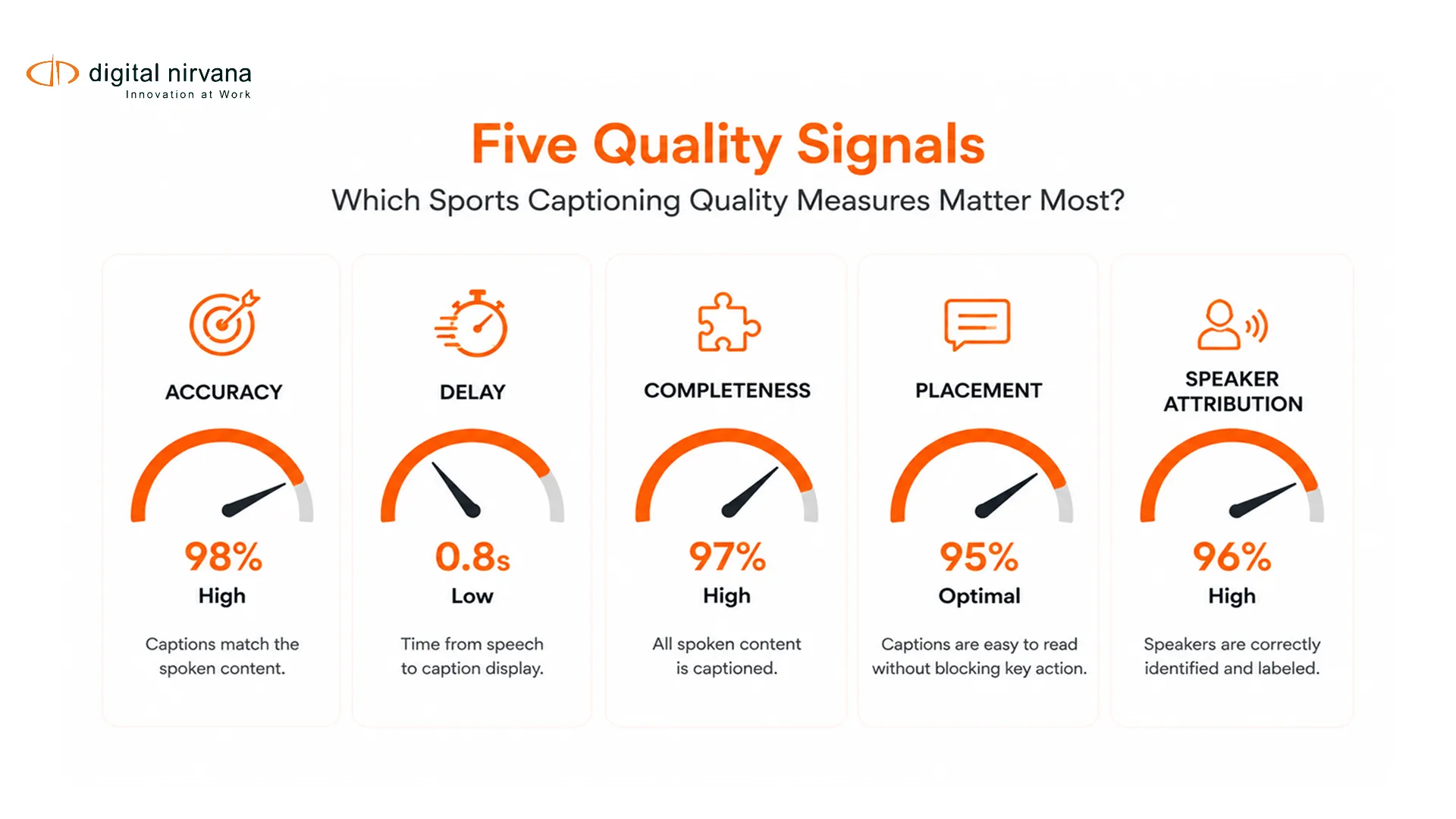
- Sports captioning quality should be measured across accuracy, synchronicity, completeness, placement, and speaker identification rather than with one accuracy percentage.
- Latency should be measured from spoken audio to displayed text at the viewer endpoint, not only at the caption encoder.
- Commentators, athletes, officials, reporters, and crowd or venue announcements need distinct identification rules.
- Rosters, pronunciations, venue names, sponsor terms, and competition vocabulary should reach the captioning workflow before the event.
- Live captions need active monitoring and escalation, while the replay or VOD version needs a separate correction pass.
- A vendor test should use real sports audio with crowd noise, rapid handoffs, overlapping voices, and unfamiliar names.
Table Of Contents
- Why Sports Captioning Is Harder Than Studio Captioning
- Which Quality Measures Matter Most
- How To Measure Caption Delay
- How Speaker Identification Should Work
- What Preparation Improves Live Accuracy
- What A Live Sports Captioning Workflow Should Include
- How To Evaluate Sports Captioning Services
- FAQs
Why Is Sports Captioning Harder Than Studio Captioning?
Sports captioning is harder because the audio, vocabulary, speakers, and pace change without warning. Commentary can accelerate during a scoring play, crowd noise can cover consonants, two analysts may interrupt each other, and a sideline reporter may join through a different audio path.
The vocabulary is also event-specific. Athlete names, team nicknames, sponsor names, venues, competition stages, tactical terms, statistics, and abbreviations vary by league and season. A general language model or captioner may recognize common words while missing the terms viewers need most.
Visual timing raises another problem. A caption describing a goal, wicket, penalty, or finish must remain close enough to the action for the viewer to connect text with the correct moment. The FCC’s television captioning guidance says captions should be accurate, synchronous, complete, and properly placed. Those four dimensions are especially interdependent in live sports.
Digital Nirvana’s guide to live captioning services for broadcast events explains the broader live workflow. Sports teams need an additional layer for event terminology, speaker changes, and post-event correction.
Which Sports Captioning Quality Measures Matter Most?
Use a scorecard that separates word accuracy from timing, attribution, completeness, and readability. A single percentage can hide a caption feed that gets ordinary commentary right but fails on names, scores, or speaker changes.
Track at least these measures:
- Text accuracy: substitutions, deletions, insertions, punctuation, and capitalization.
- Critical-term accuracy: athlete names, team names, scores, times, sponsors, locations, and competition terms.
- Synchronicity: the delay between audio and visible text.
- Completeness: whether captions continue through commentary, interviews, announcements, and meaningful non-speech audio.
- Speaker attribution: correct identification of who is speaking and when the speaker changes.
- Placement and readability: whether captions obscure scores, statistics, lower thirds, or other essential graphics.
- Recovery time: how quickly the service restores quality after an audio, network, or captioning failure.
The FCC’s captioning order established accuracy, synchronicity, program completeness, and placement as quality standards. Its best practices for real-time captioning vendors also call for metrics and minimum acceptable standards across those areas.
How Should You Measure Caption Delay?
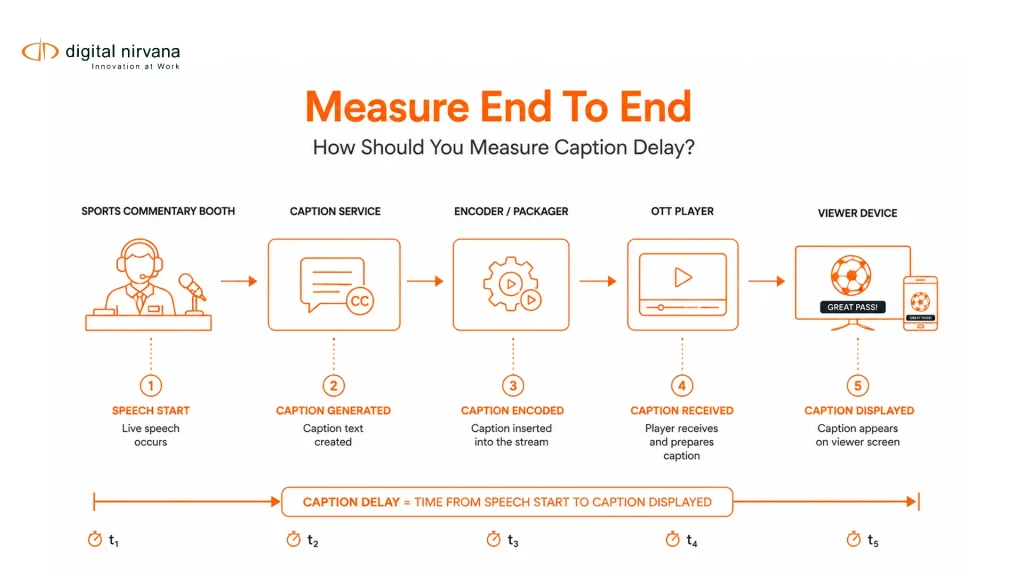
Measure caption delay end to end, from the original spoken word to the text displayed on the viewer’s device. Encoder timestamps alone do not include distribution, packaging, player, or device delay.
Use a test event with a visible and audible marker, such as a slate, clap, whistle, or spoken count. Record:
- Time the sound enters the production audio path.
- Time the caption leaves the captioning service.
- Time the caption is inserted into the broadcast or stream.
- Time the text appears on representative television, web, mobile, and OTT endpoints.
Repeat the test during ordinary commentary and a high-intensity segment. Delay may rise when speech becomes faster or when the system waits for more context.
Do not optimize latency by displaying unstable partial phrases that constantly rewrite themselves. A usable target balances prompt delivery with readable phrasing and correct timing. Log median delay, high-percentile delay, and the longest observed delay rather than reporting one best-case number.
How Should Speaker Identification Work In Sports Captions?
Speaker identification should tell the viewer who is speaking whenever the source is not clear from the picture or voice. It should remain consistent without filling every caption with unnecessary labels.
The W3C guidance for live captions states that captions include dialogue, speaker identification, sound effects, and other significant audio. In sports, the speaker set can include:
- Play-by-play commentator
- Color analyst
- Studio host
- Sideline or field reporter
- Athlete, coach, official, or interview guest
- Public-address announcer
- Interpreter or translated voice
- Unidentified off-camera speaker
Use a verified name when known. Use a stable role label when the person is not known or changes frequently. Generic chevrons can mark a change, but they do not tell viewers whether the voice belongs to the analyst, referee, reporter, or interview subject.
Speaker errors should be scored separately from word errors. Correct words assigned to the wrong person can change the meaning of a quote.
What Preparation Improves Live Sports Caption Accuracy?
Pre-event preparation improves recognition because the captioning workflow receives the names and terms most likely to fail. Preparation should begin from production data already maintained by the broadcaster or rights holder.
Provide:
- Current rosters with preferred display names
- Pronunciations, nicknames, and common abbreviations
- Coaches, officials, commentators, hosts, and reporters
- Team, league, tournament, venue, and sponsor names
- Competition terminology and likely statistical phrases
- Rundown, scripts, interview lists, and segment order
- Expected language changes and interpreter details
- A clean commentary mix or isolated audio feed when available
Updates matter. A last-minute roster change, substitute commentator, sponsor activation, or venue pronunciation can make yesterday’s glossary wrong.
For managed delivery, connect preparation to the media enrichment and captioning workflow so terminology, review, caption generation, and final deliverables do not depend on unrelated handoffs.
What Should A Live Sports Captioning Workflow Include?
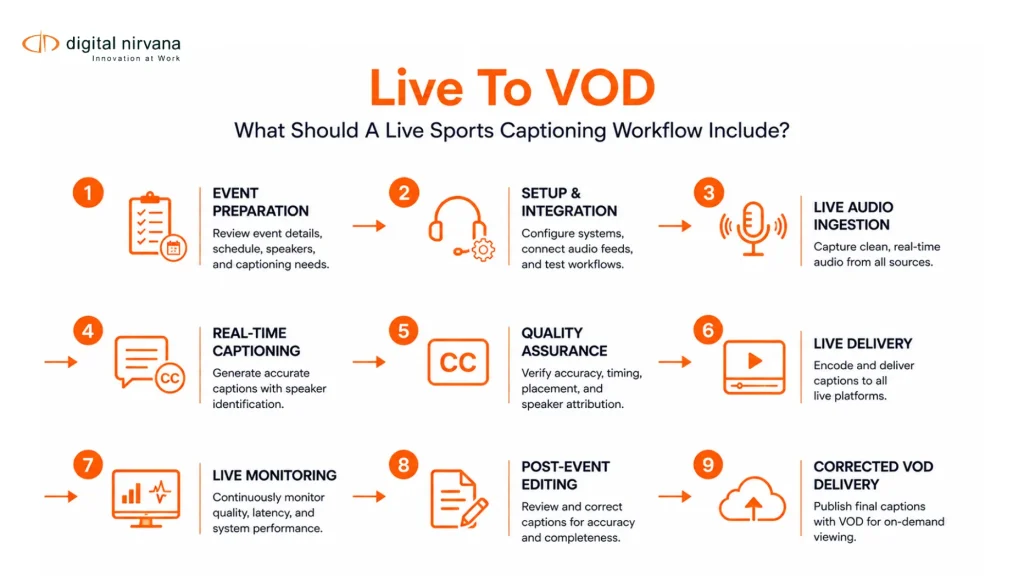
A live workflow needs preparation, redundant routing, active monitoring, incident response, and a separate VOD correction stage. Treating live output as the final archive copy carries preventable errors into replays and clips.
Use this sequence:
- Confirm the distribution platforms, caption formats, languages, frame rate, and expected delay.
- Load approved event dictionaries and speaker data.
- Test primary and backup audio, network, encoder, and return monitoring paths.
- Verify captions on real viewer endpoints before air.
- Monitor text, delay, completeness, placement, and speaker labels during the event.
- Escalate sustained delay, missing captions, incorrect routing, or repeated critical-term errors.
- Preserve the live caption output and incident log.
- Correct names, punctuation, timing, speaker labels, and missing audio for VOD.
- Revalidate the corrected file against the final program master.
The corrected version should retain the live file as a traceable source rather than silently overwriting it. That makes recurring errors easier to diagnose and improves preparation for the next event.
How Do You Evaluate Sports Captioning Services?
Evaluate vendors with a representative event sample and an agreed scorecard before committing to production. A clean studio interview does not test the conditions that make sports difficult.
Ask each vendor to caption the same sample containing rapid commentary, overlapping voices, crowd noise, names, scores, interviews, music, and graphics. Compare:
- End-to-end latency at the viewer endpoint
- Overall and critical-term accuracy
- Speaker-change and speaker-name accuracy
- Completeness through breaks and interviews
- Caption placement around score graphics
- Handling of audio loss and network interruption
- Terminology update process
- Human review and escalation options
- VOD correction process and turnaround
- Reporting, logs, and quality evidence
Digital Nirvana’s article on choosing closed captioning services provides a broader procurement framework. For sports, add event-level testing and require the vendor to explain the trade-off between delay and stable readable captions.
FAQs
Sports captioning converts live or recorded sports audio into synchronized text that includes dialogue, speaker identification, and meaningful non-speech information. It may serve television, OTT, web, mobile, venue, replay, and clip workflows.
Live sports captions should be as accurate as the live conditions permit while meeting the applicable quality and accessibility requirements. Buyers should measure ordinary words, critical names and scores, timing, completeness, placement, and attribution separately.
Sports captions appear late because speech recognition or a human captioner needs processing time, and the broadcast or streaming path adds encoding, packaging, network, player, and device delay. The full delay should be measured at the viewer endpoint.
Known speakers can be identified by name, while recurring or unknown voices can use consistent role labels such as “Analyst,” “Reporter,” or “PA Announcer.” Labels are most important when the speaker is off camera or several voices sound similar.
Automatic captioning can improve when current names, pronunciations, and event terms are loaded before air, but uncommon or newly changed names still need monitoring. High-impact errors should be corrected during the event when possible and in the VOD file afterward.
The live file should usually receive a correction pass before VOD release. Editors should fix names, timing, punctuation, attribution, missing words, and non-speech cues against the final program master.
A clean commentary feed is usually easier to caption than a full program mix dominated by crowd, music, effects, or overlapping sources. The available feed should still include meaningful audio that viewers need represented.
The agreement should define coverage, languages, delivery paths, latency measurement, quality metrics, monitoring, incident escalation, backup procedures, reporting, and VOD correction. It should also identify who supplies rosters and terminology updates.
Conclusion
Sports captioning should be planned as a live production workflow, not attached as a final output. Establish the quality scorecard, prepare the event vocabulary, test the full distribution path, monitor the viewer experience, and correct the replay copy.
Professional support is worth considering when the event has several distribution endpoints, specialist terminology, multilingual feeds, strict turnaround, or limited internal captioning staff. Start by testing one real event and comparing quality evidence, not vendor promises.