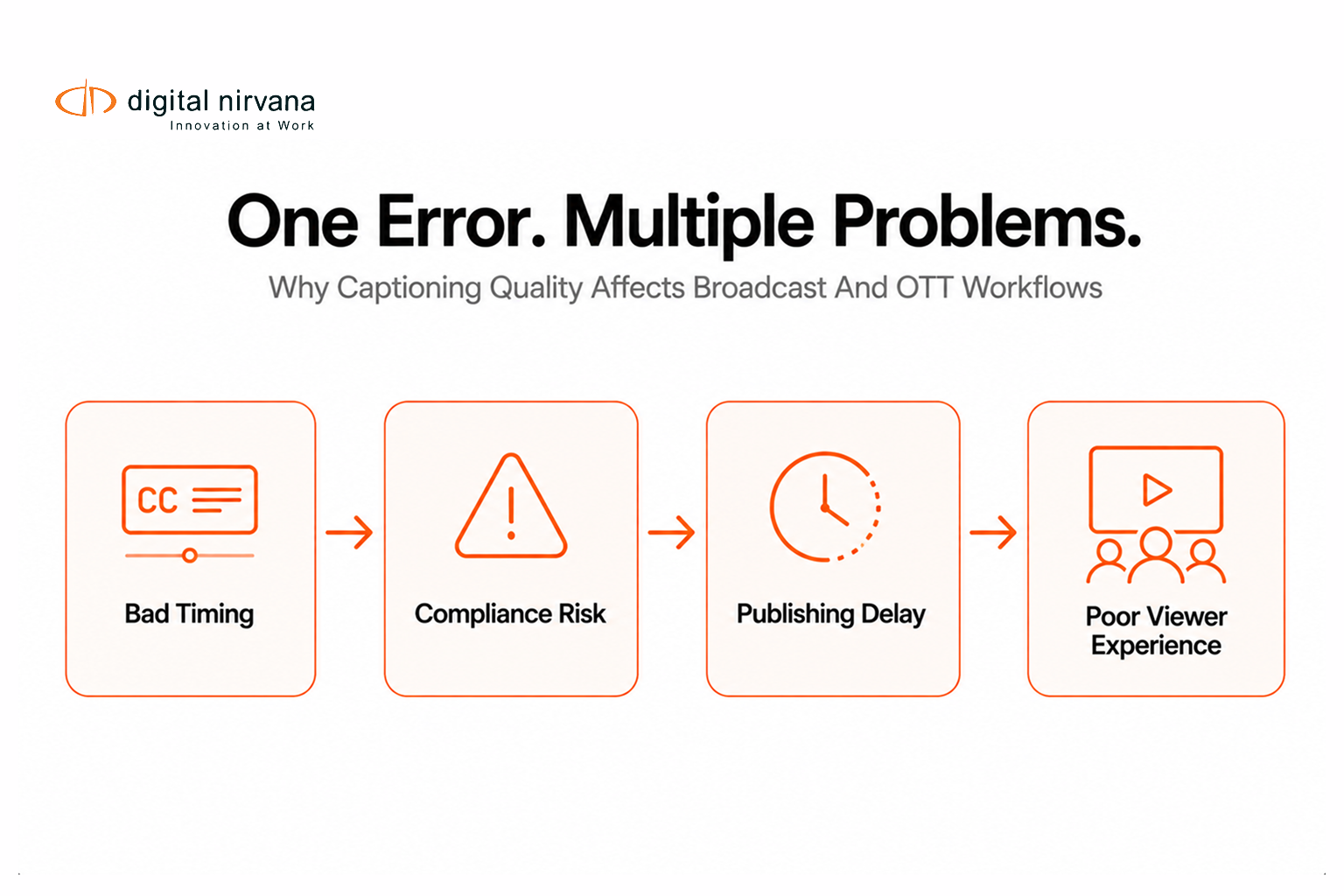
Closed captioning is way more important than most people realize. Starting with poorly timed subtitles, missing compliance standards, and more. All of these aspects can quickly delay your publishing timelines and trigger more complaints.
Approximately one-third of the public prefers to use closed captions when viewing a movie on their devices. Today’s media workflows are increasingly inclined towards better closed-captioning services, such as Media Enrichment Services by Digital Nirvana. This ensures better accessibility, compliance, content turnaround time, and overall operational efficiency.
This guide will help you analyze how to scale large operations more effectively while maintaining adequate control over caption quality, metadata intelligence, and workflow integration.
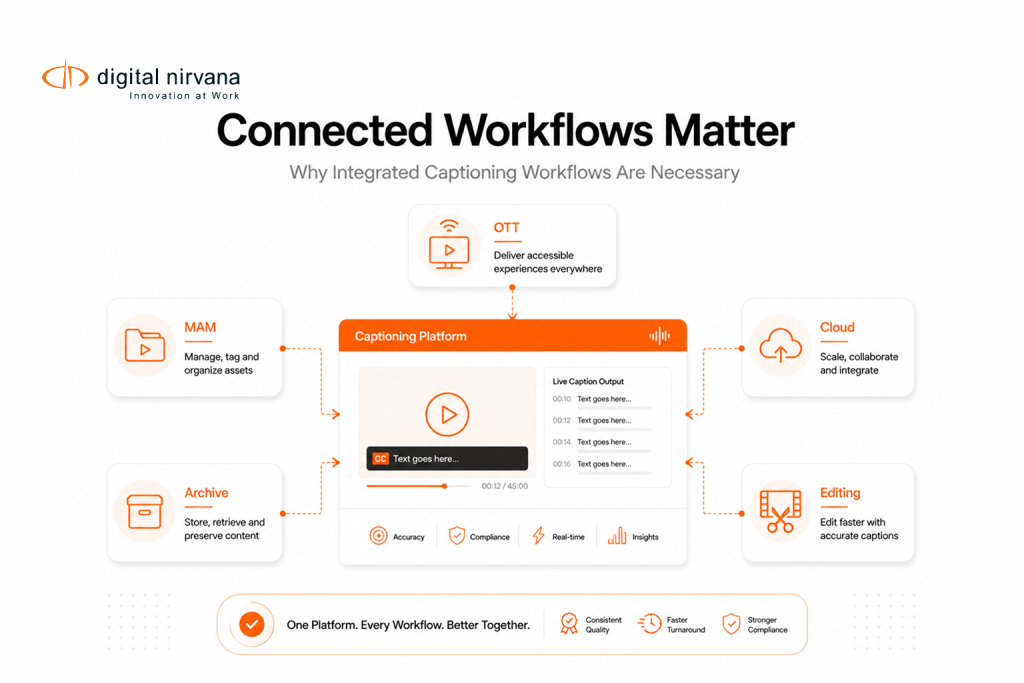
Why Are Closed Captioning Services Becoming So Important For Broadcast And OTT Teams?
Closed captions play a significant role in regulatory compliance, multilingual audiences, and other areas. They have a high importance in content delivery workflows. This is especially important for audiences who watch videos in muted environments and on social platforms. For broadcasters and OTT platforms, high-quality captioning services help with:
- Accessibility compliance
- Better audience retention
- Improved content discoverability
- Higher engagement on social and streaming platforms
- Faster global content distribution
- Easier content repurposing
- Searchable video archives
Modern closed captioning services also support metadata enrichment, AI-powered indexing, content analysis, and automated workflow management. This turns captions into valuable operational assets rather than simple text overlays.
According to Digital Nirvana’s AI workflow, automated speech-to-text, caption conformance, metadata generation, and content classification are becoming critical for scalable media operations.
How Different Are Broadcast And OTT Captioning Requirements?
One of the biggest mistakes media organizations make is assuming broadcast and OTT captioning requirements are identical. They are not.
Traditional broadcast environments often focus heavily on regulatory compliance, timing precision, live synchronization, and transmission standards. OTT platforms, on the other hand, prioritize platform-specific formatting, multilingual compatibility, viewer customization, and cross-device playback consistency.
Different OTT platforms may also have unique caption conformance requirements related to:
- Character limits
- Line breaks
- Caption positioning
- Timing thresholds
- Reading speed
- Subtitle formatting
- File formats
A strong closed captioning services provider should understand both ecosystems and support multi-platform delivery without forcing manual rework.
MediaServicesIQ includes automated closed-caption conformance tools that identify non-compliant captions and generate detailed reports on platform-specific publishing standards.
What Should You Actually Look For In Closed Captioning Services?
- Accuracy And Quality Control
Caption accuracy remains the most important factor. Errors in names, accents, technical terminology, or timing can massively affect overall viewer experience and compliance performance.
Look for captioning services that offer:
- Human-assisted review workflows
- AI-enhanced speech recognition
- Caption realignment capabilities
- Speaker differentiation
- Automatic punctuation
- Intelligent line formatting
- Quality assurance validation
TranceIQ uses AI-driven NLP processing to automatically convert transcripts to captions, with intelligent line breaks and improved readability.
- Multi-Format Support
Broadcast and OTT ecosystems rely on multiple caption file formats.
Your captioning provider should support formats such as:
- SCC
- SRT
- WebVTT
- TTML
- STL
- EBU-TT
- DFXP
The ability to process and export captions across different standards reduces operational friction when distributing content across various channels.
- Real-Time And Near-Live Capabilities
Live broadcasting and sports streaming require near-real-time caption generation.
Modern captioning services should support:
- Live speech-to-text processing
- Near-live synchronization
- Automated caption alignment
- Streaming caption outputs
- Low-latency workflows
It is important that the right platform supports streaming text delivery for near-real-time publishing workflows.
- AI And Automation
Automation is becoming essential for large-scale media operations. AI-powered captioning services can accelerate turnaround time while reducing repetitive manual effort. Advanced systems now support:
- Speech recognition
- Object detection
- Logo recognition
- Content classification
- Metadata generation
- Automatic transcription
- Caption conformance monitoring
These capabilities help broadcasters streamline production and post-production workflows.
- Workflow Integration
Disconnected tools slow down operations.
Captioning platforms should integrate directly with:
- MAM systems
- PAM systems
- Cloud storage
- OTT publishing workflows
- Broadcast monitoring systems
- Editing environments
- Archive systems
MediaServicesIQ integrates with existing workflows via open APIs and supports integration with systems such as Avid environments.
- Scalability
Content volumes continue to grow rapidly across streaming and broadcast environments.
Choose captioning services that can scale for:
- Multi-channel broadcasting
- Global OTT publishing
- Large content libraries
- Live event coverage
- High-volume episodic delivery
- Multi-language workflows
Cloud-native infrastructure plays a major role in scalability and operational flexibility.
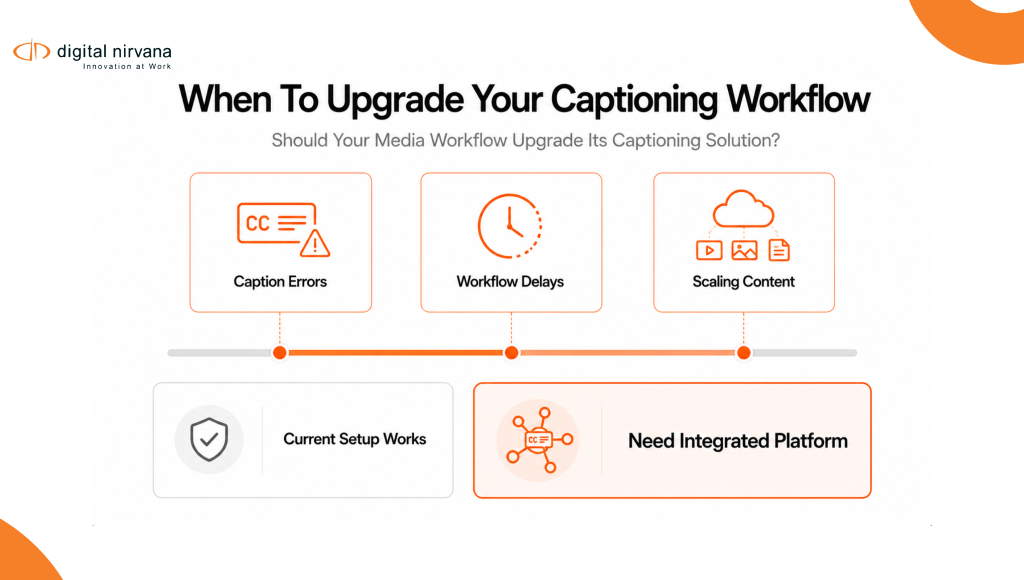
How Is AI Making Modern Captioning Workflows Faster And Smarter?
AI has transformed modern media operations significantly. Instead of replacing human expertise entirely, AI now enhances speed, scalability, and operational consistency across captioning workflows.
AI-powered captioning services can now assist with:
- Speech-to-text conversion
- Caption synchronization
- Metadata extraction
- Speaker identification
- Content classification
- Ad break detection
- Scene recognition
- Video indexing
Digital Nirvana’s MediaServicesIQ platform combines AI and machine learning capabilities to streamline production, post-production, and distribution workflows across media environments.
Its ecosystem also supports:
- Logo detection
- Face recognition
- On-screen text extraction
- Caption conformance analysis
- Content classification
- Automated reporting
These capabilities help broadcasters reduce repetitive tasks while improving operational efficiency.
Why Are More Media Teams Choosing Integrated Captioning Platforms Like Digital Nirvana’s MediaServicesIQ?
The best captioning provider is not necessarily the cheapest vendor or the fastest transcription tool. The right partner understands broadcast operations, OTT publishing requirements, AI automation, compliance workflows, and large-scale media management.
- High caption accuracy ensures consistent quality across all kinds of live broadcasts, recorded content, and other formats without compromising quality.
- AI-assisted workflows rapidly accelerate caption generation, metadata tagging, and more with ease.
- Real-time processing support prevents potential delays in caption delivery while improving audience experience and publishing schedules.
- Compliance tools help validate all kinds of captions against various OTT, broadcast, and accessibility standards, ensuring they are equally distributed across different channels.
- Multi-language capabilities ensure that your content is easily accessible across different languages and localities without any hindrances.
- Cloud scalability ensures your organization can handle sudden spikes in content demand, especially during celebrations, live events, tournaments, and more.
Digital Nirvana’s solutions are specifically designed for broadcasters, production houses, and OTT operators looking to modernize captioning and metadata workflows using AI-powered infrastructure.
Organizations handling growing content libraries, live-streaming workflows, or global distribution requirements benefit significantly from integrated captioning ecosystems rather than disconnected point solutions.
FAQs
Closed captioning services create synchronized text versions of spoken dialogue, sound effects, and audio cues for video content across broadcast and OTT platforms.
Captioning services improve accessibility, viewer engagement, content discoverability, and compliance with platform-specific distribution requirements.
Captions include dialogue and non-speech audio elements, while subtitles generally focus only on translated or transcribed dialogue.
Yes. AI-powered speech recognition and NLP technologies significantly improve speed and efficiency, especially when combined with quality assurance workflows.
A reliable provider should support formats like SCC, SRT, WebVTT, TTML, STL, and DFXP for multi-platform compatibility.
Yes. Many regions require broadcasters and streaming providers to meet accessibility and captioning compliance standards.
Modern captioning services integrate with media asset management systems, OTT publishing pipelines, cloud storage, and compliance monitoring platforms.
Conclusion
Broadcast OTT workflows require more scalable, accurate, and AI-assisted captioning support to effectively improve overall production, compliance, metadata, and publishing workflows.
This is precisely why so many broadcasters and streaming platforms are choosing MediaServicesIQ by Digital Nirvana nowadays. They enhance streamlined captioning, metadata management, and overall media intelligence workflows in the right structure. All of this while maintaining your existing ecosystem.
Key Takeaways:
- Modern closed captioning services go beyond transcription and support accessibility, compliance, metadata generation, and workflow automation. This makes them essential for scalable broadcast and OTT operations.
- Broadcast and OTT platforms follow different captioning requirements, making platform-specific conformance critical. Choosing providers familiar with multi-platform standards helps avoid publishing delays and compliance issues.
- AI-powered captioning services improve speed, operational efficiency, and large-scale content processing. However, quality assurance and workflow integration still remain equally important for consistent results.
- Integrated media workflows reduce manual effort and improve publishing efficiency significantly. Captioning systems that connect with MAM, PAM, and OTT workflows provide long-term operational value.
- Scalable cloud-based solutions help broadcasters and OTT operators manage growing content libraries. AI-driven ecosystems like Digital Nirvana’s MediaServicesIQ support modern media workflows with automation and intelligent content processing.