It’s 4:47 p.m. on a Tuesday. Breaking news just dropped. A public figure involved in a scandal. The newsroom erupts. Assignment desk yells: “Find me footage of them at the governor’s speech from 2019. We need it for the 6 p.m. segment.”
The producer frantically searches the media library. File names give nothing away: “clip_2019_07_15_v2_final_EDITED.mov”. Another one: “footage_gov_ARCHIVE.mov”. Another: “2019_EXPORT_DO_NOT_DELETE.mov”.
Fifteen minutes pass. The 6 p.m. segment is 45 minutes away. They still haven’t found the right clip. It exists somewhere (they know it does). But where?
Meanwhile, a junior producer remembers: “I think it’s in the Avid project from that series we did.” She digs through the Avid folder structure. Nested bins go six levels deep. She’s not sure which Avid project, so she searches three. Each one takes minutes to load.
Twenty minutes past the 4 p.m. deadline. Still no footage. They miss the segment. The story goes to air without the key visual. Another network scooped them with better archival material.
The post-mortem is brutal: “We had the footage. We just couldn’t find it.”
This scene repeats across newsrooms every single week. And the root cause isn’t human incompetence. It’s system architecture. It’s chaos masquerading as normal.
The PAM Problem Nobody Actually Fixes
PAM (Production Asset Management) is supposed to be the library of everything a broadcast operation creates. Every video, every audio file, every graphic, every archived segment. One searchable source of truth.
In theory.
In reality, broadcast operations live with fragmented asset storage:
- Footage lives in Avid Media Composer (editing system)
- Archived content lives in a separate digital library
- Graphics live on a shared drive
- Raw camera feeds live on storage servers
- Dailies live in a different system entirely
- Social media clips live somewhere else
- Old broadcast masters live on tape in a closet
A producer searching for “interview with CEO from 2020” has to search six different systems. Six different interfaces. Six different search languages. Six times the chance of not finding it.
The data backs this up:
- 89% of broadcast operations report searching across multiple systems daily
- 73% of newsrooms spend 15+ minutes per day on asset search inefficiency
- 47% of content created is searched for but never found, then recreated
- Average time to locate an asset: 18 minutes (should be 30 seconds)
That 18-minute average? It’s killing productivity. It’s killing deadline-driven journalism. And it’s destroying the economic value of content libraries (if you can’t find it, you can’t repurpose it, so it just sits there, worth zero).
Why PAM Integration Failed (Until Now)
The broadcast industry has known about this problem for 15 years. Vendors have built PAM systems the whole time. So why hasn’t it been solved?
Because PAM integration is harder than it looks.
A modern broadcast operation uses 4-6 different content creation and management systems, each with its own metadata standards, its own file formats, its own search interfaces. Getting them to talk to each other sounds like a simple data problem. It’s not. It’s a political problem.
Avid doesn’t want to lose control of media asset data to a central PAM. Your archive system has been working fine for 10 years (why change?). The camera company’s asset management system is proprietary. The graphics team uses their own workflow. Everyone has a different definition of what metadata matters.
So you end up with “integration” that’s actually just “we added an export button that dumps data to a CSV and then a human manually imports it somewhere else.”
That’s not integration. That’s shadow work wearing a technology costume.
Real integration means:
- All systems speaking the same metadata language
- Search working across all sources simultaneously
- Metadata flowing automatically (not manually exported/imported)
- Asset relationships preserved (this clip came from this broadcast from this interview from this day)
- Search results returning relevant content from any system
For years, that was impossible. Broadcast systems were too heterogeneous. Metadata standards too fragmented.
Until AI-powered metadata intelligence became viable.
The Seismic Shift: From Manual Metadata To Automated Understanding
Here’s what changed the game: AI that understands what’s actually inside video.
A producer searches “interview with CEO about climate policy from 2019.”
In the old PAM world: The search would fail unless someone had manually typed those exact words into metadata fields when the video was ingested. Which means it failed maybe 40% of the time (metadata was incomplete, inconsistent, or just wrong).
In the modern world: AI watches the video. It identifies the person (CEO), extracts the topics discussed (climate policy), notes the broadcast date (2019). It tags all of that automatically. The search works because the metadata is comprehensive and accurate.
This is the fundamental breakthrough that makes PAM integration actually work:
Metadata is no longer something humans create. It’s something AI extracts from the content itself.
When metadata is generated automatically, it’s:
- Consistent (same tagging rules applied to every asset)
- Complete (every asset gets tagged, not just the ones someone remembered to catalogue)
- Accurate (AI doesn’t miss details, doesn’t make typos, doesn’t get lazy at 5 p.m.)
- Linked (relationships between content are discovered automatically, not manually documented)
Suddenly, PAM integration becomes possible. Because the integration point isn’t “how do we make all these systems talk?” It’s “how do we ensure all systems have accurate, consistent metadata to search against?”
The Real Broadcast Workflow (And Where It Falls Apart)
Let’s walk through a typical broadcast operation and see where PAM integration matters:
Morning: News director wants a package on the upcoming election. It needs archival footage of past political debates, sound bites from politician interviews, and context graphics.
Old way: Producers search Avid, find nothing (it’s been archived). Search the digital library using inconsistent keywords, find 12 results but none match. Check with the archive manager, who searches on tape (literally searches physical media). Wait 2 hours for tape to load. Finally get footage. By then, the morning show deadline is missed.
New way: Producers search searchable metadata from all sources simultaneously. Results come back in 2 seconds. They can see which system each asset lives in. They pull the best clips from archive, the soundbites from Avid, graphics from the storage server. All through one interface. Total search time: 30 seconds.
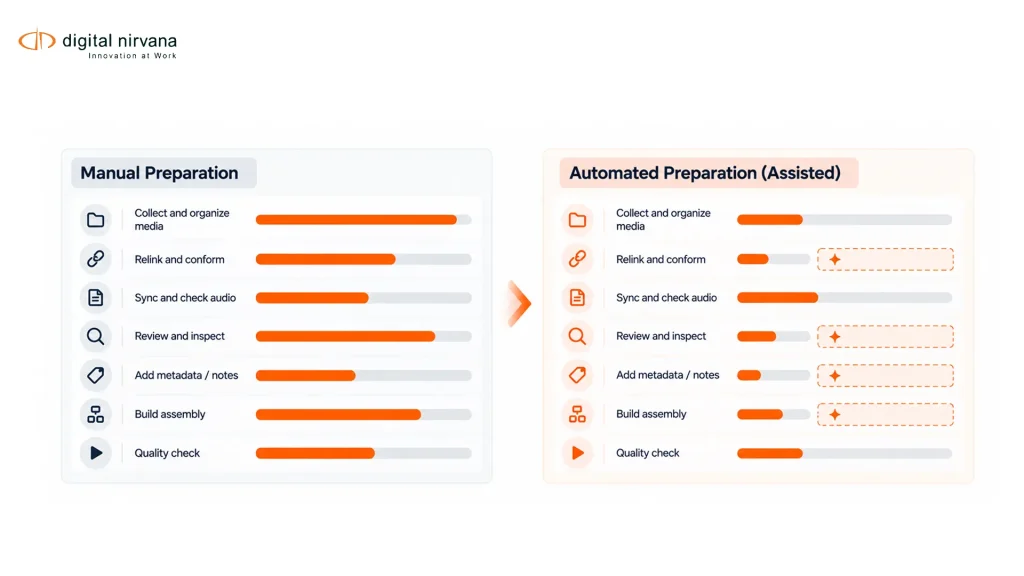
Ingest: Raw footage arrives from the field (50 GB per day). Old way: It gets dumped into a storage folder. Someone manually reviews it, creates metadata tags in Avid. Takes 2 hours per day. If they miss something important, it doesn’t get tagged. New way: Footage is automatically transcribed, tagged with speakers, topics, locations, and time codes. MediaServicesIQ processes it overnight. By morning, it’s fully indexed and searchable across the entire PAM system. Zero manual tagging required.
Post-production: A news story goes to air. Social media team wants to repurpose clips for social posts. Old way: They ask the producer for clips. Producer manually exports segments. Takes 30 minutes per story. New way: They search the PAM for clips from that story. Pull exactly what they need. No producer middleman. Clip from search to social in 90 seconds.
Archive: At the end of the year, the operation has created 10,000 broadcast-quality video assets. What’s the value of that? Zero if nobody can find it. Everything if the footage is searchable and reusable. With AI-powered metadata at scale, that archive becomes a library of reusable content worth hundreds of thousands in potential value.
The Integration Challenge: Avid, Grass Valley, And Everyone Else
Here’s where it gets technical: broadcast newsrooms don’t use generic systems. They use specialized broadcast production systems, and each one has its own data models, its own asset management philosophy, its own API (if any).
Avid Media Composer (the industry standard for editing):
- Stores metadata in proprietary bins
- Asset organization reflects folder structure (not necessarily logical)
- Search is powerful but limited to Avid ecosystem
- Export is possible but metadata doesn’t always translate cleanly
Grass Valley systems (editing and playout):
- Different metadata architecture entirely
- Integration with other systems requires custom engineering
- Asset relationships managed differently than Avid
Archive systems (often separate vendor entirely):
- Different search interface
- Different metadata standards
- Metadata might not even exist for older content
Camera systems (increasingly networked):
- Proxy footage generated automatically
- Metadata created during recording
- Often isolated from post-production systems
Connecting all of this traditionally means:
- Custom API development for each integration
- Data transformation pipelines (converting one system’s metadata format to another)
- Manual metadata mapping (deciding which Avid field maps to which archive field)
- Ongoing maintenance (when systems update, integration breaks)
This is engineering-heavy, expensive, and brittle.
The modern approach: Use AI-powered metadata as the integration language. Instead of trying to make Avid and Archive and Grass Valley all speak the same language, generate consistent, AI-extracted metadata from every system. Each system exports its content to a central metadata index. The index becomes the searchable hub.
No complex integration. No proprietary mapping. Just: “Here’s what’s actually in this video” from every source, standardized.
Broadcast Asset Monetization (The ROI Nobody Talks About)
Here’s a number that should shock broadcast operations: the average news story created is aired once, then sits dormant.
A 4-minute investigative piece takes 2 weeks to produce. It airs once. Then it’s archived. Of the 400+ video clips that went into that story (interviews, b-roll, soundbites), 395 of them are never used again.
Why? Because nobody can find them. They’re buried in archive, with metadata that doesn’t surface them, under file names that don’t describe them.
What if that archive was searchable? What if every interview, every location shot, every soundbite could be found instantly for future stories?
A broadcast operation with 5 years of searchable archive has an extraordinary asset library:
- Thousands of interview clips available for future stories
- Location footage that never needs to be re-shot
- b-roll covering every season, every weather, every scenario
- Soundbites from dozens of public figures on every topic
With proper metadata indexing, that archive becomes a production accelerator. Stories go faster (less shooting, more archival reuse). Production costs drop (no need to re-shoot covered footage). Quality improves (you can pull the best shot from 5 years of footage, not just yesterday’s shoot).
The economic impact: A newsroom with 200 stories per year, averaging 2 hours of production time each, could save 40+ hours per year through archive reuse. That’s one full-time producer freed up. Or more stories, same headcount.
At a fully loaded salary of $60K, that’s real money. And it’s just the efficiency math. The quality improvement (better stories through better asset access) is harder to quantify but very real.
Common PAM Integration Failures (Why Implementation Breaks)
Failure 1: Assuming all metadata is created equal.
You integrate your Avid system with your archive system. They’re “talking.” You feel great. Then you realize: Avid has extensive metadata for current season content (because your ingest process is strict). Archive has minimal metadata for 5-year-old content (it was tagged loosely back then). So half your assets are discoverable, half aren’t. Partial integration creates partial value.
Failure 2: Building integration around existing metadata instead of improving it.
You connect your systems and assume the metadata already in them is good enough. It’s not. AI should generate new metadata, not just move existing tags around. The best integration includes retroactive metadata enrichment (go back through the archive and tag old content properly).
Failure 3: Integrating at the system level, not the metadata level.
You hire a consultant to build APIs connecting your Avid system to your archive. Deep technical integration. Then Grass Valley playout gets added to the workflow, and your integration doesn’t support it. You’re back to square one. The mistake: building integration around technology. The fix: build integration around metadata (technology-agnostic).
Failure 4: Expecting integration without workflow redesign.
You integrate your systems but don’t change how people actually use them. Producers still search in Avid first, then archive separately. They still don’t know about the other system’s assets. Integration exists, but it’s invisible. The fix: Change the workflow. Central metadata search becomes the default. Individual systems become secondary.
Modern PAM Integration: The Complete Workflow
Here’s what a properly integrated PAM workflow looks like:
Ingest: Raw footage from camera, Avid, or archive enters the system. AI-powered transcription and tagging happens automatically. Every speaker is identified. Every location is tagged. Every topic is extracted. Time-coded transcripts are generated.
Indexing: Metadata is indexed across all systems simultaneously. Avid bins are scanned. Archive is queried. Grass Valley playout systems are connected. Camera proxy footage is analyzed. All assets appear in a central searchable index.
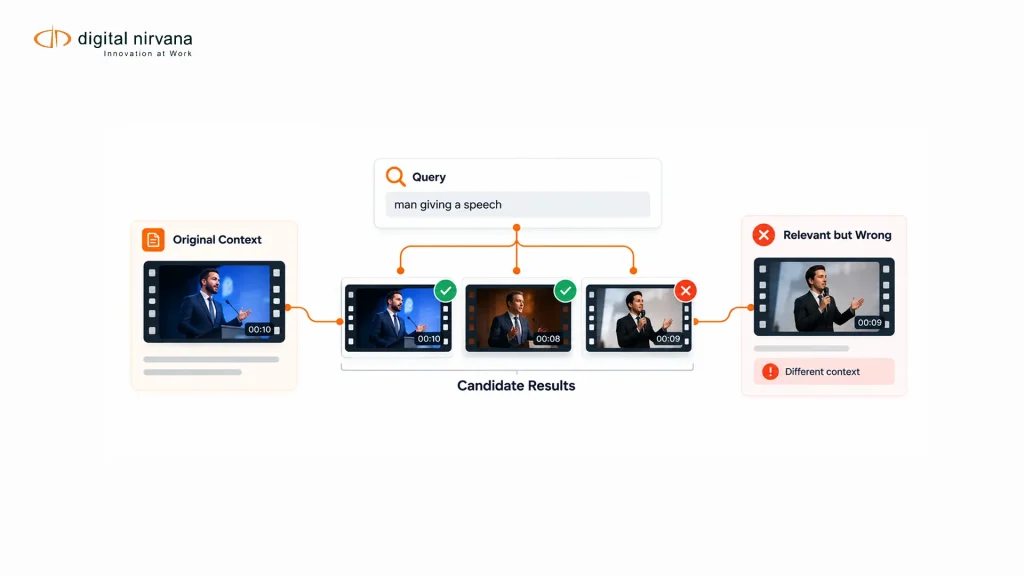
Search: A producer searches “mayor’s press conference”. Results come back from:
- Live footage (camera proxy from the field)
- Avid projects (archived edits from past coverage)
- Archive system (footage of past press conferences)
- Graphics system (lower thirds with mayor’s name)
- Audio system (soundbites from past interviews)
All in one search interface. All results ranked by relevance.
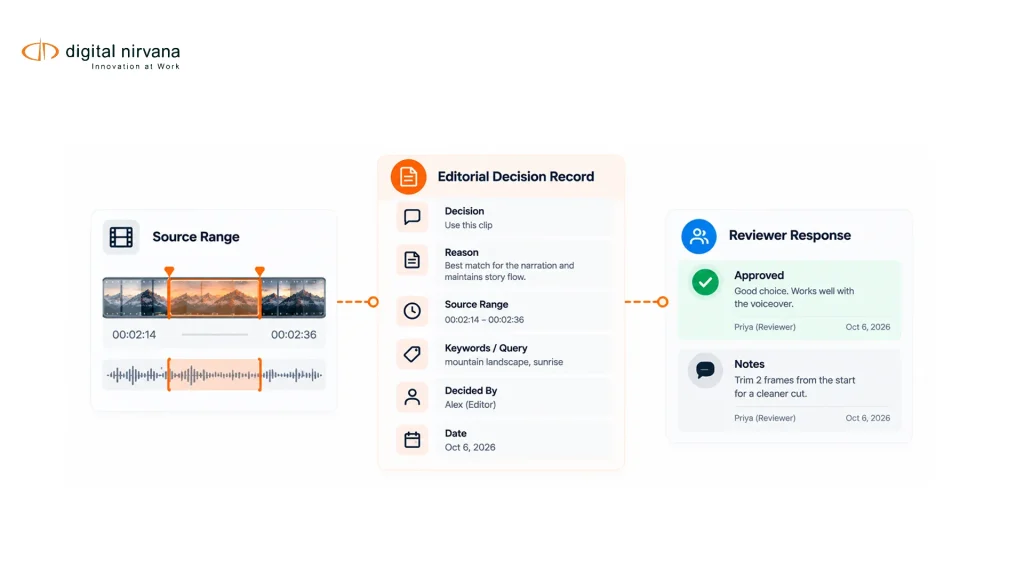
Asset Management: The producer selects a clip. The system shows:
- Where it lives (which system)
- Full metadata (speaker, location, date, duration)
- Where else it appears (this interview shows up in 7 different stories)
- Recommendations (similar content, related stories)
Workflow: Producer pulls clip. It’s automatically available to editors, graphics team, and social media. No manual handoff. Metadata flows with the asset automatically. Everyone sees consistent information.
Archival: The story airs. The asset is automatically tagged with which broadcast it appeared in, when it aired, and how it was used. This enriches the metadata for future reference. Next time someone searches, they’ll see “this footage was used in XYZ story on [date]” as context.
This isn’t theoretical. This is how modern broadcast operations work when PAM integration is done right.
Why Grass Valley Integration Matters (And How It Gets Done)
Grass Valley is a strategic partner for modern broadcast operations, and their systems are often the central hub of playout workflows. But Grass Valley systems generate different metadata than Avid. Different asset structures. Different search dialects.
The integration challenge: Connect Avid production to Grass Valley playout without losing metadata in translation.
The solution: MetadataIQ includes Grass Valley integration. It speaks both languages. Avid metadata gets translated to Grass Valley format. Grass Valley playout data gets indexed for search. Graphics and effects stay in sync across both systems.
This matters because most broadcast operations use both:
- Avid for editorial production (creating stories)
- Grass Valley for playout (broadcasting them)
If metadata stops at Avid, you lose searchability on Grass Valley content. If metadata only lives in Grass Valley, archived Avid projects go dark. The integration has to span both.
How Digital Nirvana Powers Broadcast PAM Integration
This is where broadcast operations actually solve the problem: with metadata intelligence that connects all their systems.
MetadataIQ is built specifically for broadcast workflows:
- Connects to Avid Media Composer, Grass Valley, MAM systems, and archive platforms
- Automatically extracts metadata from video (speakers, locations, topics, time codes)
- Generates searchable transcripts from audio
- Tags everything consistently across all sources
- Provides a single search interface across all systems
MediaServicesIQ adds AI capabilities:
- Facial recognition (identifies speakers automatically)
- Scene description (what’s actually happening in the footage)
- OCR (reads text on screen)
- Music identification (what’s playing in the background)
- Logo detection (which brands appear)
TranceIQ provides the foundation:
- Auto-transcription of all broadcast audio
- Time-coded transcripts (you can search and jump to exact moments)
- Multilingual support (international broadcasts, international teams)
- Caption generation for broadcast compliance
Cloud Engineering ensures the infrastructure:
- Metadata index scaled to handle thousands of hours of content
- Real-time search across all integrated systems
- Backup and redundancy (broadcast can’t afford downtime)
- Security and compliance (broadcast content is valuable)
Data Intelligence provides insights:
- Which assets are most reused
- Which content drives the most stories
- Archive value measurement
- Content lifecycle intelligence
Together, these capabilities transform PAM from “fragmented nightmare” to “integrated competitive advantage.”
Real Broadcast Example: Before and After Integration
The Setup: A major metropolitan news operation. 120 stories per week. Newsroom split between Avid (production) and Grass Valley (playout). Archive of 8 years of content (never searched because it’s too hard). Three vendors, three different systems, zero integration.
Before Integration:
- Asset search: 15-20 minutes average (checking multiple systems manually)
- Archive reuse: <5% (content exists but it’s hidden)
- Breaking news response: 30+ minutes to gather archival context
- Metadata quality: Inconsistent (70% complete across systems)
- Staff frustration: High (everyone wastes hours searching)
After Integration:
- Asset search: 45 seconds average (one interface, all systems)
- Archive reuse: 35% (content is found and repurposed constantly)
- Breaking news response: 5 minutes (archive is instantly available)
- Metadata quality: 98%+ complete (AI generates what’s missing)
- Staff efficiency: Hours freed up per week per person
- Production quality: Better stories (more time on storytelling, less time searching)
The Economics:
- 120 staff spending 2 hours/week on search = 240 hours/week = 12,500 hours/year
- Cost of that time: $300K+/year
- Integration cost: $150K (one-time) + $50K/year (maintenance)
- ROI: Breaks even in 6 months, then saves $250K+/year indefinitely
- Plus: Better stories, faster response, asset library leverage
The Strategic Importance of PAM Integration in Broadcast
Here’s what separates winning newsrooms from also-rans: asset intelligence.
The newsroom that can find footage in 30 seconds instead of 20 minutes has a competitive advantage. They respond faster to breaking news. They produce more stories per day. They reuse archive instead of re-shooting. They’re leaner, faster, sharper.
This isn’t hypothetical. This is how broadcast competition is won and lost.
The newsrooms that integrate their PAM systems are the ones that thrive. The ones that don’t are slowly losing relevance.
Key Takeaways
- PAM integration solves the “I know we have it but can’t find it” problem. Proper metadata indexing across all systems makes assets discoverable instantly.
- Manual metadata is the enemy. AI-powered metadata generation is consistent, complete, and accurate in ways humans can’t be.
- Avid and Grass Valley integration is possible. Both systems speak compatible metadata language. They don’t have to operate in isolation.
- Archive becomes valuable only when it’s searchable. An 8-year-old archive of unsearchable content is just storage cost. The same archive with proper indexing becomes a production accelerator.
- Search is the user experience, not the system. Producers don’t care about integration architecture. They care about finding what they need in 30 seconds instead of 20 minutes.
- ROI is real. Better stories, faster response, fewer re-shoots, more archive reuse. The business case pays for integration in months.
- Breaking news moves fast. The newsroom that can access historical context instantly has a competitive advantage. That’s powered by PAM integration.
Ready to Integrate Your PAM System?
Whether you’re running a major newsroom, a broadcast station group, or a regional operation, PAM integration changes everything. Asset discovery, workflow speed, content quality, and production efficiency all improve when your systems are truly connected.
Explore MetadataIQ to see how broadcast operations are integrating their Avid, Grass Valley, and archive systems into one searchable ecosystem.
Let’s talk about your PAM strategy.