For most of the last decade, metadata automation was framed as a search problem. Tag footage, make it findable, save editors time. That framing was accurate, but it undersold what’s actually happening now.
Metadata automation is quietly becoming something bigger: an active control layer sitting underneath media operations, not just a search index sitting on top of them. It’s starting to trigger workflows, route content, flag compliance risk, and feed decisions in real time, not just answer “where’s that clip.” Understanding where this is headed matters more than understanding where it’s been, because the organizations building for that shift now are the ones who won’t be scrambling to catch up in two years.
Why “Just Search” Was Always an Underselling of the Technology
Manual logging and basic tagging solved a real, immediate pain: finding footage. But treating metadata as purely a discoverability tool missed what becomes possible once metadata is generated consistently, accurately, and at the volume AI actually enables.
Once a system understands what’s inside every piece of content, at ingest, in real time, that understanding doesn’t have to stop at search. It can trigger the next step in a workflow automatically. It can flag a compliance risk before a human ever reviews the footage. It can route content to the right platform or team based on what it actually contains, not based on a producer manually tagging it after the fact. Search was the first, most obvious use case. It was never the ceiling.
The Shift From Passive Tagging to Active Workflow Triggers
The next phase of metadata automation isn’t about generating richer tags. It’s about connecting those tags directly into operational decisions, without a human sitting in the loop for every routine step.
A practical example: instead of metadata simply describing that a clip passed quality control, the system can use that same metadata to automatically trigger the next production step, transcoding, routing, or publishing, without someone manually checking a box first. The metadata isn’t just descriptive anymore. It’s functional, actively directing what happens next in the pipeline.
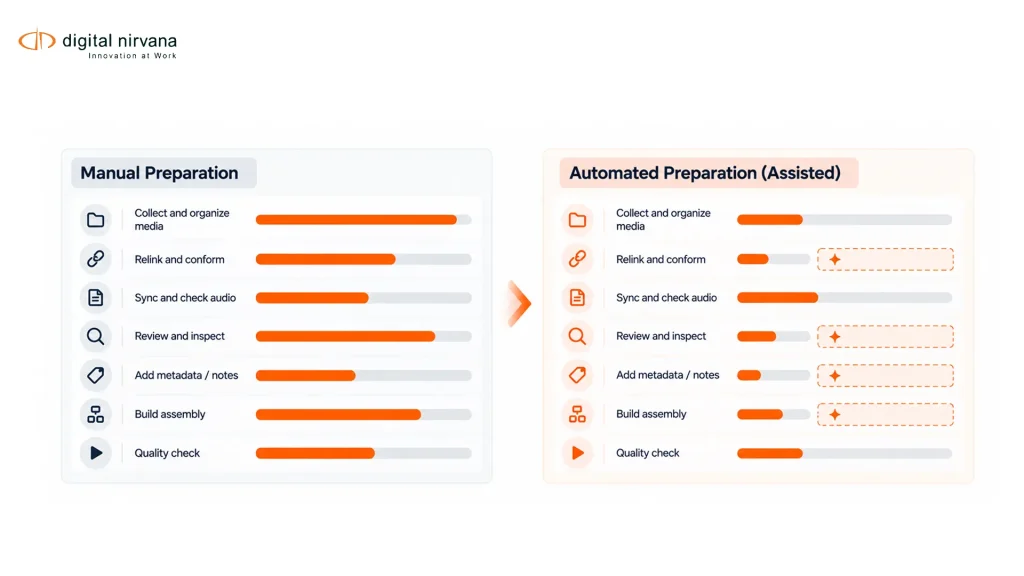
This matters because it removes a category of manual coordination that used to require a person watching for status changes and manually initiating the next task. As metadata accuracy and confidence scoring improve, more of that coordination work can shift from human oversight to automated triggering, with humans reviewing exceptions rather than approving every routine step.
Metadata as a Compliance Early-Warning System
One of the clearer signs of where this is headed shows up in compliance-sensitive content handling. Rather than compliance review happening as a separate downstream step after content is produced, metadata-driven rules engines are starting to flag sensitive content, political ad disclosures, brand mentions, specific faces or logos, the moment that content is ingested.
That shift moves compliance from a bottleneck late in the workflow to a check that happens continuously, in parallel with production, rather than blocking it. Teams get flagged issues in near-real time instead of discovering a problem during a final review pass, when it’s far more expensive and disruptive to fix.
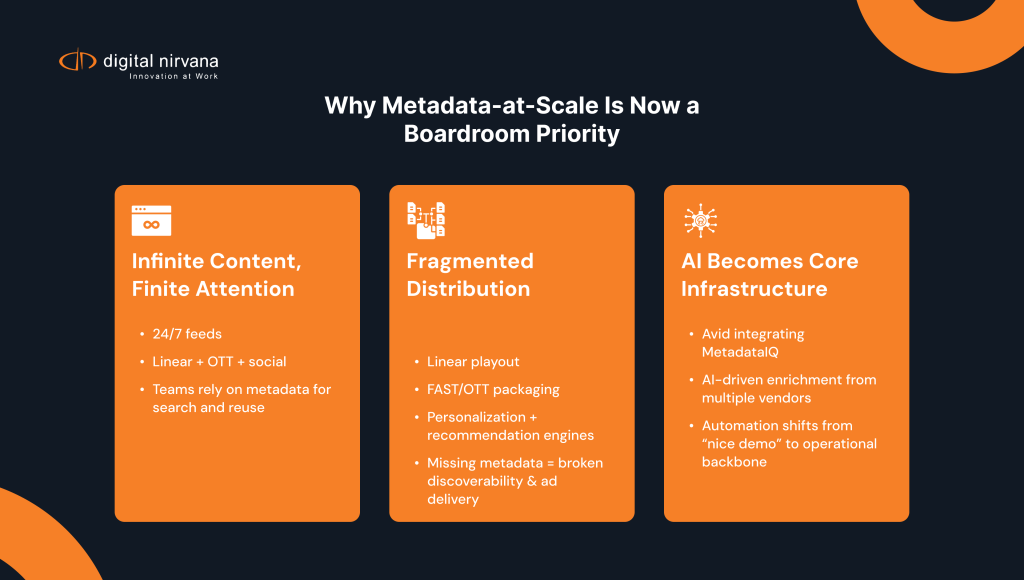
Why Metadata Needs to Get “Active,” Not Just Accurate
A subtle but important distinction is emerging in how the industry talks about metadata quality: the difference between metadata that’s accurate at the moment it’s created, and metadata that stays accurate and useful as content moves through its full lifecycle.
Active metadata updates as new versions, proxies, or high-resolution files arrive, preventing the kind of stale links and broken references that quietly erode trust in a media library over time. This matters more as workflows get more automated, since a system triggering the next step based on metadata needs that metadata to reflect current reality, not a snapshot from ingest that’s since gone stale.
The Governance Layer That’s Becoming Non-Negotiable
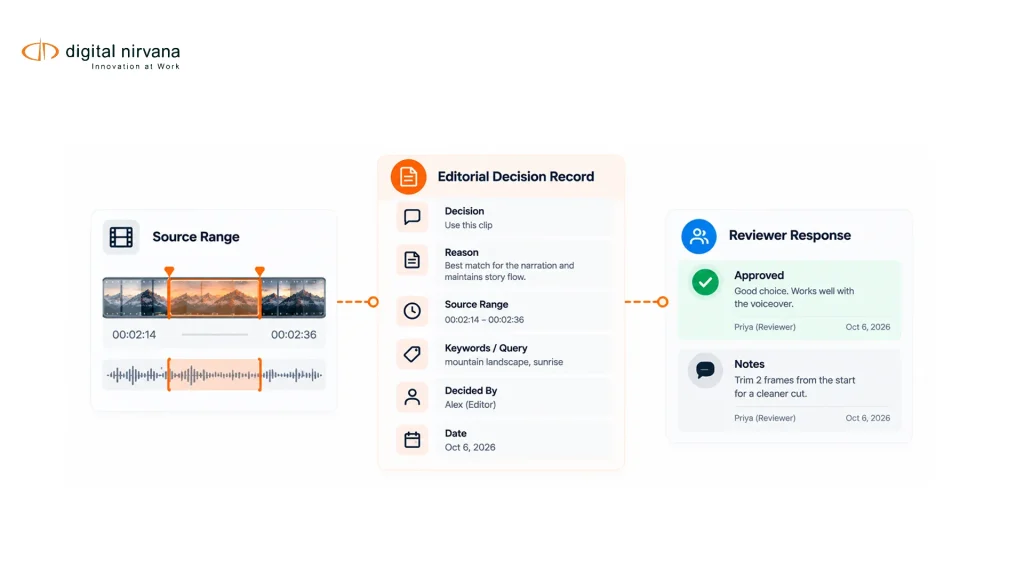
As metadata takes on more operational weight, driving workflow triggers and compliance decisions, the governance question stops being optional. Organizations scaling metadata automation are increasingly building in audit logs that capture who changed what and when, business glossaries that keep terminology consistent across teams and shows, and automated quality checks that catch metadata drift before it compounds across a growing library.
This isn’t bureaucratic overhead for its own sake. Once metadata is directly triggering production and compliance decisions, an inconsistent or unaudited metadata layer becomes a real operational risk, not just a search inconvenience. Governance is what keeps metadata trustworthy enough to actually rely on for automated decisions, not just descriptive enough to be searchable.
Where This Is Heading: Metadata as Shared Infrastructure, Not a Departmental Tool
Historically, metadata often lived within whichever team generated it first, editorial tags in one system, compliance flags in another, ad sales data somewhere else entirely. The direction media operations are moving now treats metadata as shared infrastructure that multiple departments draw from and contribute to simultaneously.
Editorial teams search by person, quote, or object and jump directly to relevant moments. Promotions and social teams pull verified clips from the same shared repository rather than requesting a separate export. Ad sales validates brand and logo appearances using the same underlying detection that powers editorial search. Compliance runs checks inside the same workflow instead of a separate downstream process. One metadata layer, multiple teams drawing real-time value from it, rather than each department maintaining its own disconnected tagging effort.
The Compounding Effect Nobody Talks About Enough
Here’s a detail that gets underemphasized: metadata automation doesn’t just deliver a one-time efficiency gain when it’s implemented. It compounds, because active metadata improves with use.
As more content moves through a well-governed metadata system, taxonomies get refined, confidence scoring improves based on real review outcomes, and the archive itself becomes progressively more valuable and more searchable, not just larger. Organizations that treat this as a long-term infrastructure investment, rather than a one-time tagging project, are the ones who see that compounding value actually materialize, often showing up as measurable improvements in speed and reduced rework within the first quarter and continuing to build from there.
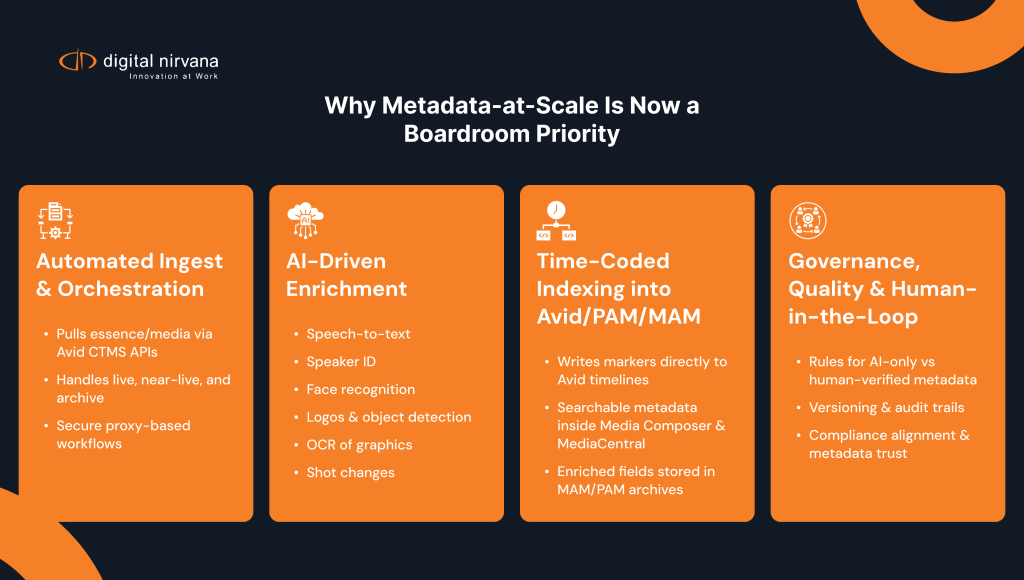
What “At Scale” Actually Requires
Getting metadata automation to genuinely operate at scale, across millions of assets and years of archive, requires a few structural things most point solutions weren’t built to handle.
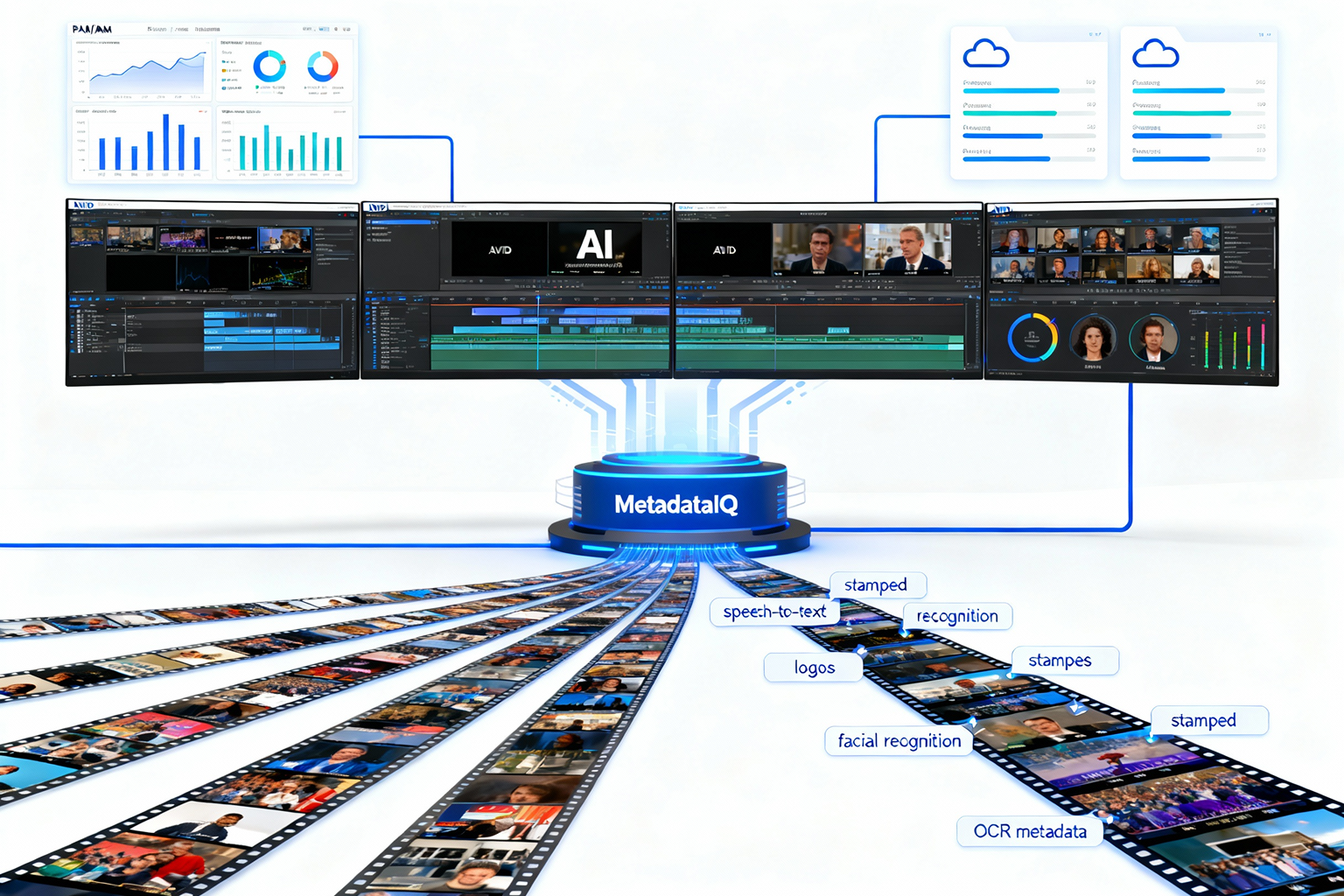
Catalog and governance layers need to scale without forcing a data structure reset every time volume grows significantly. Systems need to support both batch processing for legacy archives and real-time processing for live content simultaneously, since most media operations need both running at once. And integration needs to happen inside existing PAM, MAM, and production environments, rather than requiring teams to adopt an entirely separate interface, since asking editors and producers to change how they work is often the single biggest barrier to actual adoption.
A Realistic Path for Getting There
Organizations that successfully move toward this more active, workflow-integrated model of metadata rarely do it in one leap. A practical path tends to look like starting with one high-impact workflow, connecting it to an AI metadata platform, and using early results to identify the next automation opportunity, rather than attempting to redesign every workflow simultaneously.
From there, expanding coverage to additional channels, genres, or archive collections happens incrementally, guided by what the data actually shows about impact, rather than a fixed rollout timeline decided in advance. This mirrors how most durable infrastructure investments succeed: proving value in a contained scope before scaling the approach organization-wide.
Key Capabilities That Matter for Where This Is Headed
- Metadata generation fast and reliable enough to trigger downstream workflow steps automatically
- Rules engines that flag compliance-sensitive content at ingest, not in a separate review pass
- Active metadata that updates as new versions or files arrive, preventing stale references
- Audit logs and governance tooling built in from the start, not bolted on after scale becomes a problem
- Shared access across editorial, compliance, ad sales, and promotions teams from one metadata layer
- Support for both batch archive processing and real-time live content simultaneously
Addressing the Skepticism
“This sounds like it’s replacing human judgment in production decisions.” It’s shifting where human judgment applies, from routine, repetitive coordination to exception handling and genuine decision-making. Humans still set the rules, review flagged exceptions, and make the calls that require actual judgment.
“Our metadata is already decent, do we need to think about this yet?” Decent, accurate metadata is the prerequisite for everything described here, not a separate track. The organizations positioned to benefit from workflow-triggering metadata are the ones who already have a solid, governed metadata foundation to build on.
“This feels like a lot to plan for all at once.” It is, which is exactly why a phased, one-workflow-at-a-time approach tends to work better than attempting a full redesign. The future direction matters for planning purposes, but the path there is incremental.
How Digital Nirvana Is Built for This Direction
MetadataIQ is designed around exactly this trajectory, generating metadata that integrates directly into existing PAM, MAM, and workflow systems, with governance dashboards, audit-ready logs, and rules engines built to support compliance-sensitive content handling at ingest rather than as an afterthought.
For organizations building the transcription and speech-data foundation that powers this active metadata layer, TranceIQ provides that base, while MediaServicesIQ extends the visual detection signals, faces, logos, objects, that feed into workflow-triggering rules. Broadcasters connecting this to real-time compliance monitoring often pair it with MonitorIQ.
Why This Matters for Media Leaders Planning Past the Next Quarter
The organizations that treat metadata automation as a search convenience will keep getting search convenience. The ones treating it as infrastructure, an active layer that triggers workflows, flags risk early, and compounds in value as it scales, are building toward a materially different operational model, one where routine coordination work shrinks and human attention concentrates on genuine exceptions and decisions.
That shift doesn’t happen through a single platform purchase. It happens through consistent investment in accuracy, governance, and integration over time. Digital Nirvana’s success stories show media organizations already several steps into that shift, using metadata as shared infrastructure across editorial, compliance, and revenue teams rather than a siloed tagging tool.
Conclusion
Metadata automation started as a way to make footage searchable, and that’s still valuable. But the real trajectory points somewhere bigger: an active, governed layer that triggers workflows, flags compliance risk in real time, and gets more valuable the more content flows through it. Media organizations planning their next few years of workflow investment should be building toward that direction now, not treating today’s search improvements as the finish line.
Key Takeaways
- Metadata automation is shifting from a passive search tool to an active layer that triggers workflow steps directly
- Compliance-sensitive content flagging is moving from a downstream review step to a real-time, at-ingest check
- Active metadata that updates as content changes prevents the stale links that erode trust in automated workflows
- Governance, audit logs, and business glossaries become essential once metadata drives operational decisions, not just search
- Metadata value compounds over time as taxonomies refine and confidence scoring improves with continued use
- A phased rollout, starting with one high-impact workflow, is the realistic path toward this more integrated model