The volume of video content produced today is increasing rapidly, and most organisations struggle to manage it. A study shows that video is expected to account for more than 82% of all internet traffic, underscoring its dominance across industries. From round-the-clock news broadcasts to regulatory recordings, teams are sitting on a large volume of long-form video that often goes underutilised.
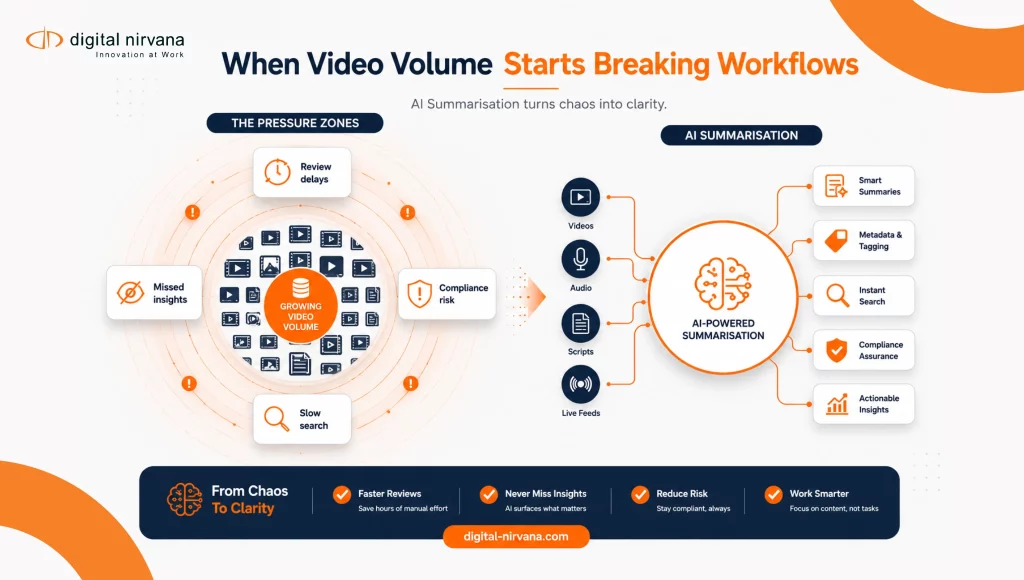
This is where AI video summarisation becomes a vital factor. By automatically considering long videos for significant insights, organisations can achieve faster decision-making, enhanced compliance, and better content searchability.
Solutions like MetaDataIQ from Digital Nirvana are planned to go beyond basic summarisation by integrating AI-driven media services with intelligent metadata, helping organisations transform the manageability and use of video content at scale.
What is AI Video Summarisation?
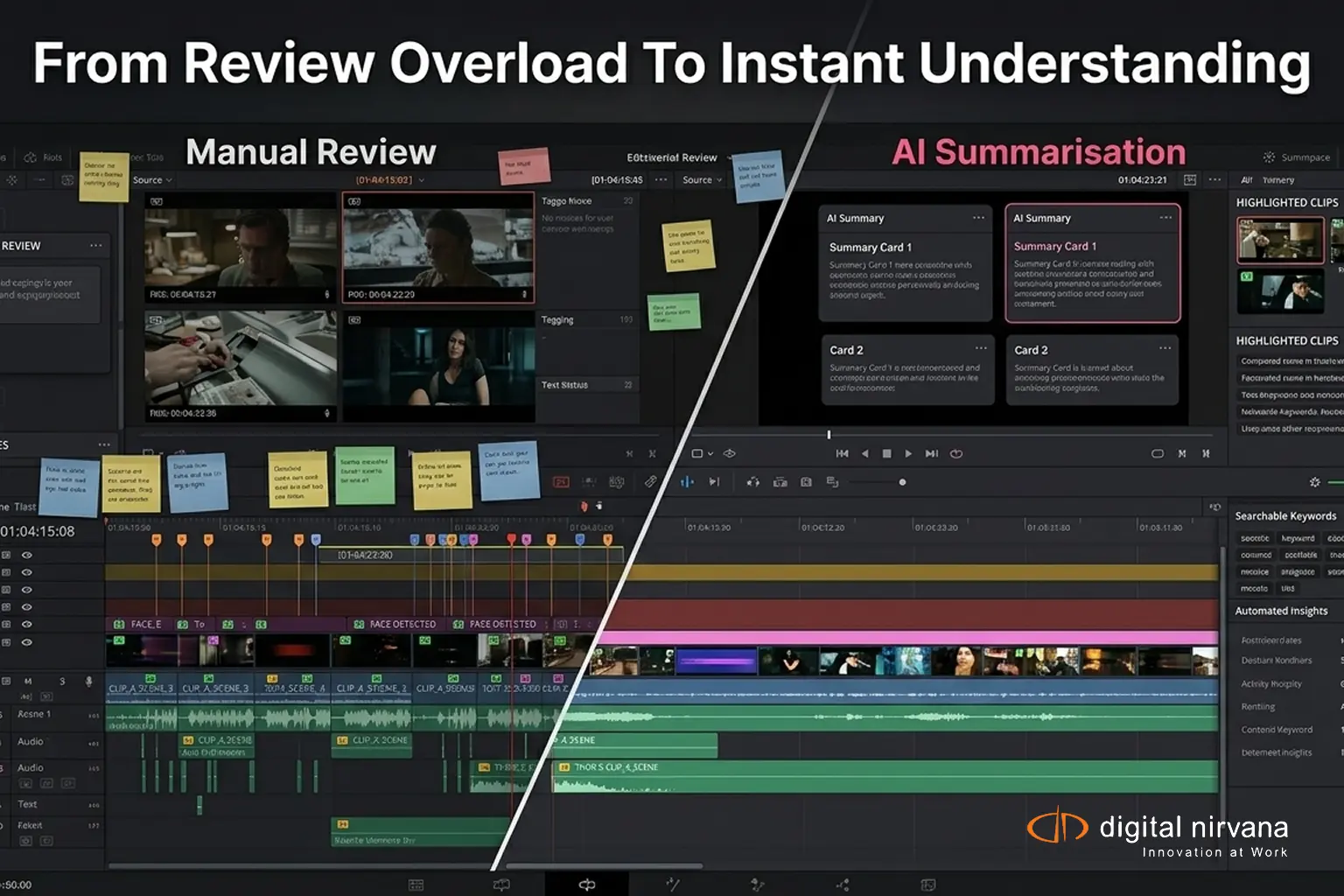
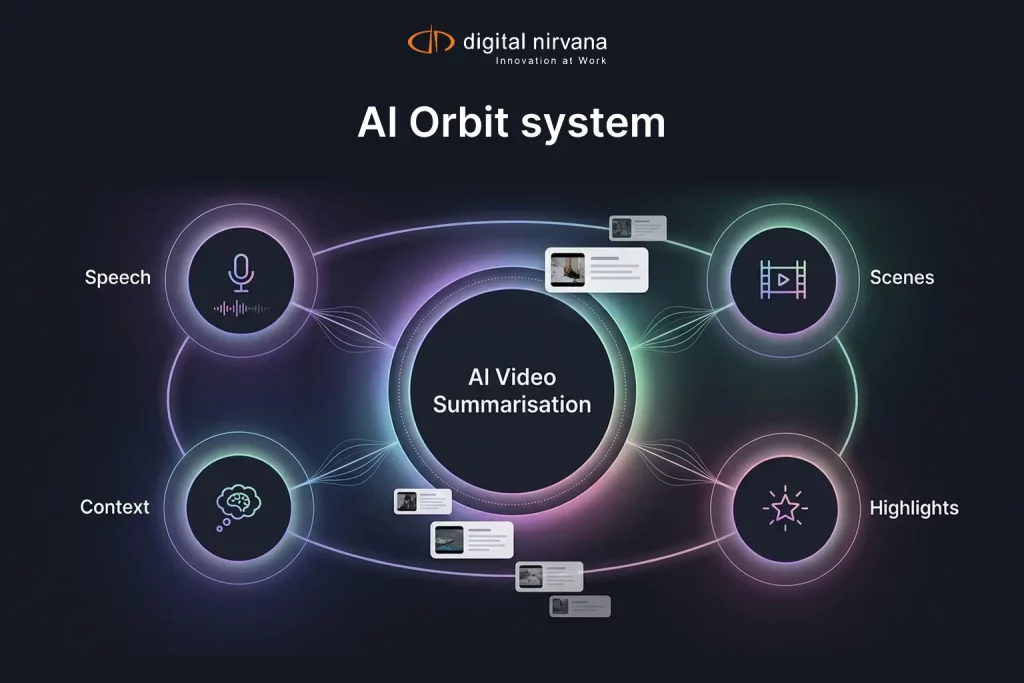
AI video summarisation uses machine learning algorithms to analyse audio and visual cues in a video and generate a concise, digestible version. It discovers vital scenes, detects changes in audio or visuals, and identifies important dialogues or actions. It is not just about saving time, but also about summarising important moments that often go unnoticed.
Why Long-Form Video is Hard To Manage?
The long-form videos exceed five minutes and consist of a single video. These types of videos include more in-depth explanations or stories and a high level of audience engagement. It allows us to discover how cloud engineering solutions help scale video processing and manage large volumes of media efficiently. However, having these advantages, the long-form video is hard to manage because:
- Less completion rates
Keeping viewers’ attention for a lengthy period can be challenging.
- Huge production costs
Huge demand for shooting, editing, and scripting needs more resources and time.
- Inadequate platforms
Not all the platforms are optimised for long-term content.
Uses In News, Compliance, and Archives
AI-driven video summarisation transforms how broadcasters handle vast archives and compliance workflows. It enables quick extraction of relevant clips, ensures regulatory adherence, and accelerates news production by identifying and indexing critical segments in real time.
- Newsrooms
In news environments, speed is everything. Be it interviews, press briefings, or live feeds, journalists must instantly highlight key moments.
With AI Video Summarisation, editors can get real-time highlights to easily generate clips, teasers, and other digital content.
- Compliance Monitoring
Regulatory compliance requires organisations to actively review and monitor broadcast content for violations, disclaimer statements, and legal requirements.
With the help of AI-powered summarisation, compliance teams can quickly flag content for review and reduce exposure risk across large volumes, and understand how broadcast monitoring solutions ensure regulatory compliance through real-time signal tracking and alerts.
- Archive Management
Learn how media enrichment solutions enhance archived video content with metadata for better search and reuse. Media archives often contain years of valuable content that remain underutilised due to poor indexing.
Video summarisation combined with metadata tagging allows organisations to rediscover and repurpose archived content, turning static storage into active assets.
How AI Video Summarisation Works?
AI summarisation is not fictitious; it is a combination of well-planned technologies. Here are the steps that show how the AI video summarisation works.
- Automatic speech recognition
The initial step is to listen and transcribe. The automatic speech recognition converts spoken words into a text transcript. Transcription quality is the foundation of the summary; if the words are misheard, the summary will also be inaccurate. This will help you to witness how advanced transcription, captioning, and subtitling solutions improve the accuracy and accessibility of video content.
- Computer vision
Once the audio is transcribed, the next step is to watch and analyse. The computer-vision algorithms analyse the video frame by frame. They detect changes in scenes, read on-screen text, and identify objects and faces. This step helps AI capture vital information that isn’t spoken, such as diagrams or product labels.
- Natural language processing
Lastly, NLP integrates the transcript with visual cues to identify the main arguments, recurring themes, and takeaways. Explore how data intelligence solutions transform unstructured video data into actionable insights. The system compresses this information into an understandable summary, with bullet points and clickable timestamps for quick navigation.
Benefits Of AI Video Summarisation
AI Video Summarisation offers several advantages. Discover how managed AI services help organisations automate workflows and scale intelligent video processing efficiently.
- Time savings
Compress hours of footage into a precise summary without missing the essential points.
- Enhanced focus
Emphasise vital moments and insights, and enable teams to concentrate on decisions rather than fast-forwarding the video.
- Scalability
AI scales efficiently; whether you have a single video or multiple, the summary process remains consistent.
- Accuracy
Machines do not get tired; AI summarises the subtle but vital details that humans might otherwise ignore.
- Compliance
It automatically identifies key segments for compliance officers and auditors.
Common Challenges And Content Gaps
The common challenges are as follows:
- Missing content
A common challenge of the content gap is the non-existence of the content. In the search analytics tool, search for queries that return no results. Then look at the keyword the user was searching for when it happened.
- Irrelevant information
Content that is no longer accurate or relevant leads to high bounce rates.
- Lack of in-depth content
Content that exists but is not as comprehensive as competitors, lacks specifics, instances, and data.
- Avoiding user intent
Content creation that does not answer the particular question behind the search query.
These challenges show how AI and ML-based media services resolve content gaps by enhancing metadata accuracy and contextual understanding.
Best Practices for Video Summarisation
The best practices for a video summarisation include:
- Make summaries goal-oriented
Customise for your audiences, internal update, client recap, or training follow-ups.
- Use timestamps
Help audiences jump to the relevant moments.
- Combine video and text
Provide both summary formats to incorporate learning preferences.
- Ensure privacy and permissions
Use internal access settings for sensitive content.
- Review before sharing
Review AI summaries for the accuracy of context.
How MetaDataIQ Improves Video Summarisation?
Organisations working with large-scale video operations, summarisation is not enough. The real value depends on the speed at which the content can be understood, searched, and acted upon. Here comes MetaDataIQ, developed by Digital Nirvana, as a more workflow-driven approach to AI video summarisation.
- It combines AI Video Summarisation with advanced metadata generation, ensuring that every piece of content is not only summarised but also structured for easy access.
- The platform integrates with existing broadcast and media workflows, allowing organisations to automate processes without disruption.
- With its scalable architecture, MetaDataIQ supports high-volume environments such as newsrooms and compliance operations, delivering consistent, reliable results.
- MetaDataIQ summarises existing PAM and MAM systems to produce content that fits directly into current workflows.
Unlike manual processes, which vary from person to person, MetaDataIQ provides standardised summaries across huge volumes of content. It improves accuracy, minimises oversight, and ensures oversight of critical information.
It is used to condense long videos into shorter, meaningful summaries for faster review and better content utilisation.
Accuracy depends on the quality of AI models and metadata integration. Advanced platforms provide highly reliable results.
It supports human editors by reducing workload but does not replace editorial judgment.
Yes, it helps identify relevant segments quickly, improving monitoring efficiency and reducing risk.
Yes, the more advanced an AI system is, the better it can process and summarise content in multiple languages. This is particularly beneficial to global broadcasters and organisations that deliver varied video content.
It eliminates the time taken in reviewing videos manually and analysing content. It allows teams to concentrate on decision-making and creative tasks rather than repetitive processes.
Yes, many modern solutions support near-real-time summarisation of live streams. This allows faster highlight creation and immediate content insights.
Industries such as media and entertainment, legal, education, and corporate enterprises benefit significantly. Any organisation dealing with large volumes of video content can improve efficiency and insights.
Conclusion
AI video summarisation is not only an option for organisations dealing with large volumes of video content. It has now become a foundational capacity that delivers efficiency, strength, compliance, and allows smarter content utilisation.
By integrating advanced summarisation with strong metadata intelligence, Digital Nirvana offers a more complete and scalable approach through the MetaDataIQ platform. It is designed for real-world broadcast, compliance, and archive atmospheres and goes beyond basic automation to offer actionable insights and seamless integration.
Digital Nirvana helps organisations not just manage video with expertise but leverage it as a strategic asset, which, in turn, facilitates better governance and increased content value.
Key Takeaways:
- AI Video Summarisation provides fast, actionable video summaries that save time and manual effort.
- As a result, searching for and archiving relevant content becomes easier and more accurate.
- It strengthens compliance monitoring and accuracy. It improves accuracy and minimises the risk of missing regulatory needs.
- It unlocks value from archived content by transforming it into searchable, reusable content. Organizations can easily repurpose the existing media for new use cases.
- Integrated platforms like MetaDataIQ deliver end-to-end efficiency by combining summarisation, metadata, and automation into a single system and providing global reach.