It’s 7:43 AM on a Tuesday. A morning show is live. Fifteen minutes in, a guest tells a joke that crosses a line. Not subtly. Not in a way that’s open to interpretation. In a way that’s clearly offensive.
The studio audience goes quiet. The host freezes for a beat. The phones at the FCC start ringing by 7:48 AM.
By 9 AM, the station has received 847 complaints. By noon, it’s 4,200. By end of business, it’s national news. The parent company is issuing apologies. The advertiser is threatening to pull their entire campaign. The host is suspended. The compliance officer is getting calls from lawyers.
All of this happened because nobody in the control room was actively monitoring the content in real time.
The engineer was monitoring technical signal. The director was managing the live show. The operations manager was handling logistics. But nobody was actually listening to what was being broadcast and ready to intervene when things went sideways.
This is the story of modern broadcast monitoring, and it’s more critical (and more ignored) than almost any other operational function in television.
Why Content Monitoring Became a Crisis Nobody Saw Coming
Fifteen years ago, broadcast monitoring was straightforward. A compliance officer watched the feed. If something seemed problematic, they made a note. Problems were rare because content was pre-screened, guests were vetted, and live television was genuinely shocking.
Then everything changed.
Social media made every incident viral instantly. Cancel culture made every mistake existential. Guest screeners started working remotely with less vetting. Live programming expanded. News cycles got tighter. Budget cuts meant fewer people watching fewer monitors.
Meanwhile, regulatory pressure actually increased. The FCC didn’t lighten up on content standards. They actually got more aggressive. Indecency fines. Public file requirements. Harassment of broadcasters over offensive content. The regulatory burden kept growing even as stations cut staff to handle it.
And then there’s the advertiser problem. Major brands have zero tolerance for association with offensive content. A single problematic moment and they pull campaigns. A single viral clip and they abandon the station entirely. The financial risk of a single bad moment is now in the millions.
So here’s the crisis: broadcast operations became riskier, regulatory oversight became stricter, and resources to manage it all got tighter. Something had to give.
What gave was active monitoring. Most broadcasters stopped systematically watching their own content in real time and just hoped nothing went wrong.
That strategy works until it doesn’t. And when it doesn’t, it’s catastrophic.
The Compliance Minefield Nobody Talks About
Let’s be specific about what broadcasters are actually liable for.
In the United States, the FCC has broad indecency standards. Content that’s “patently offensive,” that depicts sexual conduct in a way that’s “pandering,” and that lacks “serious literary, artistic, political, or scientific value” can trigger fines and license challenges. The FCC doesn’t have to prove intent. They just have to prove it was broadcast.
If your station airs offensive content, you pay fines. Those fines range from $10,000 to $350,000+ per incident. Multiple incidents and you’re looking at six figures in penalties.
But the financial hit isn’t just the fine. It’s the advertiser exodus. It’s the public relations crisis. It’s the license renewal challenge. It’s the brand damage that lasts for years.
Add to this the regulatory burden of maintaining public files, documenting what was broadcast, proving you had monitoring procedures in place. The FCC doesn’t care if you didn’t catch the problem. They care that you didn’t have systems to catch problems.
Here’s what most broadcasters don’t realize: when you’re audited, the FCC doesn’t ask “did you monitor content?” They ask “where are your monitoring procedures?” If you can’t show documented procedures, you look negligent. That’s worse than missing one thing. That’s suggesting you never even tried.
This isn’t theoretical. Broadcast stations are being fined and challenged over content that aired years ago, sometimes by new management that inherited the problem.
The Technical Dimension That Kills You Silently
Content monitoring isn’t just about catching offensive material. It’s also about catching technical failures that degrade content.
A commercial break has audio that cuts in and out. A video feed loses sync. A graphic displays incorrectly. A low-resolution feed gets broadcast by accident. A closed caption is missing or wildly inaccurate.
These aren’t compliance violations, but they’re quality problems. And quality problems accumulate. After a month of occasional audio glitches, viewers stop trusting the station. After a season of caption errors, accessibility advocates start complaining. After a year of technical issues, the station develops a reputation for being sloppy.
This affects viewership. It affects advertiser confidence. It affects your ability to win premium accounts.
Most broadcast operations have monitoring for signal quality (QoE monitoring). But signal quality and content quality are different things. You can have a perfect signal that carries terrible content. You can have technically flawless delivery that includes a mistake that costs you millions.
Real broadcast monitoring catches both.
Understand how QoE monitoring and content compliance work together to protect broadcast operations.
The Story That Haunts One Regional Network
A six-station regional network in the Midwest operated with minimal monitoring. The compliance officer watched the flagship station most days. Other stations got checked sporadically. Budget was tight. Staffing was lean.
One evening, a news report aired on the secondary station. A guest made an on-air reference to a sensitive topic in a way that was arguably defamatory toward a particular group.
Nobody caught it during the broadcast. But a media watchdog group saw it. They filed a complaint with the FCC. The complaint was noticed by a local activist organization. Within 48 hours, it was social media.
The station tried to manage it. They issued a statement. They said the guest misspoke. They said they regretted the comment. It didn’t matter.
The primary advertiser on that station pulled their entire $800,000 annual contract. Two other advertisers reduced spending. The station’s ratings dropped 12% in three months as viewers left for competitors.
The FCC fined the station $25,000.
But here’s the cost that really mattered: the station had to hire a full-time compliance officer ($60,000/year), invest in monitoring infrastructure ($40,000), and implement new procedures (hundreds of hours of labor). The actual incident cost them well over $1 million when you account for lost revenue, fines, and new procedures.
If they’d had systematic content monitoring in place, that single moment would have been caught in real time. The station could have corrected it during the broadcast or made a note that it wasn’t intentional. Problem managed. Damage prevented.
Instead, they learned the expensive way that monitoring isn’t optional.
Why Your Current System Is Probably Not Catching What It Should
Here’s what most broadcast operations are doing for content monitoring: asking a person to watch the feed and take notes.
On paper, this sounds fine. In reality, it’s a disaster waiting to happen.
Human monitoring has massive blind spots. A monitor gets distracted. They’re tired. They step away for five minutes exactly when something problematic happens. They don’t know the context of what they’re hearing (is this character’s dialogue acceptable? Is this guest known for controversy? Is this a repeat offense?). They miss things.
Worse, human monitoring doesn’t scale. As you add channels, as you add programming hours, as you add live content, you need more monitors. And more monitors means more expense, more training, more coordination, and more variability in what actually gets caught.
The cost of hiring enough monitors to cover a multi-channel operation 24/7 is astronomical. So most stations don’t do it. They monitor opportunistically and hope nothing goes wrong.
That’s not a monitoring strategy. That’s just luck.
How Modern Monitoring Actually Works
The teams that are winning right now use something completely different.
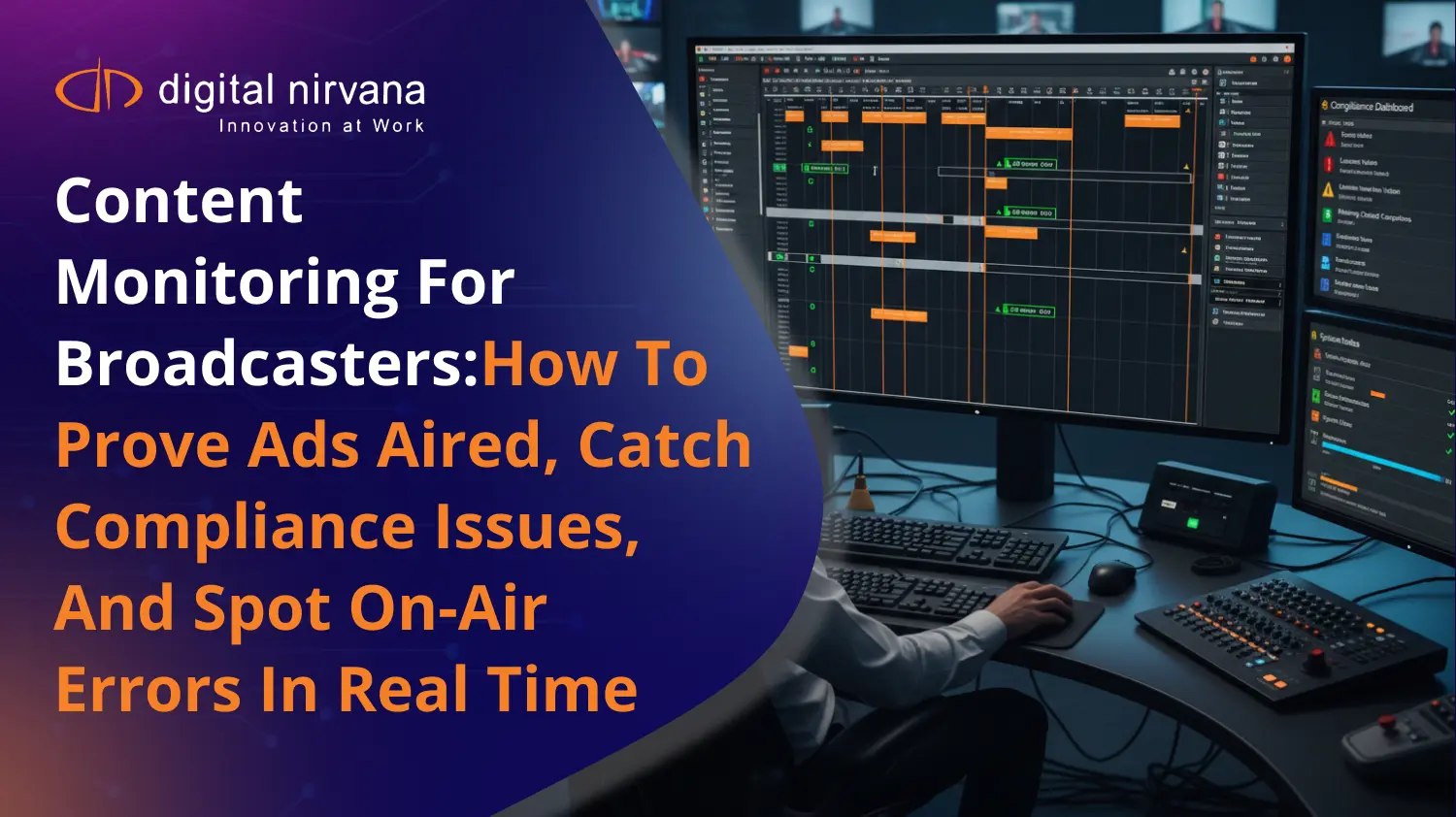
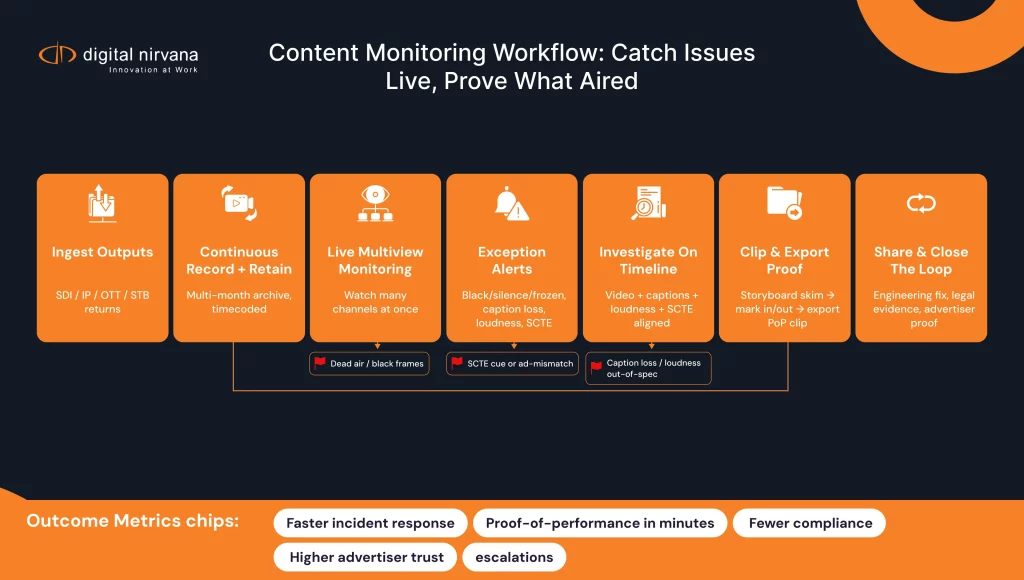
Automated systems monitor content continuously. The system analyzes audio and video in real time. It flags potential problems based on customizable rules: specific words, sudden volume spikes, unusual content patterns, unexpected scene changes.
When something gets flagged, a human reviewer gets an alert immediately. Not hours later. Not after the broadcast ends. In real time, as the content is airing.
The human reviewer watches the flagged moment, confirms whether it’s actually a problem, and if so, communicates with the control room about what should happen next. Mute it? Cut to emergency backup content? Prepare an on-air correction? The decision happens in seconds, not hours.
This hybrid model catches 95%+ of problems while keeping human costs manageable. The AI does the heavy lifting (monitoring everything continuously). Humans do the judgment (deciding what actually matters).
Simultaneously, the system documents everything. Every flagged moment gets logged. Every intervention gets recorded. When (not if) someone asks whether you monitor your content, you can pull documentation showing exactly what you caught and how you handled it.
This transforms compliance from reactive (hoping nothing bad happens) to proactive (documenting that you’re actively managing risk).
The Workflow That Changed Everything for One Broadcaster
A mid-market broadcaster with four stations implemented automated content monitoring last year.
In the first six months, the system flagged 347 moments that required human review. Of those, 23 were genuine concerns (profanity that slipped through, controversial guest statements, technical issues). The team handled all 23 in real time, mostly by being prepared or making minor on-air corrections.
Zero FCC complaints. Zero advertiser issues. Zero compliance violations.
More importantly, the compliance officer went from living in constant anxiety (what did we miss?) to having actual confidence. She had documented proof that the station was systematically monitoring content. She had log files showing what got flagged, when, and how it was handled.
When the FCC called for an audit, she pulled the documentation. “Here’s six months of continuous monitoring. Here’s every flag. Here’s every intervention. Here’s our process. Here’s our training.” The audit took half the time it normally does because the evidence was so thorough.
The station also started using the monitoring data for training. New shows that got flagged frequently? The team reviewed the footage and coached talent. Guests who consistently created problems? The station learned to screen them differently or brief them more thoroughly.
The monitoring system became infrastructure for not just compliance, but actual quality improvement.
Why Content Standards Keep Changing Faster Than You Can React
Here’s something that keeps broadcast managers up at night: what’s acceptable keeps shifting.
Fifteen years ago, certain words were automatically filtered. Today, those words appear in network television sometimes. Cancel culture means that context that used to protect you now doesn’t. A joke that was fine five years ago is now considered insensitive.
The regulatory landscape isn’t stable. The FCC’s interpretation of indecency changes with administrations. What one commissioner considers protected speech, another considers obscene.
This doesn’t mean you can’t operate. It means you have to be systematic, documented, and prepared. You have to be able to show that you’re taking content seriously. That you’re monitoring actively. That you’re making good-faith decisions about what gets broadcast.
Static compliance rules aren’t enough anymore. You need monitoring infrastructure that’s flexible, that improves over time, and that creates documentation of your decision-making process.
That’s not a burden. That’s actually your protection.
The Competitive Advantage Nobody Realizes
Here’s something that’s just starting to matter: broadcast stations with documented content monitoring and QoE monitoring are more attractive to premium advertisers.
A national advertiser considering where to place a $500,000 campaign doesn’t just ask “can you deliver the reach?” They also ask “can you protect our brand?” Stations with documented monitoring infrastructure can answer yes. Stations without it have to hope the question doesn’t come up.
As regulatory pressure increases (and it will), broadcasters without systematic monitoring will become less insurable, less financeable, and less attractive to advertisers. Broadcasters with monitoring will become the premium tier.
This isn’t paranoia. It’s just math. Risk-aware buyers will pay more to broadcast on stations with lower risk. Stations with documented monitoring have lower risk.
Your Monitoring Gap Is Probably Larger Than You Think
If your monitoring is mostly manual, you’re probably not catching 20-30% of actual problems. Not because your team is incompetent, but because human monitoring has inherent limitations. Fatigue, distraction, context blindness, inconsistency.
With automated monitoring, that gap closes to 2-5%.
The difference between 20% and 2% is the difference between occasional disasters and actual compliance.
Why Digital Nirvana Is the Standard for Broadcast Content Monitoring and Compliance
Content monitoring is technically complex, operationally demanding, and existentially important to broadcast operations. Most solutions focus on one element: either technical signal monitoring, or manual content logging, or after-the-fact compliance documentation. None of them integrate the full monitoring requirement into a unified system designed specifically for broadcast risk management.
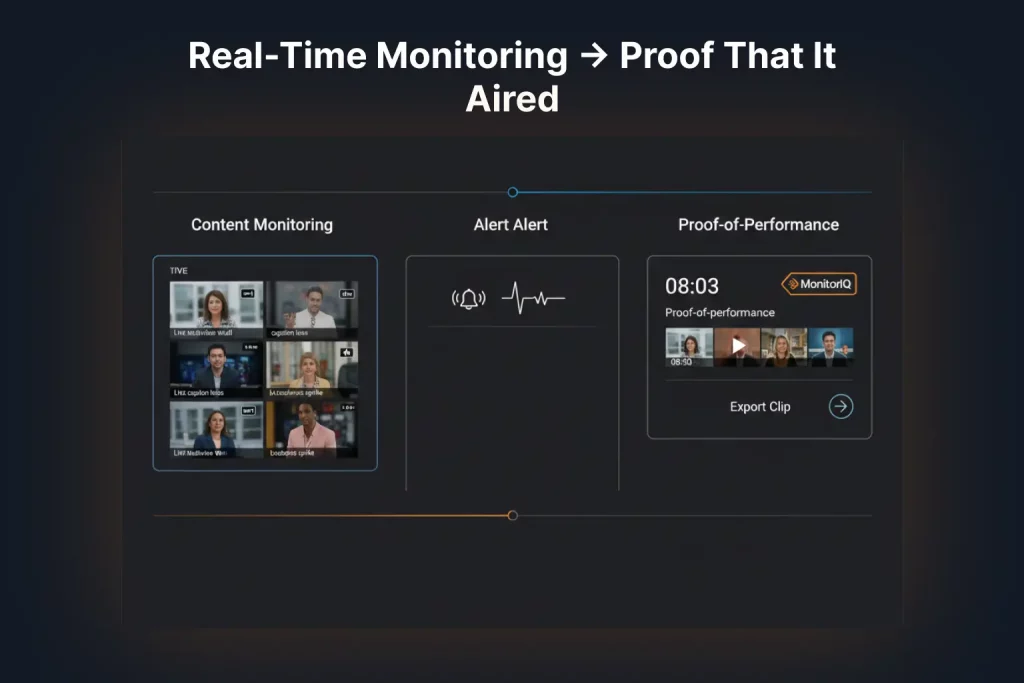
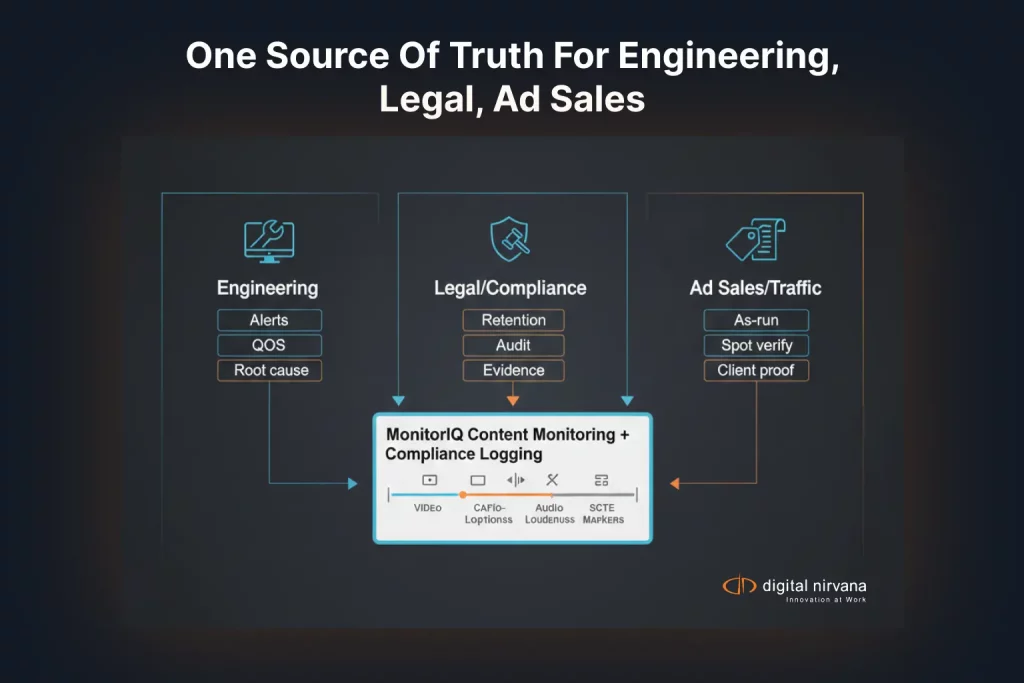
MonitorIQ was built specifically for this. It combines real-time content monitoring, QoE monitoring, compliance logging, and automated flagging into a single unified platform for broadcast operations. Every second of broadcast content is monitored simultaneously for technical quality, compliance concerns, and operational issues. When something needs attention, human operators get an alert immediately, not after the fact. The system creates timestamped documentation of every flag and every intervention, giving you the compliance proof that regulators demand and that auditors expect.
For broadcasters managing multiple channels or complex programming schedules, MonitorIQ’s integration with broadcast automation systems allows coordinated monitoring across your entire operation. Some stations also benefit from Media Enrichment’s managed monitoring services, which extend monitoring expertise across your operation with human analysts who specialize in broadcast compliance. Additionally, AI-powered content detection through MediaServicesIQ can identify specific content issues (profanity, violence indicators, sensitive topics) with machine learning precision, enabling you to customize monitoring rules for your specific brand and regulatory environment.
The result is predictable: FCC compliance becomes demonstrable rather than aspirational. Brand protection becomes systematic rather than accidental. Staff confidence increases because they know what’s being watched and why. And when regulators call, you pull documentation instead of explanation. That shift from hoping nothing goes wrong to proving you’re managing everything transforms your risk profile entirely.
FAQ
Q: Is content monitoring required by the FCC?
The FCC doesn’t explicitly mandate continuous monitoring, but they require broadcasters to have procedures for ensuring compliance with broadcast standards. When they audit, they ask whether you have documented monitoring processes. If you can’t show processes, you look negligent. If content violations occur, the FCC assumes you should have caught them with proper monitoring procedures.
Q: What’s the difference between content monitoring and technical signal monitoring?
Technical monitoring (QoE monitoring) checks whether the broadcast signal is clean, audio is at correct levels, video is properly compressed, and technical specs are met. Content monitoring checks what’s actually being broadcast for compliance issues, quality problems, and brand-safety concerns. You need both.
Q: Can automated monitoring catch everything?
No system catches 100% of problems. But automated monitoring catches 95%+ of issues that trained operators would catch, while eliminating human fatigue and distraction. The goal isn’t perfection. It’s systematic management of risk.
Q: What happens if we get flagged by the FCC?
The FCC can assess fines ranging from $10,000 to $350,000+ per incident. More importantly, they can issue cease-and-desist orders, require you to file detailed compliance documentation, or challenge your license renewal. If you can show that you were monitoring, that you caught most problems, and that any violations were addressed immediately, you’re in much better position.
Q: Does monitoring cost more than the fines we might receive?
Yes. Monitoring infrastructure costs $30,000-$100,000 annually depending on station size. A single FCC fine is $25,000+. A single advertiser exodus is $200,000+. The cost of monitoring is less than the cost of one compliance failure.
Q: Can we just hire more compliance staff instead of buying monitoring software?
You could, but it would be far more expensive and less effective. Hiring five monitors for 24/7 coverage across multiple channels would cost $300,000+ annually. Monitoring software costs $50,000-$100,000 and catches more issues consistently.
Q: What should we monitor for?
That depends on your format and brand standards. Most stations monitor for: profanity, indecency, graphic violence, defamatory statements, regulatory violations, technical issues (audio/video quality), and brand-sensitive content. Some stations customize based on their specific brand values.
Q: How do we respond when the automated system flags something?
You have several options depending on the severity and timing: mute audio if it’s profanity, cut to backup content if it’s a guest issue, prepare an on-air correction if it’s technical, or document it for post-broadcast follow-up. The system should alert you in real time so you have options.
Q: Does content monitoring help with anything besides compliance?
Yes. It helps you track quality issues (audio glitches, graphic errors), identify talent development needs (coaches based on repeated problems), and improve programming decisions (understanding why certain shows get flagged). Monitoring is also valuable for post-broadcast analysis and training.
Q: Can we implement monitoring gradually instead of station-wide?
Yes. Many broadcasters start with flagship channels or prime-time programming, then expand. However, the more channels you monitor, the better your risk profile looks to regulators and advertisers.
The Moment When Monitoring Stops Being Optional
You’ve heard the stories. You know the risks. You’ve probably had moments where you were grateful nothing went wrong, or moments where you wished you’d caught something earlier.
But knowing the problem and solving it are different things. Most broadcasters are still operating with fingers crossed, hoping that systematic monitoring isn’t necessary.
The broadcasters winning right now aren’t hoping. They’re monitoring. They’re documenting. They’re managing risk systematically instead of crossing their fingers.
The question isn’t whether you need monitoring. The question is how much a single compliance failure would cost you before you decide it’s time to implement it.
Schedule a 20-minute consultation to audit your current content monitoring gaps and see exactly what risks you might be overlooking. No sales pitch. Just clarity on your specific situation and what systematic monitoring could protect.
Your FCC compliance depends on it. Your advertiser relationships depend on it. Your brand reputation depends on it.
Content monitoring isn’t optional anymore. It’s essential infrastructure.