Introduction
Transcription guidelines turn a subjective instruction such as “make it accurate” into a repeatable production standard. Broadcast and media teams need rules for words, names, timecodes, speaker changes, non-speech audio, unclear passages, punctuation, review and delivery. Without those decisions, two valid-looking transcripts can behave very differently in editing, search, accessibility or compliance work.
This guide provides an operational baseline. Each organization should adapt it to the intended use, content type, language and contractual or regulatory requirements.
Key Takeaways
- Define the transcript’s purpose before selecting style and timing detail.
- Preserve meaning and speaker intent while applying consistent readability rules.
- Use stable speaker labels and a documented method for unknown speakers.
- Specify the timecode source and granularity in the job brief.
- Measure errors by consequence and require a separate QC pass for higher-risk work.
Table Of Contents
- Set the scope
- Core style rules
- Speaker labels and audio cues
- Timecode standards
- Quality control
- Delivery checklist
- FAQs
Start With The Transcript’s Purpose
An editing transcript, an archive transcript and a caption file do not have identical requirements. An editor may need timecoded speaker turns and faithful wording. An archive may need normalized names and searchable topics. Captions must also represent meaningful non-speech audio, synchronize with the program and follow display constraints.
Record the intended use, language variant, expected turnaround, source quality, required format and review level before work begins. If a deliverable may serve more than one use, choose the strictest necessary requirements or produce separate outputs.
Digital Nirvana’s overview of broadcast transcripts provides additional context on how transcript purpose shapes the workflow.
Core Transcription Style Rules
| Element | Baseline Rule | Escalate When |
| Spoken words | Preserve meaning and do not rewrite the speaker | Audio is unclear or wording changes legal meaning |
| Names | Verify against approved references when available | Multiple spellings or identities are plausible |
| Numbers | Apply one documented numeric style | A figure affects finance, science or compliance |
| Fillers | Keep or remove according to verbatim level | Removal could change tone or intent |
| False starts | Mark consistently or omit in clean-read work | The restart changes meaning |
| Profanity | Transcribe, mask or flag according to policy | Distribution rules are unclear |
| Unclear audio | Use a standard marker with timecode | The passage is material to the use case |
| Punctuation | Add readable punctuation without changing meaning | Syntax remains ambiguous |
Define whether the job is strict verbatim, edited verbatim or clean read. Strict verbatim retains fillers, repetitions and false starts under the selected style. Edited verbatim can remove specified disfluencies while preserving wording. Clean read permits more editorial cleanup and therefore needs tighter boundaries and approval.
Speaker Labels And Non-Speech Audio
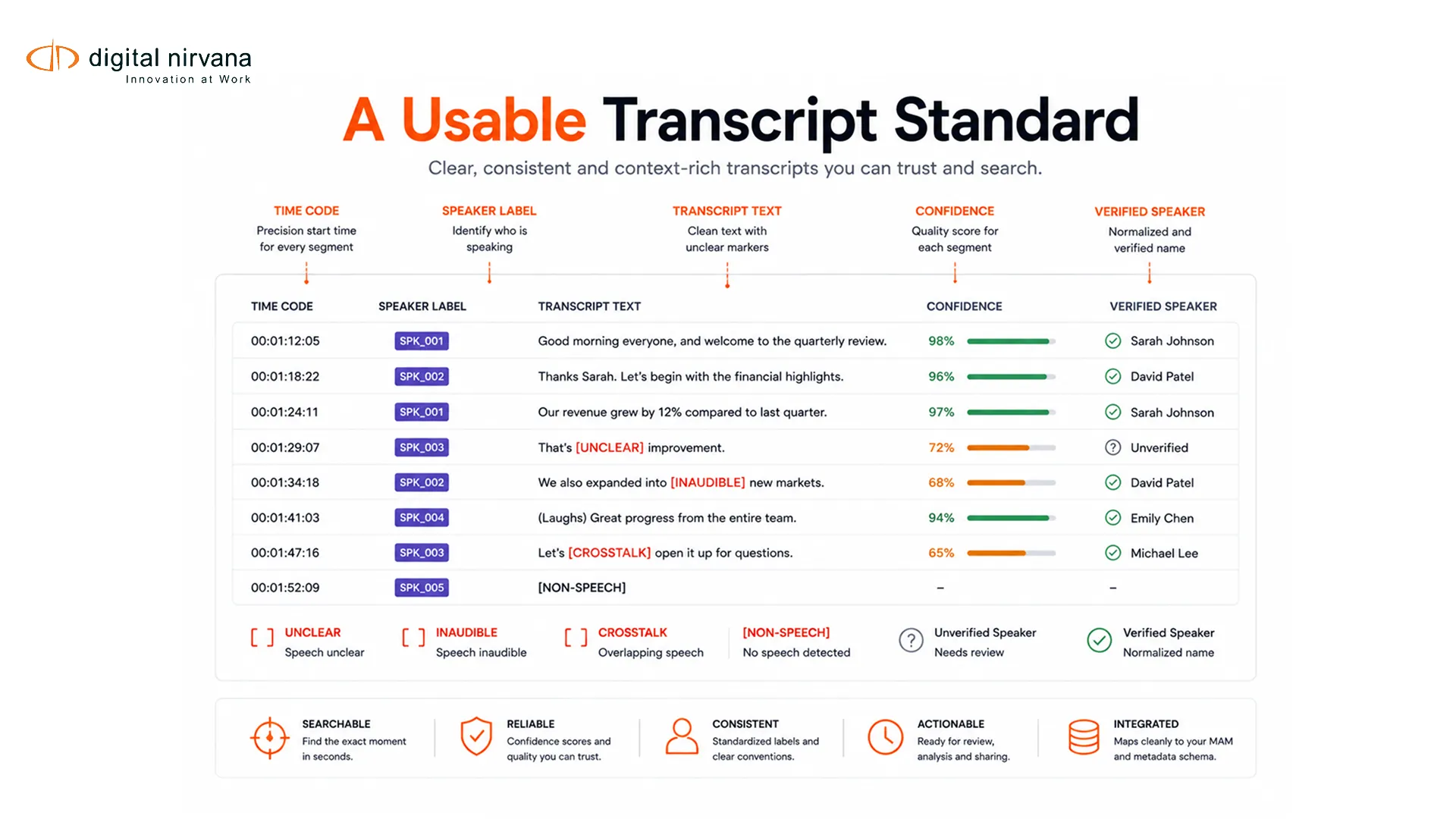
Use a stable identifier for each speaker. Prefer an approved name and role when known. When identity is uncertain, use neutral labels such as SPEAKER 1 and SPEAKER 2 rather than guessing. Keep the label consistent across the file and record any later identity correction.
Mark a speaker change even when two people overlap. If crosstalk prevents reliable wording, note the overlap and flag the affected time range. For panels or fast news exchanges, a reference roster and visual review can improve labeling.
Non-speech information should be included when the use requires it. Examples include music, applause, alarms, laughter and significant environmental sounds. The DCMP Captioning Key speaker-identification guidance offers a useful public reference for readable speaker treatment in caption contexts. Transcripts may use different display rules, but the need for clear identity remains.
Timecode Transcription Standards
Specify whether timestamps follow source timecode, program time or media-relative elapsed time. Record the frame rate and whether drop-frame numbering applies. SMPTE’s time-code overview explains why time code identifies frames and why the job specification must name the timing basis.
Choose a granularity that matches the task:
- Paragraph or interval timestamps suit broad reference and review.
- Speaker-turn timestamps help interviews, panels and legal review.
- Phrase-level timestamps support detailed editing and search.
- Word-level timing may be required for automated alignment but creates more data and review work.
Do not invent precision the source does not support. A transcript generated from a proxy with a shifted start can be internally consistent and still fail to align with the master. Include a known sync point or validate representative cues before delivery.
For a deeper comparison, see timecoded transcription for editing and compliance.
A Practical Quality-Control Process
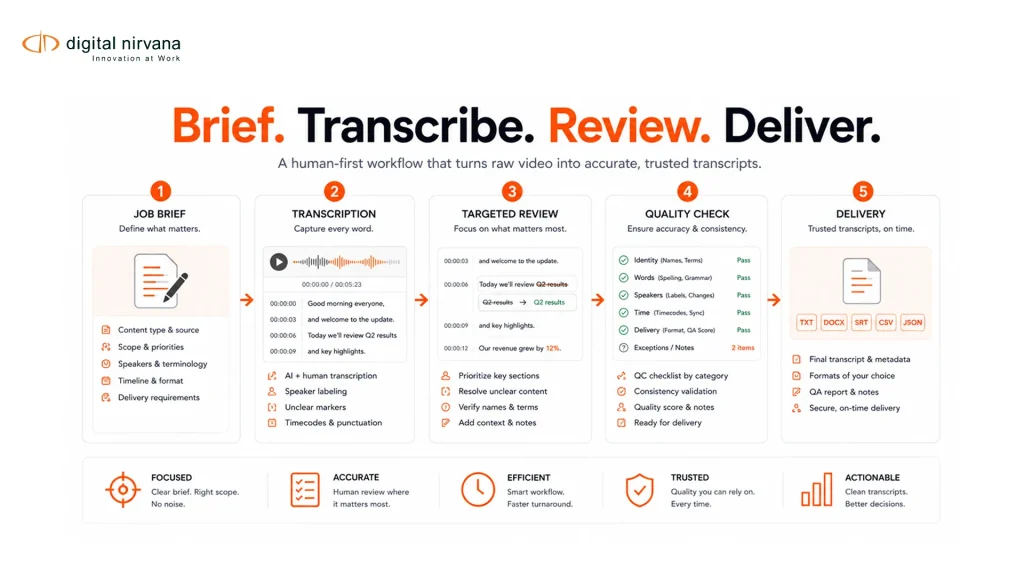
First, confirm the file identity, duration, language and timecode basis. Second, review text against the media rather than proofreading text alone. Third, verify names, numbers, acronyms and high-consequence statements against approved sources. Fourth, check speaker changes and time alignment. Fifth, run a consistency pass for style and required markers.
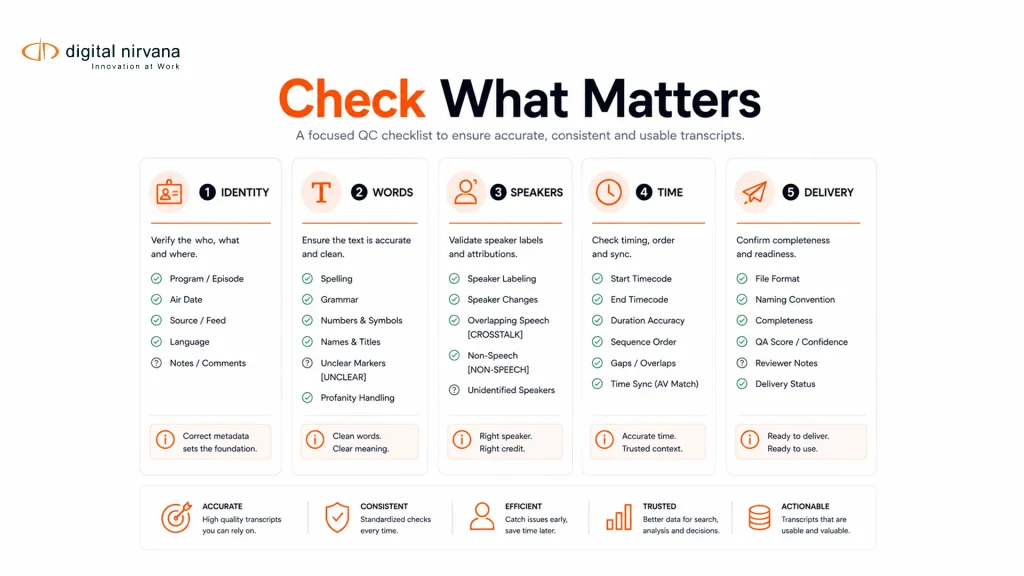
Quality metrics should reflect the use. Word error rate can summarize substitutions, deletions and insertions, but it treats every word similarly. A wrong person’s name or dollar figure may matter more than a filler-word difference. Add weighted error categories for proper nouns, numbers, speaker identity, timing and omitted material.
Separate production and QC roles for high-impact work where feasible. If the same person performs both, require a second pass after a break and use a checklist that records exceptions.
Delivery Checklist
- Correct asset identifier, version and duration
- Approved file format and character encoding
- Named language and regional variant
- Declared verbatim level and style version
- Consistent speaker labels
- Timecode basis, frame rate and granularity
- Standard markers for unclear or overlapping audio
- Completed QC status and exception notes
- Secure delivery path and retention instruction
TranceIQ supports transcription, caption and subtitle workflow orchestration and review. Digital Nirvana’s Media Enrichment services address managed transcription and related language work. The platform and managed-service roles should be selected according to who will operate the workflow and perform review.
FAQs
They should define purpose, verbatim level, names, numbers, punctuation, speaker labels, non-speech audio, unclear passages, timecodes, QC and delivery.
Verbatim styles retain more of the speaker’s exact delivery. Clean read removes specified disfluencies or repairs readability, so its editorial limits must be documented.
Use stable neutral labels and do not guess. Update the label only when an approved reference supports the identity.
It depends on the workflow. Editing and detailed review usually need speaker-turn, phrase or word timing, while reference transcripts may use wider intervals.
No. Add checks for names, numbers, speaker identity, omissions and time alignment because those errors can have greater operational impact.
No. Captions add synchronization and display requirements and normally represent meaningful non-speech audio. A transcript may be formatted for editing, research or records.
Conclusion
Good transcription standards make decisions visible before production begins. A documented style, timing basis, speaker method and QC process reduce disagreement and make exceptions easier to manage. The standard should be as detailed as the transcript’s downstream consequence requires.
To plan an operated service or review workflow around these requirements, contact Digital Nirvana.