Introduction
Video OCR extracts text that appears inside video frames and connects it to a time range. That can make lower thirds, scoreboards, tickers, location straps, signs and end credits searchable even when the words are never spoken. For news, sports and archive teams, the result can fill gaps left by file metadata and transcription.
Reliable video OCR requires more than running character recognition on every frame. A workflow must decide where to look, consolidate repeated text, handle animation and low contrast, preserve timecodes and route uncertain results for review.
Key Takeaways
- Video OCR detects visible text, recognizes characters and maps the result to time.
- Region selection and frame sampling strongly affect accuracy and cost.
- Repeated text should be consolidated into one timed occurrence.
- OCR output needs normalization, confidence rules and context from other signals.
- MediaServicesIQ and MetadataIQ address different layers of the workflow.
Table Of Contents
- What video OCR extracts
- How the workflow operates
- Common failure modes
- Evaluation and QC
- From API output to searchable metadata
- FAQs
What Can Video OCR Extract?
News lower thirds can identify speakers, roles and locations. Sports scoreboards expose teams, scores, periods and clocks. Financial tickers and breaking-news crawls carry changing text. Signs, labels and slates provide contextual terms. End credits list people and companies that may not appear in a transcript.
These elements have different layouts and persistence. A lower third may animate into a stable region. A scoreboard updates one field while the rest remains fixed. A ticker moves continuously. One OCR configuration will not treat all of them equally well.
Google Cloud’s text-detection documentation shows an output structure that includes text, time segments and frame-level bounding boxes. The structure is useful because a search result needs evidence of both what was read and when it appeared.
How A Video OCR Workflow Operates
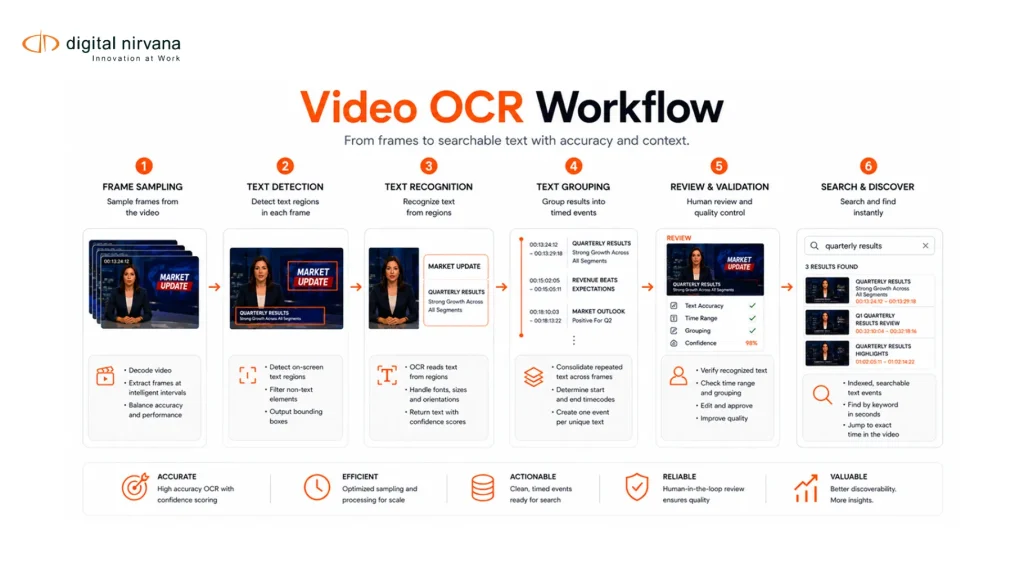
The workflow begins by sampling frames or processing selected time ranges. Text detection identifies regions likely to contain characters. OCR converts those regions into strings. Each observation is attached to a timestamp and spatial region.
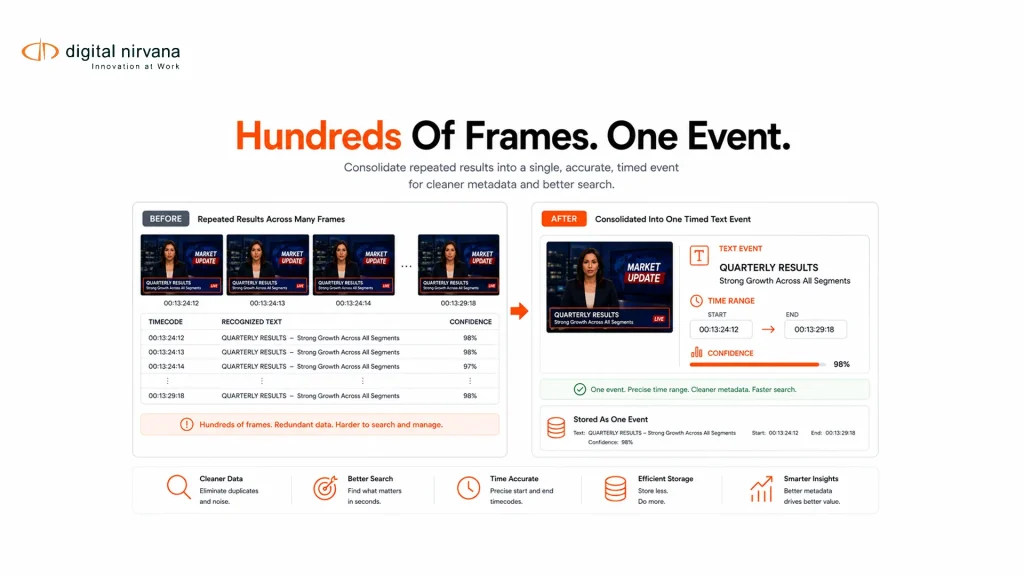
Next, the system groups near-identical strings across consecutive frames. Without this step, a five-second lower third could produce hundreds of duplicate records. Normalization can resolve casing, whitespace and predictable character substitutions. Business rules can then map a result into fields such as person, role, team or location only when the context supports that interpretation.
Finally, the output enters a search index or review queue. The record should keep the source asset, time range, recognized string, confidence, region and model version. A reviewer needs to see the text in context before approving a name or other high-impact field.
Digital Nirvana’s guide to video indexing and smarter search explains how OCR can join speech, faces, objects and scenes in a multimodal index.
Common Video OCR Failure Modes
| Failure Mode | Typical Cause | Practical Response |
| Character substitution | Compression, small type, stylized font | Higher-quality source, crop, language model, review |
| Duplicate records | Same graphic persists across frames | Similarity grouping and duration merge |
| Missed moving text | Ticker motion or brief animation | Adjust sampling and track the text region |
| False text | Textured background or graphic edges | Region rules, confidence threshold, minimum duration |
| Wrong reading order | Multi-line lower third or scoreboard | Layout-aware parsing and field templates |
| Context error | Correct string mapped to wrong entity type | Combine OCR with program and transcript context |
Language and script also matter. Character sets, accents and mixed-language graphics should be represented in the test sample. Scoreboards and template-driven graphics may benefit from fixed regions, while archive footage with varied layouts requires more general detection.
How To Evaluate OCR And QC Results
Create a reference set of visible text events with exact strings and time ranges. Include the graphic types and difficult conditions users will search. Measure character or word accuracy, event recall, false detections and time overlap.
Also measure consolidation quality. One graphic should normally become one searchable occurrence, even if the system observes it in many frames. Check whether updates inside a persistent graphic, such as a changing score, create meaningful new events without flooding the index.
Review output by confidence band and use case. A misspelled generic topic may be inconvenient. A misspelled person’s name can damage discovery and downstream reporting. Apply stricter review to names, rights, compliance and other high-consequence fields.
The Azure Video Indexer insights overview shows OCR alongside other timed insights, which is a useful model for contextual review even when an organization uses a different service.
From OCR API Output To Searchable Metadata
MediaServicesIQ is Digital Nirvana’s family of composable media-analysis services. It is the relevant layer when a development team needs callable capabilities such as OCR as part of its own pipeline.
MetadataIQ supports packaged indexing and metadata enrichment around a MAM, PAM or DAM. It can combine timed insights and manage the path toward searchable records. Neither role should be described as replacing the asset-management system that owns the media.
FAQs
Video OCR is the process of detecting and recognizing text in video frames, then associating the recognized string with a position and time range.
Yes. Quality depends on resolution, font, contrast, motion, compression, language and the rules used to group results across frames.
OCR reads visible text. Transcription converts speech into text. Combining both can find names or topics that appear in only one signal.
It can read scoreboard text and digits, but a reliable score workflow also needs layout parsing, update logic and context about teams, period and clock.
The workflow compares strings and regions over adjacent frames, then merges stable or near-identical observations into one timed event.
Review is recommended for uncertain results and fields where an error affects identity, rights, compliance or editorial decisions.
Conclusion
Video OCR makes a visual layer of media searchable. The production value comes from time alignment, deduplication, normalization and review, not from character recognition alone. Teams should test each graphic pattern they plan to use and define how approved text enters the archive.
To assess OCR as an API capability or part of a metadata workflow, contact Digital Nirvana.