Introduction
Most media and content teams already have a digital asset management platform in place. You have a single source of truth for your assets, permissions are under control, and storage is centralized. On paper, everything looks right.
In reality, people still scrub through timelines, rename files manually, and struggle to find the right clip under a deadline. The bottleneck is not the system you use to store media; it is the metadata that makes that media searchable, compliant, and reusable.
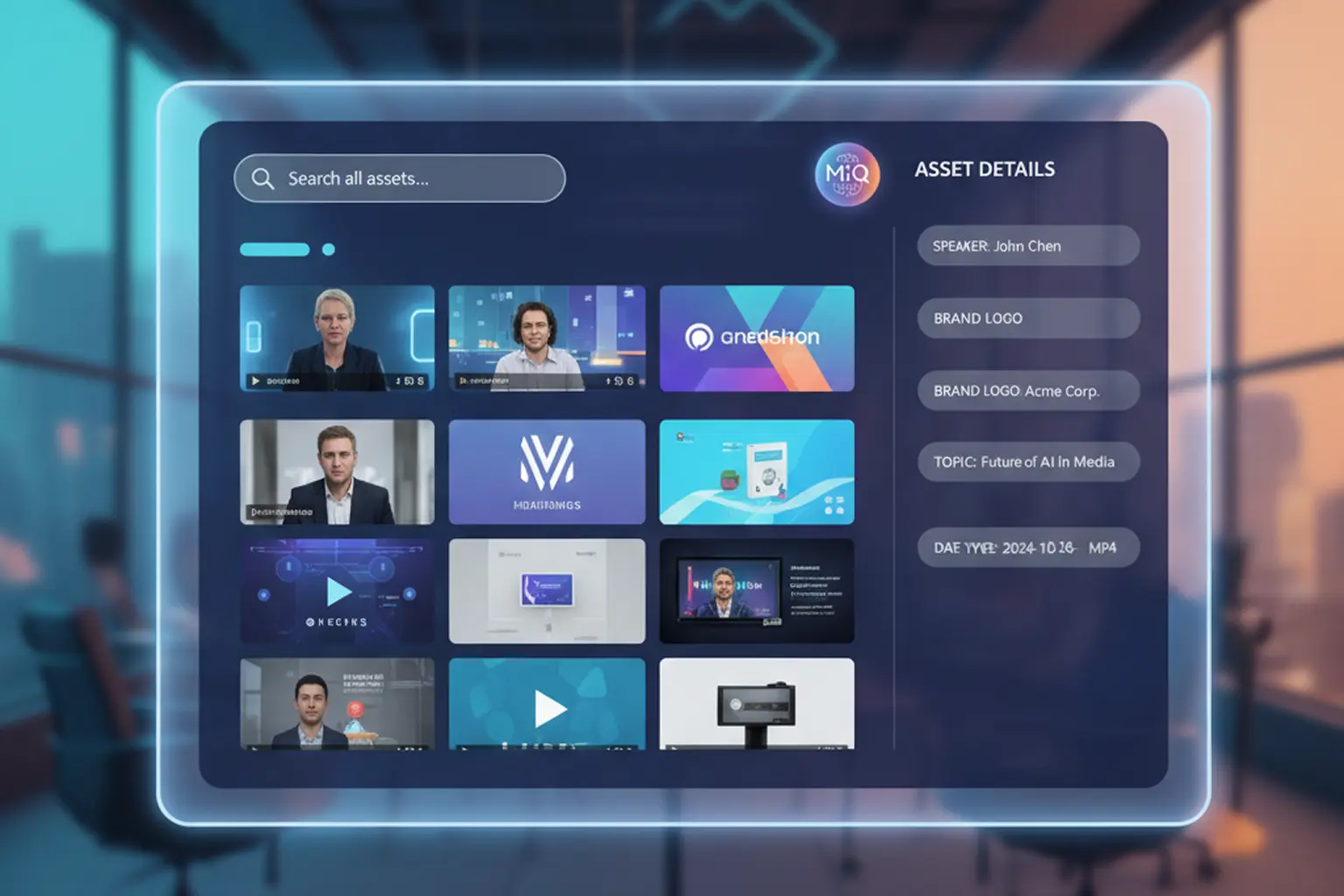
This is precisely where MetadataIQ comes in. Built by Digital Nirvana for broadcast-grade media workflows, MetadataIQ sits alongside your existing PAM, MAM, and digital asset management platforms. It automates metadata generation, adds time-coded intelligence, and feeds it back into the tools your teams already use, so you get more value from your current stack instead of ripping it out and starting again.
This article walks through how MetadataIQ supercharges your digital asset management platform without replacing it, and how that combination transforms searchability, compliance, and content velocity across your organization.
Why your digital asset management platform lives or dies on metadata
A modern digital asset management platform centralizes your files, controls access, and supports reuse across teams. It helps store, organize, and distribute images, video, audio, documents, and more from a single location.
But the performance of any DAM is only as strong as its metadata.
Without rich, consistent metadata:
- Search becomes guesswork instead of a reliable tool
- Teams duplicate work because they cannot find existing assets.
- Rights and compliance conditions are hard to track
- Archives become cold storage instead of revenue-generating libraries
Typical pain points we see in media and broadcast environments include:
- Manual logging and tagging cannot keep up with the volume
- Inconsistent keywords and taxonomies between teams and shows
- Difficulty locating specific moments inside long-form content
- Limited support for compliance-sensitive metadata, such as political ads, disclosures, or brand mentions
- Under-monetized archives because assets are effectively invisible
Most DAM platforms offer basic tagging and some automation, but they are not tuned for the complexities of broadcast and video-heavy workflows at scale. Leading DAM vendors increasingly acknowledge that AI-driven metadata automation is becoming essential to make search and governance truly effective.
That is the gap MetadataIQ is built to fill.
Meet MetadataIQ: metadata automation built for media, not generic AI
MetadataIQ is Digital Nirvana’s AI- and ML-powered metadata automation platform designed specifically for broadcasters, sports networks, OTT providers, and media-intensive teams.
Instead of acting as yet another asset repository, MetadataIQ focuses on one job: generating, enriching, and governing metadata for your audio and video content, then pushing that intelligence back into your existing systems.
Key capabilities include:
- Automated, time-coded speech-to-text transcripts with punctuation and speaker turns
- Video intelligence for faces, logos, on-screen text, and objects
- Topic, keyword, and rules-based tagging for compliance and content discovery
- Native integrations with Avid MediaCentral, Telestream, Grass Valley, and a wide range of MAM and DAM systems
- Governance dashboards that score metadata quality and flag missing or non-compliant tags
- Batch processing for massive libraries and real-time processing for live content
Importantly, MetadataIQ is embedded into existing broadcast and production ecosystems rather than bolted on as a separate application. Editors see time-coded markers on their timelines. Archive teams see enriched metadata fields in their asset management systems. News and sports teams get live feeds indexed as they roll.
The result is a metadata layer that understands media, understands compliance, and understands your production realities.
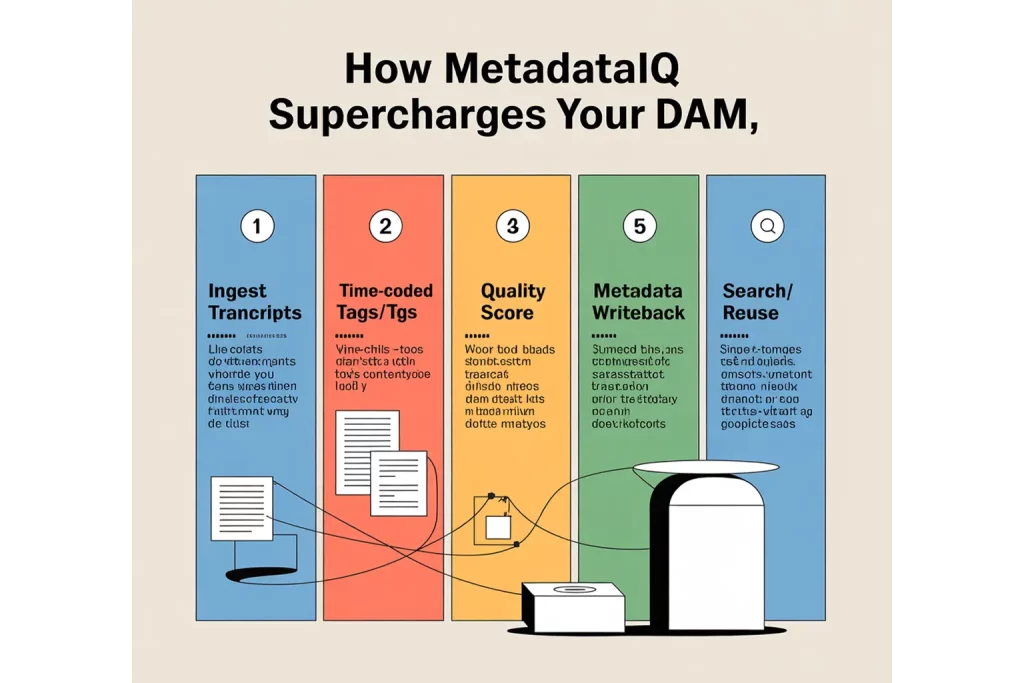
How MetadataIQ integrates with your digital asset management platform
A common concern for technology leaders is whether adding a metadata automation platform will duplicate or replace their existing DAM or MAM investments. With MetadataIQ, it does not.
Instead, MetadataIQ sits within your content lifecycle and channels intelligence back into the platforms you already use.
At a high level, the integration looks like this:
- Content ingest
- Content enters your environment through your PAM/MAM or digital asset management platform.
- Files, streams, or watch folders are registered with MetadataIQ via tight integrations or API calls.
- Automated analysis and tagging
- MetadataIQ applies AI/ML engines for speech-to-text, object and logo detection, and on-screen text.
- It generates time-coded transcripts, topics, and rules-based tags, including compliance-sensitive categories.
- Metadata enrichment and governance
- Custom rules and business taxonomies align tags with your internal vocabulary, show slates, or advertiser requirements.
- The governance dashboard scores completeness and highlights gaps before assets go to air or to market.
- Round-trip back to DAM / MAM / PAM
- Time-coded markers and structured metadata are written back into systems like Avid MediaCentral and your broader MAM or DAM stack.
- Users continue working in the interfaces they know, but with far richer metadata powering search, clip creation, and compliance checks.
Because MetadataIQ is integration-first, it plays well with both broadcast-centric MAMs and enterprise digital asset management platforms used by marketing, corporate communications, or archives.
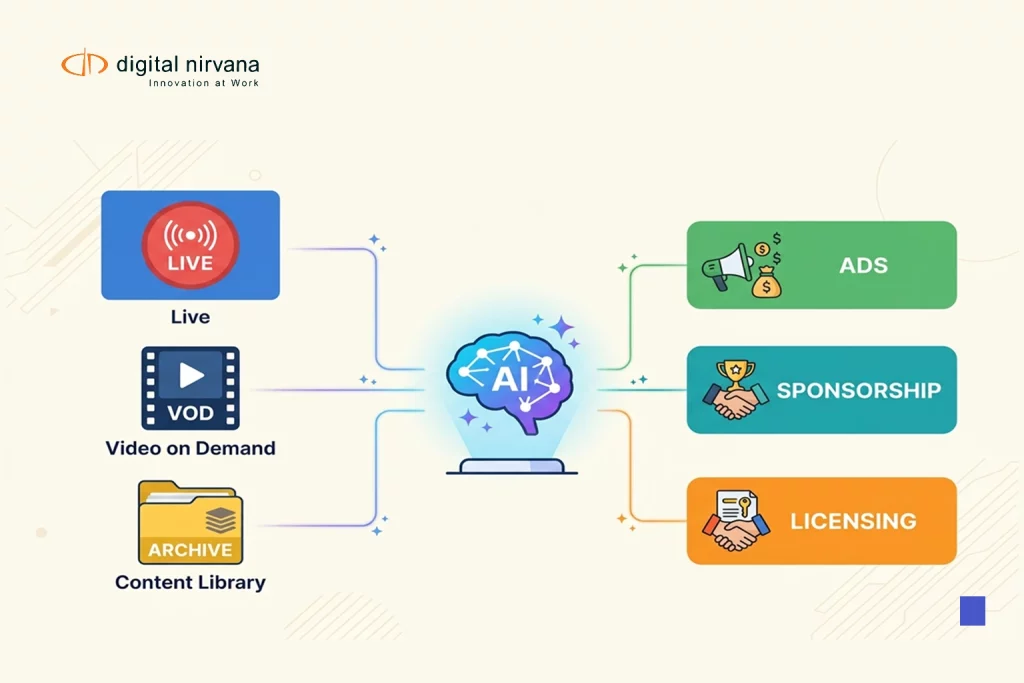
Live, turn, and archive workflows.
Different teams experience the integration differently.
- Live news and sports
- As live feeds come in, MetadataIQ generates speech-to-text, detects key on-screen elements, and applies topic tags in real time.
- Your MAM or DAM receives time-coded markers so producers can search “post-game coach interview” or “goal in extra time” within minutes, not hours.
- Fast-turn entertainment and episodic content
- For daily shows, reality TV, or promos, editors get pre-logged timelines with segments, speakers, and branded moments flagged.
- Clipping, promo creation, and versioning become far faster because the tedious logging work is already done.
- Deep archives and libraries
- For back catalogs and historical footage, MetadataIQ runs in batch mode, enriching decades of content with consistent metadata.
- Once that enriched metadata syncs back into your digital asset management platform, previously invisible assets suddenly become discoverable and licensable.
What stays in the DAM, what shifts to MetadataIQ
To avoid confusion, it helps to be clear about responsibilities:
Your digital asset management platform continues to own:
- Centralized storage, versioning, and access control
- Asset lifecycle states, such as in-production, approved, archived, and retired
- Brand and rights management policies at the asset level
- Distribution, delivery, and downstream integrations into marketing or playout systems
MetadataIQ adds:
- Automated generation of descriptive, technical, and compliance-oriented metadata at scale
- Time-based metadata aligned with specific shots, scenes, speakers, and events
- Governance, scoring, and auditing of metadata quality
- Seamless round-trip of that enriched metadata back into your DAM, MAM, and edit systems
In other words, MetadataIQ does the heavy lifting on metadata so your DAM can finally deliver on the promise of fast, accurate, compliant content discovery.
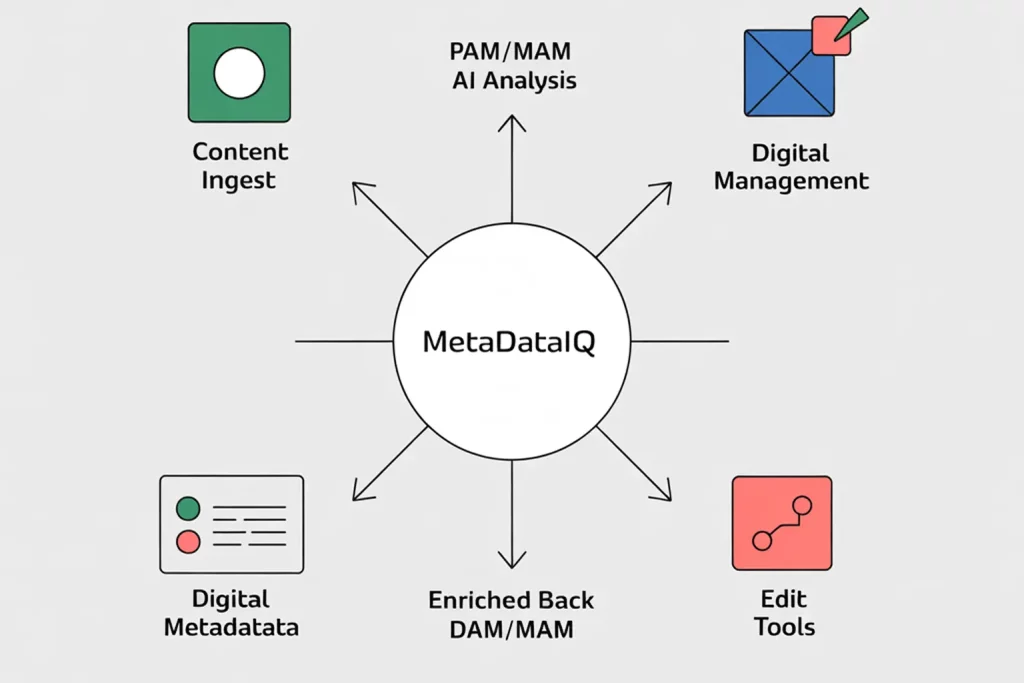
What you unlock with MetadataIQ + DAM
When you pair MetadataIQ with your digital asset management platform, the impact is evident throughout the entire content lifecycle.
Searchability and reuse
With AI-generated, time-coded metadata:
- Producers and editors can search for exact quotes, topics, faces, or locations instead of relying on generic filenames.
- Marketing and social teams can quickly pull on-brand, rights-cleared clips from the DAM without involving ops for every request.
- Archives become a living resource for re-versioning, thematic collections, and licensed packages.
Industry research around AI-driven metadata automation consistently highlights improved searchability and faster retrieval as primary benefits.
Faster production and collaboration
Because MetadataIQ does the logging and tagging automatically:
- Editors spend more time cutting and less time scrubbing.
- Producers can assemble rough cuts and stringouts using intelligent search criteria.
- Remote and distributed teams rely on the same enriched metadata, reducing back-and-forth and duplicated effort.
Combined with workflow automation features in your DAM or MAM, this metadata foundation drives measurable gains in cycle time and throughput.
Governance, compliance, and audit readiness
For broadcasters and content owners, compliance is non-negotiable.
MetadataIQ can detect and tag categories such as political advertising, profanity, brand mentions, and regulatory disclosures, then expose that data back into your content management stack.
The governance layer lets you:
- See which assets meet internal and external guidelines at a glance
- Prove due diligence to regulators and advertisers with audit-ready logs.
- Define and enforce rules based on region, channel, or client contract
Rather than treating compliance as a separate workflow, MetadataIQ helps integrate it into how your digital asset management platform operates day to day.
Content monetization and archive activation
Rich metadata is a prerequisite for effective content monetization strategies. When your archives are well-indexed, it becomes easier to package footage for syndication, license deals, or thematic compilations.
MetadataIQ supports monetization by:
- Revealing high-value segments buried in long-form content
- Making it straightforward to bundle assets by topic, personality, or event
- Ensuring historical content is tagged to current compliance and rights standards, so it is safe to re-use and resell
Your digital asset management platform remains the storefront and distribution hub; MetadataIQ is the engine that makes the catalog browsable.
DAM alone vs DAM + MetadataIQ: side-by-side view
Below is a simplified comparison of what teams typically experience.
| Dimension | DAM only | DAM + MetadataIQ |
| Metadata coverage | Mostly manual, inconsistent, limited in depth | Automated, consistent, time-coded, compliance-aware |
| Search and discovery | Filename and basic keyword-driven | Granular search by topics, people, quotes, moments |
| Logging effort | High manual effort for every program | Automated logging for live, fast-turn, and archives |
| Compliance and governance | Separate checks, spreadsheet-driven | Built-in tagging and dashboards for audit readiness |
| Archive monetization | Opportunistic, hard to operationalize | Systematic reuse based on rich, structured metadata |
| Integration with edit systems | Indirect | Direct markers into Avid and other editorial tools |
This is not about replacing your digital asset management platform; it is about unlocking its full potential.
Common integration scenarios and architectures
Every organization’s media stack is different, but several patterns are emerging in the market.
- Broadcast-centric stack
- PAM/MAM: Avid MediaCentral, Grass Valley, or similar
- DAM: Often used for marketing and corporate content, separate from production
- MetadataIQ: Integrated into PAM/MAM for ingest, logging, and editing; metadata then syncs to DAM for downstream use
- OTT and streaming providers
- MAM/DAM hybrid managing mezzanine and distribution assets
- MetadataIQ: Used for automated QC tagging, localization support (through transcripts and captions), and theme-based packaging for recommendations and promotions
- Enterprise and government media teams
- Enterprise DAM as the system of record for all media
- MetadataIQ: Connected as an enrichment engine, particularly for legislative sessions, public meetings, training content, and public-facing archives
Across all scenarios, the architectural principle is the same: keep your digital asset management platform as the system of record, while using MetadataIQ as the intelligence layer that enriches it.
When to add MetadataIQ instead of replacing your DAM
If you are evaluating options, here are signals that it is time to add MetadataIQ rather than start a full DAM replacement:
- Your users complain more about “finding things” than about the DAM interface itself.
- Logging, clipping, and compliance reviews still rely heavily on spreadsheets and manual notes.
- You are considering replacing the DAM solely to get better AI or metadata features.
- You have an extensive archive that is technically stored but practically unusable.
- Live and fast-turn teams feel disconnected from the DAM because it does not reflect real-time content.
In these cases, supercharging your current digital asset management platform with MetadataIQ typically delivers faster ROI and less operational risk than a rip-and-replace project.
9. Implementation steps, timeline, and change management
A typical MetadataIQ integration with your digital asset management stack follows a phased approach:
- Discovery and workflow mapping
- Align on use cases: live, fast-turn, archive, or all three
- Map existing PAM/MAM/DAM touchpoints, metadata schemas, and compliance requirements.
- Pilot integration
- Connect MetadataIQ to a limited set of feeds, shows, or archive collections.
- Validate transcription quality, tagging rules, and round-trip behavior into your DAM and edit systems.
- Taxonomy and rules tuning
- Align AI-generated tags with your internal vocabularies and naming conventions.
- Define region-specific or client-specific compliance rules
- Rollout to production
- Expand integration to more channels and teams
- Provide targeted training for producers, editors, archivists, and compliance staff
- Continuous optimization
- Use MetadataIQ dashboards and DAM analytics to spot gaps and new opportunities
- Adjust models, rules, and workflows as your content strategy evolves.
Because users stay in familiar tools, change management is mainly about helping teams trust and fully use the richer metadata they now see.
To explore what this could look like in your environment, Digital Nirvana typically recommends starting with a focused demo and a workflow-specific proof of concept tied to measurable KPIs, such as reduced search time, improved clip turnaround, or increased archive revenue.
FAQs
No. MetadataIQ is designed to work with your existing PAM, MAM, and digital asset management platforms. It focuses on automated metadata generation, enrichment, and governance, then feeds that intelligence back into the systems you already use.
MetadataIQ integrates natively with Avid MediaCentral, Telestream, Grass Valley, and many other broadcast and media systems. It also connects to a wide range of MAM and DAM platforms via APIs and custom connectors, making it well-suited to complex hybrid environments.
MetadataIQ is tuned for professional broadcast and media workflows, with AI and machine learning models optimized for real-world news, sports, and entertainment content. It combines automated speech-to-text and video intelligence with rules-based engines and human-defined taxonomies to deliver high accuracy and consistency at scale.
The goal is the opposite. By making it easier to identify political content, brand mentions, disclosures, profanity, and other sensitive categories, MetadataIQ helps teams catch potential issues earlier and maintain audit-ready records. It can also be configured for region-specific regulations such as FCC, GDPR, and Ofcom requirements.
Yes. MetadataIQ supports both real-time processing for live news and sports and batch processing for large archives. Many organizations start with archive enrichment to unlock new monetization opportunities, then extend the integration to live and fast-turn workflows.
While timelines vary, teams typically start seeing tangible benefits once the first pilot workflows are live and metadata is flowing back into the digital asset management platform. Improvements include faster search, reduced manual logging, and more confident compliance checks. From there, broader rollout compounds the impact.
Conclusion
A modern digital asset management platform is no longer enough on its own. Without rich, time-coded, and compliance-aware metadata, even the best DAM ends up as a sophisticated storage system rather than an actual engine for content discovery and monetization.
MetadataIQ changes that equation. By directly integrating with your existing PAM, MAM, and digital asset management platforms, it automates the most challenging part of the workflow: generating and governing metadata at scale. The result is a stack that feels entirely new, without the disruption, cost, and risk of ripping and replacing the systems your teams rely on every day.
If you are ready to turn your DAM into a truly intelligent media backbone, the next step is simple: connect with Digital Nirvana, see MetadataIQ in action within your workflows, and define a focused pilot that proves its value in weeks, not years.