A regional broadcaster gets a call from legal. A political ad ran during a debate special, and a candidate’s campaign is disputing whether it aired at all, and if it did, whether it ran in full. The compliance team has hundreds of hours of recorded programming across three channels. Somewhere in there is a 30-second clip that needs to be found, verified, and packaged with proof, by end of day.
This is the moment every broadcast compliance lead dreads. And it’s exactly the moment media indexing with timecoded evidence packs was built to solve.
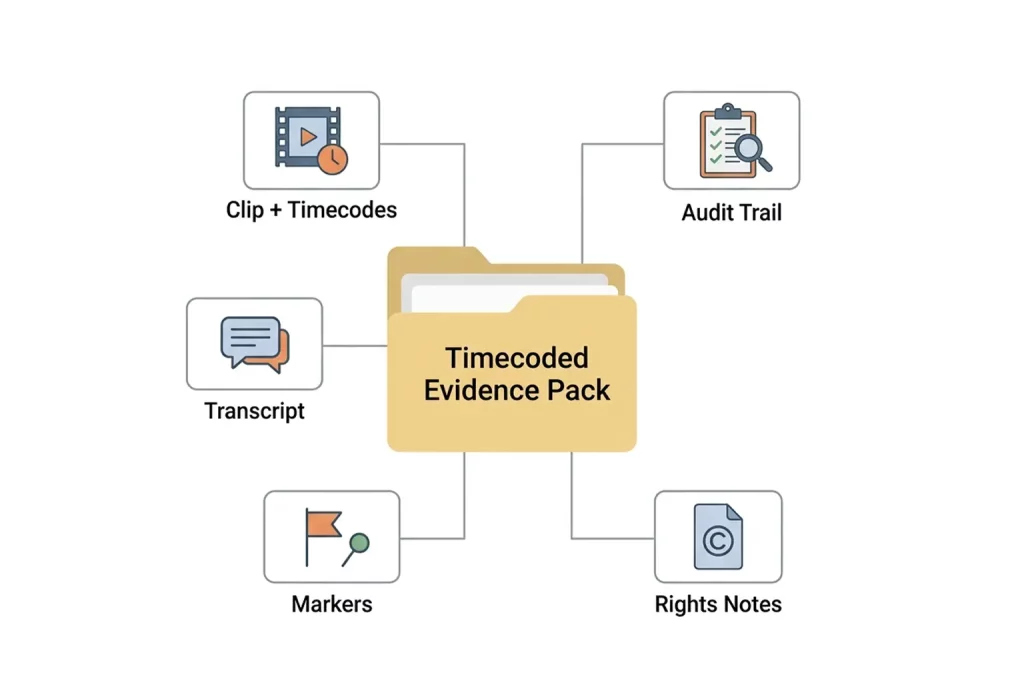
What Is a Timecoded Evidence Pack, Exactly?
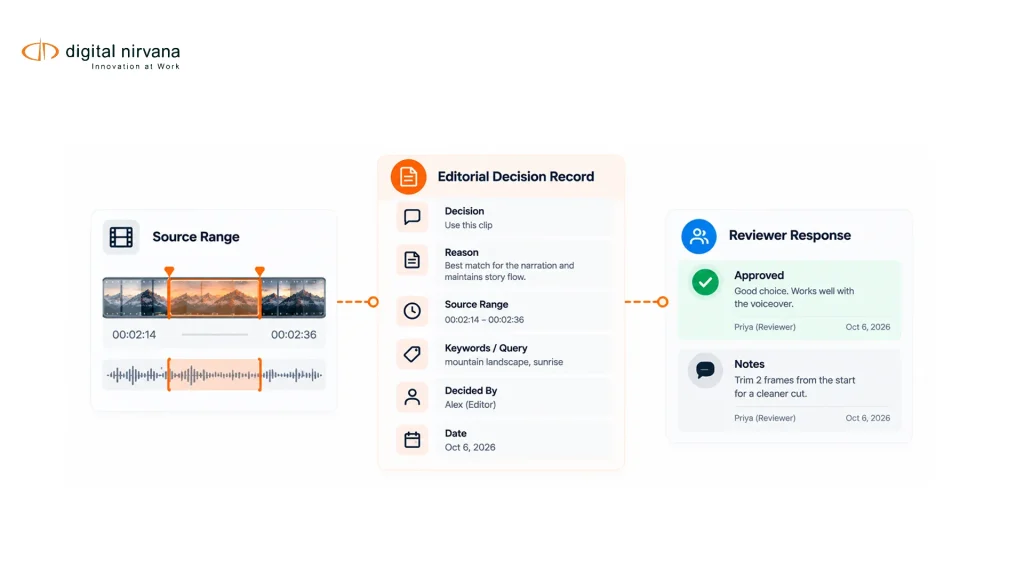
A timecoded evidence pack is a bundled set of proof, video segment, transcript, metadata, and airtime record, tied to an exact timecode in a broadcast or media asset. Instead of handing over a raw recording and hoping someone finds the right moment, teams deliver a precise, defensible package that shows exactly what aired, when it aired, and in what context.
Think of it as the difference between saying “the ad ran sometime that night” and being able to say “the ad ran at 9:14:22 PM, lasted 29.8 seconds, and appeared exactly as approved.” One is a claim. The other is evidence.
Why This Problem Is Getting Bigger, Not Smaller
Broadcast and streaming operations are under more scrutiny than they were even two years ago. Regulatory bodies continue to tighten expectations around accessibility and advertising transparency, and disputes over ad placement, political content, and sponsor commitments have become routine business, not rare exceptions.
At the same time, content volume keeps climbing. Multi-channel station groups, OTT platforms, and sports producers generate more hours of footage in a week than compliance teams used to review in a quarter. Manual review simply cannot keep pace with that volume, especially when a dispute demands an answer within hours, not weeks.
Add in the growing complexity of proving compliance across linear, OTT, and FAST channels simultaneously, and it becomes clear why “find the clip and prove it” has turned into a full-time operational challenge for media operations and legal teams alike.
Where Traditional Approaches Fall Short
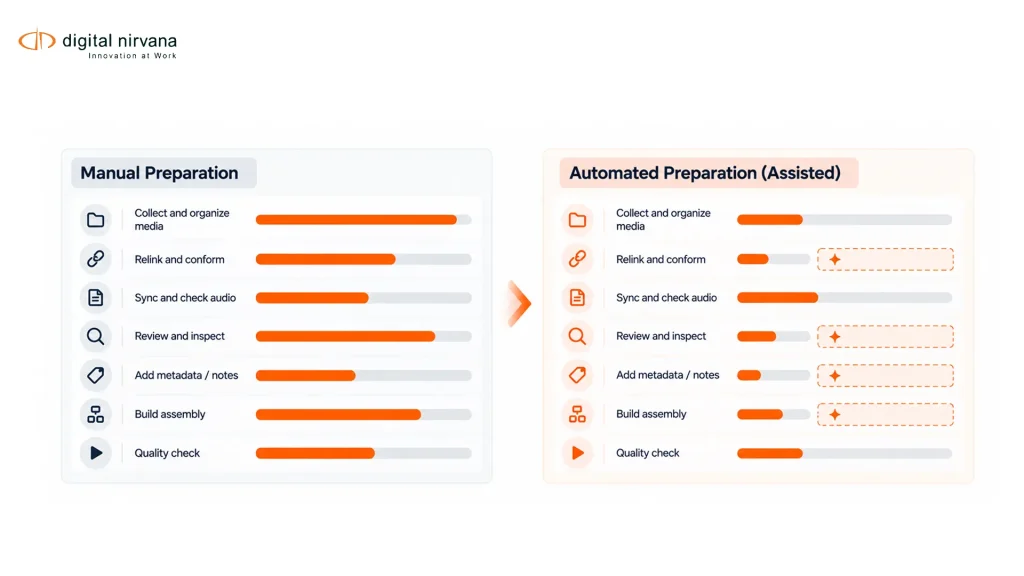
Most legacy workflows depend on a mix of manual logging, spot-check reviews, and human memory. Someone scrubs through hours of footage looking for a timestamp. Someone else cross-references a paper or spreadsheet traffic log. If captions or loudness data are needed too, that’s often a separate system entirely.
This approach has three consistent failure points:
- Speed. Manual scrubbing through hours of footage to locate a 30-second segment can eat an entire workday.
- Fragmentation. Video, transcript, caption, and traffic data often live in different systems, so building one coherent evidence package means stitching pieces together by hand.
- Defensibility. A screenshot or a rough timestamp doesn’t hold up well under legal or regulatory scrutiny. Evidence needs to be precise, timecoded, and traceable back to the original asset.
None of this is a people problem. It’s a workflow and tooling problem, and it’s one that AI-powered media indexing was designed to close.
How AI-Powered Media Indexing Builds Evidence Packs
At its core, media indexing applies AI to break down every asset, live or archived, into searchable, timecoded metadata. Speech becomes a synchronized transcript. Faces, logos, and on-screen text become tagged, time-stamped markers. Scene changes, ad breaks, and program segments get flagged automatically as the content is ingested or processed.
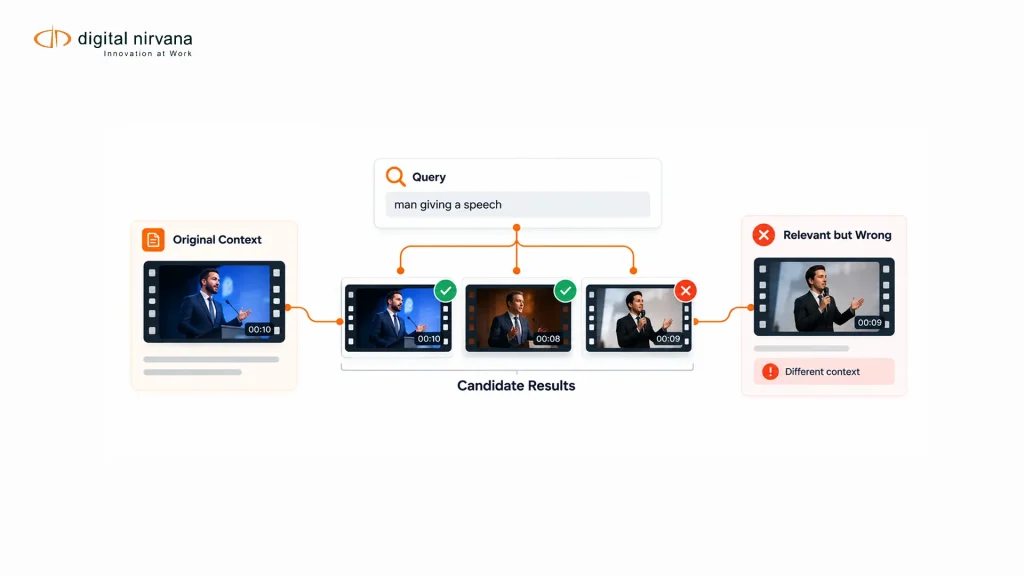
Once that indexing layer exists, building an evidence pack stops being a manual hunt and becomes a search query. A compliance officer can search “candidate name” or “sponsor logo” across weeks of programming and get results down to the second, not the hour.
The strongest platforms tie this indexing directly into broadcast monitoring, so the same system tracking loudness, closed captions, and signal quality can also pull the exact segment, transcript, and airtime log needed for a dispute. That’s the connective tissue between MetadataIQ style media indexing and MonitorIQ style broadcast compliance logging: one finds the moment, the other proves what actually aired.
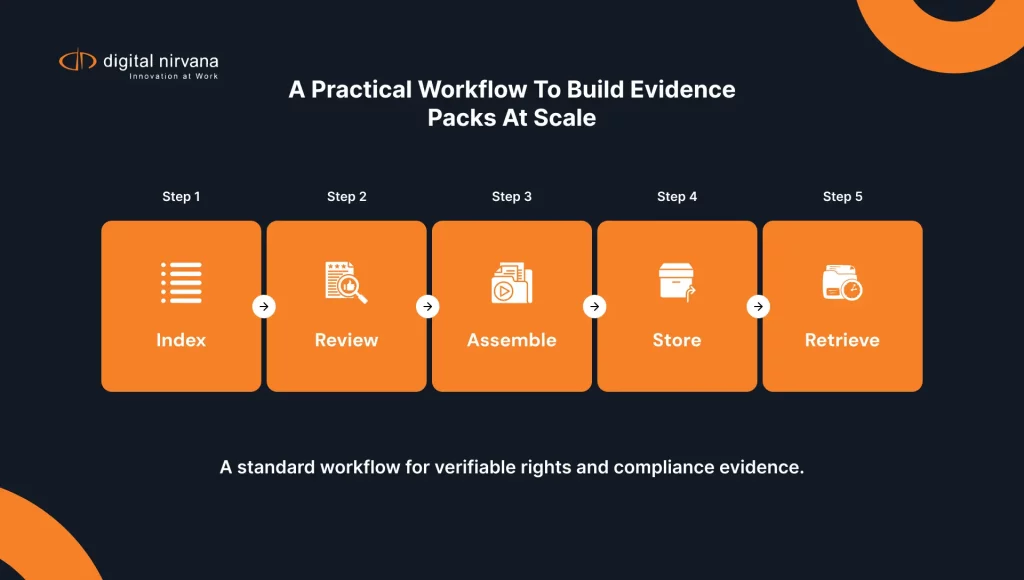
A Real-World Workflow: From Dispute to Delivered Evidence
Here’s how this typically plays out inside a well-equipped media operations team.
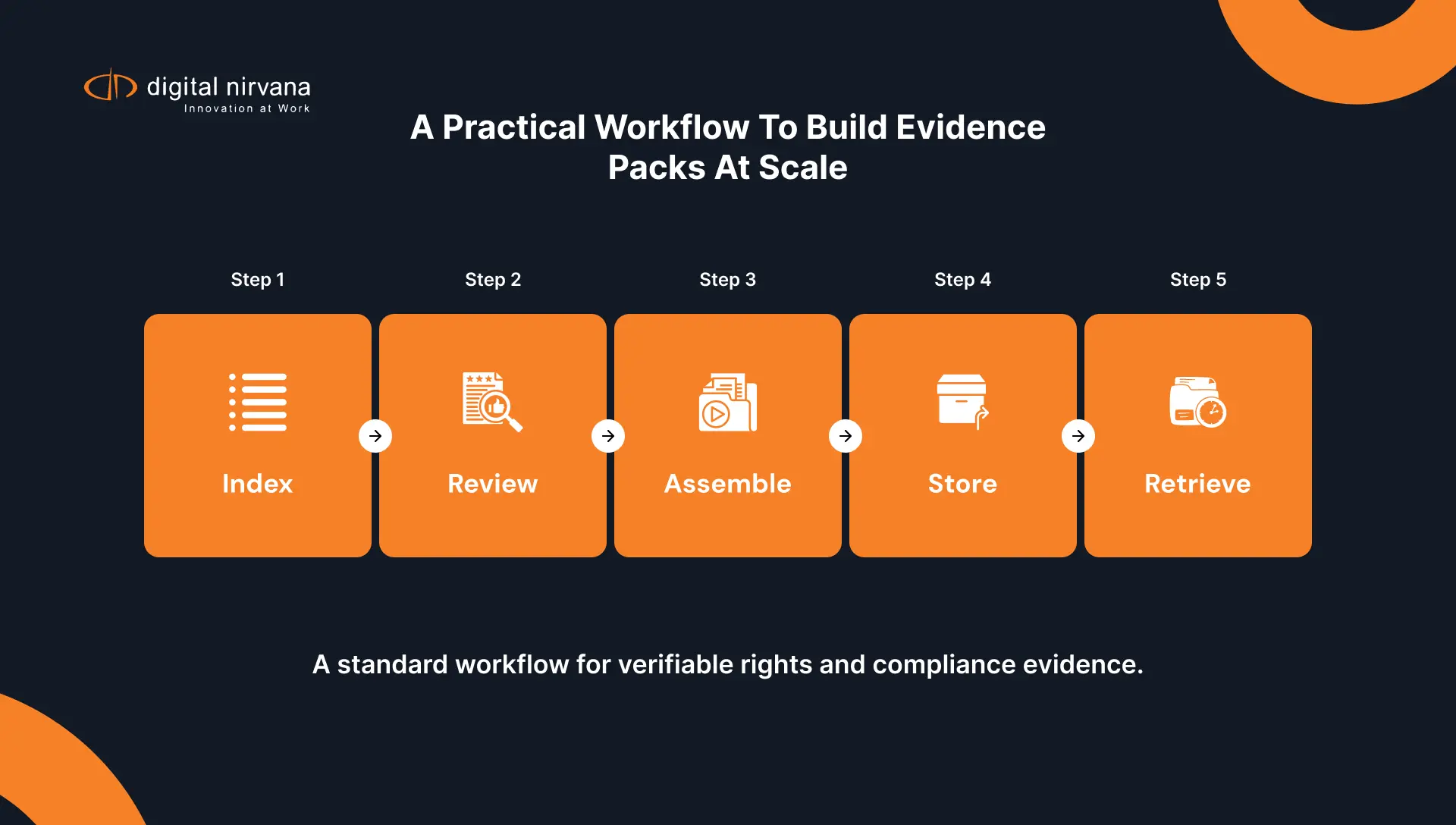
- The trigger. Legal, a sponsor, or a regulator flags a specific spot, statement, or segment that needs verification.
- The search. Instead of scrubbing raw footage, the compliance lead searches indexed metadata by keyword, speaker, logo, or approximate time window.
- The pull. The system returns the exact clip, matched transcript, and technical metadata (resolution, loudness, caption status) tied to that timecode.
- The package. All of it, video segment, transcript excerpt, airtime record, and technical proof, gets exported as one evidence pack.
- The delivery. Legal or compliance sends a defensible, time-stamped package instead of a vague explanation.
What used to take a full day of manual review can now take minutes, because the indexing work happened automatically as the content was ingested, not after the fact when someone went looking for it.
The Measurable Impact of Getting This Right
Teams that move from manual logging to AI-assisted media indexing generally see improvement in three areas that matter most under pressure: response time to disputes, consistency of documentation, and reduced legal exposure from incomplete or unverifiable records.
Faster response time isn’t just a convenience. In compliance disputes, a slow or incomplete answer can look like an admission that something went wrong, even when it didn’t. A precise, quick evidence pack protects the organization’s credibility as much as it protects against penalties.
What to Prioritize When Evaluating an Evidence Pack Solution
Not every metadata tool is built for this use case. When evaluating a system, look for:
- Frame-accurate timecoding, not approximate timestamps
- Searchable transcripts synchronized to video, not separate caption files
- Integration with existing MAM/DAM and playout systems so indexing happens without disrupting existing workflows
- Export-ready packaging that bundles video, transcript, and metadata into one deliverable
- Support for both live and archival content, since disputes can surface months after original airing
Common Objections, Answered
“We already log everything manually, it works for us.” Manual logging works until volume, speed, or scrutiny increases. Most teams don’t feel the gap until a dispute demands an answer faster than their process can deliver one.
“We don’t want to replace our whole monitoring system.” You don’t have to. Modern media indexing tools are built to integrate with existing MAM, DAM, and monitoring infrastructure rather than forcing a rip-and-replace.
“AI-generated transcripts and tags aren’t accurate enough for legal use.” This is a fair concern, and it’s exactly why the strongest workflows pair AI-based transcription and captioning with human review before anything becomes part of an official evidence package.
FAQ
What counts as acceptable evidence for a broadcast compliance dispute? Generally, a timecoded video segment, synchronized transcript, and technical airtime log (channel, date, duration) sourced directly from the original broadcast or platform record.
How far back should archives be searchable? This depends on regulatory requirements and contract terms, but many broadcasters retain searchable, indexed archives for a year or longer to cover ad disputes, political content challenges, and rights inquiries.
Can this process work for live and archived content? Yes. Indexing can happen in near real time during live broadcast or applied retroactively across archived libraries, which is particularly useful for media archives and rights holders revisiting older footage.
Where Digital Nirvana Fits Into This Picture
Building fast, defensible evidence packs depends on having indexing infrastructure in place before a dispute happens, not scrambling to build it afterward. Digital Nirvana’s approach connects AI-powered media indexing with broadcast monitoring and human-reviewed transcription, so the metadata, transcripts, and compliance logs a team needs already exist by the time legal calls.
That means searchable, timecoded metadata across live and archival content, tied directly to proof-of-performance and compliance monitoring workflows, backed by AI microservices that can detect logos, faces, and on-screen text automatically inside every asset. For teams managing high-volume data alongside media, similar data intelligence and cloud engineering support helps keep these systems scalable as archives grow.
Bringing It Together for Media Operations Teams
Compliance, legal, and media operations teams don’t need more raw footage. They need faster access to the right five seconds of it, with proof attached. That’s the real value of pairing AI-powered media indexing with structured evidence packaging: it turns hours of unindexed content into a searchable, defensible resource that’s ready the moment a question comes in. Reviewing recent success stories from broadcasters and OTT platforms shows this shift is already well underway across the industry.
Conclusion
Disputes over what aired, when, and how are not going away. If anything, they’re becoming more frequent as content volume grows and scrutiny tightens across broadcast and streaming platforms. Teams that still rely on manual logging and scattered systems will keep losing time, and sometimes credibility, every time a challenge comes in. Teams that invest in AI-powered media indexing and timecoded evidence packs turn what used to be a scramble into a routine, defensible process.
Key Takeaways
- Timecoded evidence packs combine video segments, transcripts, and metadata into one defensible, time-stamped package.
- Manual logging and fragmented systems slow down response time and weaken the credibility of compliance answers.
- AI-powered media indexing turns hours of raw footage into searchable, frame-accurate metadata as content is ingested.
- The strongest workflows connect media indexing with broadcast compliance monitoring and human-reviewed transcription.
- Prioritize frame-accurate timecoding, synchronized transcripts, and export-ready packaging when evaluating a solution.
- Searchable archives should extend beyond live monitoring to cover disputes that surface months after original airing.