A newsroom producer is 12 minutes from air. She needs a 20 second clip of a senator’s floor speech from three weeks ago. The archive has thousands of hours of raw feed, and the only way to find that clip is to scrub through timecodes by hand or ask whoever logged it that day. This is not a hypothetical. It happens in newsrooms and sports control rooms every single week, and it is almost always a taxonomy problem, not a technology problem.
Metadata tagging only works when it is built on a consistent, well-governed taxonomy. Without one, teams end up with a library full of tags that mean different things to different people, which makes search unreliable no matter how much AI sits underneath it. This post walks through what a metadata tagging taxonomy for news and sports actually looks like, why it matters more than the tagging tool itself, and how to build one that scales.
Why Tagging Without a Taxonomy Falls Apart
Most media organizations already tag content in some form. The problem is that tags get created ad hoc. One editor calls a segment “election2024,” another calls it “election_2024,” and a third calls it “politics_nov.” Search treats these as three different things, and the clip nobody can find might be the one everyone needs.
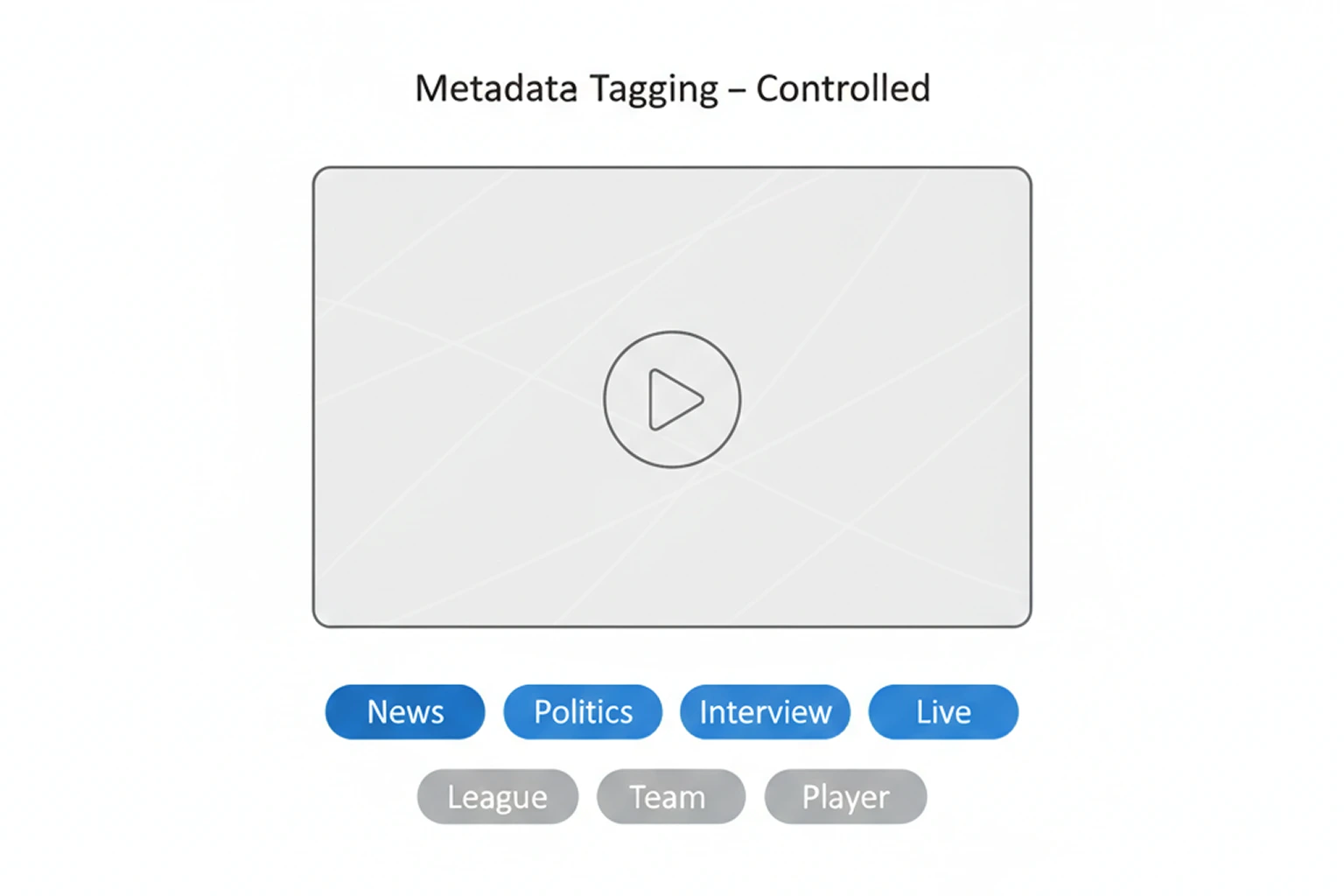
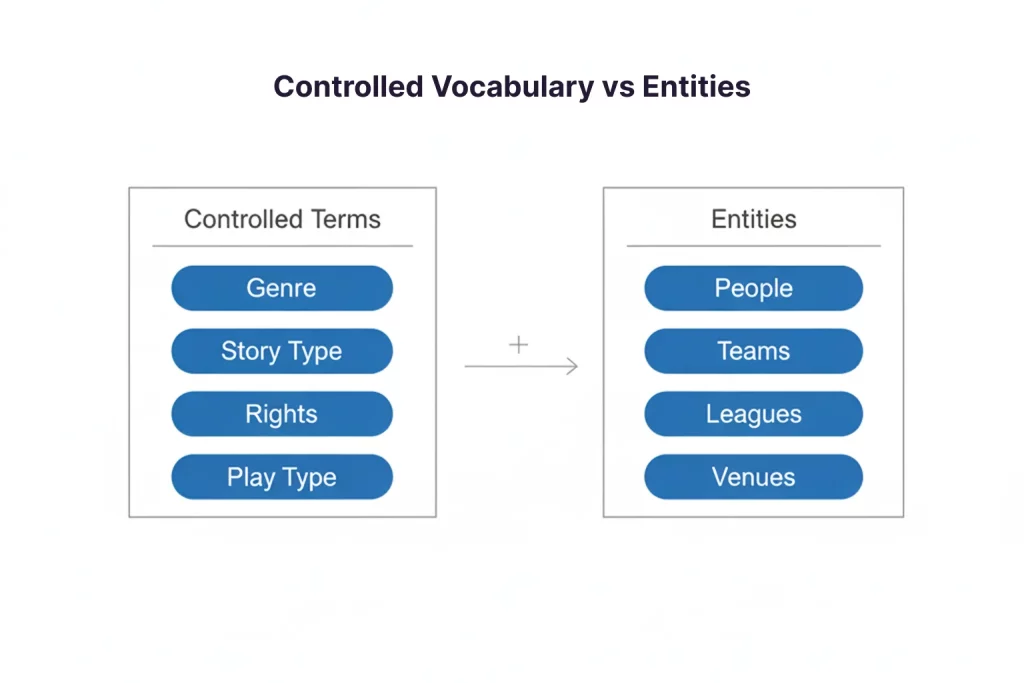
A taxonomy solves this by defining a controlled vocabulary before tagging starts. It sets the categories, the hierarchy between them, and the rules for how new terms get added. Think of it as the grammar of your metadata. Tags are the words, and the taxonomy is what makes those words consistent enough to be searchable at scale.
This distinction matters even more for news and sports, where content volume is high, turnaround windows are short, and the same asset (a player, a location, a public figure, a play type) needs to be findable across months or years of archive.
The Market Context: Why This Is More Urgent Now
Live and archival video volume keeps climbing across news and sports operations, driven by multi-platform distribution, FAST channels, and social-first clipping demands. At the same time, audiences expect near-instant turnaround on highlights and breaking coverage, which puts direct pressure on how fast a team can locate footage.
Regulatory and accessibility expectations (FCC and Ofcom guidance on captioning, for instance) also mean metadata increasingly has to carry compliance-relevant context, not just descriptive tags. A taxonomy built only for “what is in the shot” quickly becomes insufficient when legal, standards, and compliance teams need to query the same archive for a different purpose.
Where Manual and Ad Hoc Tagging Breaks Down
Manual logging has an obvious ceiling. A single log operator can realistically tag a fraction of the live and archival footage a newsroom or sports network generates in a day. Common failure points include:
- Free-text tagging with no controlled vocabulary, so the same entity gets multiple spellings
- No agreed hierarchy, so “NFL,” “football,” and “sports” all live at the same level
- Tags that describe only the obvious (a player’s name) while missing searchable context (formation, play type, sponsor visibility)
- No ownership over who can add new taxonomy terms, so the vocabulary sprawls over time
None of this is a people problem. It is what happens when tagging scales faster than governance.
How a Metadata Tagging Taxonomy Actually Works
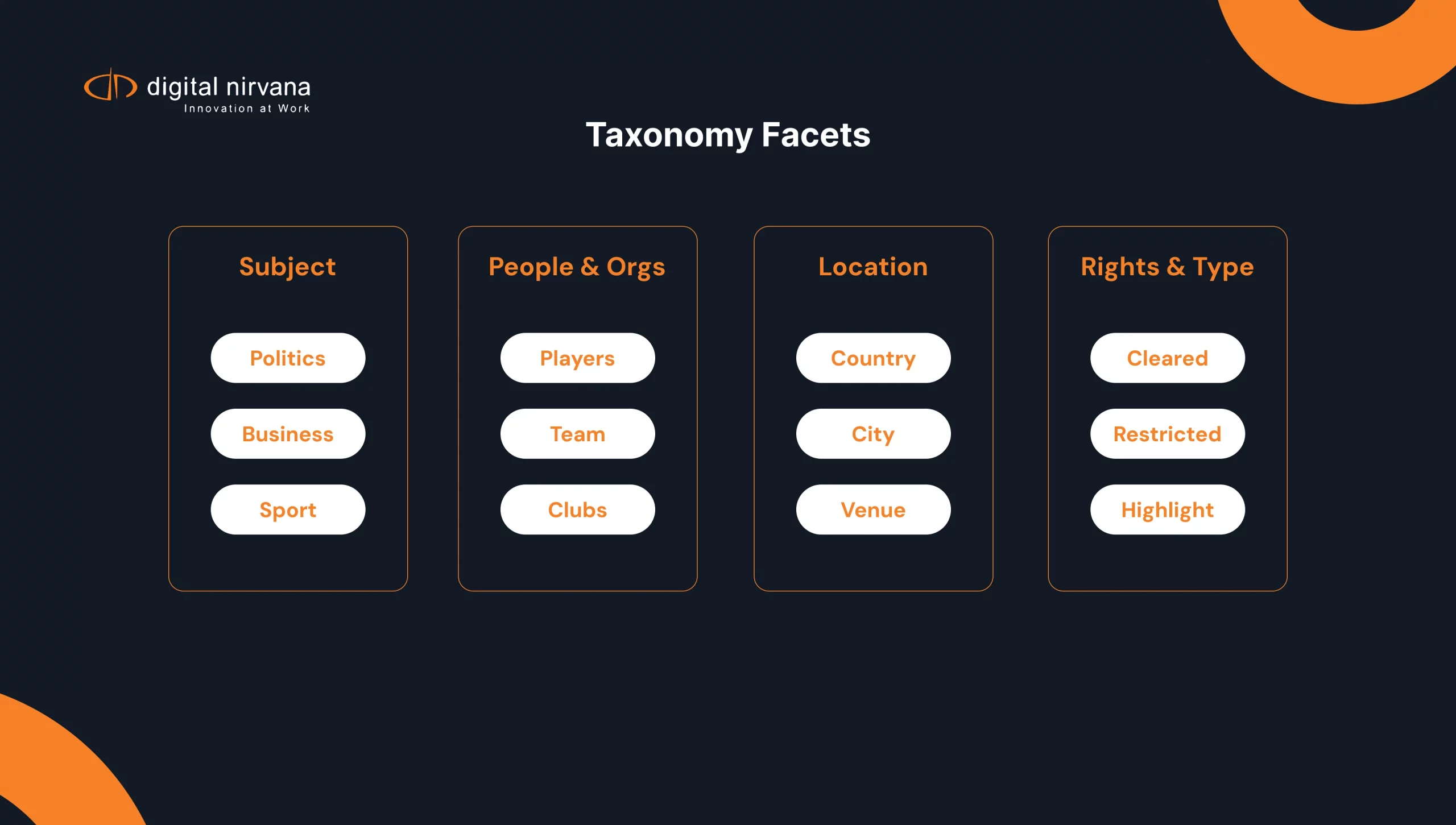
A working taxonomy for news and sports typically organizes around four layers:
- Entity tags – people, teams, organizations, locations, brands and sponsors
- Event tags – game type, segment type, breaking news category, election cycle, tournament round
- Descriptive tags – scene description, action type, on-screen text, visual elements detected through AI (logos, objects, faces)
- Operational tags – rights status, compliance flags, usage restrictions, distribution windows
Each layer has its own governance rules. Entity tags, for example, should map to a controlled list that gets updated centrally rather than created freely by whoever is logging that day. Descriptive tags can lean more heavily on automation, since AI-driven scene detection, OCR, and object recognition are well suited to generating consistent, high-volume descriptive metadata that a human reviewer can verify rather than create from scratch.
This is where automated metadata tagging earns its keep. Solutions like MetadataIQ apply AI to generate consistent tags at ingest, live or archival, and map them into a governed taxonomy instead of leaving tag creation to individual judgment.
A Real-World Workflow: Sports Highlights Under Deadline
Consider a sports production team covering a live game. Every play needs to be searchable within minutes for highlight packages and social clips. With a taxonomy in place:
- Live footage is ingested and automatically tagged by play type, player, and formation
- Sponsor logos and on-field branding are tagged for sponsorship reporting
- Scene and action metadata (a touchdown, a penalty, a replay-worthy moment) is generated as the feed comes in
- The highlights team searches by entity and event tags rather than scrubbing raw footage
The same structure applies to a newsroom during breaking coverage. A taxonomy that separates entity, event, descriptive, and operational tags means a producer can search “senator name + floor speech + this congressional session” and get an exact result, instead of a list of loosely related clips.
Measurable Impact of a Governed Taxonomy
Organizations that move from manual, ad hoc tagging to a governed taxonomy consistently report faster retrieval and better reuse of existing footage. The clearest gains show up in three places: search time per clip, the number of assets that get reused instead of re-shot or re-licensed, and the reduction in duplicate or conflicting tags across teams.
Archive and rights teams in particular benefit, since a well-tagged library becomes a monetizable asset rather than a cost center. Footage that used to sit unused because nobody could find it becomes searchable for licensing, clip sales, or FAST channel packaging.
Implementation Considerations
Rolling out a taxonomy is not a one-time project. A few things matter early:
- Decide who owns the taxonomy (usually a metadata or archive lead, not IT alone)
- Start with your highest-volume content categories first, not the whole library at once
- Build in a review cycle for new terms so the vocabulary doesn’t fragment again in six months
- Make sure your taxonomy integrates with existing MAM or DAM systems and production tools like Avid or Grass Valley, rather than living as a separate spreadsheet
Teams evaluating Cloud Engineering support for this kind of integration should treat taxonomy migration as part of the broader infrastructure conversation, not an afterthought bolted on later.
Key Capabilities to Prioritize
| Capability | Why It Matters | Common Gap |
|---|---|---|
| Controlled vocabulary management | Prevents duplicate or conflicting tags | Free-text tagging with no central list |
| AI-assisted descriptive tagging | Scales tagging beyond manual capacity | Manual logging can’t keep pace with volume |
| Hierarchical category structure | Makes broad and narrow searches both possible | Flat tag lists with no parent-child relationships |
| MAM/DAM and NLE integration | Keeps metadata usable inside existing workflows | Taxonomy lives outside the tools editors actually use |
| Governance and ownership | Keeps the taxonomy consistent over time | No one is accountable for new term approval |
Common Objections, Answered
“Our editors already tag things well enough.” Manual tagging usually works until volume or turnaround pressure increases. A taxonomy protects that quality at scale instead of relying on individual habits.
“We don’t want to rebuild our whole archive.” A taxonomy can be layered onto existing metadata over time, starting with the highest-value or highest-traffic content first.
“AI tagging will get things wrong.” This is why a governed taxonomy pairs AI-generated tags with human review, particularly for entity and compliance-sensitive categories, rather than trusting automation blindly.
Success Metrics to Track
Once a taxonomy is in place, track average search time per clip, percentage of archive footage reused versus re-shot, number of tag disputes or corrections per month, and how quickly new content categories (a new sponsor, a new segment format) get formally added to the vocabulary. A shrinking correction rate over time is usually the clearest sign the taxonomy is holding up.
Where This Fits Into a Broader Media Intelligence Strategy
A metadata taxonomy is the foundation, but it works best alongside the AI capabilities that generate and apply those tags at scale. MetadataIQ is built specifically for high-volume media indexing and search across live and archival content, which is exactly the kind of environment where taxonomy discipline pays off fastest. For teams that also need scene descriptions, object and logo recognition, or OCR to feed that taxonomy, MediaServicesIQ handles the AI/ML layer that generates descriptive metadata automatically.
Compliance-sensitive tags, like political mentions or sponsor visibility, often need to connect to broadcast monitoring workflows as well. That’s where MonitorIQ supports proof-of-performance and content monitoring alongside archive metadata. And for organizations sitting on years of under-tagged footage, pairing taxonomy work with Media Enrichment services can help close the backlog with managed, human-reviewed tagging rather than starting from zero internally.
Why This Matters for Digital Nirvana Customers Specifically
News and sports organizations that have worked through this exact problem consistently land on the same conclusion: a taxonomy is only as strong as the systems enforcing it day to day. Digital Nirvana’s approach combines AI-driven tagging with human-in-the-loop review, so the taxonomy doesn’t drift as new content categories, sponsors, or story types get added. This matters most for archive and rights teams trying to turn dormant footage into a monetizable library, and for live production teams who need metadata generated in real time, not applied after the fact. Case examples across broadcast, OTT, and sports customers are detailed in Digital Nirvana’s success stories, which show how this plays out across different content volumes and workflows.
Conclusion
A metadata tagging taxonomy is not a nice-to-have for news and sports organizations working at any real scale. It’s the difference between an archive that gets used and one that quietly becomes dead weight. The tools that generate tags matter, but they only deliver value when there is a governed structure underneath them that keeps every tag consistent, searchable, and useful six months or six years from now.
Key Takeaways
- Tagging without a controlled taxonomy leads to inconsistent, unsearchable metadata, regardless of how much AI is involved
- A working taxonomy separates entity, event, descriptive, and operational tags, each with its own governance rules
- AI-assisted tagging scales descriptive metadata generation, but human review still matters for entity and compliance-sensitive tags
- Start taxonomy rollouts with your highest-volume content, not the entire archive at once
- Track search time, reuse rate, and tag correction frequency to know if the taxonomy is actually working
FAQ
What is a metadata taxonomy in media operations? It’s a controlled, hierarchical structure of tags and categories used to describe media assets consistently, so that search and retrieval work reliably across an entire archive.
How is a taxonomy different from tagging itself? Tagging is applying labels to content. A taxonomy is the governed vocabulary and structure that determines what those labels are and how they relate to each other.
Can AI generate a full taxonomy on its own? AI is well suited to generating descriptive tags at scale (scenes, objects, faces, logos), but the taxonomy structure itself still needs human governance, especially for entity and compliance categories.
How long does it take to implement a taxonomy across an existing archive? It varies by archive size, but most teams start with their highest-traffic content categories first and expand over several months rather than attempting a full migration at once.