A media archive manager gets a call from a licensing partner asking for every clip of a specific stadium exterior shot from the last five years of game coverage. The footage exists somewhere across thousands of hours of raw video. Without an index, that request means days of manual scrubbing, or worse, a quiet “we can’t locate that” reply that costs the deal.
This is the exact problem media indexing was built to solve, and it’s become one of the most searched, most misunderstood terms in media operations. Teams often use “metadata,” “tagging,” and “indexing” interchangeably, which makes it hard to know what you actually need when your archive stops being searchable at scale.
This guide breaks down what media indexing actually means, how it differs from related terms like metadata tagging, why it matters more now than it did five years ago, and what a modern, AI-powered indexing workflow looks like for broadcasters, archives, and post-production teams.
What Does Media Indexing Actually Mean?
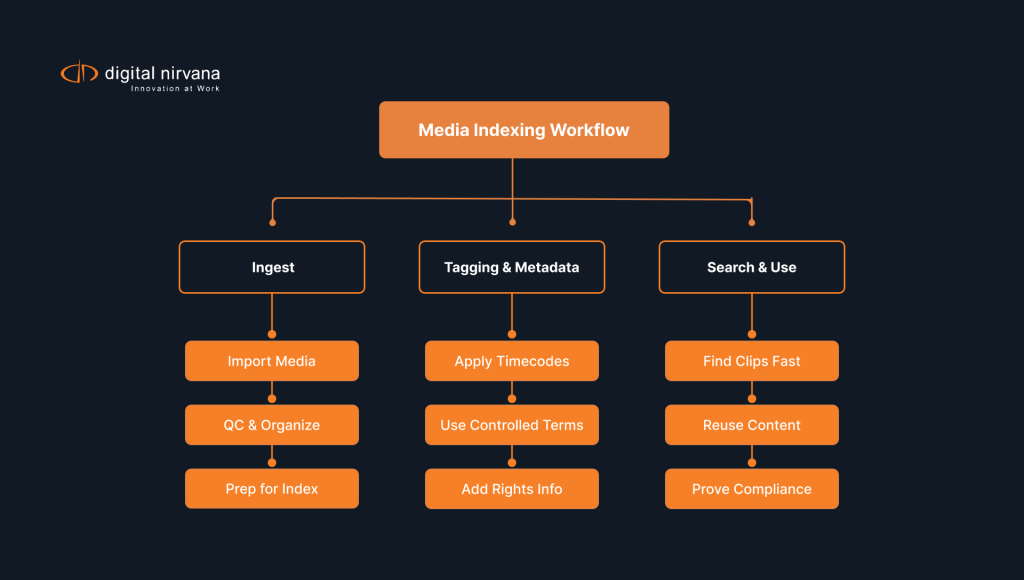
Media indexing is the process of analyzing audio and video content and organizing it into a searchable structure, typically built around time-coded metadata, so that specific moments, people, objects, or topics inside that content can be located quickly without watching the footage in full.
Think of it the way a library catalog works for books, except instead of organizing by title and author, media indexing organizes by what actually happens inside the content: who’s speaking, what’s shown on screen, what topics come up, where scene changes occur, and when specific visual or audio events take place.
A properly indexed video isn’t just tagged with a title and a description. It’s broken down into a searchable, time-coded map of everything meaningful inside it, so a search for “stadium exterior” or “CEO mentions Q3 earnings” returns the exact timestamp, not just the file it lives in.
Media Indexing vs. Metadata Tagging vs. Transcription: Clearing Up the Confusion
These three terms get used loosely, and the overlap causes real confusion when teams are evaluating tools or building a workflow.
Transcription converts spoken audio into text. It’s a component of indexing, not the whole picture, since it only captures what’s said, not what’s shown.
Metadata tagging applies descriptive labels to a media asset, sometimes at the file level (title, date, category) and sometimes at a more granular level (specific tags for people, locations, or topics). Tagging can exist without deep time-coded structure.
Media indexing combines both of these, plus visual analysis (scene detection, object and face recognition, on-screen text), into a unified, time-coded, searchable structure. It’s the umbrella process that makes an archive genuinely searchable rather than just labeled.
| Term | What It Captures | Searchable By |
| Transcription | Spoken audio as text | Keywords in dialogue |
| Metadata tagging | Descriptive labels on the asset | Tags, categories, titles |
| Media indexing | Transcription + tagging + visual analysis, time-coded | Specific moments, people, objects, topics, scenes |
Why Media Indexing Matters More Than It Used To
A few shifts in how media gets produced and monetized have made indexing a core operational requirement rather than a nice-to-have.
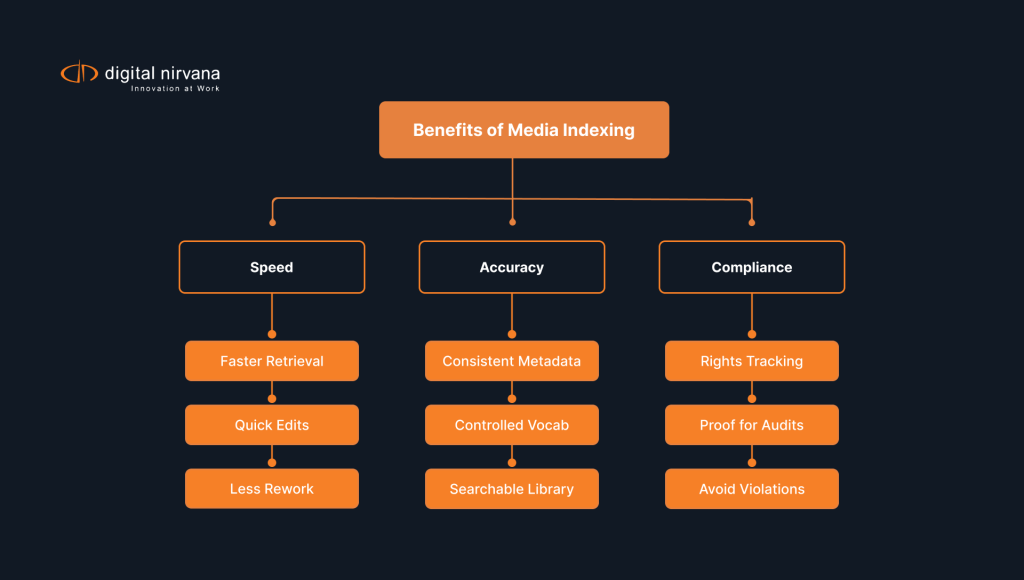
Content volume has grown dramatically. Broadcasters, sports leagues, and OTT platforms generate far more raw footage per week than they did even a few years ago, and manual logging simply cannot keep pace with that volume.
Monetization increasingly depends on findability. Archive licensing, highlight generation, and content repurposing all depend on being able to locate a specific moment quickly. An archive that isn’t indexed is effectively an archive that can’t be monetized, regardless of how much valuable footage it contains.
Compliance and legal review also depend on search. Political mentions, disclosures, sensitive content flags, and discovery requests all require the ability to search across historical footage quickly, not scrub through it manually under deadline pressure.
How Media Indexing Actually Works
A modern indexing pipeline layers several forms of AI analysis on top of raw audio and video as it’s ingested.
Automatic speech recognition transcribes dialogue and commentary into searchable, time-coded text. Scene detection identifies changes in camera angle, setting, or visual context throughout the footage. Object, face, and logo recognition tags specific people, brands, and items as they appear on screen. Optical character recognition captures on-screen text like chyrons, scoreboards, and graphics. And natural language processing analyzes the transcript for topics, named entities, and themes, adding a semantic search layer on top of literal keyword matching.
Together, these layers turn a flat video file into a structured, queryable dataset. A search for “sponsor logo, third quarter” or “CEO discussing supply chain” returns exact timestamps instead of requiring a human to know where to look in the first place.
Platforms such as MetadataIQ are built specifically around this kind of AI-driven media indexing, combining tagging, search, and quality scoring with integrations across MAM, DAM, and PAM systems so the indexing happens inside the same environment teams already use for asset management. For teams that need the underlying AI capabilities (ASR, OCR, scene and object detection) available as standalone components, MediaServicesIQ offers those functions through APIs that plug into existing workflows.
A Real-World Example: Indexing a Sports Archive
Consider a regional sports network sitting on fifteen years of unindexed game footage. A sponsor asks for every clip in which their signage is visible during the final two minutes of a close game, across the entire archive, for a retrospective campaign.
Without indexing, that request is functionally impossible to fulfill within a reasonable timeframe. With an indexed archive, the same request becomes a search query: logo detection plus game-clock metadata plus score-margin data, filtered across fifteen years of footage. What would have taken weeks of manual review returns results in minutes, and footage that had been sitting as a cost center suddenly becomes a revenue opportunity.
This is the pattern across most media indexing use cases: the value isn’t in the indexing itself, it’s in what becomes possible once the archive is searchable. Reviewing Digital Nirvana’s success stories shows this same shift playing out across broadcasters, sports organizations, and archives that moved from unsearchable footage to indexed, monetizable libraries.

Measurable Impact of a Properly Indexed Archive
Teams that move from manual or partial indexing to a full AI-driven indexing workflow typically see dramatic reductions in search time, often from hours down to seconds or minutes for a specific query. Archive licensing requests that used to take days to fulfill get answered the same day. Highlight and clip production speeds up significantly because producers search instead of scrub. And compliance teams gain the ability to search historical footage for sensitive content or disclosures on demand rather than relying on institutional memory of where things are.
Traditional Indexing Approaches and Their Limitations
Manual cataloging, where human loggers watch footage and record metadata by hand, remains accurate but doesn’t scale. It works for small, low-volume archives but becomes untenable once content volume grows past what a logging team can realistically review.
Basic keyword tagging without time-coding gets an archive partially searchable at the file level, but it still leaves teams scrubbing within a file to find the specific moment they need. Transcription-only tools solve the spoken-word search problem but miss everything visual, which matters enormously for sports, news, and any content where the meaningful moment isn’t necessarily narrated.
The workflow that actually scales combines automated speech recognition, visual analysis, and time-coded structure into one indexed system, with a human quality review layer for high-stakes or ambiguous content.

Key Capabilities to Prioritize When Evaluating an Indexing Solution
When comparing media indexing tools, prioritize platforms that support both live and archive processing, not just batch indexing of already-completed content. Look for visual analysis capabilities (scene, object, face, and logo detection) alongside transcription, since text-only indexing misses a large share of what matters in video content. Confirm the platform integrates with your existing MAM, DAM, or PAM system rather than requiring a separate silo for indexed assets. And check for quality scoring or confidence metrics on automated tags, since not all AI-generated metadata carries the same reliability, particularly for names, brands, and less common terminology.
Implementation Checklist
- Audit current archive size and identify what percentage is currently searchable at the moment level (not just file level)
- Confirm the indexing platform integrates with your existing MAM, DAM, or PAM system
- Decide which visual analysis layers matter most for your content (face recognition for sports and news, logo detection for ad and sponsor content, OCR for graphics-heavy content)
- Establish a human QC process for high-stakes or ambiguous automated tags
- Prioritize indexing your highest-value or most-requested archive segments first rather than attempting a full backlog at once
- Set internal search benchmarks (time to locate a specific moment) to measure improvement over time
Common Objections, Addressed
“We already tag our content.” Tagging at the file level tells you what a video is about, not where a specific moment lives inside it. Full indexing adds the time-coded, moment-level searchability that file-level tagging can’t provide on its own.
“Our archive is too large to index retroactively.” Most teams don’t need to index an entire historical archive at once. Prioritizing high-value or frequently requested segments first delivers immediate value while the rest of the archive gets indexed incrementally.
“AI tagging isn’t accurate enough for our needs.” Modern indexing platforms pair automated tagging with quality scoring and optional human review layers, which means teams can apply more scrutiny to high-stakes content while letting automation handle high-volume, lower-risk tagging.
How This Connects to Digital Nirvana’s Approach
Media indexing sits at the center of how Digital Nirvana approaches media operations. MetadataIQ handles the core indexing workflow, combining AI tagging, search, and quality scoring with direct MAM and DAM integration. Broadcasters that also need live compliance visibility alongside indexing often pair this with MonitorIQ for QoE, loudness, and proof-of-performance monitoring across the same content. Teams whose indexing needs include accurate transcripts as a foundation layer benefit from TranceIQ, since a clean transcript strengthens every downstream search and tagging function.
For organizations managing large volumes of unstructured data beyond media assets, the same indexing principles extend into Data Intelligence workflows built around data labeling and validation. And teams running AI-generated metadata at scale often add a Managed AI review layer to keep automated tagging accurate and audit-ready as archive volume grows.
Why Indexing Is the Foundation, Not the Finish Line
It’s worth remembering that indexing isn’t the end goal, it’s the infrastructure that makes everything else possible. A well-indexed archive supports faster highlight production, new licensing revenue, stronger compliance posture, and better audience discovery, all built on the same underlying searchable structure. Teams that treat indexing as a one-time project rather than an ongoing part of the ingest workflow tend to fall behind quickly, since every new piece of unindexed content adds to the same searchability gap that started the problem in the first place. Building indexing into the ingest pipeline from day one, rather than treating it as a backlog to clear later, is what separates archives that stay valuable from ones that quietly become unusable.
FAQ
What is the difference between media indexing and metadata tagging? Metadata tagging applies descriptive labels to a media asset, often at the file level. Media indexing goes further, combining tagging with transcription and visual analysis into a time-coded structure that makes specific moments inside the content searchable, not just the file itself.
Is media indexing the same as transcription? No. Transcription converts spoken audio into text and is one component of indexing, but full indexing also includes visual analysis like scene detection, object and face recognition, and on-screen text capture.
How long does it take to index an existing video archive? This depends on archive size and the depth of analysis applied, but most teams index in phases, prioritizing high-value or frequently requested content first rather than processing an entire historical archive at once.
Can media indexing work with live broadcast content, not just archived footage? Yes. Modern indexing platforms support both live and archive processing, tagging content in near real time as it’s broadcast or ingested, in addition to indexing historical footage.
Conclusion
Media indexing means turning raw audio and video into a searchable, time-coded structure that makes every moment inside your content findable, not just the file it lives in. As content volume grows and monetization increasingly depends on findability, indexing has shifted from a nice-to-have archival practice to a core operational requirement. Teams that build AI-driven indexing into their ingest workflow, backed by a human quality layer for high-stakes content, turn their archives from a cost center into one of their most valuable assets.
Key Takeaways
- Media indexing combines transcription, metadata tagging, and visual analysis into a searchable, time-coded structure, not just file-level labels.
- It differs from transcription and tagging alone by capturing what’s shown on screen, not just what’s said.
- Growing content volume and monetization needs have made indexing a core operational requirement rather than an optional archival step.
- A modern indexing pipeline layers ASR, scene detection, object and face recognition, and OCR to build a fully searchable archive.
- Prioritizing high-value archive segments first delivers faster ROI than attempting to index an entire historical backlog at once.
- A hybrid AI-plus-human-review model keeps automated tagging accurate for high-stakes or ambiguous content.