Most content teams start their localization journey with subtitles. It’s fast, relatively inexpensive, and often enough to test new markets.
But at some point, subtitles alone stop moving the needle.
You see strong interest from specific regions, kids, and casual viewers drop off quickly, or your competitors launch dubbed versions that suddenly pull ahead.
That’s the moment you have to ask a different question:
Is it time to invest in dubbing, and if so, where, for which titles, and at what level of quality?
The dubbing and subtitling market is projected to grow at an 8.3% CAGR between 2022 and 2030, driven by demand for multilingual content on OTT and streaming platforms. Platforms like Netflix now offer subtitles and dubbing in 30+ languages for many titles, because almost one-third of their viewership comes from non-English shows.
At Digital Nirvana, our Subs & Dubs solution is built for exactly this decision point: helping you move beyond “subs only” with AI-powered dubbing plus human-in-the-loop quality control, so you can scale global audio without blowing up the budget.
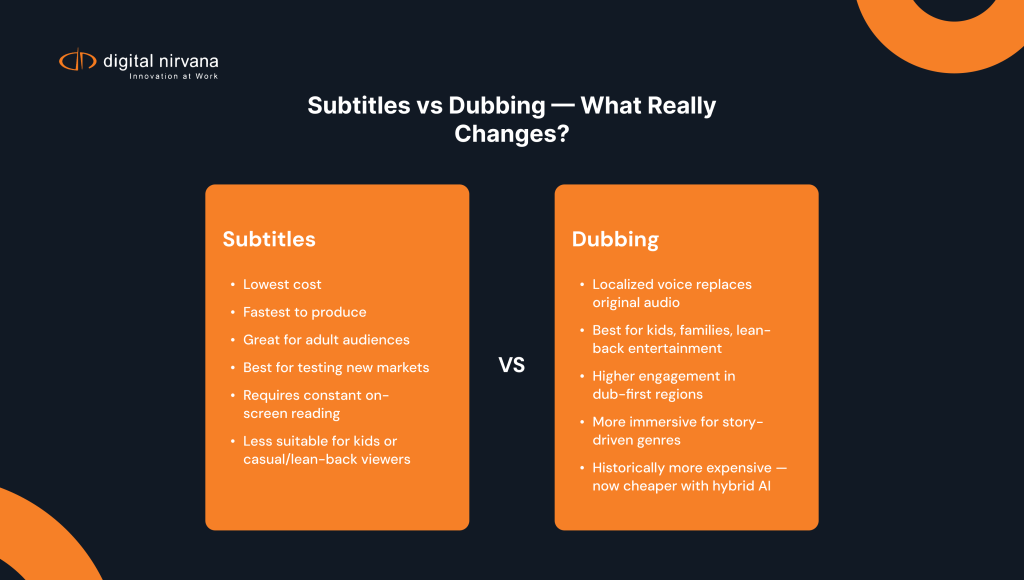
Subtitles vs dubbing: what really changes when you invest in dubbing?
Subtitles and dubbing do the same job, making content understandable, but they feel very different to viewers.
Subtitles:
- Fast and cost-effective
- Great for audiences comfortable with reading on-screen text
- Still the default starting point for most OTT and streaming localization strategies.
Dubbing:
- Replaces or layers over the original audio with localized voices
- Better suited for younger audiences who can’t read quickly yet, and for viewers who find subtitles distracting
- Often preferred in “dub-first” markets and for high-value entertainment content
Traditional dubbing can cost up to 15x more than subtitling, once you factor in studios, voice talent, and post-audio. That’s why many organizations delay or avoid dubbing even when the audience is clearly asking for it.
The good news: hybrid AI dubbing models and platforms like Subs & Dubs are changing that cost equation, making it practical to invest in dubbing for more titles and markets than before.
Why are more platforms investing in dubbing now
A few macro trends are pushing dubbing from “nice to have” to “competitive necessity”:
- Global streaming platforms see massive engagement with non-English content, and viewers increasingly expect polished local-language audio as a standard feature.
- Studies report that, when given a choice, a large majority of viewers prefer dubbed content over subtitles in many markets, especially for lean-back entertainment.
- New tools, such as AI speech synthesis, voice cloning, and human-in-the-loop QC, let teams deliver dubbing faster and at lower cost without sacrificing natural performance.
So the real question isn’t “subs or dubs forever?” It’s: Where in your catalog does it actually pay off to invest in dubbing right now?
6 clear signs it’s time to invest in dubbing
Use these as a practical checklist.
1. Your growth markets are “dub-first” cultures
In many European and Latin American markets, audiences are historically more comfortable with dubbed audio than subtitles, especially for mainstream TV and film.
Signals to watch:
- High traffic from these regions, but lower-than-expected completion rates
- Viewer feedback asking specifically for local-language audio
- Competitors are launching dubbed versions for the same markets
If you see strong organic demand from these territories, continuing with subtitles alone may cap your growth.
2. Your slate includes kids’ content or family viewing
Subtitles don’t work for:
- Young children who can’t read fluently yet
- Parents who want kids to follow the story without help
- Fast-paced, visually dense animation or slapstick comedy
This is why most children’s programming is dubbed rather than subtitled globally.
If you’re spending real budget on kids’ content or family IP, dubbing isn’t a luxury; it’s table stakes.
3. Engagement with subtitled versions has plateaued
Sometimes the data tells you it’s time to invest in dubbing:
- Viewers click into subtitled content but drop off early
- Average watch time for subtitled titles lags far behind local-language originals
- You see strong trailer views but weak completion on the actual episodes
Industry data suggests that dubbed content can deliver higher watch-through rates and longer session times in certain regions than subtitles alone. When you’ve already optimized thumbnails, marketing, and metadata, but engagement still lags, dubbing becomes a smart test, not just a cost line.
4. You’re competing directly with dubbed alternatives
If your audience can choose between:
- A competitor’s fully dubbed series
- Your version with only subtitles
…you’re likely losing viewers who prefer to lean back and listen rather than read.
This is especially true in crowded genres like drama, telenovelas, anime, and kids’ animation, where dubbed experiences are the norm.
If the market sets a dubbing standard, not investing in dubbing becomes a competitive risk.
5. You’re building long-tail libraries and FAST channels
The economics of dubbing improve when:
- You’ll exploit content for years, not weeks
- The same title appears across multiple platforms (OTT, FAST, linear, YouTube)
- You can repurpose dubbed assets into promos, trailers, and localized marketing.
Dubbing becomes less about a single campaign and more about increasing lifetime value per asset. Industry reports show that subtitling and dubbing together often account for less than 3% of overall content budgets, yet strongly influence reach and monetization.
If you’re building a long-tail or evergreen library, this is precisely when it makes sense to invest in dubbing for your best-performing titles.
6. Accessibility and brand experience are core to your strategy
Subtitles are crucial for accessibility, but they’re not the whole picture:
- Viewers with specific visual or cognitive impairments may struggle with fast subtitles
- Heavily stylized visuals, lower-thirds, and on-screen text can make subtitles overwhelming
- Brand-driven content may rely on voice, tone, and emotion that land better in localized audio
Dubbing lets you match your brand voice to each market, not just translate words on screen. AI + human workflows let you clone or cast voices that remain consistent across campaigns and seasons, which is hard to achieve with subs alone.
How AI + human workflows change the economics of dubbing
For many organizations, the main objection to investing in dubbing is cost and speed.
Traditional dubbing:
- Studio time, casting, direction, multiple review passes
- Weeks of scheduling for even a single episode
- Significantly higher per-minute cost than subtitling.
Hybrid AI dubbing, as described in Digital Nirvana’s own 2025 dubbing playbook, works differently:
- AI models handle transcription, first-pass translation, timing, and draft voice synthesis
- Human linguists and directors refine meaning, tone, and key lines
- Audio engineers focus on mix, loudness, and lip-sync where it really matters.
With Subs & Dubs, that hybrid model is baked in:
- AI-powered subtitling and dubbing in 60+ languages
- Up to 10x faster localization compared to traditional workflows
- Up to 50% cost savings today, with potential to reach 75% as automation improves.
That means you can invest in dubbing where it counts, top markets, high-value IP, and kids/family content without needing a Hollywood-sized budget.
How to prioritize what to dub (and what to keep subtitled)
A simple way to plan your first investment in dubbing:
1. Segment your catalog:
- Tier A: Flagship shows, kids’ content, high-volume courses, or premium originals
- Tier B: Solid performers, niche genres, evergreen library titles
- Tier C: Experimental or low-stakes content, internal training, or short-lived campaigns
2. Overlay market data:
- Where do you already see strong traction?
- Which regions show dub-first preferences or express a clear desire for local audio?
3. Decide per segment:
- Tier A in dub-first markets: Invest in dubbing with a hybrid AI + human workflow
- Tier B: Pilot dubbing for a subset of languages; keep subs everywhere else
- Tier C: Stick with subtitles only, or use lighter AI-only dubbing where appropriate
This avoids an all-or-nothing approach and lets you invest in dubbing where ROI is most apparent.
Why choose Digital Nirvana’s Subs & Dubs when you’re ready to invest in dubbing?
Subs & Dubs is built for teams who want to move beyond subtitles without building their own dubbing studio from scratch.
From the product page and broader localization portfolio, here’s what you can lean on:
- AI-powered subtitles & dubbing
Generate precise subtitles and natural-sounding dubs in 60+ languages, driven by AI and refined by human experts. - Hybrid AI + human-in-the-loop workflow
Achieve up to 10x faster turnaround with AI automation, while human reviewers protect tone, cultural nuance, and performance. - Cost-effective scaling
Save up to 50% compared to traditional dubbing, with a roadmap toward even higher efficiencies as models improve. - One-stop localization stack
Access transcription, captioning, subtitling, translation, and dubbing in a single pipeline, integrated with tools like TranceIQ and Digital Nirvana’s media enrichment solutions. - High-quality speech synthesis & voice cloning
Use advanced speech synthesis with human QC to avoid the “robotic dub” problem and maintain a consistent brand or character voice. - Flexible integration
Work with a variety of content platforms and formats, including OTT and FAST, eLearning, and enterprise video.
In other words, when you decide it’s finally time to invest in dubbing, Subs & Dubs gives you a production-ready, AI-accelerated pipeline instead of a blank sheet of paper.
FAQs: When should you invest in dubbing, and how does Subs & Dubs help?
Not always. Subtitles are still the right choice when you’re testing a new market with a limited budget, when your audience is culturally used to reading subtitles (such as in some Nordic regions), or when the content is short, technical, or primarily informational. Dubbing makes more sense when you’re targeting kids and family viewing, working in dub-preferred regions, or localizing premium, story-driven content where a fully native viewing experience matters. In practice, most mature localization strategies use both: subtitles almost everywhere, and dubbing where it clearly pays off.
It’s usually the right time to explore dubbing when you see strong viewership from one or more non-native language markets, but lower completion rates or watch time on subtitled versions. Clear competitive pressure from dubbed alternatives and a long-term exploitation plan for the content across multiple platforms (over years, not weeks) are also strong signals. If you can confidently check two or more of these boxes for a given title or market, it’s likely time to at least pilot dubbing.
You don’t need to jump into 20 languages from day one. Most teams start with one or two core growth markets where demand or revenue potential is most apparent, and focus on kids/family or flagship titles that justify a higher investment in experience. A common approach is to run a pilot comparing subtitled and dubbed performance on metrics such as watch time, retention, and conversions. Subs & Dubs is designed to scale from a small pilot to complete catalog runs, so starting small is not just acceptable—it’s expected.
You should absolutely keep subtitles. Best practice is to always offer subtitles for accessibility, search, and user preference, and then layer dubbing on top for the markets, genres, or age groups where you know it will increase engagement. Major platforms like Netflix already expose complete language lists for both subtitles and dubbing on TV apps, allowing viewers to choose the combination that works best for them.
AI-only dubbing can sound flat or robotic if it’s left on autopilot. Subs & Dubs avoids this by using high-quality speech synthesis and voice cloning as a starting point, then adding human-in-the-loop review for critical lines, emotional beats, and overall tone. Audio post-production and lip-sync rules are tuned to the genre—for example, stricter sync for drama and more flexible treatment for explainers. This hybrid approach preserves the speed and cost advantages of AI while maintaining a natural, believable listening experience.
Some content types can still benefit from dubbing, but they’re usually better suited to a human-heavy approach. Prestige drama and theatrical releases, comedy that depends on timing, wordplay, or local references, and high-stakes brand films where tone and nuance must be perfect all fall into this category. In these cases, AI can still help with script preparation, timing, and basic passes, while human actors and directors handle the final performance—exactly the hybrid model outlined in Digital Nirvana’s hybrid AI dubbing guidance.
Timelines depend on factors like content length, the number of target languages, whether you need strict lip-sync or can work with more flexible narration, and how many review rounds you require. Because Subs & Dubs combines AI automation with human review, many customers experience turnaround times up to ten times faster than traditional, fully manual dubbing pipelines. A typical pattern is to select one or two titles and one or two languages, run a pilot with clear quality and timing targets, and then compare performance and cost against your existing subtitling-only approach.