A sports desk producer gets a text at 9:47 PM. The client wants a 30-second sponsor cut of the game-winning goal, tagged with the sponsor’s logo visible, ready for social by 10:00 PM. The clip lives somewhere inside four hours of raw match footage. Thirteen minutes on the clock. No time to scrub timelines by hand.
This is the reality for newsrooms, sports broadcasters, and streaming platforms every single day. Live content moves fast, and if your metadata can’t move with it, you lose the moment, the engagement, and sometimes the client.
Real-time metadata has quietly become the difference between teams that publish while a story is still trending and teams that publish after the internet has already moved on. This blog breaks down what real-time metadata actually means for live news, sports, and streaming operations, why manual workflows can’t keep pace anymore, and what a modern metadata pipeline looks like in practice.
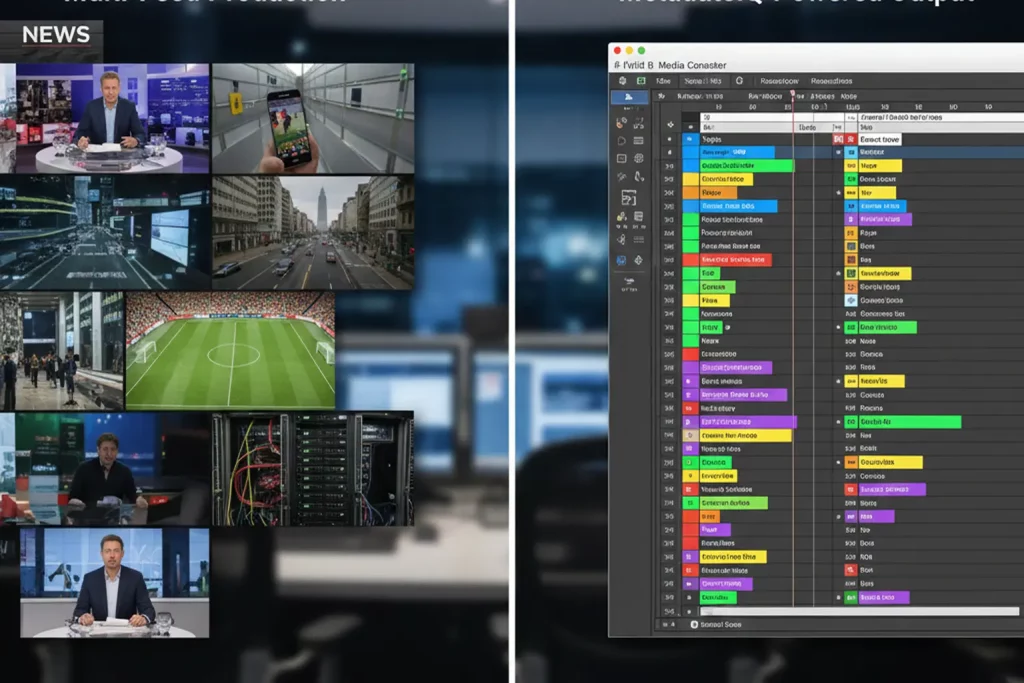
Why Live Content Breaks Traditional Metadata Workflows
Traditional metadata tagging was built for a slower media world. Editors would review footage after the fact, apply keywords, log timecodes, and file it away for later retrieval. That process works reasonably well for on-demand content with no urgency attached to it.
Live news, live sports, and live-to-streaming events don’t offer that luxury. A goal, a breaking headline, or a viral on-air moment needs to be discoverable within seconds, not hours. When metadata tagging happens after the broadcast instead of during it, teams lose the window where the content is most valuable: while the story is still live and audiences are still watching.
The cost isn’t abstract. Missed sponsor deadlines mean damaged client relationships. Delayed breaking-news clips mean lost audience share to faster competitors. Untagged archive footage from a live event becomes nearly impossible to find six months later when a licensing opportunity comes up.
What Real-Time Metadata Actually Means
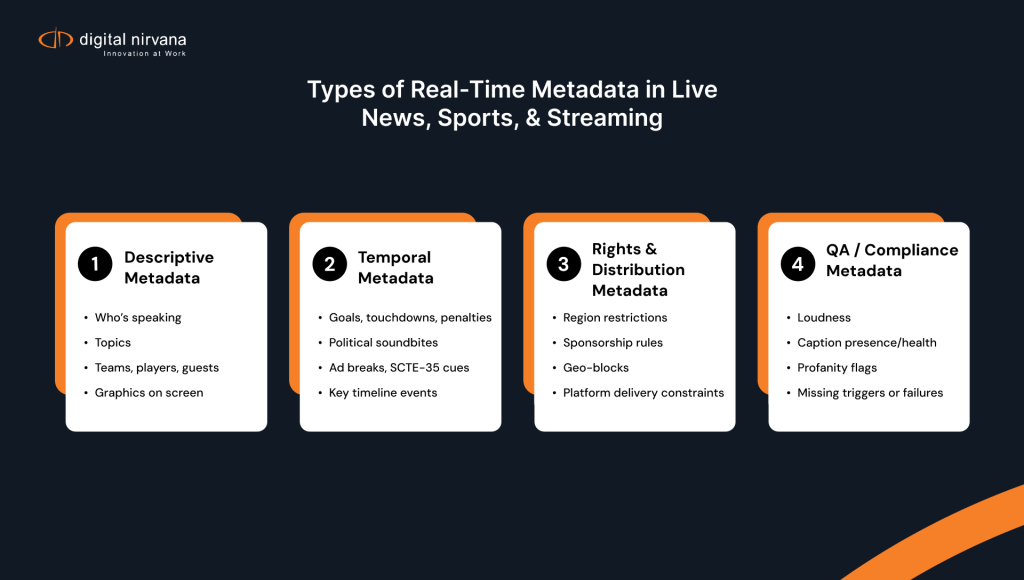
Real-time metadata is the automated generation of searchable, time-coded information (transcripts, speaker identification, on-screen text, object and logo detection, scene changes, player and location recognition) as content is being ingested or broadcast, rather than after the fact.
Instead of an editor manually logging “goal scored, minute 78, home team,” a real-time metadata engine listens to commentary, reads on-screen graphics, detects the crowd reaction spike, and tags the moment automatically, often before the broadcast segment has even ended. Platforms like MetadataIQ are built to handle both live and archive processing, with integrations across Avid, Grass Valley, and other MAM and DAM systems, which means the tagging happens inside the same pipeline producers already use, not as a separate manual step bolted on afterward.
This matters because the value of live content decays fast. A clip that takes two hours to locate and package has a fraction of the engagement potential of one published within minutes.
The Market Context: Why This Is Becoming Non-Negotiable
A few converging trends have made real-time metadata a baseline requirement rather than a nice-to-have.
Streaming catalogs keep growing, and audiences expect near-instant clip availability across social platforms during live events. Sports leagues and broadcasters increasingly monetize highlights through short-form social content, and that window closes within minutes of the play happening. Newsrooms compete not just with other broadcasters but with independent creators who can post a phone-shot clip before a traditional news team finishes logging their own footage.
At the same time, regulatory and accessibility expectations, including FCC captioning requirements, mean live content also needs to be searchable for compliance and accessibility review, not just for editorial reuse. Real-time metadata supports both goals at once: faster publishing and faster compliance verification.
Where Manual and Legacy Approaches Fall Short
Manual logging depends entirely on how many trained loggers a team can staff during a live event, and that number rarely scales with footage volume. A four-hour football match generates far more raw content than any human logger can meaningfully tag in real time while also watching for the moments that matter.
Legacy automated tools, meanwhile, often stop at basic speech-to-text without contextual layers like scene detection, player recognition, or logo identification. That leaves teams with a searchable transcript but no way to quickly find “the moment the ball crossed the line” or “every shot showing the sponsor’s signage.” Metadata without visual and contextual context is only half the picture during a live event.
How Real-Time Metadata Systems Actually Work
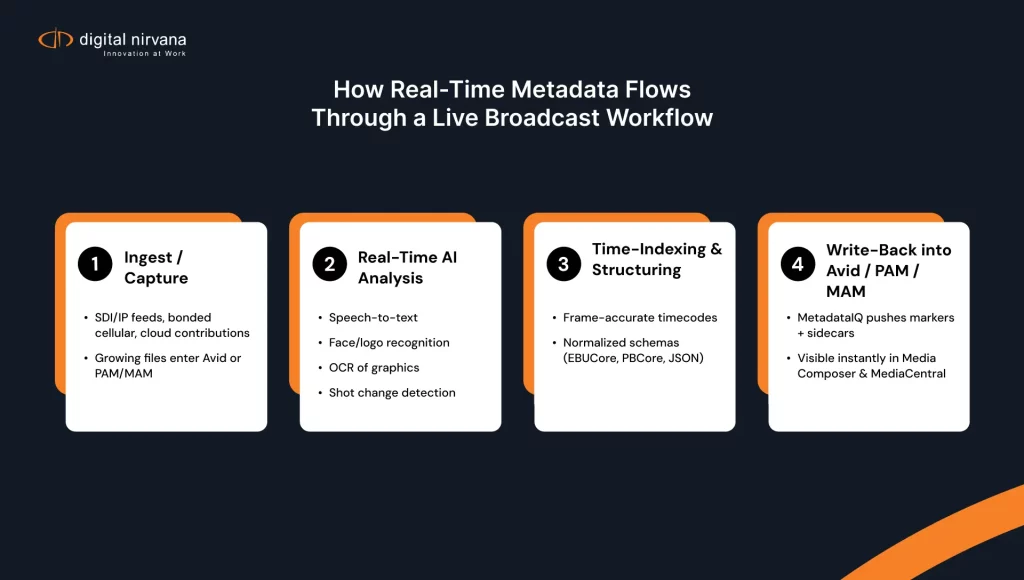
A modern real-time metadata pipeline typically layers several AI capabilities on top of the live or near-live feed.
Automatic speech recognition transcribes commentary and dialogue as it happens, creating a searchable, time-coded text layer. Scene and object detection identifies changes in camera angle, on-field action, or graphic overlays. Face and logo recognition flags specific players, coaches, sponsors, or on-screen personalities the moment they appear. On-screen text and OCR capture scoreboards, chyrons, and lower-thirds so that score changes and headline text become searchable data points too.
Solutions such as MediaServicesIQ offer AI and ML microservices covering ASR, NLP, scene explanation, and logo, object, and facial recognition through APIs, which lets teams plug specific detection capabilities directly into their existing production workflow rather than replacing the whole pipeline. This modular approach matters because most newsrooms and sports operations already have established tools; they need metadata intelligence added in, not a system that requires starting from scratch.
A Real-World Workflow: Inside a Live Sports Broadcast
Picture a live football broadcast running through a modern metadata pipeline. As the match streams, automatic transcription captures commentary in real time. The system detects a spike in crowd noise and camera cuts synchronized with a goal, flagging that moment automatically. Logo detection confirms the sponsor’s branding is visible in the replay angle. Player recognition tags the scorer by name.
Within roughly two to three minutes of the goal, that clip is already searchable inside the archive system, complete with player name, sponsor visibility confirmation, and timecode. The highlights producer searches “goal, sponsor visible” instead of scrubbing four hours of footage, and the sponsor cut goes out well before the 10:00 PM deadline instead of after it.
The same principle applies to a breaking-news segment. As a press conference airs live, transcription and keyword flagging surface the specific quote a digital editor needs, letting the team publish an article with an embedded clip while the story is still the top search result, not twelve hours later when the moment has already faded from the news cycle.
Measurable Impact: What Teams Actually Gain
Teams that move from manual or delayed logging to real-time metadata typically report meaningful shifts in three areas: search and retrieval speed, publishing turnaround, and archive value.
| Area | Manual/Delayed Logging | Real-Time Metadata |
| Time to locate a specific moment | 30–90+ minutes for long-form footage | Seconds to a few minutes |
| Sponsor/highlight clip turnaround | Often misses live deadlines | Delivered within the live window |
| Archive searchability | Inconsistent, logger-dependent | Consistent, automated, scalable |
| Compliance/accessibility readiness | Reviewed after broadcast | Available as content airs |
The bigger, longer-term gain is archive value. Every live event tagged in real time becomes an immediately searchable, monetizable archive asset instead of a pile of raw footage someone has to enrich manually months later.
Implementation Considerations Before You Adopt Real-Time Metadata
Before rolling out a real-time metadata system, a few operational questions are worth answering honestly.
What existing systems does it need to integrate with? Most broadcasters run Avid, Grass Valley, or a specific MAM or DAM platform, and the metadata engine needs to plug into that environment rather than force a parallel system. What latency is acceptable? True live events (sports, breaking news) need near-instant tagging, while some streaming content may tolerate a short delay. Who owns quality control? Automated tagging is strong but benefits from a human review layer for high-stakes content, particularly anything tied to compliance or sponsor obligations. And how will the archive be governed long term, so metadata stays consistent as taxonomies evolve?
Key Capabilities to Prioritize When Evaluating a Solution
Not every metadata tool is built for live-speed operations. When evaluating options, prioritize systems that support true live and archive processing in one platform, not just batch processing after the fact. Look for logo, object, face, and scene recognition alongside transcription, since text alone misses most of what matters visually in sports and news content. Confirm the platform integrates with your existing MAM, DAM, and NLE tools rather than requiring a separate silo. And check whether dashboards give producers a real-time view of what’s been tagged, so teams aren’t searching blind during a live event.
Addressing the Common Objections
“We already have a transcription tool.” Transcription alone tells you what was said, not what was shown. Sports and news moments are often visual first (a goal, a graphic, a face), and text-only tools miss that layer entirely.
“Our loggers handle this fine.” Manual logging works at low volume. It breaks down during high-stakes live events when speed matters most and staffing can’t scale to match footage volume in real time.
“AI tagging feels risky for live compliance content.” A hybrid approach, where automated tagging handles speed and a human review layer handles accuracy, addresses this directly. Automation surfaces the moment; a person confirms it before it goes out under a compliance or legal obligation.
How This Connects to Digital Nirvana’s Approach
This is the exact problem MetadataIQ was built to solve, offering media indexing and search with quality scoring, live and archive processing, and integrations across Avid, Grass Valley, and MAM and DAM systems for broadcasters, sports producers, and newsrooms. For teams that also need broadcast-level compliance visibility alongside content metadata, MonitorIQ adds monitoring for quality of experience, loudness, and proof-of-performance during the same live window. And where live events also require fast captioning or multilingual delivery, TranceIQ and Media Enrichment extend the same real-time philosophy into accessibility and localization.
Teams running AI-heavy metadata pipelines in production also benefit from the human-in-the-loop review layer offered through Managed AI, which helps confirm tagging accuracy on high-stakes live content before it reaches a sponsor, compliance officer, or publishing queue.
Why This Matters Beyond a Single Broadcast
Real-time metadata isn’t just a production convenience. It changes what an organization’s entire content archive is worth over time. A sports league that tags every match in real time builds a searchable library that supports future licensing, sponsor reporting, and highlight-reel generation without anyone touching raw footage again. A newsroom that tags breaking coverage as it airs builds an internal knowledge base that speeds up every future story referencing that event. Reviewing Digital Nirvana’s success stories shows how this shift plays out across broadcast, OTT, and sports operations that moved from reactive logging to live, searchable metadata as a standard part of their workflow.
FAQ
How fast is “real time” for metadata tagging during a live broadcast? Most modern systems tag key moments within seconds to a few minutes of them occurring, fast enough to support live clipping and sponsor deadlines during the same broadcast window.
Does real-time metadata replace human review entirely? No. Automated tagging handles speed and scale, but a human review layer still adds value for high-stakes content tied to compliance, legal, or sponsor obligations.
Can real-time metadata work with our existing MAM or DAM system? Yes, this is one of the most important evaluation criteria. Look for platforms built to integrate with existing MAM, DAM, Avid, and Grass Valley environments rather than requiring a separate parallel system.
Is real-time metadata only useful for sports and news, or does it apply to other live streaming events? It applies broadly to any live-to-streaming scenario, including product launches, conferences, and OTT live events, anywhere fast clip turnaround and searchability matter.
Conclusion
Live news, sports, and streaming events don’t wait for anyone, and the teams that win the moment are the ones whose metadata keeps pace with the broadcast itself. Real-time metadata turns raw live footage into instantly searchable, monetizable, and compliance-ready content the second it airs, not hours or days later. As audience expectations for speed keep climbing and archive value keeps compounding, this capability is quickly becoming table stakes rather than a competitive edge.
Key Takeaways
- Real-time metadata tags live content (transcripts, faces, logos, scenes, on-screen text) as it airs, not after the broadcast ends.
- Manual logging and legacy transcription-only tools can’t scale to match live footage volume or visual complexity.
- A modern pipeline should integrate directly with existing Avid, Grass Valley, MAM, and DAM systems rather than replace them.
- Teams see the biggest gains in clip turnaround speed, sponsor deadline compliance, and long-term archive searchability.
- A hybrid AI-plus-human review model keeps automated tagging accurate for high-stakes, compliance-sensitive live content.
- Every live event tagged in real time becomes a permanent, searchable archive asset rather than untapped raw footage.