A localization manager gets an email on a Friday afternoon. A new OTT title is launching in 12 territories in three weeks, and every subtitle file needs to pass platform-specific QC before ingestion. Nine languages. Six different delivery formats. One deadline.
This scenario plays out every week across streaming operations teams. OTT platforms move fast, catalogs grow constantly, and subtitle turnaround has become one of the biggest bottlenecks between content acquisition and content going live. Get the format wrong or miss a QC flag, and the file bounces back, the launch slips, and the platform relationship takes a hit.
This guide breaks down the subtitle formats OTT teams actually need to know, the QC checks that catch problems before delivery, and how fast subtitling actually happens without sacrificing accuracy.
Why Subtitle Speed and Accuracy Both Matter Right Now
Streaming catalogs are expanding into new languages and regions faster than most localization teams can staff for. At the same time, platforms like Netflix, Amazon, Hulu, and Disney+ enforce increasingly strict technical delivery specifications, and a rejected file means a delayed release date.
Add accessibility requirements into the mix (FCC rules in the US, Ofcom standards in the UK) and subtitle work stops being a “nice to have” localization task and becomes a compliance requirement with legal weight. Teams that treat subtitling as an afterthought end up paying for it in missed launch windows and reprocessing costs.
The teams that handle this well share one thing in common: they treat subtitle format and QC as a defined, repeatable workflow, not a one-off task handled differently every time.
The Subtitle Formats OTT Teams Actually Work With
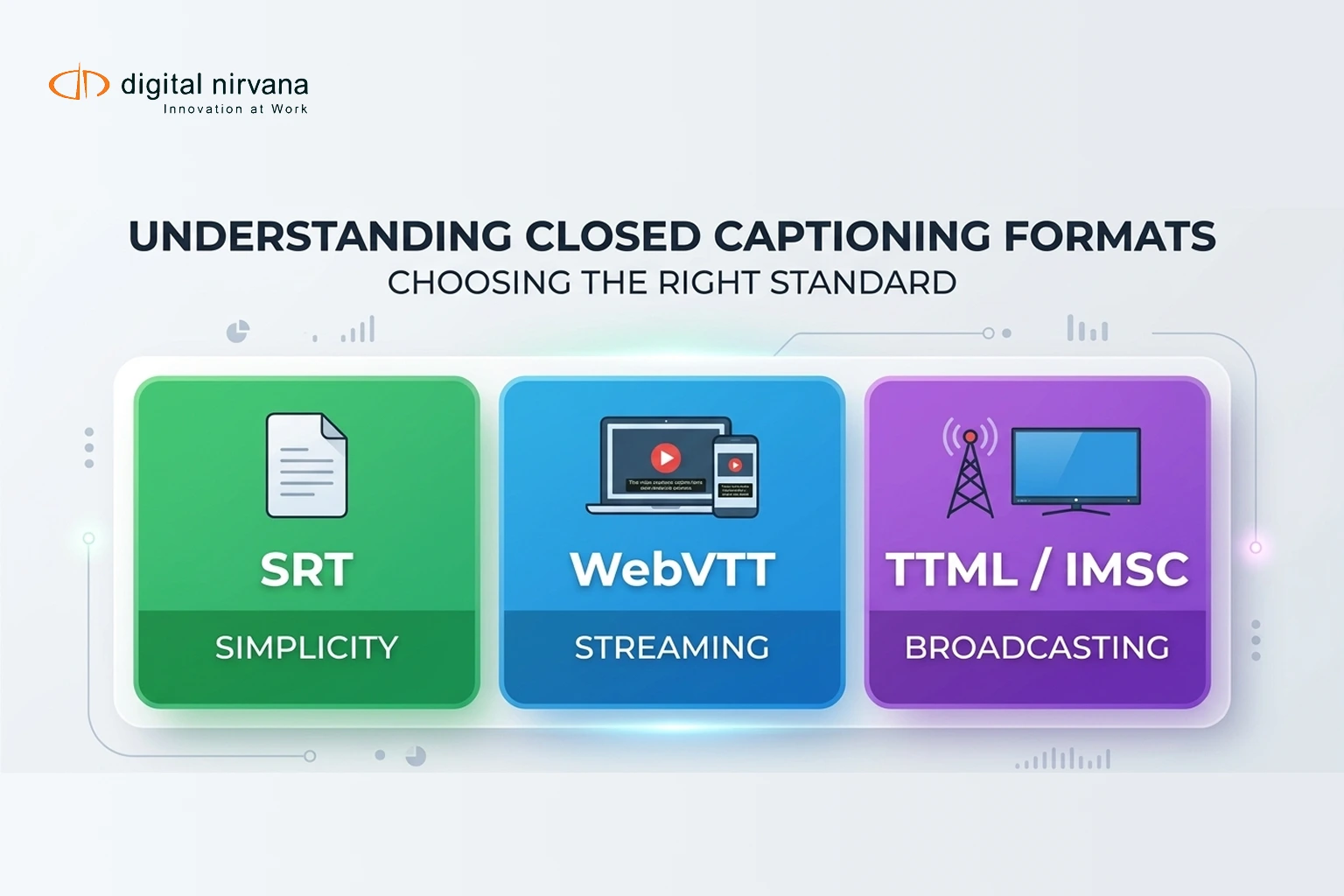
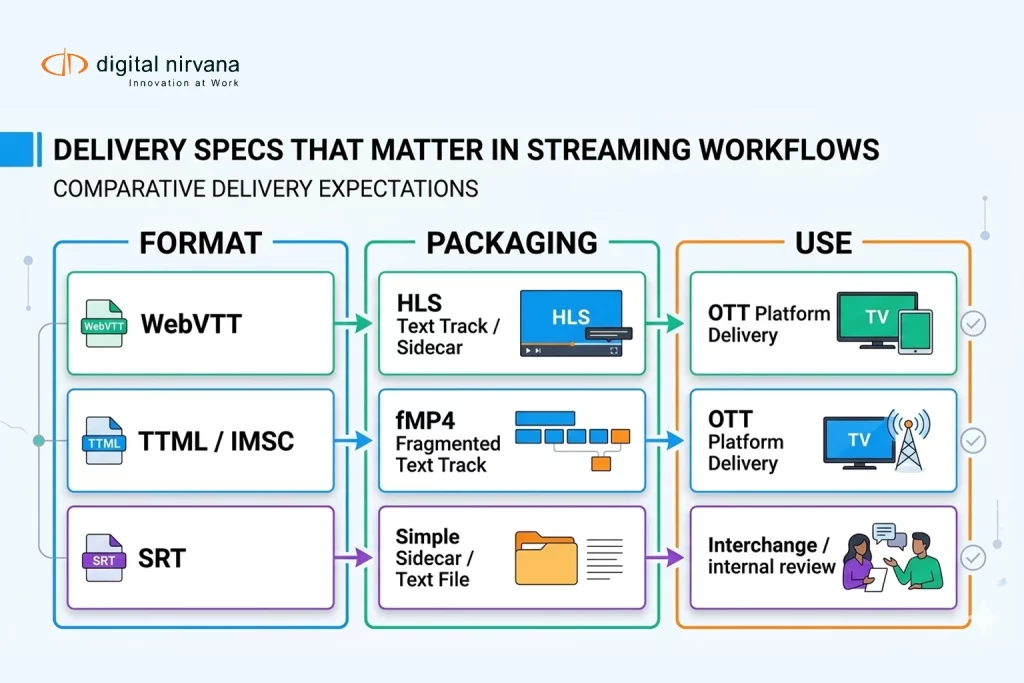
Not every subtitle file is interchangeable. Each format serves a different delivery pipeline, and platforms typically specify exactly which one they accept.
| Format | Common Use | Key Characteristic |
|---|---|---|
| SRT (SubRip) | Web players, basic OTT delivery | Simple, no styling, widely supported |
| VTT (WebVTT) | HTML5 video players, most streaming platforms | Supports styling, positioning, and metadata |
| SCC (Scenarist Closed Caption) | US broadcast and some OTT delivery | Encodes 608/708 caption data |
| TTML / DFXP | Netflix, Amazon, and many enterprise OTT specs | XML-based, precise timing and styling control |
| STL (EBU) | European broadcast delivery | Widely used across EU broadcasters |
| IMSC1 | Modern streaming standard | Increasingly required for global OTT compliance |
A subtitle file built correctly in one format does not automatically convert cleanly into another. Frame rate mismatches, character encoding issues, and styling tags often break during conversion, which is exactly where most QC failures originate. Understanding caption conformance requirements before a project starts saves significant rework later.
Where Traditional Subtitling Workflows Fall Short
Most localization backlogs are not caused by translation quality. They are caused by workflow friction: manual timecoding, format conversion errors, and QC that happens too late in the process.
A few common gaps show up repeatedly:
- Vendors deliver subtitles in one format, but the platform requires another, triggering a full rework cycle.
- Timing drift is caught only after ingestion, when it is far more expensive to fix.
- Reading speed and line length rules vary by platform and language, and manual QC teams miss these inconsistently.
- Multiple vendors handle different languages with no shared QC standard, producing uneven quality across a title’s language set.
None of these are translation problems. They are process problems, and they are solvable with the right combination of automation and human review.
How Fast, Accurate OTT Subtitling Actually Works
Modern subtitling workflows combine AI-generated timecoding and draft translation with human linguistic review, rather than relying entirely on one or the other. This is where speed and accuracy stop being a trade-off.
Step one: source transcript and timecoding. Automated speech recognition generates a time-coded transcript of the source audio, which becomes the foundation for every subsequent language version.
Step two: translation and adaptation. Professional linguists translate and adapt the source text, adjusting for reading speed, cultural context, and line-break rules specific to the target language.
Step three: format-specific output. The finished subtitle is generated in the exact format and frame rate the destination platform requires, whether that is TTML for a Netflix delivery or VTT for a web player.
Step four: platform-specific QC. Before delivery, the file is checked against the platform’s technical spec sheet, not a generic subtitle standard.
Solutions like Media Enrichment services combine this kind of AI-assisted speed with human review, which matters most when a title needs to launch in a dozen languages on the same deadline. MetadataIQ’s time-coded transcript foundation also means the same underlying data can power search, indexing, and clip generation later, not just subtitles.
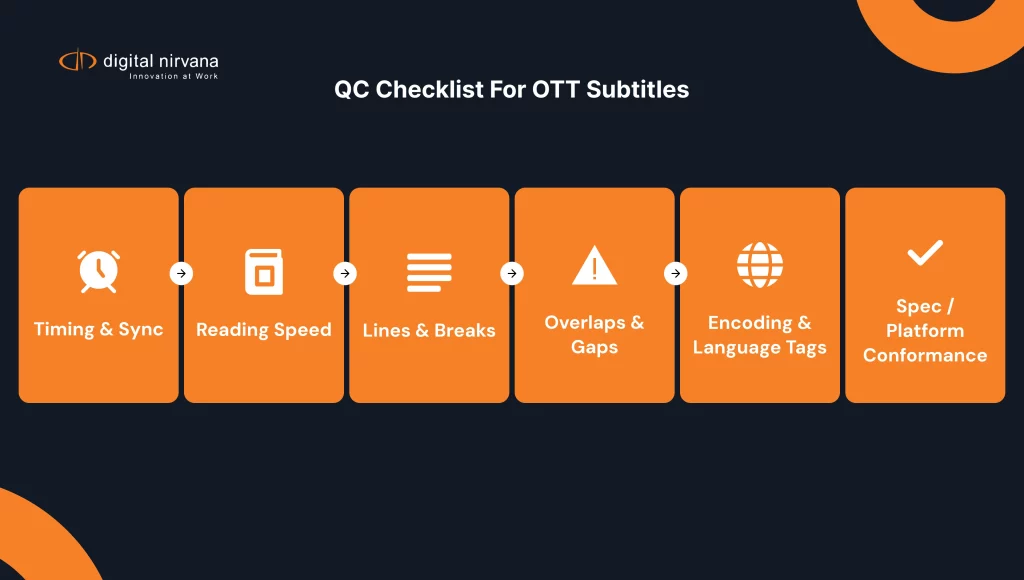
The OTT Subtitle QC Checklist
Before any subtitle file goes out the door, it should pass these checks. Teams that build this into a repeatable process catch far fewer rejections downstream.
Technical checks:
- File format matches the platform’s exact specification (TTML, VTT, SRT, STL, IMSC1)
- Frame rate matches the source video (23.976, 25, 29.97, etc.)
- Character encoding is correct for the target language (especially for non-Latin scripts)
- Timecodes are synced within the platform’s allowed tolerance
Linguistic checks:
- Reading speed falls within platform guidelines (typically 17-20 characters per second)
- Line length does not exceed platform limits (commonly 42 characters per line)
- No more than two lines display at once, unless the platform allows more
- Translation preserves meaning, tone, and cultural context, not just literal wording
Compliance checks:
- Speaker identification is included where required
- Non-speech elements (music cues, sound effects) are captioned where needed for accessibility
- Captions meet FCC accessibility requirements for US audiences, or Ofcom standards for UK content
- Forced narratives and burned-in text are handled per platform delivery notes
Delivery checks:
- File naming follows the platform’s required convention
- Subtitle file is tested against the actual video asset before submission
- QC sign-off is documented for audit purposes
A checklist like this only works if it is applied consistently, which is why manual, ad hoc QC tends to break down as catalog volume grows.
What to Prioritize When Evaluating a Subtitling Partner
Not every subtitling vendor is built for OTT-scale throughput. When evaluating a partner or platform, a few capabilities matter more than others:
- Multi-format output from a single source file, so one transcript can generate SRT, TTML, VTT, and STL without separate rework for each.
- Platform-specific QC templates built around the actual technical specs of Netflix, Amazon, Hulu, Disney+, and regional platforms.
- Human review layered on AI output, since fully automated subtitling still misses cultural nuance and idiomatic translation.
- Scalable turnaround that holds up when a catalog expansion or new market launch multiplies volume overnight.
- Integration with existing MAM/DAM systems, so subtitle delivery does not require a separate manual handoff.
Common Objections, Answered
“We already have a captioning vendor.” Most existing vendors handle one format well but struggle when a title needs six formats across nine languages on the same week. The question is not whether a vendor can caption, it is whether they can do it consistently at OTT scale without quality slipping.
“Manual QC has worked so far.” Manual QC scales linearly with headcount. Catalog growth does not. Once volume increases, manual-only QC becomes the bottleneck that delays launches.
“AI translation is risky for subtitles.” That is a fair concern for AI-only output. The safer model pairs AI-generated timecoding and draft translation with human linguistic review, which is exactly how accuracy and speed coexist in current subtitling workflows.
How Digital Nirvana Supports Fast, Compliant OTT Subtitling
Digital Nirvana’s subtitling and captioning capabilities are built around this exact problem: OTT teams need speed without compromising conformance. TranceIQ handles cloud-based transcription, captioning, and subtitle generation with built-in caption conformance checks, so files are already aligned to platform specs before they reach final QC. For teams that need additional language coverage or 24/7 turnaround during a launch crunch, Media Enrichment adds human-assisted captioning, translation, and dubbing capacity on top of the automated workflow.
Because the same time-coded transcript that powers subtitle generation also feeds MetadataIQ’s media indexing and search capabilities, and MediaServicesIQ’s AI-driven content intelligence, OTT teams get more than a compliant subtitle file. They get a reusable data asset that supports search, clip generation, and future localization work. Several of these workflows are documented in Digital Nirvana’s success stories, where OTT and broadcast teams describe measurable turnaround improvements after adopting this combined AI-plus-human approach.
Bringing It All Together
Fast OTT subtitling is not about choosing between speed and accuracy. It is about building a workflow where the right format, the right QC checks, and the right mix of automation and human review happen in the correct order, every time. When that process is repeatable, catalog growth and new market launches stop being a scramble and start being routine.
Teams that get this right treat subtitle QC as a standing part of their content pipeline, not an afterthought bolted on before delivery. That shift, more than any single tool, is what keeps launch dates on track.
Key Takeaways
- OTT platforms each require specific subtitle formats (TTML, VTT, SRT, STL, IMSC1), and files rarely convert cleanly between them without careful QC.
- Most subtitle delivery failures come from workflow gaps, not translation quality: format mismatches, late-stage timing issues, and inconsistent QC standards across vendors.
- A reliable QC checklist covers technical specs, linguistic accuracy, accessibility compliance, and delivery formatting, applied consistently across every title and language.
- Combining AI-driven transcription and timecoding with human linguistic review delivers both the speed and the accuracy OTT launches demand.
- The same time-coded transcript used for subtitles can power search, metadata, and content intelligence workflows well beyond the original localization project.
FAQ
What is the most common subtitle format required by OTT platforms? TTML and VTT are the most widely required formats among major OTT platforms, though SRT and STL are still common for simpler or regional deliveries.
How fast can OTT subtitles be turned around for a multi-language launch? Turnaround depends on language count and volume, but AI-assisted transcription paired with human review typically compresses timelines from days to hours per language when the workflow is set up correctly.
What causes most subtitle QC rejections? Frame rate mismatches, incorrect character encoding, reading speed violations, and format specs that do not match the destination platform account for the majority of rejections.
Do subtitles need to meet accessibility regulations even for streaming content? Yes. FCC rules in the US and Ofcom standards in the UK both apply accessibility requirements to streaming content, not just broadcast television.