FAST and OTT make global distribution look easy, until subtitles break on one device, drift out of sync on another, or get rejected because the format is technically valid but not platform-compliant.
If you are buying media subtitling services, the real requirement is not “give me subtitles.” It is “deliver the exact subtitle format and spec each platform expects, with QC that holds up at scale.”
This guide covers delivery specs, the practical differences between SRT, WebVTT, and TTML/IMSC, plus a QC checklist and procurement questions you can use to select a vendor with confidence.
What FAST/OTT Subtitling Delivery Really Means
In OTT, subtitles are not just text. They are time-based data that must remain aligned across packaging, streaming manifests, and playback on many devices.
A clean FAST/OTT subtitling workflow usually includes:
- Language and accessibility intent decisions (subtitles vs SDH, forced narrative, multiple languages).
- Format selection based on platform and packaging (SRT, WebVTT, TTML/IMSC).
- Packaging alignment to keep timecodes synchronized in the stream, not just in the file.
- QC that checks both language quality and spec compliance to ensure deliveries do not bounce in distribution.
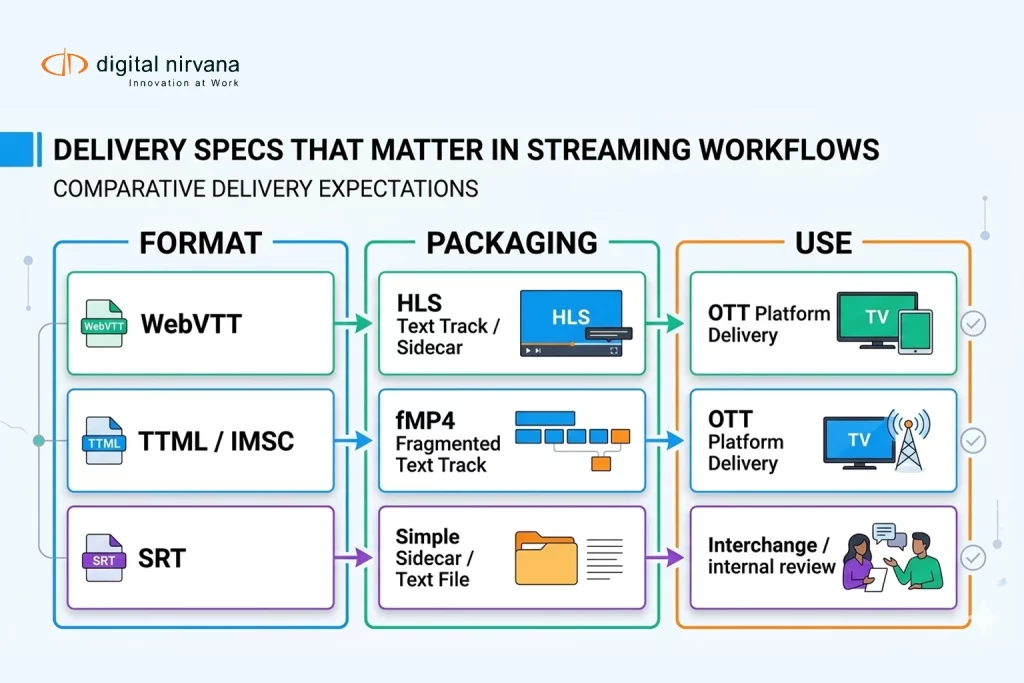
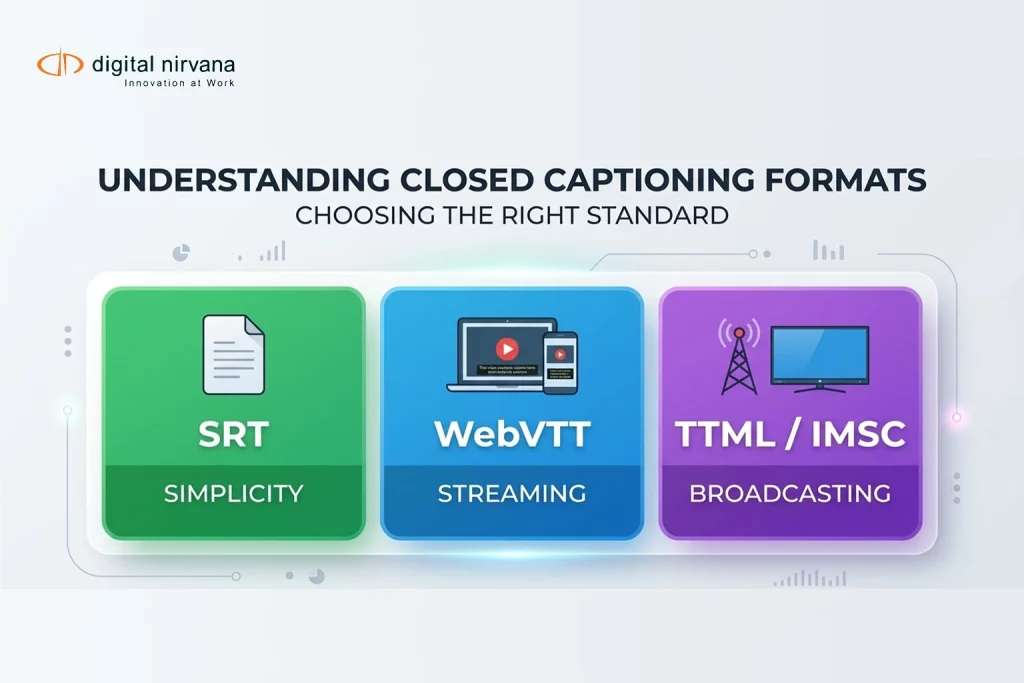
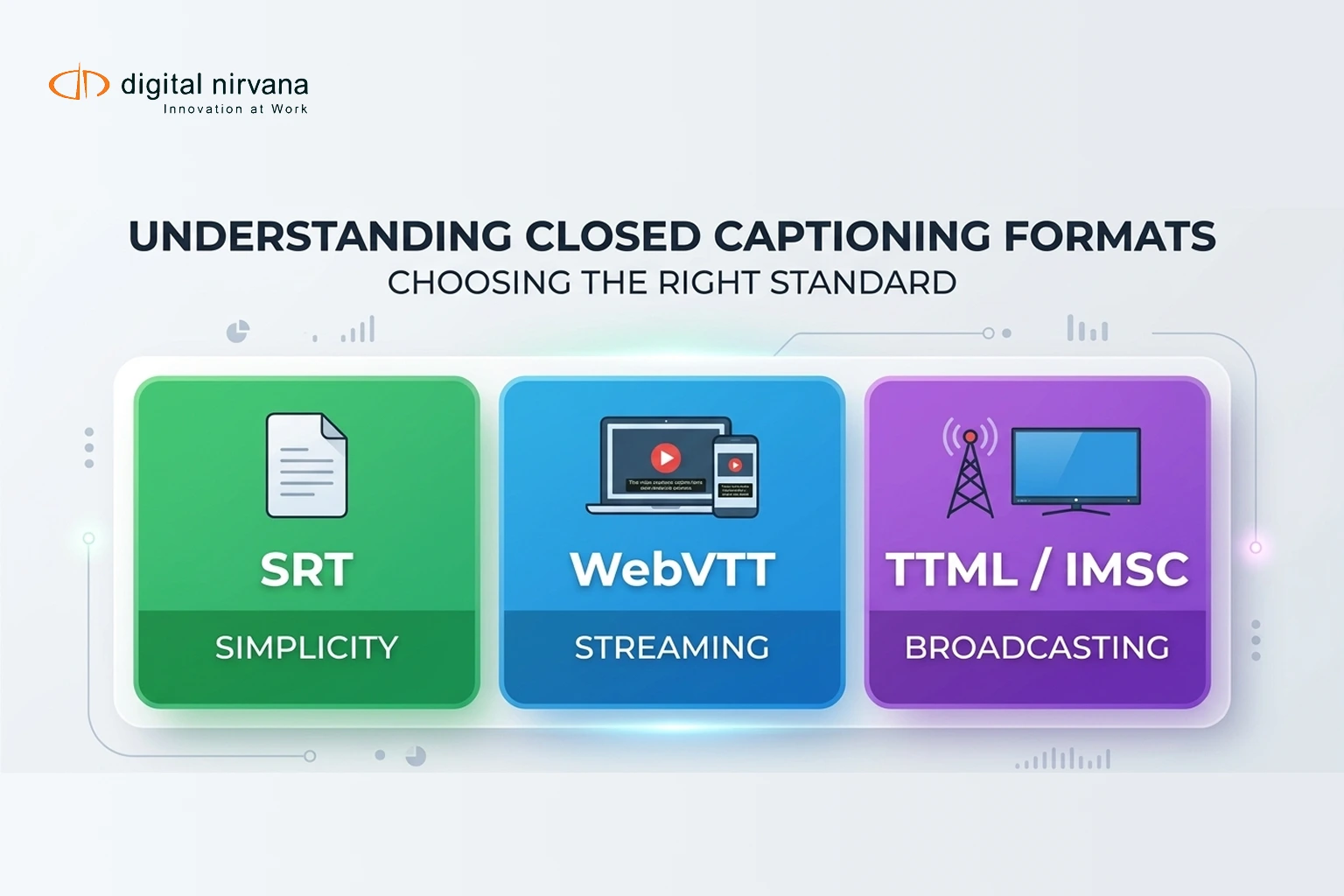
SRT Vs WebVTT Vs TTML/IMSC: What Each Format Is Best For
WebVTT and IMSC exist because streaming needs more than a simple subtitle file. WebVTT is designed for timed text tracks on the web, connected to the HTML track element.
IMSC is a TTML profile designed specifically for subtitle and caption delivery, with validation and presentation requirements for interoperability.
Format Comparison Table
| Format | What It Is | Where It Commonly Fits In FAST/OTT |
| SRT | Simple, widely supported text subtitles | Common for uploads, internal review, quick turnarounds, and some platform sidecar deliveries, but often converted for streaming packaging |
| WebVTT (VTT) | Web timed text format for text tracks | Widely used for web players and HLS subtitle workflows; supports cues and metadata, and is standardized by W3C |
| TTML / IMSC | XML timed text, structured styling and layout | Common in professional OTT delivery, vendor specs, and platform compliance. Netflix uses a defined IMSC profile subset for deliveries |
Practical rule of thumb
If your player is web-first, WebVTT is usually the path. If your delivery is platform-grade and spec-heavy, TTML/IMSC is often required. If you start with SRT, expect conversion and conformance checks before final delivery.
Delivery Specs That Matter In Streaming Workflows
FAST/OTT subtitle issues usually come from time alignment, packaging, and platform rules, not from translation quality alone.
HLS Time Alignment And WebVTT
In HLS workflows, WebVTT subtitles are often segmented and must stay synchronized with audio and video. RFC 8216 describes using an X-TIMESTAMP-MAP header to map WebVTT cue timestamps to MPEG-2 timestamps for synchronization.
What to verify in deliveries
- WebVTT headers and timing alignment are correct, especially after transcodes or repackaging.
TTML/IMSC Conformance And Platform Subsets
Even when you deliver IMSC, platforms may enforce a specific subset. Netflix, for example, publishes an IMSC 1.1 profile subset with explicit feature restrictions and delivery expectations.
What to verify in deliveries
- The file conforms to the platform subset, not just to “generic TTML.”
Sidecar Vs Embedded Subtitle Tracks
OTT pipelines may carry subtitles as sidecar assets or as tracks packaged in fMP4, depending on the output and the platform.
A useful reference point is AWS MediaConvert’s support tables, which show how IMSC and TTML can be delivered as raw XML or as a fragmented MP4 sidecar, depending on DASH or CMAF output choices.
What to verify in deliveries
- You know whether the platform expects sidecar files, in-manifest tracks, or fMP4 subtitle tracks, and your vendor can deliver in that form.
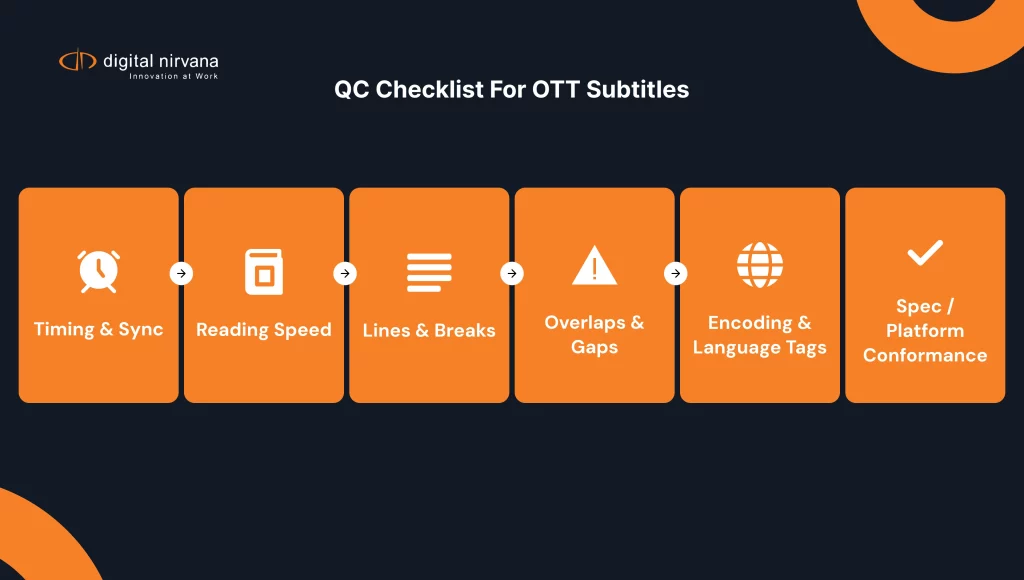
QC Checklist For OTT Subtitles
This is the checklist to use with any media subtitling services provider. It covers both language quality and technical compliance.
FAST/OTT Subtitling QC Checklist Table
| QC Area | What To Check | Why It Matters |
| Timing And Sync | No drift, correct in/out timing, no negative durations | Drift is one of the top reasons FAST/OTT subtitles get flagged, especially after packaging changes |
| Reading Speed | Comfortable WPM or CPS limits per audience and platform | Professional guidance often targets around 160–180 WPM or similar ranges, but limits vary by platform and content type |
| Line Length And Line Breaks | 2 lines max, break on natural linguistic boundaries | WebVTT and timed text specs expect a clean structure and consistent text encoding |
| Overlaps And Gaps | No overlapping cues unless spec allows, no flashes | Prevents flicker, missed lines, and player rendering errors |
| Encoding And Characters | UTF-8, correct punctuation, diacritics, and locale characters | Platform acceptance and correct track selection depend on accurate language metadata |
| Language Tags | Correct language codes, consistent naming across assets | Platform acceptance and correct track selection depends on accurate language metadata |
| Subtitle Type Coverage | Full subs, SDH where required, forced narrative where required | Style guides define different behaviors for SDH and forced narrative |
| Style And Placement | Safe area, no collisions with lower-thirds, legible layout | Prevents unreadable subs on FAST ad overlays and graphics-heavy content |
| Spec Conformance | WebVTT structure, TTML/IMSC feature usage aligned to platform rules | Platforms reject “valid” files that violate their subset rules |
Two QC deliverables to request from vendors
- A short conformance report stating what was checked, which spec profile was targeted, and what was corrected.
- A sample playback validation across at least one reference player environment for your key delivery type (HLS web, OTT app, or downstream packager).
Procurement Questions To Ask Subtitling Vendors
Use these questions for RFPs and vendor comparisons.
Delivery And Formats
- Which formats do you deliver natively: SRT, WebVTT, TTML, IMSC, and do you support platform subsets like Netflix IMSC profiles?
- Can you deliver as sidecar files and as packaged subtitle tracks (for example, fMP4 sidecar where needed)?
- Can you handle forced narrative tracks and SDH as separate deliverables when platforms require them?
Quality And QC Operations
- What is your QC process for reading speed, line breaks, and timing validation?
- Do you run automated checks plus human QC, and what gets escalated to senior reviewers?
- How do you handle revisions, and do you provide a QC or change log with each update?
Scale, Turnaround, And Security
- What turnaround options do you support for episodic and high-volume FAST libraries?
- How do you secure content and subtitle assets during transfer and storage? Digital Nirvana highlights data security and secure archival in its services messaging.
- Can you support multilingual subtitling at scale? Digital Nirvana positions subtitling across 20+ languages in its media enrichment solutions and 35+ languages for subtitling services.
How Digital Nirvana Supports FAST/OTT Subtitling
Digital Nirvana’s media enrichment solutions package includes subtitling alongside captioning, transcription, translation, and related accessibility services, with a flexible turnaround and a focus on quality.
For FAST/OTT specifically, two things matter most: format readiness and dependable QC.
What you can expect from Digital Nirvana’s approach:
- Subtitling and localization are designed for global reach, aligned to real distribution needs.
- QC emphasis, with a focus on error-free, industry-standard subtitle delivery and operational support.
- A broader ecosystem, including TranceIQ, is positioned to generate, review, and export subtitle and caption formats while aligning with major outlet style guidelines.
Meet Digital Nirvana At NAB Show 2026
If you’re heading to NAB Show 2026, stop by to see how Digital Nirvana helps teams automatically turn live and recorded video into structured, searchable intelligence. You’ll get a workflow-focused look at how MetadataIQ supports faster review, better discovery, and smoother handoffs across production, compliance, and distribution.
You can meet the team at Booth N1555 in Las Vegas, April 19–22, 2026. If you want dedicated time, book a demo slot ahead of the show.
FAQs
Most workflows use a mix: SRT for simple sidecar needs and interchange, WebVTT for web and HLS subtitle workflows, and TTML/IMSC for platform-grade OTT deliveries that require stricter conformance.
HLS commonly uses WebVTT for subtitles, and the HLS RFC describes the X-TIMESTAMP-MAP in WebVTT headers to synchronize across renditions.
IMSC is a TTML profile designed for subtitle and caption delivery, with defined validation and rendering expectations that help interoperability across systems.
Because platforms often enforce specific subsets and restrictions. Netflix, for example, publishes restrictions and recommendations for its IMSC profile subset.
Timing sync, reading speed, 2-line layout rules, encoding, correct language tags, and conformance to the target spec or platform subset.
Conclusion
Media subtitling services for FAST and OTT succeed when they treat subtitles as a technical delivery asset, not just translated text. The best results come from choosing the right format for the platform, aligning packaging and timing to the streaming spec, and running QC that is both linguistic and compliance-focused.
Key Takeaways:
- Pick formats based on delivery, not preference: SRT for interchange, WebVTT for web and HLS workflows, TTML/IMSC for spec-heavy OTT.
- Time alignment is a real streaming problem; validate sync after packaging and ensure WebVTT timing headers are handled correctly.
- Platform subsets matter; “valid TTML” is not always “accepted TTML.”
- Use a QC checklist that covers timing, reading speed, layout, encoding, language tags, and spec conformance.
- Digital Nirvana’s media enrichment and subtitling services are designed to deliver platform-ready subtitles with QC focus and scalable multilingual support