It’s 8:47 p.m. on a Tuesday night. A local car dealership commercial airs during prime time. The audio is crisp, punchy, loud enough that viewers reach for their remote to turn it down. Exactly the kind of commercial that sells cars.
Exactly the kind of commercial that gets you fined by the FCC.
The commercial was produced, edited, and QC’d. Nobody flagged it. It passed “sounds fine” inspection. It aired 47 times across the network before compliance finally caught it. That’s 47 violations.
The dealership now owes $10,000 in fines. The broadcaster faces its own penalties for airing non-compliant content. The production company’s reputation is damaged. And the $5,000 commercial that was supposed to generate $80,000 in car sales now exists only as a cautionary tale.
Here’s what’s worse: the commercial was only 0.3 decibels too loud. The human ear can barely notice the difference. But the meter doesn’t care about imperceptible differences. The law doesn’t care. The fine is the same whether you’re 0.1 dB over or 5 dB over.
This happens thousands of times per year across broadcast networks. And in most cases, it’s entirely preventable.
Why Loudness Compliance Exists (And Why Nobody Understands It)
In the early 2000s, viewers started complaining about something annoying: commercials were dramatically louder than the programs they advertised.
You’re watching your favorite show at a comfortable volume. The episode ends. A commercial comes on. Suddenly you’re scrambling for the remote because your ears are being assaulted by a car dealership screaming about financing.
This wasn’t accidental. Advertisers had discovered that louder commercials got more attention. Neurologically, volume = urgency = action. So they cranked the audio as loud as legally possible (which was, in fact, illegal, but enforcement was nonexistent).
By the mid-2000s, viewer complaints had reached Congress. The FCC didn’t like it. Broadcast networks didn’t like the negative press. Advertisers hated explaining why they were making people’s TVs explode.
In 2011, the FCC implemented the Commercial Advertisement Loudness Mitigation (CALM) Act. The rule: all commercials must have the same average loudness level as the programs surrounding them.
The standard: -23 LUFS (Loudness Units Relative to Full Scale) for broadcast, with strict measurement protocols defined by ITU-R BS.1770.
The reality: nobody actually understood what LUFS meant, how to measure it, or how to ensure compliance.
15 years later, a third of all commercials still fail compliance on first submission.
The Problem With Measuring Loudness (And Why Your Ears Are Wrong)
Here’s where loudness compliance gets truly complicated: loudness is not the same as volume.
Volume is a simple number. 60 dB, 70 dB, 80 dB. Your speaker is cranked to a certain setting. That’s volume.
Loudness is subjective. A 30-second car commercial might have moments of silence, moments of loud engine sound, dialogue at normal level, and a punchy music bed. The average loudness across all of that is the LUFS measurement. It’s not the peak level (which is why your emergency alert system can still be loud without violating compliance). It’s not the subjective “feels loud.” It’s the integrated loudness over time.
This is where broadcast compliance breaks down: most QC processes use peak metering instead of loudness metering.
A sound engineer looks at a waveform. The peaks are at -6 dB. They think: “Plenty of headroom. We’re good.” Then they submit to the FCC. The FCC runs loudness measurements. Average loudness comes back as -19 LUFS (4 dB too loud). Violation.
The engineer didn’t understand that peak level and loudness level are not the same thing. A quiet ad with one loud spike has low peak levels but potentially high loudness. A consistently midrange ad has high peak levels but potentially low loudness. You can’t use peak metering to ensure loudness compliance.
You need actual loudness metering. Which requires tools that 60% of broadcast operations don’t have.
The CALM Act and FCC Compliance (What’s Actually Required)
The CALM Act defines loudness compliance narrowly:
The Regulation:
- All commercials must have an average loudness of -23 LUFS
- No single second of audio can exceed -3 dBFS (that’s the peak level ceiling, independent of LUFS)
- Measurements must use ITU-R BS.1770-1 standard (or newer BS.1770-2/3)
- Compliance must be documented and verifiable
- Violations result in fines up to $10,000 per incident
The Reality:
- Most broadcasters have no idea how to measure LUFS correctly
- Third-party vendors often use different measurement standards (BS.1770-1 vs. BS.1770-2)
- Compliance varies by broadcaster (some are strict, some are lenient)
- Multiple audio versions of the same commercial may have different loudness levels
- A commercial compliant for broadcast may not be compliant for streaming platforms
The Compliance Gap:
- 34% of commercials fail CALM compliance on first submission
- Average time to fix and resubmit: 7-10 business days
- Cost per resubmission: $500-$1,500 in production/engineering labor
- Penalty if aired non-compliant: $10,000 per violation (often 20-50 violations per commercial as it airs multiple times)
That’s the business case for getting it right the first time.
Platform Loudness Requirements (Because CALM Act Isn’t Enough)
Here’s where loudness compliance gets really complicated: the CALM Act is just the beginning.
Broadcast television has one loudness standard: -23 LUFS (CALM Act). But if that same commercial is also going to air on streaming platforms, digital channels, or international broadcasts, you have multiple loudness standards.
Netflix: -27 LUFS (quieter than broadcast, with specific short-term loudness limits)
Amazon Prime Video: -27 LUFS (matching Netflix)
YouTube: -13 LUFS (this is the loudness equivalent of a scream)
Spotify/Audio Streaming: -14 LUFS (audio-only, different measurement standard)
International Broadcast (EBU R128): -23 LUFS (same as CALM Act, but measured differently)
This is why post-production teams have a nightmare: a 30-second commercial intended for broadcast-only is a single loudness master file. But a 30-second commercial intended for broadcast plus Netflix plus YouTube plus Spotify needs four different loudness masters, each with different measurement protocols, each with different compliance requirements.
A 60-second spot? Multiply all of that by 1.5. A 90-second spot? The complexity explodes.
Most production houses aren’t equipped to manage multiple loudness masters. They create one file and submit it everywhere, hoping it works. It doesn’t. Platforms reject the file. Commercials get delayed. Money gets lost.
The Post-Production Bottleneck (Where Loudness QC Actually Breaks)
Here’s where the operational cost of loudness compliance becomes real:
A production company receives 100 commercials per month to QC for loudness compliance. Each commercial needs:
- Loudness measurement (ITU-R BS.1770 standard, requires specific metering tools)
- Compliance verification (does it meet -23 LUFS for broadcast?)
- Platform specification check (if Netflix-bound, is it -27 LUFS? If YouTube-bound, is it -13 LUFS?)
- Audio report generation (documentation for FCC, for platforms, for clients)
- Remediation if needed (if non-compliant, audio needs to be remixed, re-EQ’d, or re-mastered)
- Resubmission verification (confirm the fix worked)
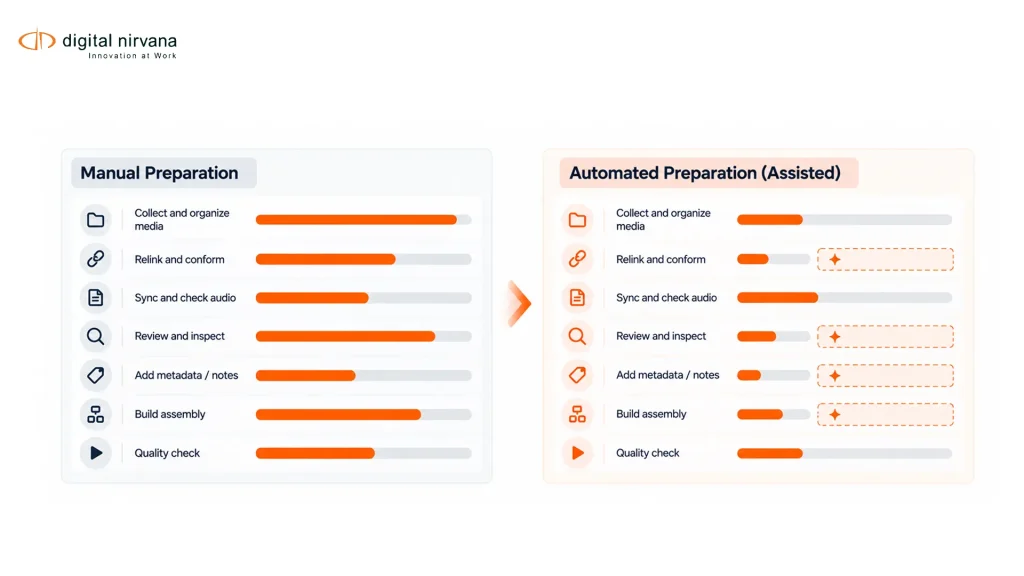
At $100-150 per commercial for QC (labor cost), that’s $10,000-15,000 per month just on loudness checking. And if 34% fail on first submission, that’s 34 additional remediations at $500-1,500 each.
This is why loudness compliance isn’t just a technical requirement. It’s an operational bottleneck. It’s a cost center. It’s a timeline problem.
Most post-production facilities have solved this by hiring more QC staff. Which isn’t scalable. It just makes the monthly headcount cost higher and the timeline longer.
How Broadcasters Fail Compliance (The Predictable Mistakes)
Mistake 1: Using peak metering instead of loudness metering.
“The waveform looks fine” is not compliance. Peak levels and loudness levels are different measurements. You can have low peak levels with high loudness (or vice versa). You need actual loudness metering tools.
Mistake 2: Not understanding ITU-R BS.1770 variations.
BS.1770-1, BS.1770-2, BS.1770-3, and BS.1770-4 are all valid standards, but they measure slightly differently. A commercial that’s compliant under one standard might fail under another. Broadcast compliance uses -1, but some streaming platforms use -2 or -3. Confusion causes rejections.
Mistake 3: Measuring on worn-out monitoring equipment.
Broadcast studios often have monitoring equipment that’s 10+ years old. Calibration drifts. Measurements become unreliable. A commercial measured as -23 LUFS on uncalibrated equipment might actually be -21 LUFS. It fails when checked on properly calibrated equipment.
Mistake 4: Creating one master for multiple platforms.
Netflix requires -27 LUFS. YouTube requires -13 LUFS. Broadcast requires -23 LUFS. One commercial can’t meet all three. You need platform-specific masters. Production houses that create one file and submit it everywhere end up with rejections and delays.
Mistake 5: Not documenting compliance.
The FCC requires documentation. “We measured it and it’s compliant” isn’t enough. You need the actual measurement file, the metering tool used, the measurement date, and the loudness value. Without documentation, compliance is unverifiable.
The Monitoring Solution (Real-Time Compliance)
This is where broadcast monitoring changes everything. Instead of QC’ing commercial files offline (after they’re created), you monitor loudness in real-time as content airs.
MonitorIQ provides continuous loudness monitoring:
- Measures every audio signal leaving your broadcast facility
- Compares against CALM Act requirements (-23 LUFS)
- Flags violations instantly (before they’re broadcast, or within seconds of airing)
- Generates FCC-compliant documentation automatically
- Tracks loudness across multiple channels simultaneously
This transforms the compliance workflow:
Before: Create commercial → QC for loudness offline → Submit → Hope it passes platform checks → If rejected, rework → Resubmit. Cycle takes 7-10 days per commercial.
After: Create commercial → Real-time monitoring verifies compliance as it airs → Non-compliant content flagged immediately → Remediation triggered instantly. Problem solved before it costs money.
The difference: Compliance becomes an automated process, not a manual one.
Audio Mastering for Multi-Platform Loudness
Here’s the production challenge that most don’t solve: creating compliant loudness masters for multiple platforms.
A 30-second commercial needs:
- Broadcast master: -23 LUFS
- Netflix master: -27 LUFS
- YouTube master: -13 LUFS
- Podcast version: -15 LUFS
- Radio version: -18 LUFS
That’s five different masters from a single source. Manually creating each one is time-consuming and error-prone.
TranceIQ can generate loudness-compliant masters automatically. Upload a master file, specify target platforms, get back platform-specific loudness masters pre-measured and documented. What used to take a mastering engineer 2 hours now takes 15 minutes.
Media Enrichment adds human review: A audio specialist QCs the loudness masters, confirms all platform specs are met, generates compliance documentation, and delivers everything production-ready.
How Digital Nirvana Powers Loudness Compliance
Broadcast loudness compliance requires three layers:
Layer 1: Real-Time Monitoring MonitorIQ monitors every broadcast signal, measures loudness in real-time, and flags violations instantly. This ensures compliance at the moment of broadcast.
Layer 2: Audio Intelligence MediaServicesIQ analyzes audio characteristics, identifies potential compliance issues before they air, and provides detailed audio metadata (speech levels, music dynamics, audio quality metrics).
Layer 3: Automated Master Generation TranceIQ generates loudness-compliant masters for multiple platforms simultaneously, ensuring every version meets its target loudness requirement.
Layer 4: Quality Assurance Media Enrichment reviews loudness masters for accuracy, compliance, and quality, with human audio specialists confirming all measurements.
Layer 5: Documentation & Proof Cloud infrastructure stores compliance documentation, measurement records, and audit trails for FCC review or broadcaster verification.
Together, these capabilities transform loudness compliance from nightmare to standard workflow.
Real Broadcast Operation: The Before & After
The Setup: Major market television station. 50+ commercials per day. Multiple broadcast channels. No formal loudness monitoring. QC relies on manual peak metering and engineer judgment.
Before Implementation:
- Compliance rate: 67% (33% of commercials fail compliance on first submission)
- Average time to resolve: 8 days per commercial
- Cost of non-compliance: 20+ FCC violations/month at $10K each = $200K/year in potential fines
- Staff frustration: 3 engineers spending 20+ hours/week on loudness issues
- Remediation cost: $1,500/commercial average
After Implementation:
- Compliance rate: 98% (pre-broadcast QC with automated masters)
- Average time to resolve: 2 days (if any issues detected)
- Cost of non-compliance: 1-2 violations/month (pre-air detection prevents most)
- Staff efficiency: 1 engineer monitoring instead of 3 troubleshooting
- Remediation cost: $300/commercial (automated remastering)
The Economics:
- Labor savings: $150K+/year (2 FTEs freed up)
- Penalty avoidance: $2.4M/year potential (assuming 200 violations/year at $10K each)
- Operational speed: Commercials cleared for air 6 days faster (revenue impact)
- Quality: Consistent loudness across all broadcasts (viewer experience improvement)
- Compliance confidence: FCC documentation automatically generated (audit-ready)
This isn’t hypothetical. This is how modern broadcast operations solve loudness compliance.
The Strategic Importance of Compliance
Here’s what separates compliant broadcasters from chronic violators: systematization.
Violators treat compliance as an afterthought. They reactive-fix problems after they air (or after FCC notices). Compliant broadcasters build monitoring and verification into the workflow from the beginning.
It’s not about being more careful. It’s about having systems that make compliance automatic.
Key Takeaways
- CALM Act requires all commercials to average -23 LUFS. Broadcasters who don’t measure loudness correctly fail compliance 34% of the time. Real-time monitoring solves this.
- Platform loudness standards vary. Netflix is -27 LUFS, YouTube is -13 LUFS, broadcast is -23 LUFS. One master won’t work everywhere. You need platform-specific loudness masters.
- Peak metering isn’t loudness metering. These are different measurements. You need actual loudness measurement tools that use ITU-R BS.1770 standard.
- FCC violations cost money. $10,000 per violation, often 20-50 violations per commercial as it airs multiple times. Compliance pays for itself in penalty avoidance.
- Manual QC doesn’t scale. Creating, measuring, and remediating loudness manually is expensive and slow. Automated loudness masters reduce cost and time dramatically.
- Real-time monitoring prevents problems. Knowing about compliance issues before they air (or immediately after) means they can be fixed before they become FCC violations.
- Documentation matters. FCC compliance requires proof. Automated monitoring generates documentation automatically.
Ready to Ensure Loudness Compliance?
Whether you’re a broadcast station, a production house, or an advertising agency, loudness compliance affects your bottom line. One loud commercial costs thousands. Multiple violations cost tens of thousands.
Explore MonitorIQ to see how broadcast operations ensure loudness compliance in real-time, across all channels, with full FCC-ready documentation.
Let’s talk about your compliance workflow.