You need a quiet reaction after a tense exchange. Nobody logged that description, and the transcript contains no useful phrase. Semantic video search can retrieve moments related to a description’s meaning, giving an editor candidates beyond exact words or filenames. The result still needs source verification: a visually suitable reaction can belong to the wrong person, event, or point in the story.
For editorial teams, the practical test is whether a search result becomes a usable, correctly identified source range. A convincing thumbnail alone does not meet that requirement.
Key Takeaways
- Semantic retrieval finds related meaning, while exact search remains useful for names, quotations, and identifiers.
- Evaluate returned moments against both the query and the editorial context surrounding the source.
- Test known matches, difficult near-matches, and requests for footage that is absent.
- Preserve source identity, ranges, and permissions when moving results into an edit.
- Measure usable retrieval and missed material rather than relying on a similarity score alone.
Table Of Contents
- How Does Semantic Video Search Work?
- When Is Exact Search Still Better?
- What Makes A Search Result Editorially Usable?
- How Should Editors Test Retrieval Quality?
- Why Can A Relevant Result Still Be Wrong?
- How Should Search Connect To The Timeline?
- FAQs
- Conclusion
How Does Semantic Video Search Work?
Semantic search represents content and the search request in a form that allows their meanings to be compared. A retrieval system ranks candidate material using those representations and returns the associated media.
The Amazon Nova embeddings service card describes this pattern using embeddings for media and queries. An embedding is a numerical representation used for comparison. It is not a human-written log entry or a factual verdict about a scene.
Different systems may analyze different inputs, including images, speech, or combinations of modalities. Ask which signals are actually used in the product you are evaluating. Do not infer full audiovisual understanding from a demonstration of visual search alone.
For editors, implementation matters when it changes what can be found. A system that misses quiet visual action may be unsuitable for B-roll discovery even if its dialogue retrieval is effective.
When Is Exact Search Still Better?
Use exact search when the requirement is an exact statement, asset identifier, or verified metadata value. Use semantic retrieval when the request describes an action, scene, or relationship that may not have been logged with your chosen words.
Adobe’s search guidance for Premiere illustrates the distinction between semantic visual matching and exact transcript or metadata matching. Do not assume every search box behaves the same way across all fields.
Combine methods where the assignment demands precision. A producer might first restrict results to the approved event and then search visually for an audience reaction. The restriction narrows the eligible material; the semantic query helps rank it.
Digital Nirvana’s timecoded transcription guide provides related context for locating spoken content. A transcript-based route and a visual route can complement each other without answering identical questions.
What Makes A Search Result Editorially Usable?
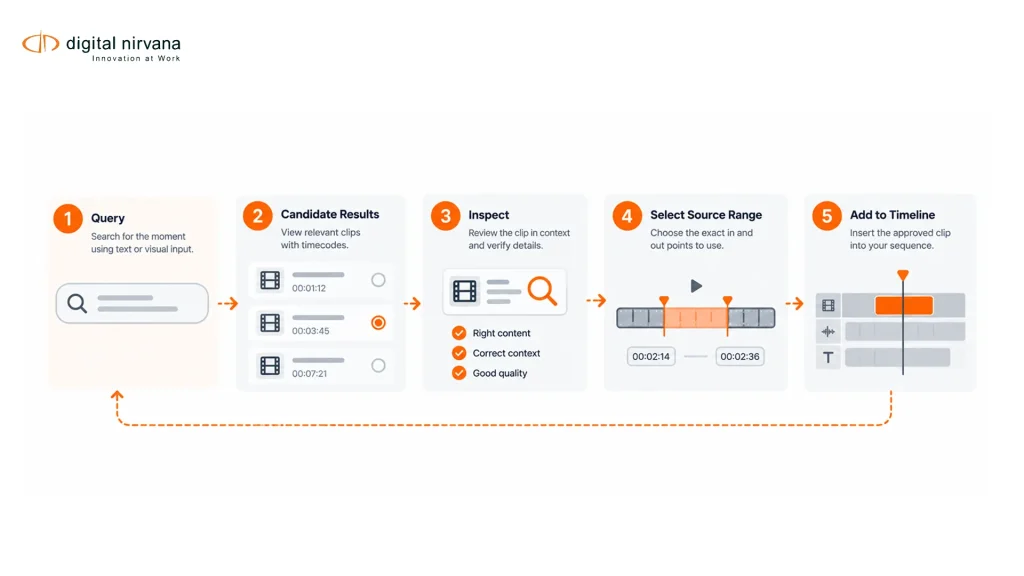
A useful result contains enough context to decide whether you can use it and enough source information to retrieve it correctly. Require more than a thumbnail and a confidence-looking number.
Use this proposed acceptance record for each selected result:
- Original asset identifier and the rendition shown in preview.
- Source range and the relevant time interpretation.
- Event or project association.
- Search query and filters used.
- Applicable usage restrictions and unresolved questions.
- The editor’s acceptance or rejection reason.
Not every system exposes all these fields automatically. Where a field is required but missing, define how the workflow supplies it before treating the search tool as production-ready.
For established archives, MetadataIQ’s indexing role is distinct from the editor’s final decision to use a shot. Metadata supports discovery; editorial suitability and permission to publish require their own checks.
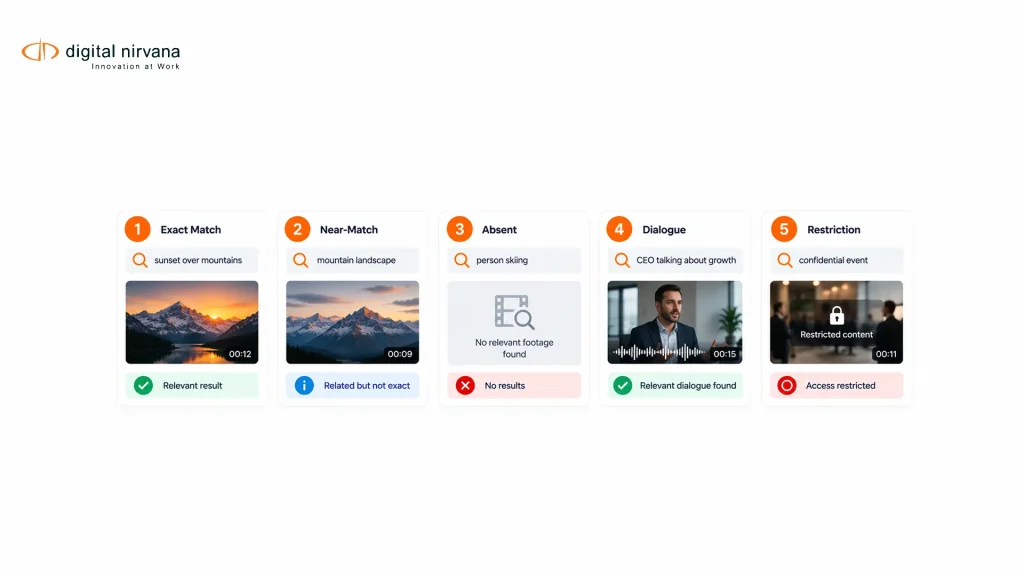
How Should Editors Test Retrieval Quality?
Build a small, labeled test set from material the team knows. Write the expected matches before running queries so reviewers cannot quietly redefine success around whatever appears.
| Test Type | Example Request | What You Are Testing |
| Known match | A visible action in a confirmed source | Whether relevant footage is retrieved |
| Near-match | Similar action from a different event | Whether context prevents false acceptance |
| Absent material | A scene that is not in the library | Whether users recognize unsupported results |
| Exact dialogue | A verified sentence | Whether transcript retrieval preserves wording |
| Restricted material | A matching asset outside a user’s access | Whether access controls hold |
These are illustrative test categories, not performance claims. Keep the queries stable during vendor comparison and allow reviewers to examine missed results as well as returned results.
Measure how often the first reviewed candidates are usable, how much known relevant material is missed, and how long it takes to accept a source range. Record the reasons for rejection, especially wrong event, poor temporal boundary, and insufficient rights information.
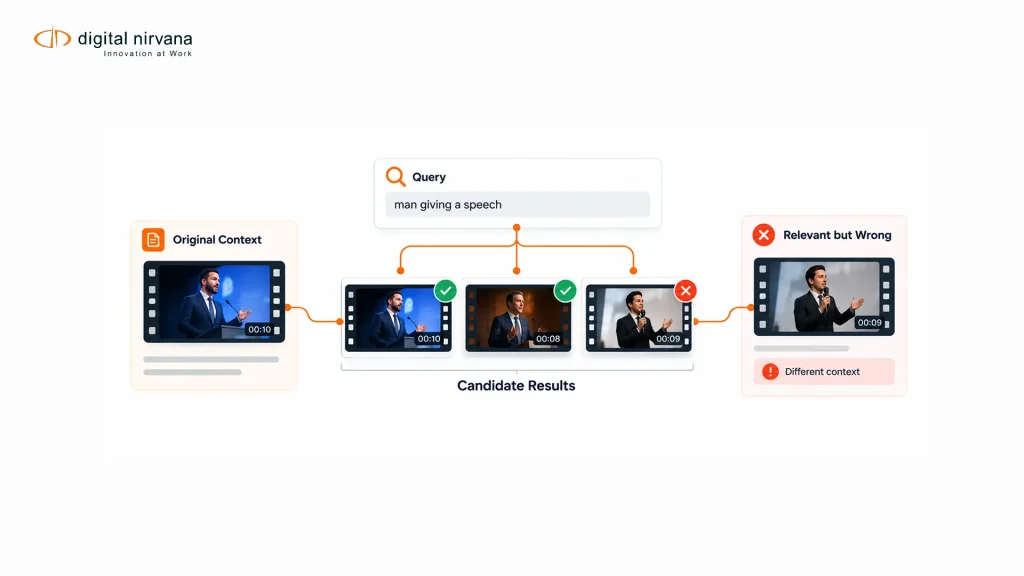
Why Can A Relevant Result Still Be Wrong?
Similarity does not establish chronology, identity, or causation. A scene can look right while creating a misleading impression when inserted into another sequence.
Consider an illustrative news package about a disputed vote. A search for an angry crowd retrieves a protest from a different date. The visual meaning fits, but using it without explanation could misrepresent the event. Review the source record and surrounding footage before accepting the shot.
Boundary errors create another problem. A returned range may omit the action that explains a reaction or include material from the next scene. Extend the preview around the candidate before setting final in and out points.
Require the operator to reject a plausible but unsupported result. A search interface that always returns something should not teach the team to assume that something must satisfy the brief. Absence is a valid outcome.
How Should Search Connect To The Timeline?
Move a selected source range into the edit together with its identity and the context needed for review. The integration should preserve the difference between a retrieved candidate and an approved editorial selection.
Digital Nirvana’s RoughCut search workflow offers a product context for meaning-based discovery. During a demonstration, follow one result through selection, revision, and downstream use rather than stopping when it appears in search.
Assign responsibility for correcting metadata when an editor finds an error. Decide whether the correction applies to the project, the source asset, or the wider archive, and preserve the distinction between verified facts and subjective editorial notes.
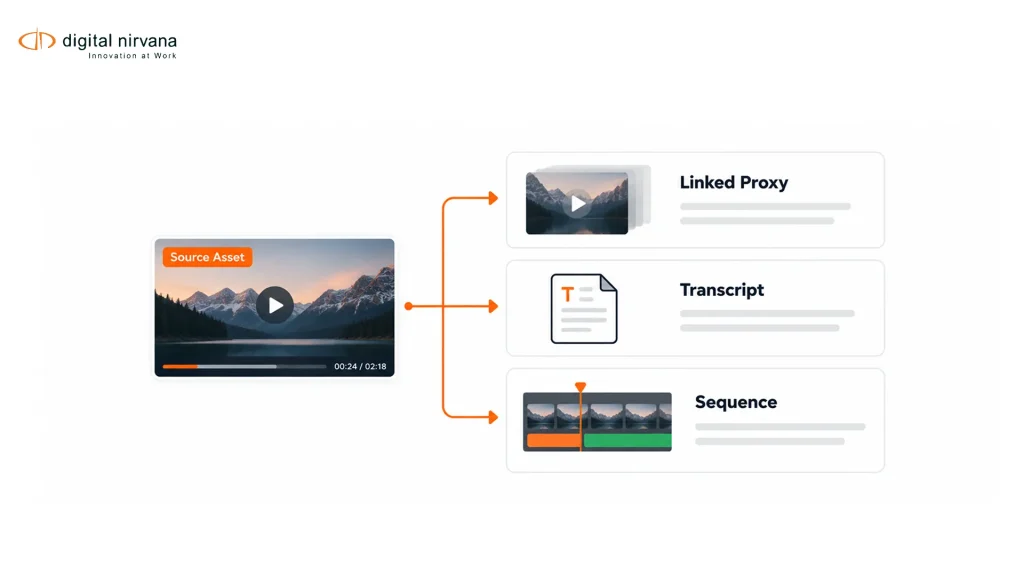
Then test retrieval again after a source moves or a proxy changes. Search quality has little operational value if accepted results become difficult to reconnect to their originals during finishing.
FAQs
Semantic video search retrieves media based on meaning-related similarity between a request and analyzed content. It can find candidates that do not share the exact words used in a manual log.
It can reduce some discovery work, but it does not remove the need for verified identity, rights, and editorial context. Human corrections remain useful where those details affect publication.
Visual analysis can support retrieval of nonverbal action, depending on the system. Test the relevant footage and confirm which modalities the product actually analyzes.
A similarity score does not establish that a shot belongs to the right event or is cleared for use. Treat it as a retrieval signal and verify the source.
Transcript search locates spoken text, while semantic retrieval can match broader descriptions. A product may combine both approaches, with different behavior for each field.
Record that the available results do not satisfy the brief and use another research or sourcing route. Choosing the closest-looking shot is not a substitute for finding appropriate footage.
Conclusion
Build a retrieval test around moments your editors already know, including deliberate near-matches. Follow each accepted result into the timeline and inspect what information survives. Use that evidence to discuss your search-to-edit requirements with Digital Nirvana.