Introduction
The MAM vs DAM decision is not a contest between three interchangeable product labels. Media asset management, digital asset management and production asset management systems overlap, but they are designed around different asset types, users and stages of work. A broadcaster may need long-term program management, a production team may need high-speed collaboration around work-in-progress files, and a marketing team may need approved brand assets with rights and distribution controls.
The useful question is not which acronym is best. It is which system should own each workflow, and how metadata and media will move across the resulting architecture.
Key Takeaways
- DAM centers on approved digital assets and broad business distribution.
- PAM centers on work-in-progress media and editing collaboration.
- MAM centers on rich audiovisual assets across ingest, operations, archive and reuse.
- Product names are inconsistent, so evaluate capabilities and ownership boundaries.
- Metadata enrichment should complement the system of record rather than create a second one.
Table Of Contents
- What MAM, DAM and PAM mean
- Side-by-side comparison
- Decision questions
- How the systems work together
- The role of metadata intelligence
- FAQs
What Do MAM, DAM And PAM Mean?
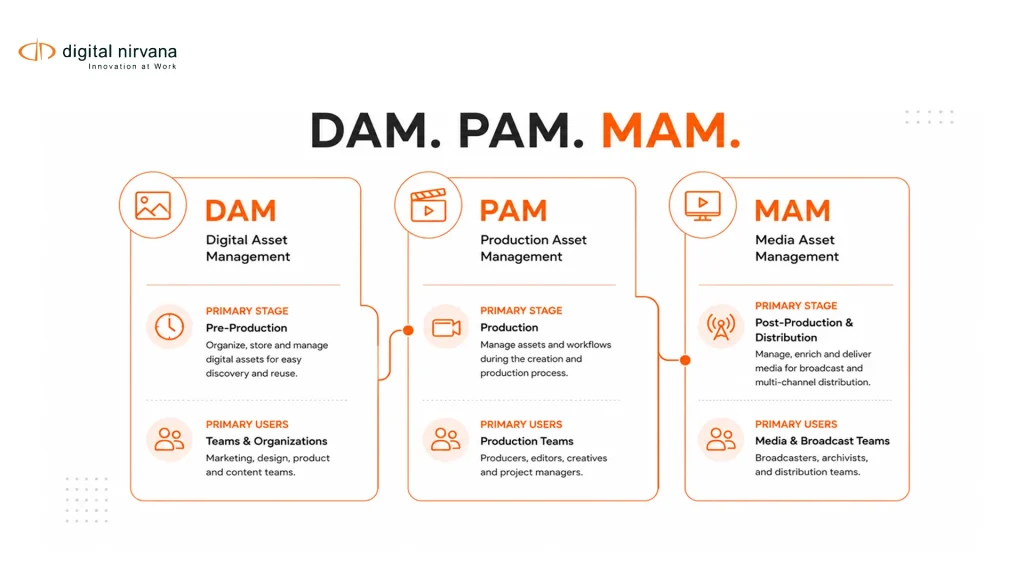
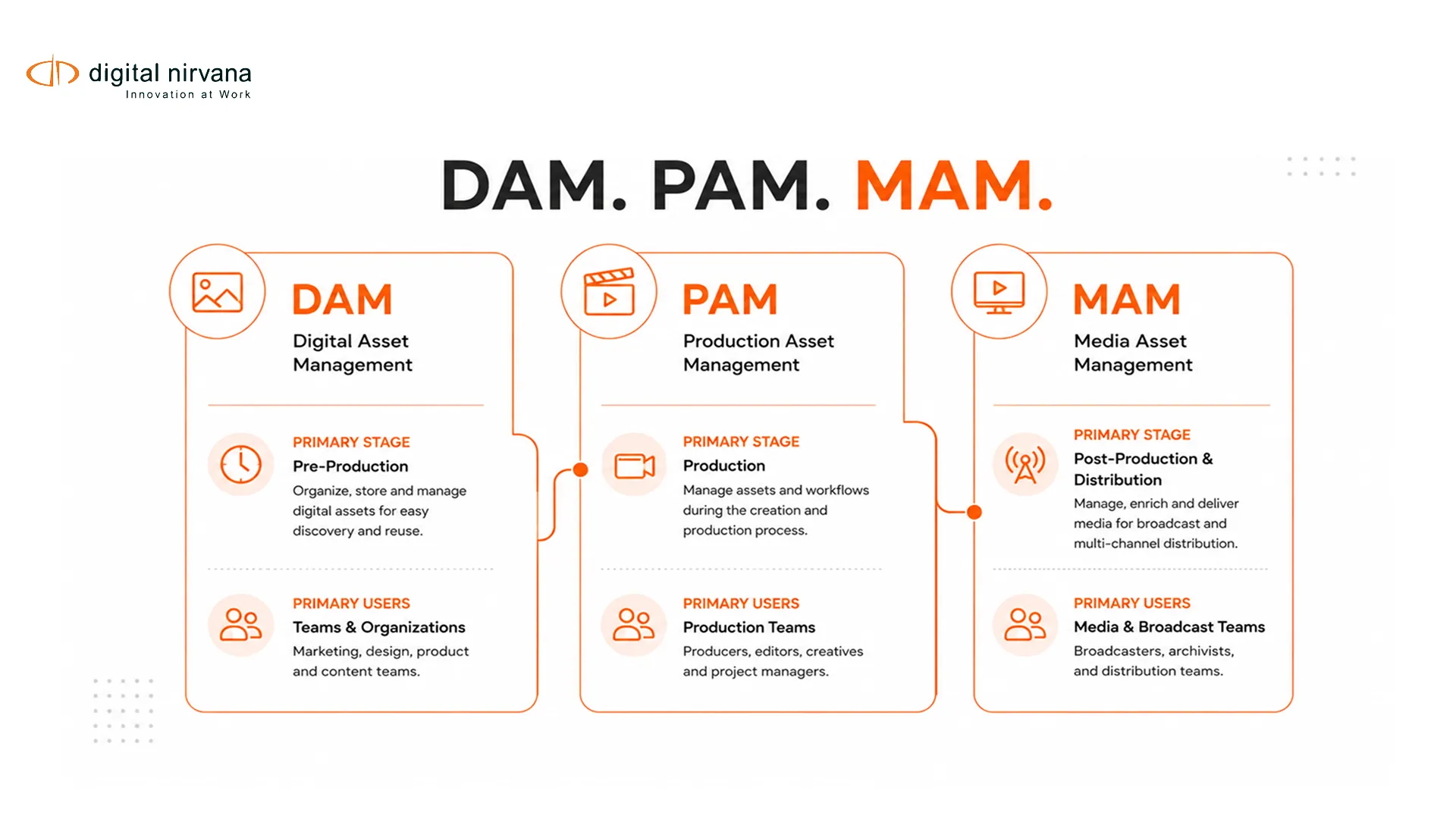
A digital asset management system organizes and distributes digital files such as images, documents, campaign videos and design assets. Its common users include marketing, brand, communications and creative teams. Approval status, rights, versions and channel-ready renditions are often central.
A production asset management system supports media while it is being made. It is commonly close to nonlinear editing, shared storage and production tooling. Proxies, project relationships, fast access and collaboration around work-in-progress material matter more than long-term enterprise distribution.
A media asset management system is designed around rich media operations. It can support ingest, technical metadata, proxies, editorial discovery, workflow state, archive and reuse across long-form or high-volume audiovisual collections. MAM often spans more of the media life cycle than PAM, although real products can blur the boundary.
The Library of Congress introduction to metadata is a useful reminder that descriptive, structural and administrative information serve different purposes. A system choice must account for all three, not only a list of searchable keywords.
MAM vs DAM vs PAM Comparison
| Dimension | DAM | PAM | MAM |
| Primary stage | Approved asset use and distribution | Active production | Media operations, archive and reuse |
| Common users | Marketing, brand, design | Editors, producers, post-production | Broadcast operations, archivists, producers |
| Typical assets | Images, documents, campaign files | Source media, projects, sequences, proxies | Programs, clips, feeds, masters, derivatives |
| Workflow emphasis | Approval, rights, versions, portals | Editing speed, collaboration, shared projects | Ingest, technical processing, discovery, preservation |
| Metadata depth | Brand and business context | Project and production context | Timecoded, technical and descriptive media context |
| Editing proximity | Usually indirect | Very close | Varies by architecture |
| Archive role | Approved business library | Usually short-to-medium production life | Often long-term audiovisual archive |
This table is a starting point, not a product definition. Some DAM platforms support video production. Some MAM products include PAM functions. Procurement should use workflows and acceptance criteria rather than relying on the category named in a vendor’s homepage.
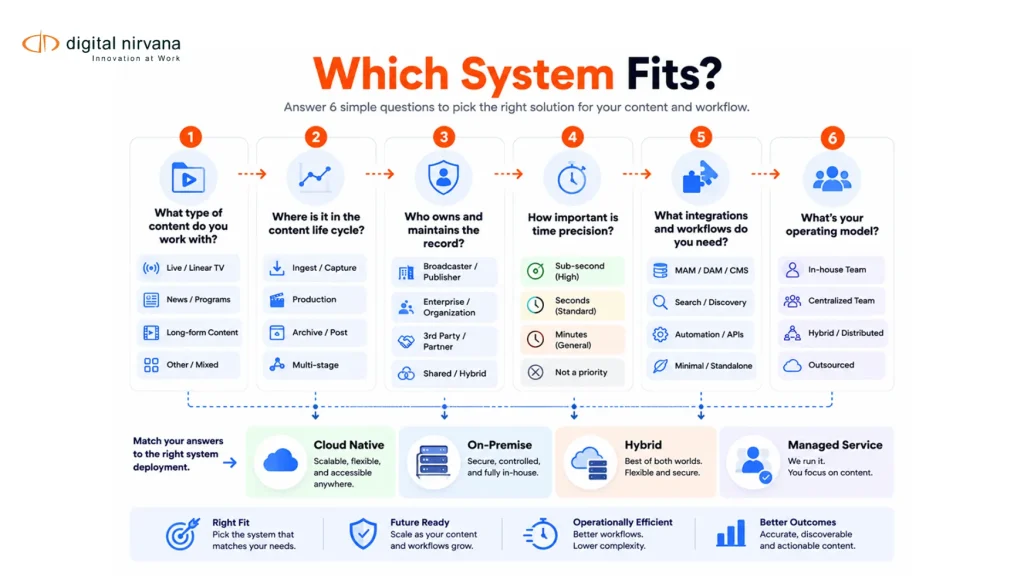
Six Questions That Clarify The Decision
First, which asset types dominate? High-resolution programs, live feeds and frame-accurate clips point toward media-specific capabilities. A mixed brand library used across departments may fit DAM patterns.
Second, where is the asset in its life cycle? If editors are cutting material now, PAM functions may be central. If teams must preserve, find and reuse broadcast content for years, MAM functions carry more weight.
Third, who is the system of record? Name the system that owns authoritative identifiers, rights, versions and retention state. Without this decision, integrations can create contradictory metadata.
Fourth, what is the required time precision? File-level tags may be enough for a brand image. Media discovery may require metadata tied to a spoken quote, face, lower third or scene.
Fifth, which adjacent systems must connect? Consider editing tools, automation, storage, archive, traffic, scheduling, rights and distribution. Require vendors to show the data flow, not only say an integration is available.
Sixth, what operating model can the team support? Configuration, taxonomy governance, review and maintenance determine whether advanced features remain useful after launch.
Digital Nirvana’s article on MAM systems across news, sports and entertainment offers workflow-specific context for this assessment.
How MAM, DAM And PAM Can Work Together
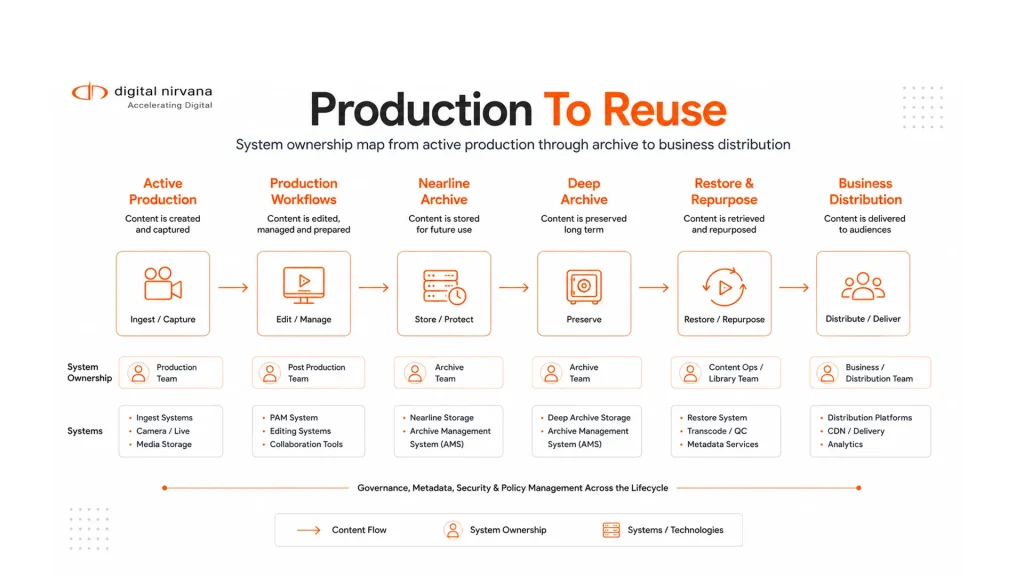
A large media organization may need all three patterns. A PAM can support an editing workgroup, then pass approved masters and selected metadata into a MAM. The MAM can preserve and expose finished and raw program assets. A DAM can receive campaign-ready clips, stills and approved descriptions for business users and external partners.
The integration should pass stable identifiers and only the metadata each destination needs. Copying every field everywhere makes ownership unclear. An event-based handoff, supported by a documented mapping and retry process, is easier to govern than informal file exports.
The Metadata Encoding and Transmission Standard overview explains how structural metadata can record the relationships among files and digital objects. The METS overview is not a product-selection rule, but it demonstrates why media relationships and provenance deserve explicit treatment.
Where Metadata Intelligence Fits
Speech, faces, objects, text and scenes can make large media libraries easier to search. The resulting data still needs a workflow for normalization, review and delivery into the system of record. That intelligence layer should not be described as a replacement for a MAM, PAM or DAM.
MetadataIQ is positioned as a metadata and indexing layer that complements those platforms. Teams can use it to enrich assets and improve discovery while keeping asset governance in the appropriate management system. Digital Nirvana’s guide to metadata management for broadcast teams covers the operating practices behind that model.
FAQs
MAM is typically designed around audiovisual operations and rich media workflows. DAM often serves a broader business audience that manages approved digital assets, brand material and distribution.
PAM focuses on work-in-progress production and editing collaboration. MAM often extends into ingest, enterprise discovery, archive and reuse across the media life cycle.
Yes. The question is whether it supports the required formats, proxies, time-based metadata, workflow depth, scale and editing connections for the intended video operation.
Not always. A smaller operation may cover several patterns with one platform. Larger organizations often separate production, long-term media management and enterprise brand distribution.
No. MetadataIQ is a metadata enrichment and indexing layer designed to complement a MAM, PAM or DAM.
Use representative workflows, system ownership, integration evidence, metadata requirements and operational acceptance tests. Treat the vendor category as orientation, not proof of fit.
Conclusion
MAM, DAM and PAM describe different centers of gravity. A sound architecture assigns each workflow and authoritative field to the system best equipped to own it. It also makes production-to-archive-to-distribution handoffs explicit.
For a workflow-level assessment of metadata enrichment around an existing media stack, contact Digital Nirvana.