A single “keep everything for 90 days” setting is not a retention policy. Broadcast evidence can include off-air audio and video, captions, subtitles, loudness and signal measurements, as-run data, schedules, ad verification, alerts, operator actions, and exported clips. A defensible broadcast recording retention policy maps each record category to a documented legal, contractual, operational, or editorial purpose, then applies the correct clock, storage controls, legal holds, and deletion evidence.
This guide is operational information, not legal advice. Requirements differ by jurisdiction, license, service, content type, dispute status, and contract. Broadcasters should confirm the current rules that apply to each service with regulators and qualified counsel.
Key Takeaways
- Retain the output as actually broadcast when the applicable rule or evidence requires it, not only a studio or pre-transmission feed.
- Different record classes may require different retention periods and start events.
- Regulatory minimums are a floor for the applicable obligation, not a universal answer for every business record.
- Legal holds, active complaints, investigations, and disputes should suspend scheduled deletion for relevant evidence.
- Storage design should preserve time accuracy, completeness, integrity, access control, and rapid retrieval.
- Delete expired data consistently and retain an auditable record of policy execution.
Table Of Contents
- What Broadcast Retention Should Cover
- How To Determine Retention Periods
- What A Retention Schedule Should Contain
- How To Design Storage Tiers
- How To Preserve Evidence Quality
- How Legal Holds And Deletion Work
- How To Test The Policy
- FAQs
What Should A Broadcast Retention Policy Cover?
The policy should cover every record needed to reconstruct what aired, how it was delivered, and how the organization responded.
Potential record classes include:
- Off-air or post-transmission audio and video
- Channel and regional variants
- OTT, FAST, simulcast, and digital-stream outputs
- Captions, subtitles, audio description, and ancillary data
- Electronic program guide and schedule data
- As-run logs and automation events
- Loudness, signal, black-frame, freeze, silence, and transport measurements
- Political, sponsorship, and advertising records
- Alerts, acknowledgements, operator notes, and incident tickets
- Screenshots, clips, exports, and regulator submissions
- Access, configuration, and audit logs
Do not assume one recording proves every output. Ofcom’s note on retention and production of recordings emphasizes that a recording of a separate online stream or a pre-broadcast studio output may not satisfy a licence condition requiring the licensed service’s output as broadcast.
Digital Nirvana’s guide to content monitoring for broadcasters explains why compliance coverage increasingly spans RF, IP, OTT, and FAST variants. The retention inventory should mirror the monitored delivery map.
How Do You Determine Retention Periods?
Start with an obligation register, then assign retention by record class and service. Avoid copying a duration from another jurisdiction or applying the longest period to everything without a documented reason.
For each record, identify:
- Jurisdiction and regulator
- Licence or authorization
- Applicable rule or licence condition
- Contractual requirement
- Complaint, litigation, or investigation exposure
- Operational and editorial reuse
- Privacy, rights, and security limits
- Retention start event
- Minimum and approved maximum period
- Responsible owner and reviewer
Official examples show why one global number is unsafe. Some Ofcom community-radio decisions cite a 42-day recording requirement, while a television licensing decision cites 60 days for sound-and-vision recordings. The exact obligation depends on the licence and service. In the United States, FCC political-file records have a separate rule: the Commission’s 2024 order notes that the relevant records must be retained for at least two years.
These examples are not a retention schedule for another broadcaster. They demonstrate that content recordings, political documentation, and other records can have different clocks.
What Should A Retention Schedule Contain?
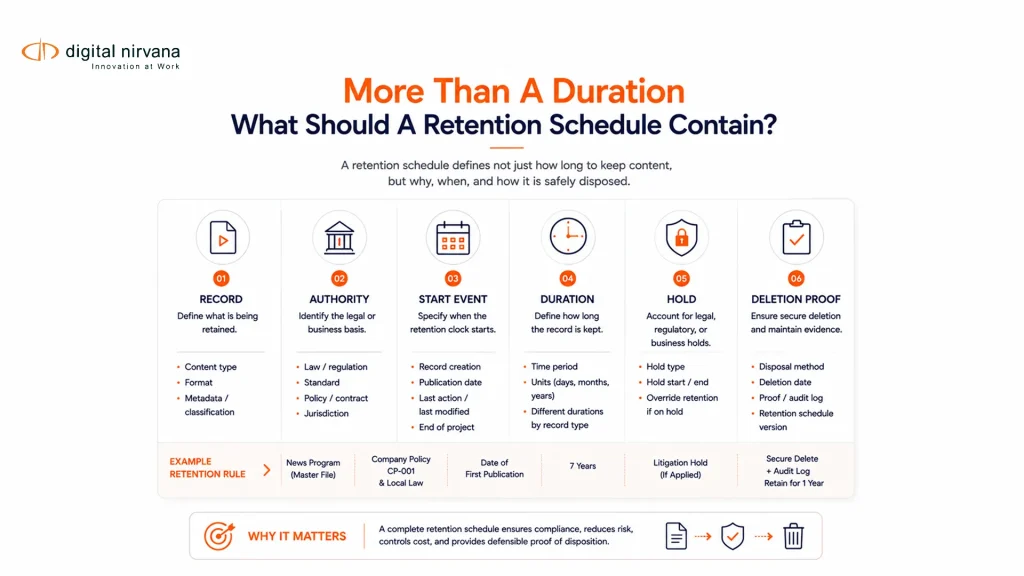
A retention schedule converts the obligation register into executable rules.
Each line should state:
- Record category and system
- Service, channel, territory, and output point
- Purpose and authority
- Trigger that starts the clock
- Retention period
- Legal-hold behavior
- Storage class
- Access roles
- Integrity and time-reference requirements
- Retrieval target
- Disposal method
- Evidence of deletion
- Policy owner and approval date
Use precise triggers. “Two years” is incomplete without stating whether the clock begins at broadcast, contract end, campaign end, final invoice, complaint closure, or another event.
Separate minimum retention from extended business retention. If editorial reuse justifies keeping a preservation master longer, document that purpose and apply appropriate rights and access controls. Do not silently turn a compliance logger into a permanent archive.
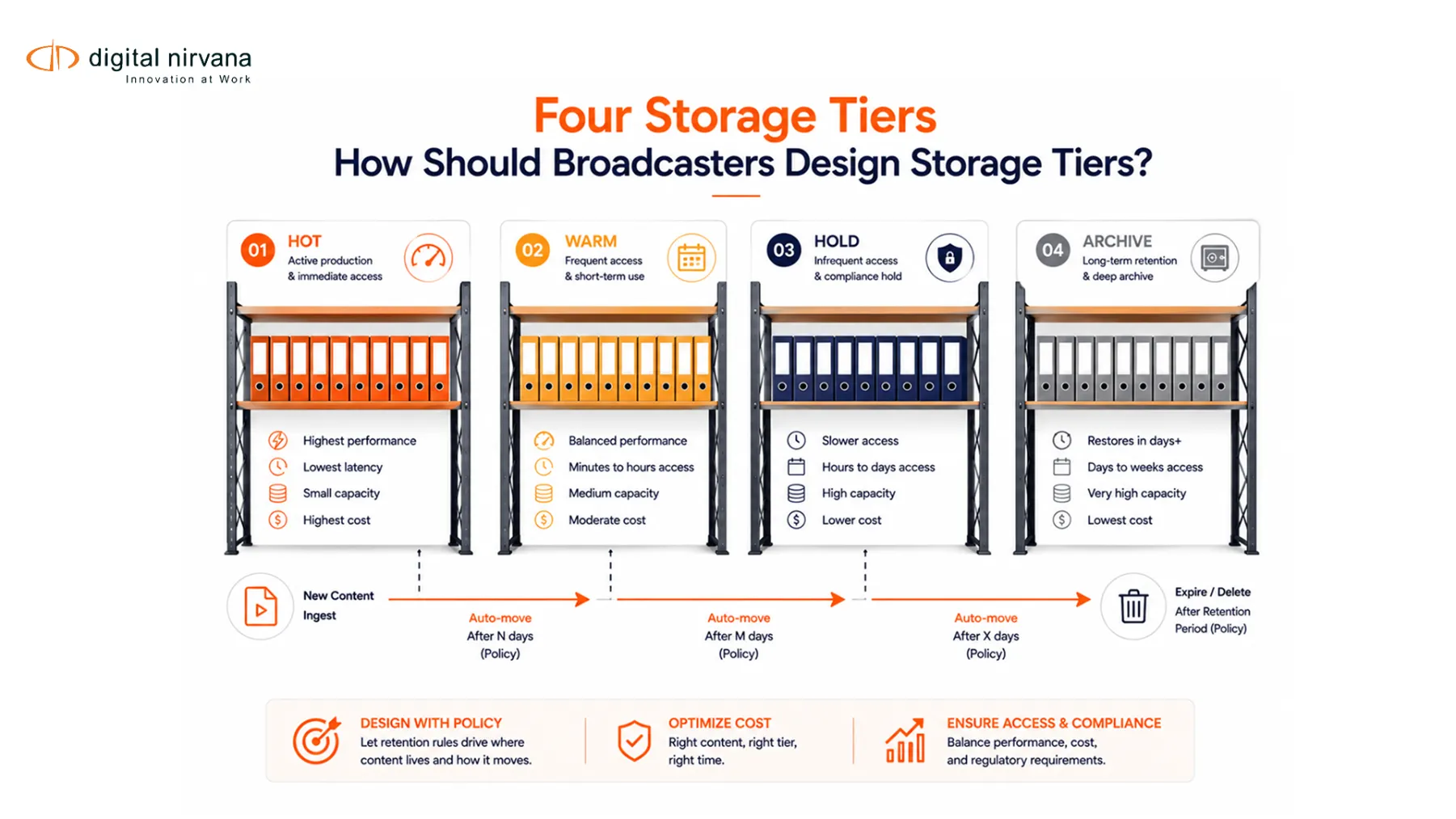
How Should Broadcasters Design Storage Tiers?
Match storage performance and cost to the probability and urgency of retrieval. Recent recordings may require immediate playback, while older evidence can move to lower-cost storage if retrieval obligations still remain achievable.
A tiered design can include:
- Hot window: recent recordings and logs available for immediate search, review, clipping, and incident response.
- Warm window: older evidence with indexed metadata and a defined restore time.
- Hold tier: protected copies for active complaints, disputes, investigations, or litigation.
- Archive tier: selected assets retained for editorial, historical, or preservation purposes under a separate archive policy.
Calculate capacity using every required channel and variant, the actual bit rate, audio tracks, ancillary data, redundancy, metadata overhead, growth, and restore workspace. Include failure tolerance and monitoring of storage health.
The MonitorIQ signal monitoring overview describes monitoring across broadcast signals and content. Product specialists should confirm the recording, storage, retrieval, and export functions available for the intended deployment before those capabilities appear in a policy.
How Do You Preserve Evidence Quality?
Retained media is useful only if teams can show what it represents and retrieve the right interval.
Controls should address:
- Synchronized and monitored time sources
- Continuous channel and service identification
- Gap detection and recording-health alerts
- Preservation of captions and relevant ancillary data
- Hashes or other integrity checks where appropriate
- Immutable or restricted storage for high-risk evidence
- Role-based access and audit history
- Documented exports that retain source, time range, and operator
- Routine playback and restore tests
Keep context with the recording. A clip without the channel, timezone, timestamp, program, output point, and surrounding material may be difficult to interpret. Store the schedule and as-run relationship needed to find the event.
Regulatory examples also show the importance of producing the correct recording promptly. Ofcom has described retention and production as fundamental to its ability to assess compliance. A file that exists but cannot be found, restored, or authenticated creates operational risk.
How Do Legal Holds And Deletion Work?
A legal hold suspends ordinary disposal for records relevant to a complaint, investigation, audit, dispute, or litigation. The hold process should identify the affected channels, dates, record categories, systems, custodians, and variants.
Define:
- Who may issue and release a hold
- How the scope reaches every storage tier and backup
- How owners acknowledge the instruction
- How deletion jobs exclude held records
- How new related records are captured
- How the hold is reviewed and closed
After the approved period expires and no hold applies, deletion should be predictable. Record what rule ran, what was deleted, when it occurred, which exceptions remained, and whether disposal completed successfully.
Keeping data indefinitely can increase privacy, security, rights, discovery, and storage exposure. Deleting too early can destroy required evidence. Governance must control both risks.
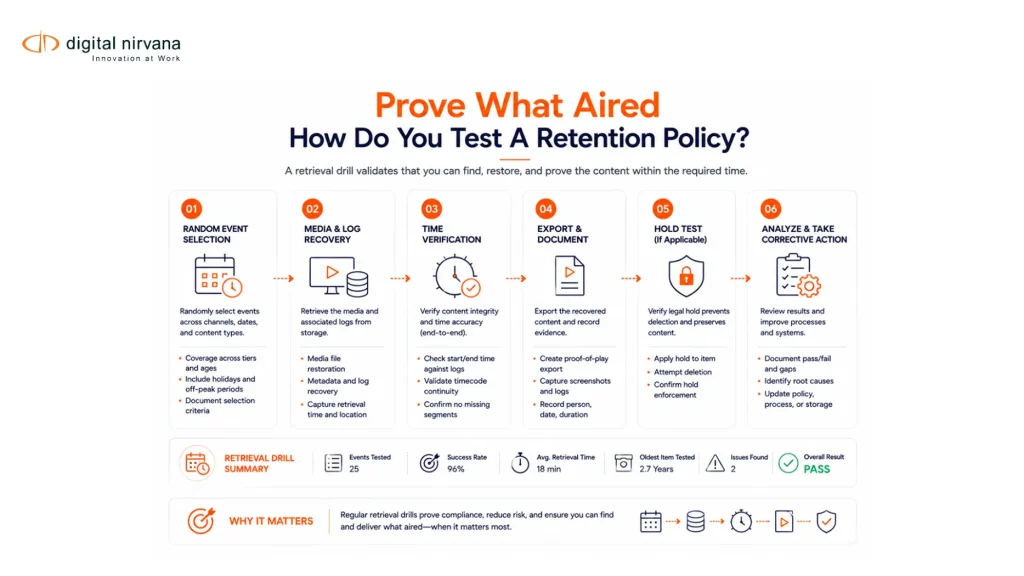
How Do You Test A Retention Policy?
Test the policy by asking teams to retrieve and prove a defined broadcast event from every required output.
Run quarterly or risk-based exercises:
- Select random channels, dates, and time ranges
- Include a caption or signal incident
- Retrieve media, ancillary data, logs, and operator history
- Confirm the clock and timezone
- Compare the recording with the schedule and as-run data
- Export a review package
- Test a legal hold
- Verify that expired, unheld data was deleted
- Record gaps, restore times, and corrective actions
Also test failover. A redundant recorder that captures the wrong source or shares the same failure mode does not provide meaningful protection.
FAQs
Broadcast recording retention is the controlled preservation of aired content and related evidence for defined regulatory, contractual, operational, or editorial periods.
There is no universal period. The correct duration depends on jurisdiction, licence, service, record category, contracts, complaints, and legal holds.
Store the output required by the applicable obligation and evidence purpose. When proof of broadcast is needed, a pre-transmission studio feed may be insufficient.
They may be necessary to demonstrate accessibility, reconstruct the audience experience, or resolve a complaint. Map them to the applicable obligation and output.
A legal hold pauses normal deletion for records potentially relevant to an investigation, complaint, audit, dispute, or litigation.
Suitability depends on the obligation and controls, including location, access, integrity, availability, restore time, deletion, and contract terms.
Usually not without a documented archive purpose. Indefinite retention can create privacy, rights, security, discovery, and cost risks.
Test on a documented schedule and after material changes to channels, platforms, rules, storage, or monitoring systems.
Conclusion
Build retention around evidence classes and obligations, not one duration. Capture the correct outputs, preserve context and integrity, define holds, test retrieval, and delete expired records consistently.
Professional support is useful when multiple channels, regional variants, delivery paths, monitoring systems, and storage tiers must operate under one controlled policy. Legal and compliance owners should approve the final schedule.