Choosing a metadata standard is not a contest between two field lists. It is a decision about the assets an archive describes, the organizations it exchanges records with, the technical representations it must preserve, and the systems that will consume the data. PBCore is often a practical fit for audiovisual collections and public-media exchange, while EBUCore offers a broad broadcast-oriented model with XML and semantic-web representations. The right choice starts with use cases and sample records, not geography alone.
Key Takeaways
- PBCore and EBUCore both describe audiovisual content and draw on Dublin Core concepts, but their structures and implementation communities differ.
- PBCore 2.1 organizes records around assets and their physical or digital instantiations.
- EBUCore 1.10 supports descriptive and technical broadcast metadata and provides XML and RDF-oriented implementation paths.
- Neither standard removes the need for controlled vocabularies, identifiers, local rules, validation, and governance.
- An archive may keep a richer internal model and create standards-based exchange profiles rather than force every local field into one schema.
- Test real records, including rights, versions, parts, technical formats, and time-based metadata, before committing.
Table Of Contents
- What PBCore Is
- What EBUCore Is
- How PBCore And EBUCore Differ
- Which Standard Fits Which Archive
- How To Build An Application Profile
- How To Test A Metadata Crosswalk
- When To Support Both Standards
- FAQs
What Is PBCore?
PBCore is a cataloging and data-sharing standard designed for audiovisual media. It was developed by the United States public broadcasting community and is now used by broadcasters, archives, libraries, and other organizations managing moving-image and sound collections.
The official PBCore XML Schema page identifies PBCore 2.1 as the current release and describes 15 containers, 82 elements, and 49 XML attributes. Its structure separates information about an intellectual asset from information about a specific physical or digital representation.
That distinction is useful for an archive holding one program with several manifestations, such as:
- An original videotape
- A preservation master
- A mezzanine file
- A proxy
- A caption or transcript file
- A published derivative
PBCore can express descriptive information, creators and contributors, rights, relations, annotations, and detailed instantiation data. The PBCore elements documentation groups its structure into root, asset, and instantiation elements.
What Is EBUCore?
EBUCore is the European Broadcasting Union’s common metadata set for describing radio, television, and other media assets. It addresses creation, management, preservation, exchange, and distribution use cases.
The current published EBUCore 1.10 specification adds capabilities for areas including dynamic acquisition metadata, the Audio Definition Model, timed text, scenes, people, actions, and emotions. The EBU also maintains EBUCore resources on GitHub.
EBUCore can be implemented through XML and RDF-oriented representations. This gives organizations options for document exchange, graph relationships, linked data, and integration with a wider broadcast metadata environment.
The flexibility is valuable, but it also raises design questions. An implementation still needs to define which classes and properties are required, which vocabularies are allowed, and how system-specific data maps to the chosen profile.
How Do PBCore And EBUCore Differ?
The most useful comparison is how each standard represents the archive’s priority relationships and exchange requirements.
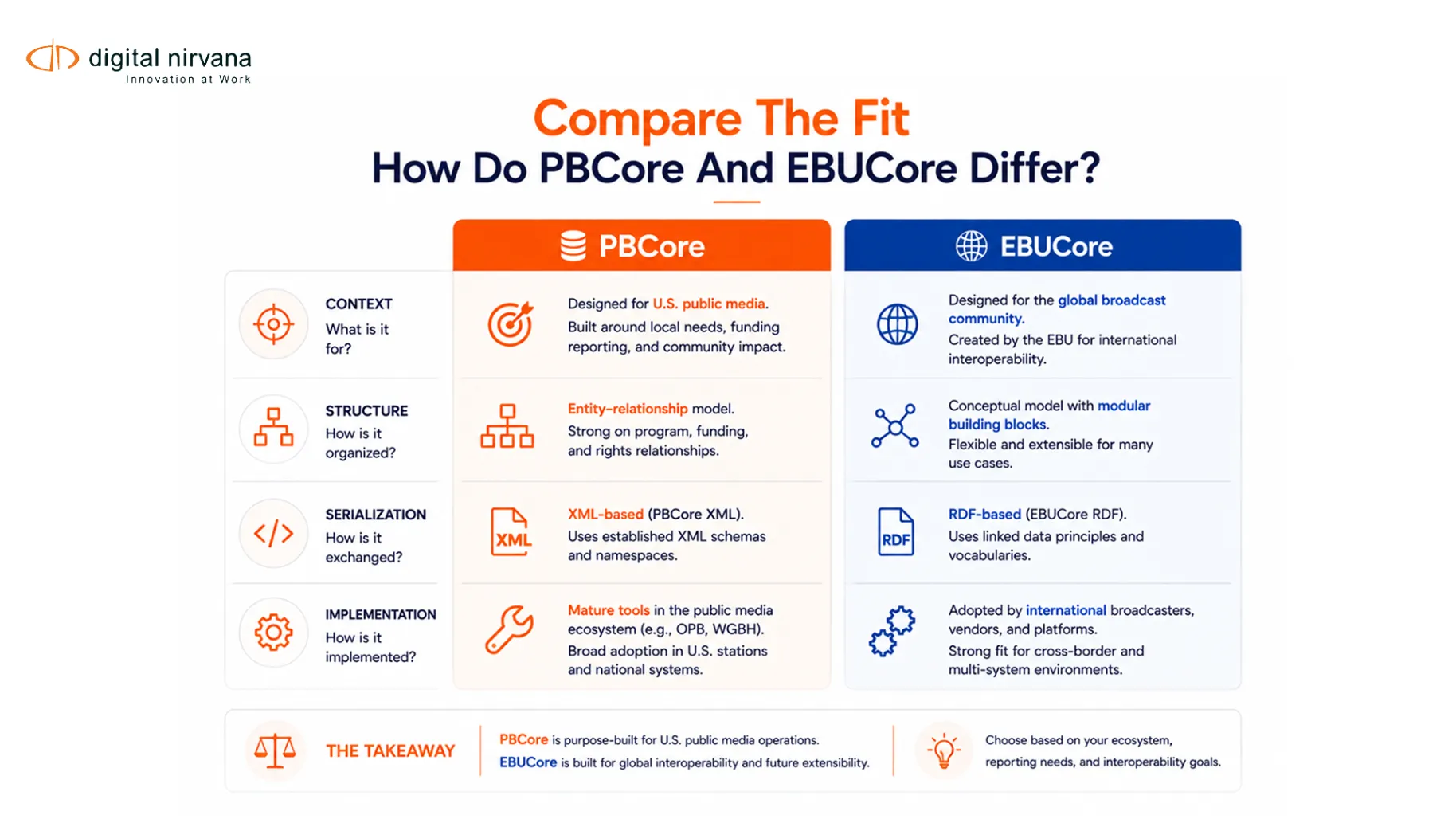
- Primary context: PBCore emphasizes audiovisual cataloging, archives, public media, and exchange. EBUCore spans broadcast and media creation, management, preservation, and distribution.
- Current referenced version: PBCore 2.1 and EBUCore 1.10 are the versions used in this comparison.
- Common serialization: PBCore supplies an XML Schema. EBUCore provides XML and RDF-oriented models.
- Core modeling emphasis: PBCore centers intellectual assets and their instantiations. EBUCore models media resources, entities, technical properties, and relationships.
- Implementation appeal: PBCore offers a direct audiovisual cataloging structure and community guidance. EBUCore offers a broad broadcast model and semantic relationship options.
- Main design task: PBCore implementers define required elements, vocabularies, and asset-to-instantiation rules. EBUCore implementers select the model subset, relationships, vocabularies, and serialization.
This table is directional, not a substitute for schema analysis. Both standards can describe titles, descriptions, subjects, contributors, rights, identifiers, dates, relations, and technical media characteristics. The difference becomes clearer when implementers model several versions, complex parts, dynamic technical properties, or graph relationships.
Do not assume every local field has a direct one-to-one destination. House data may combine concepts, use free text where a standard expects a controlled value, or omit the relationships needed to interpret a code.
Which Standard Fits Which Media Archive?
Choose the standard that best supports the archive’s exchange partners, asset structure, tooling, and staff capabilities.
PBCore may be the stronger starting point when:
- Partners already request or deliver PBCore XML
- The collection is centered on audiovisual cataloging and preservation
- Asset and instantiation relationships match the local inventory model
- Archivists can use the PBCore handbook, templates, and cataloging tools
- Public-media interoperability is a priority
EBUCore may be the stronger starting point when:
- The organization works within EBU or European broadcast ecosystems
- Production, acquisition, distribution, and archive metadata need a shared model
- RDF, linked data, or graph relationships are strategic requirements
- Existing systems or partners use EBUCore-based profiles
- The archive needs EBU-oriented technical and media relationship models
The answer may also be neither as the internal master model. A MAM, DAM, or archive can maintain a governed house schema and transform selected fields into PBCore, EBUCore, or partner-specific packages. Digital Nirvana’s guide to production workflow metadata explains why time-based and operational metadata often need to remain usable inside established PAM and MAM workflows.
How Do You Build An Application Profile?
An application profile states exactly how one organization uses a standard. It turns an optional, flexible specification into implementable rules.
Document:
- Required, recommended, optional, and prohibited fields
- Cardinality for each field
- Controlled vocabularies and code lists
- Identifier syntax and authority
- Date, duration, language, and technical value formats
- Asset, version, part, and instantiation relationships
- Rights and access statements
- Rules for unknown, not applicable, and confidential values
- Validation errors versus warnings
- Ownership and change control
Include examples for a simple program, a multi-part episode, a compilation, an item with several instantiations, and a born-digital asset with captions and transcript derivatives. Human-readable guidance should accompany the machine-readable schema.
The standard should not become the archive’s only documentation. Record why each field exists, who supplies it, which system owns it, and which downstream process depends on it.
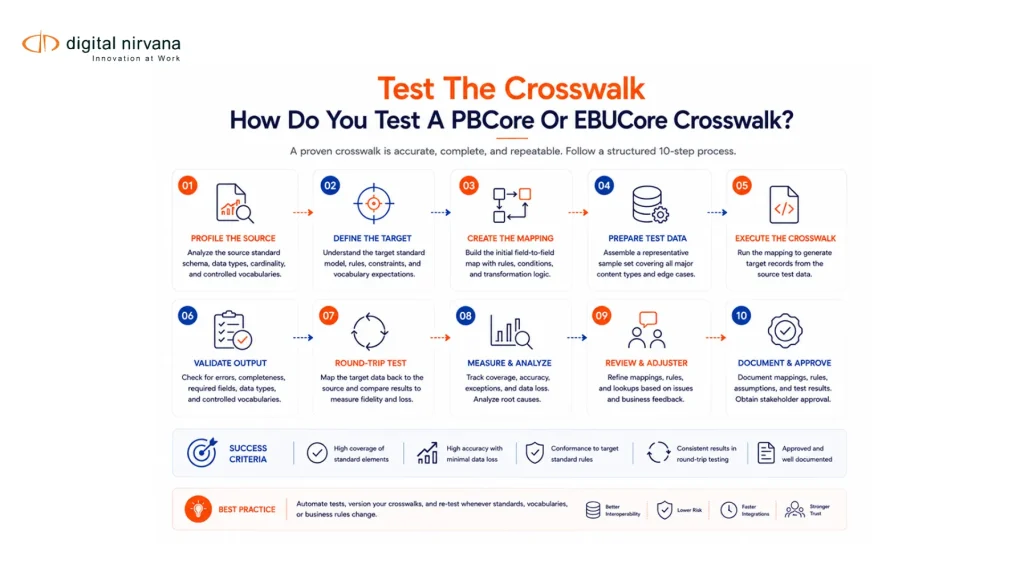
How Do You Test A PBCore Or EBUCore Crosswalk?
Test the crosswalk with representative records and retrieval tasks before migrating or publishing at scale.
Use this sequence:
- Profile source fields, values, nulls, repetition, and inconsistencies.
- Select records that include common and difficult structures.
- Map fields and values separately.
- Record exact, conditional, transformed, concatenated, split, and unmapped results.
- Generate target records.
- Validate them against the selected schema and application profile.
- Round-trip a sample back into a test system.
- Compare meaning, relationships, identifiers, and search results.
- Have archivists review losses and ambiguities.
- Approve exceptions before production.
Field mapping alone is not enough. For example, a local “format” value might combine carrier, codec, frame rate, and resolution. Sending that string to one broad target field preserves characters but not necessarily meaning.
Digital Nirvana’s MetadataIQ overview positions automated metadata as a searchable layer connected to media systems. Standards mapping should preserve the timecodes, identities, relationships, and controlled terms that make that layer useful.
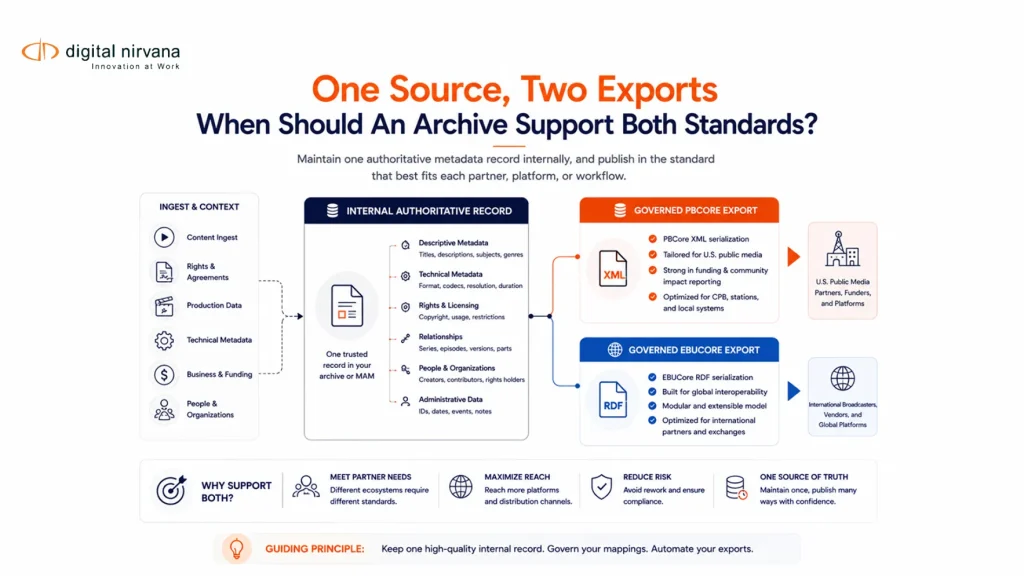
When Should An Archive Support Both Standards?
Support both when distinct partners or workflows require them and a governed transformation can preserve meaning. Do not maintain two uncontrolled master records by hand.
A sustainable pattern is:
- One authoritative internal record
- Explicit source-of-truth rules by field
- Versioned mappings to PBCore and EBUCore
- Automated schema and vocabulary validation
- Exception reports for unmapped or ambiguous data
- Sample-based semantic review after changes
Keep transformation versions with exported records so teams can reproduce what was sent. When either standard or a partner profile changes, compare the old and new output on a regression set.
The Digital Nirvana article on news broadcast metadata notes that standards mapping can help archives and partners parse records while house forms remain practical for daily work. That is the central design principle: interoperability at the boundary, usability and governance at the source.
FAQs
PBCore is used to describe, manage, preserve, and exchange metadata about audiovisual assets and their physical or digital instantiations.
EBUCore is used to describe media across broadcast creation, management, preservation, exchange, and distribution workflows.
No. It originated in the United States public broadcasting community, but other audiovisual archives, libraries, and media organizations can use it.
No. It is maintained by the European Broadcasting Union, but any organization can assess or implement the published specification.
Yes. An archive can maintain one governed internal model and generate different exchange records through versioned mappings.
Both draw on Dublin Core concepts while extending them for audiovisual and broadcast requirements. Their structures and implementation options differ.
No. Schema `validation` checks structural rules, but it cannot guarantee accurate descriptions, consistent vocabularies, correct relationships, or useful search results.
Not automatically. A house schema may remain the authoritative model if standards-based application profiles and mappings meet exchange requirements without losing operational meaning.
Conclusion
Choose PBCore or EBUCore by tracing real assets, relationships, partners, and downstream uses. Build an application profile, test representative records, validate structure and meaning, and retain documented mappings.
Professional help is valuable when multiple systems, legacy fields, standards, and time-based metadata must be reconciled without disrupting search. A small crosswalk pilot usually reveals more than a feature checklist.