A breaking news clip needs captions within minutes. A podcast producer wants searchable transcripts before publishing. A compliance team must retrieve broadcast records instantly during an audit. In today’s media environment, speed alone is not enough. Accuracy matters equally here.
Everything is now transitioning into AI and more integrated systems for better audio transcription. The global AI transcription market is approximately $3.86 billion and is projected to reach $29.45 billion by 2034.
Solutions like MonitorIQ by Digital Nirvana are now gaining traction because they actively help broadcasters and media companies monitor, analyze, record, and even repurpose content in the most efficient manner. In this guide, let’s explore how audio transcription services work and how they can enhance your overall metadata workflows.
Why Are Media Teams Relying More On Audio Transcription Services Today?
Media production moves fast. Newsrooms, broadcasters, and even streaming platforms generate humongous volumes of audio and video content daily. Managing such a large amount of data is simply impossible.
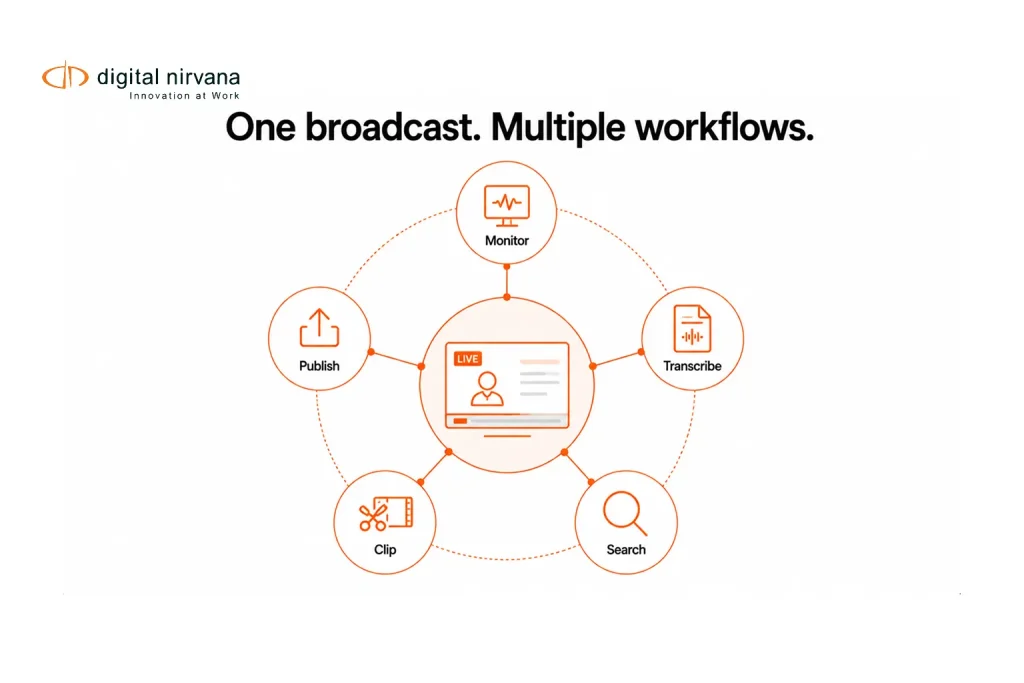
Audio transcription services help teams convert the spoken content into searchable text, such as:
- Captioning and subtitling
- Broadcast compliance logging
- Content indexing and archiving
- Search and retrieval
- Metadata generation
- Content repurposing
- Accessibility compliance
- Ad verification and monitoring
For media organizations, transcription is no longer a standalone task. It is part of a larger content intelligence workflow.
What Impacts Transcription Accuracy In Media Workflows?
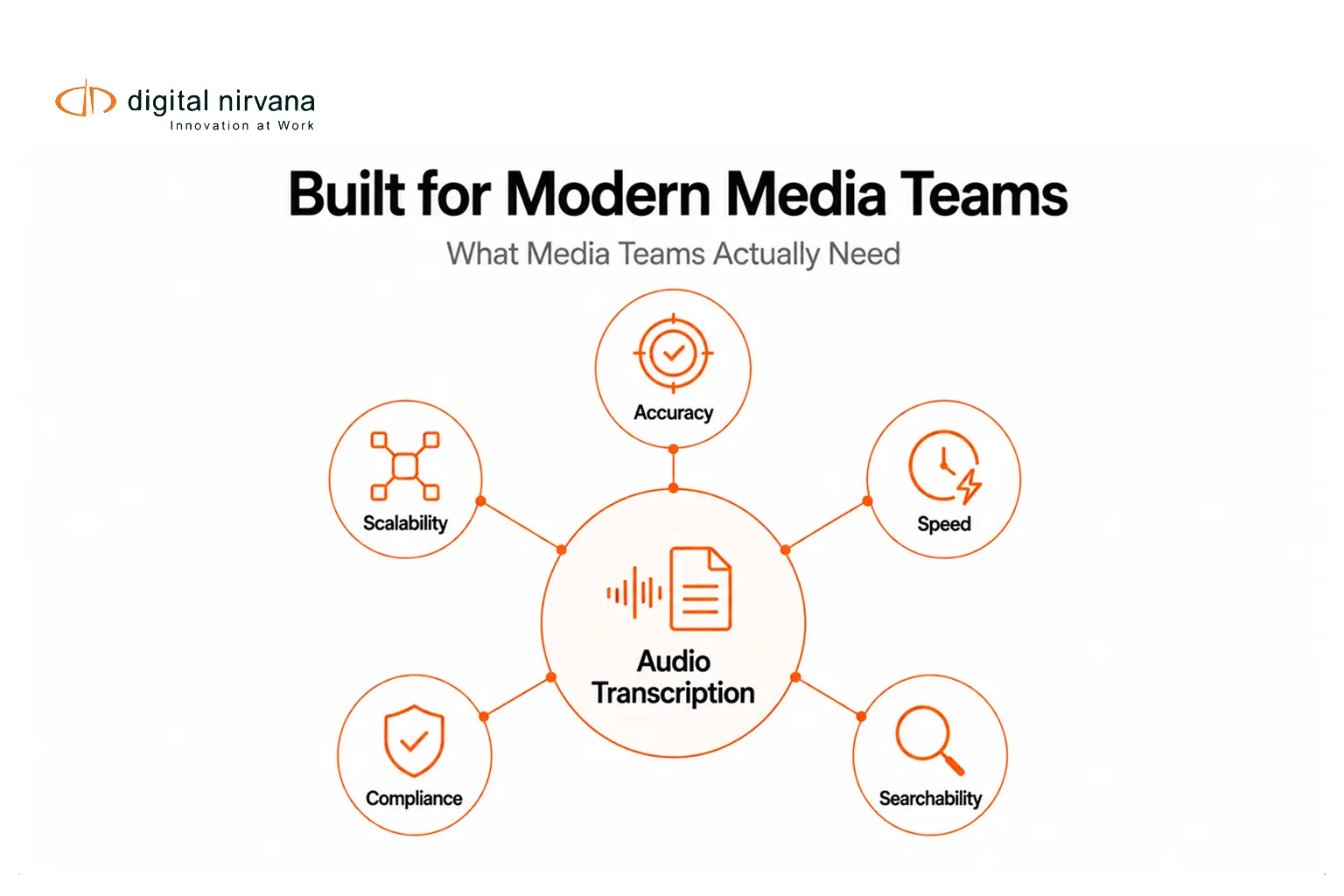
Accuracy is indeed one of the most important factors in audio transcription services. These factors significantly impact transcription quality.
- Audio Quality
Background noise, overlapping speech, or even inconsistent microphone quality can greatly reduce accuracy. Broadcast-grade monitoring systems effectively maintain higher audio integrity across a vast range of recording and logging workflows.
- Speaker Identification
Media content includes everything, like multiple speakers, interviews, panel discussions, and whatnot. Only the best transcription systems effectively use speaker diarization, which can help distinguish between speakers with the greatest accuracy.
- Industry Terminology
General transcription tools are not enough for specialized vocabulary, especially in industries like finance, sports, politics, healthcare, or even entertainment. AI models can effectively use domain-specific terminology to improve overall recognition rates.
- Human Review Processes
AI-powered speech recognition significantly improves overall accuracy, which is critical for managing media workflows. Automated speech recognition with editorial validation brings way better transcript quality.
- Metadata Integration
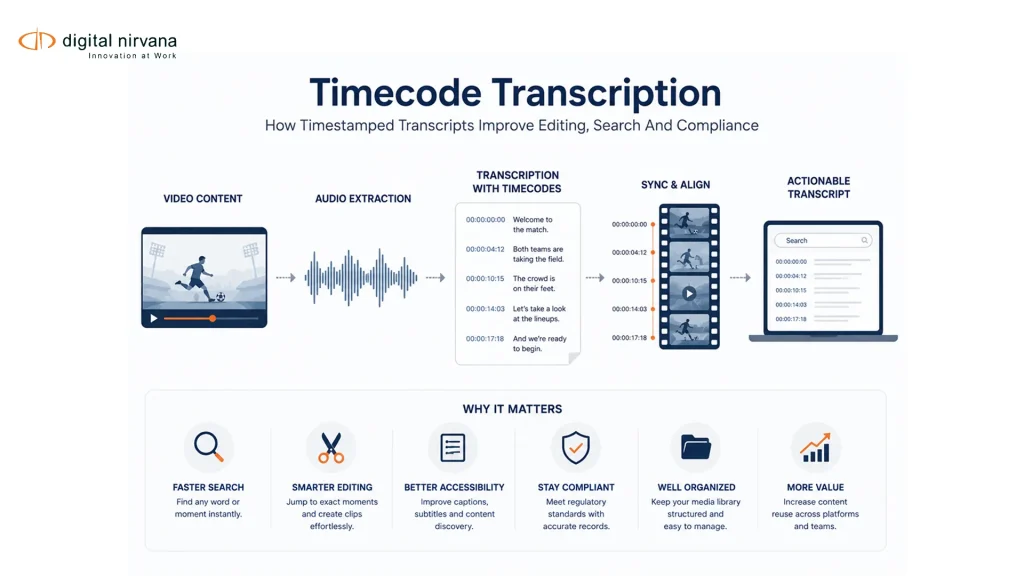
Transcription becomes more valuable when integrated with timestamps, captions, speaker labels, and searchable metadata.
According to Digital Nirvana’s MonitorIQ, integrated metadata workflows enable broadcasters to retrieve and repurpose content more quickly while improving compliance and monitoring operations.
Why is Turnaround Speed Important in Broadcasting And OTT?
In media production, delays can directly impact audience engagement, publishing schedules, and operational efficiency.
Fast turnaround is critical for:
- Live news broadcasting
- Sports coverage
- Social media clipping
- Podcast publishing
- OTT content delivery
- Compliance reporting
- Emergency broadcasts
Where Are Media Transcription Services Used Across Modern Media Teams?
Media transcription services support a wide range of operational and editorial workflows.
- Broadcast Compliance Logging
Broadcasters are required to maintain records of aired content for regulatory compliance and proof-of-performance requirements.
Transcripts make it easier to quickly search historical content, retrieve segments, and verify broadcast activity.
MonitorIQ supports compliance logging, monitoring, metadata indexing, and searchable content retrieval for broadcasters managing large volumes of media assets.
- News Production
News teams often work against extremely tight deadlines. Searchable transcripts help producers locate interview quotes, create clips faster, and accelerate newsroom workflows.
AI-assisted transcription also reduces manual logging time for editors and journalists.
- Podcast And OTT Content
Podcast creators and streaming platforms use transcripts to improve SEO, accessibility, and audience engagement.
Text transcripts help search engines understand audio content, making episodes easier to discover online.
- Closed Captioning And Accessibility
Accessibility compliance is a growing requirement across digital media platforms.
Accurate transcription supports:
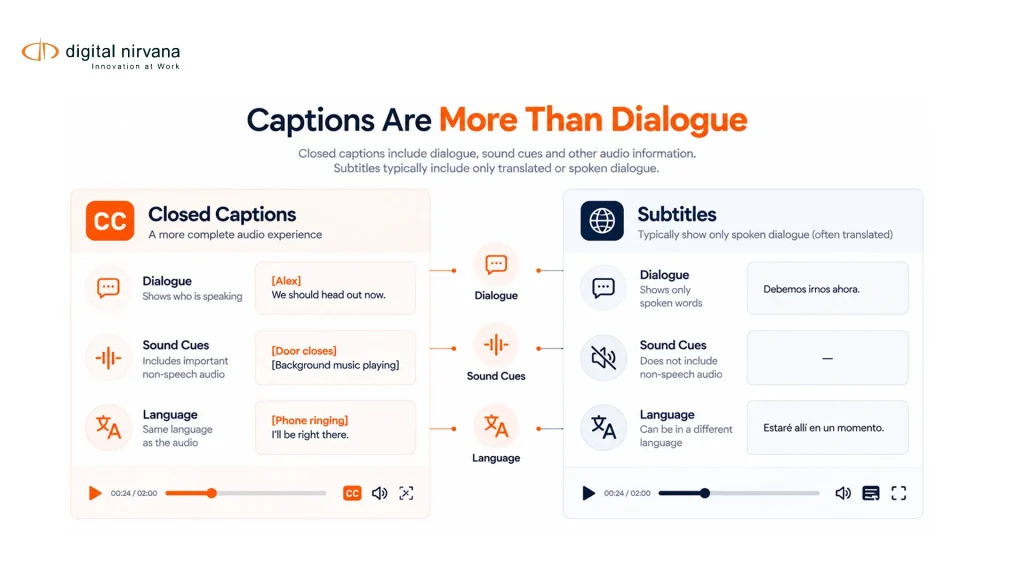
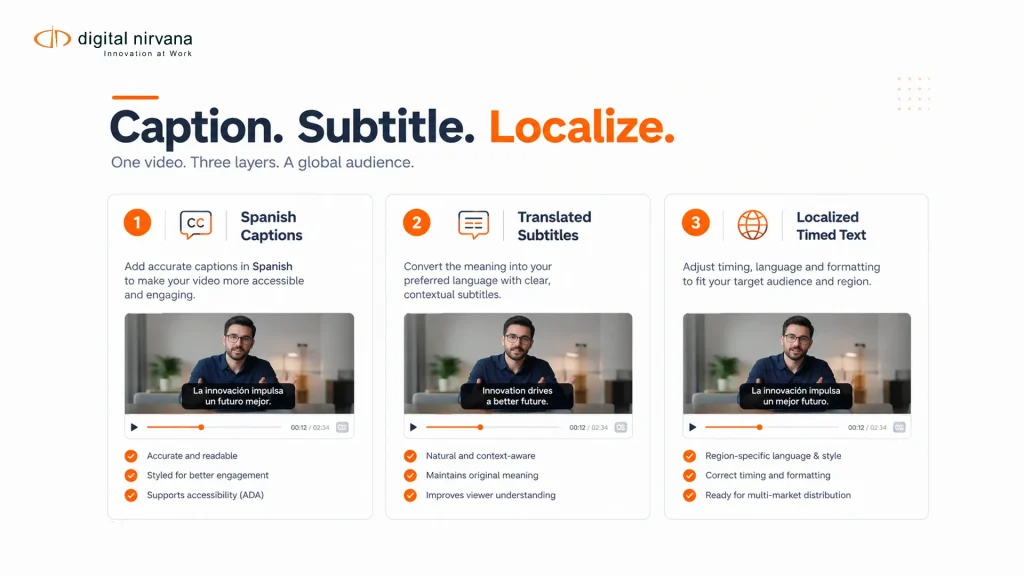
- Closed captions
- Subtitles
- Multilingual translations
- Hearing accessibility standards
Media organizations increasingly use AI-powered workflows to streamline caption generation and subtitle delivery.
- Content Repurposing
One interview can become:
- A blog article
- Social media snippets
- YouTube captions
- Email newsletters
- Promotional clips
Searchable transcripts simplify content repurposing and help marketing teams maximize media value.
- Ad Verification And Competitive Monitoring
Broadcasters and advertisers use transcription-enabled monitoring tools to verify ad placements and analyze competitor broadcasts.
Digital Nirvana’s monitoring solutions support content analysis, ad tracking, logo detection, and metadata indexing for competitive intelligence workflows.
What Problems Still Slow Down Traditional Transcription Workflows?
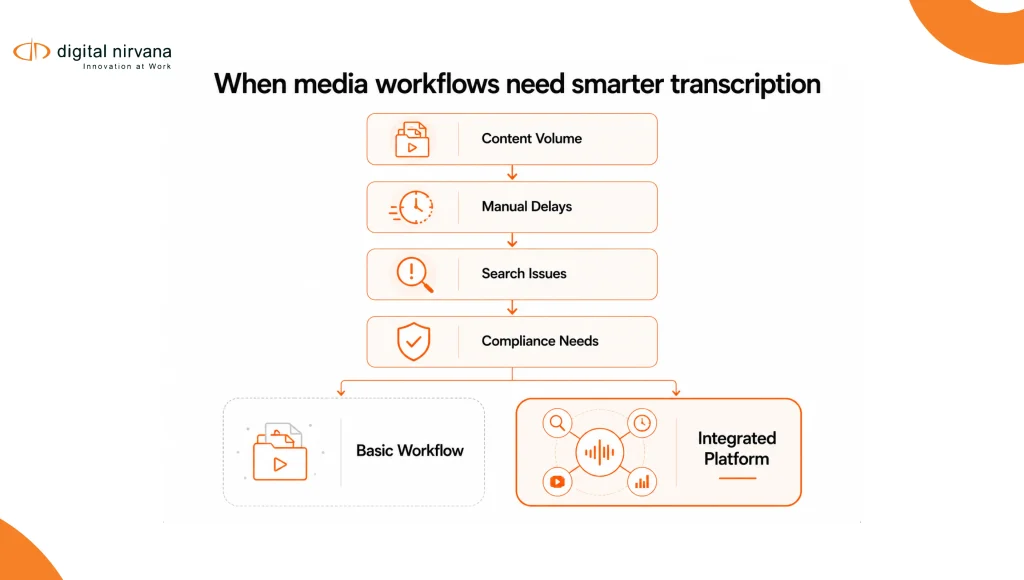
Despite the benefits, many media organizations still face operational bottlenecks with outdated transcription processes.
- Manual Workflows
Traditional transcription often requires substantial manual review, tagging, and formatting. This slows editorial teams and increases operational costs.
- Lack Of Integration
Standalone transcription tools create disconnected workflows that require users to switch between multiple systems for monitoring, logging, editing, and retrieval. Integrated platforms improve workflow efficiency significantly.
- Scalability Issues
Large broadcasters manage hundreds of channels, live feeds, and archived assets simultaneously. Scalable media transcription services are essential for handling enterprise-level workloads.
- Limited Searchability
Without metadata integration, transcripts become difficult to organize and retrieve effectively. AI-powered indexing improves content discoverability across large media libraries.
How Does Digital Nirvana Simplify Transcription, Monitoring, And Media Operations?
Managing modern media operations requires much more than basic speech-to-text conversion. Broadcasters, OTT platforms, production houses, and digital publishers handle massive volumes of live and recorded content every day, making monitoring, compliance management, transcription, and content retrieval increasingly difficult without the right infrastructure.
- They actually combine monitoring, transcription, compliance logging, and content management workflows within a centralized system designed specifically for modern media operations.
- The MonitorIQ platform continuously monitors television, radio, streaming, and OTT feeds in real time.
- Its AI-powered transcription and metadata generation capabilities help media teams convert spoken content into searchable text while automatically organizing media assets with specific timestamps, keywords, and metadata for faster search and retrieval workflows.
- Instead of manually reviewing hours of recorded content, production teams can now quickly locate interviews, breaking news clips, advertisements, or specific spoken phrases in no time.
- The platform is structured to support scalable media environments. This makes them ideal for broadcasters and content publishers handling high-volume, multi-channel operations.
This creates a unified workflow that improves operational efficiency across departments.
Digital Nirvana’s MonitorIQ platform supports monitoring across the full video delivery chain, from production environments to OTT distribution. For broadcasters and large media networks, integration reduces workflow fragmentation and helps teams respond faster during live operations.
FAQs
Audio transcription services convert spoken audio into written text for media production, compliance, accessibility, and content management workflows.
Media transcription services help broadcasters improve searchability, compliance logging, caption generation, and content repurposing across large media libraries.
Modern AI transcription systems can achieve high accuracy levels, especially when combined with human review and high-quality audio input.
Yes. Many modern platforms provide near real-time transcription capabilities for live news, sports, and OTT streaming workflows.
Search engines cannot fully interpret audio or video content. Transcripts make media content searchable and improve discoverability online.
Media transcription services are designed specifically for broadcast workflows, compliance logging, metadata indexing, and content retrieval operations.
MonitorIQ helps broadcasters monitor, log, search, analyze, and repurpose media content while supporting AI-powered transcription and metadata workflows.
Conclusion
The need for fast, accurate, and scalable audio transcription services is increasing at a rapid pace. So many broadcasters, OTT providers, and digital publishers rely on transcription services like MonitorIQ by Digital Nirvana.
It is important to implement integrated workflows that combine several aspects, such as compliance logging, intelligent search capabilities, and other features. Their AI-powered media transcription services ensure that your team can actually deliver content quickly, and accurately. This yields far better results than the manual transcription services used earlier.
Key Takeaways:
- Audio transcription services help media teams improve accessibility, compliance, and content discoverability. They also support faster editorial and production workflows across multiple platforms.
- Accuracy depends heavily on audio quality, speaker recognition, metadata integration, and AI model training. Human review remains important for critical broadcast environments.
- Fast turnaround times are essential for live broadcasting, podcast publishing, OTT workflows, and social media distribution. Real-time transcription helps teams respond faster to audience demands.
- Integrated media transcription services provide far more value than standalone transcription tools. Unified workflows improve monitoring, logging, searchability, and content management efficiency.
- AI-powered platforms like MonitorIQ help broadcasters automate media monitoring, transcription, metadata analysis, and compliance operations at scale.