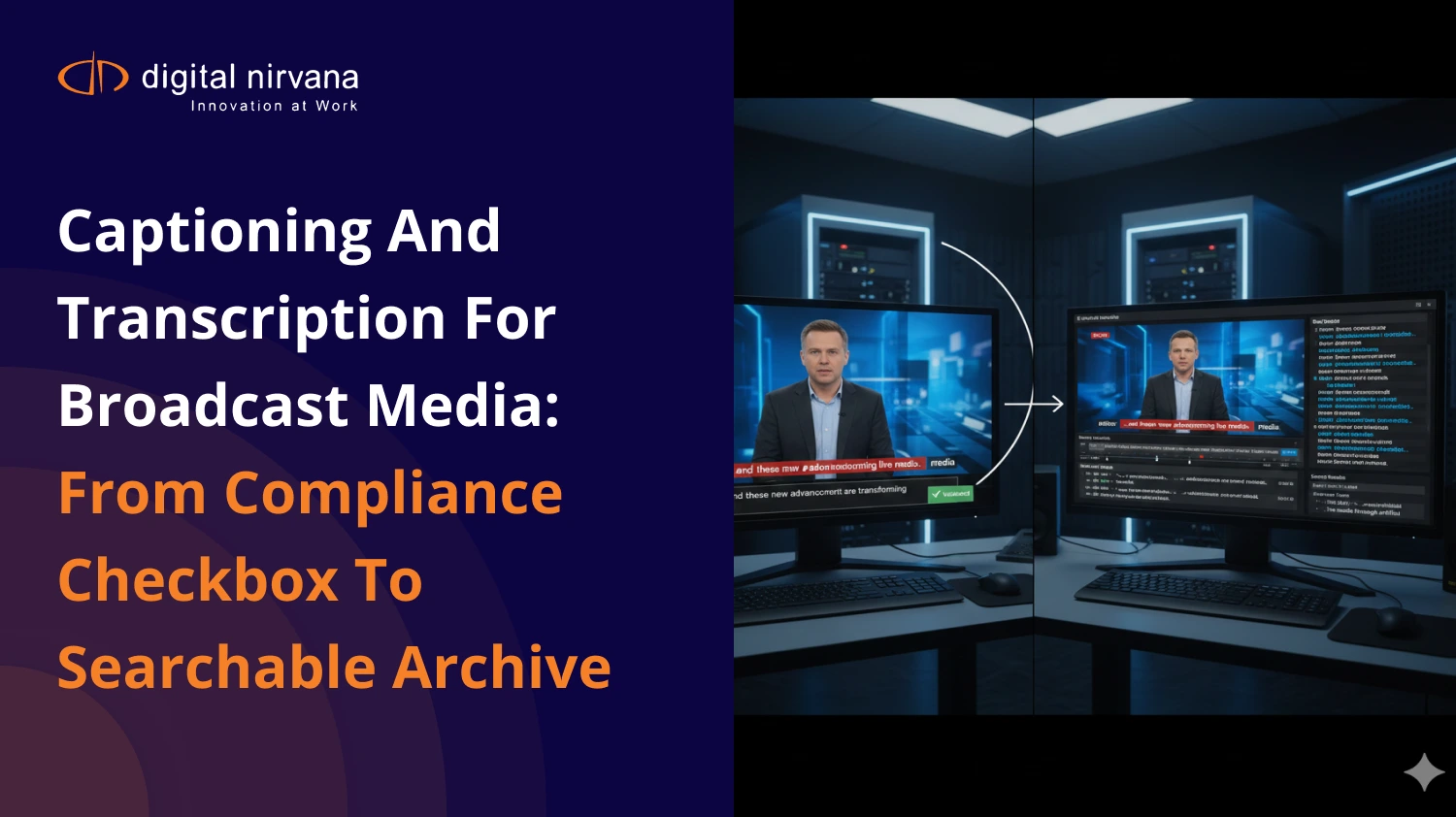
A master control operator gets an alert mid-broadcast: captions have dropped out of sync during a live segment. There’s no time to fix it before the moment airs, and by the time anyone reviews the footage, the FCC complaint window is already open. This is the reality of broadcast captioning. It isn’t a one-time production task. It’s a live, ongoing compliance obligation that has to hold up under real-time pressure, every single broadcast, every single day.
Captioning and transcription for broadcast media carry a different weight than captioning for streaming or on-demand content. The regulatory bar is higher, the tolerance for error is lower, and the consequences of getting it wrong show up as compliance violations, not just viewer complaints. This guide breaks down what broadcast captioning actually requires, where teams tend to fall short, and how a transcription-first workflow keeps compliance and quality moving together instead of fighting each other.
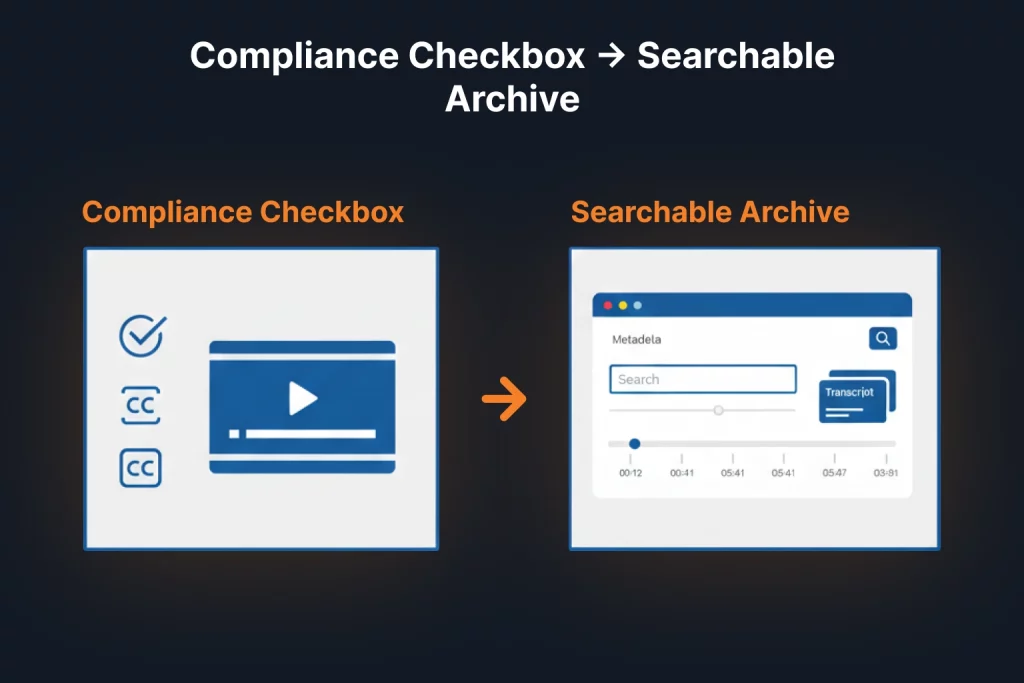
Why Broadcast Captioning Carries More Regulatory Weight
Almost all new, non-exempt video programming shown on US television must be captioned, and that obligation sits specifically with video programming distributors, including broadcasters, cable operators, and satellite providers. Since 2014, the FCC has held those captions to four defined quality standards: accuracy, synchronicity, completeness, and placement, codified under 47 CFR § 79.1(j)(2).
Each standard carries specific technical requirements. Captions must match spoken words in their original language, in the order spoken, without paraphrasing except where time constraints genuinely force it, and proper names and places cannot be substituted. Non-verbal information matters too, including speaker identification, music cues, and sound effects, when the program allows for it. Captions must begin when speech begins and end when it ends, run from the beginning to the end of the program, and never obscure faces, graphics, or other content essential to understanding what’s on screen.
For prerecorded programming, the rules permit only de minimis errors, meaning the bar for accuracy is genuinely high. Live and near-live programming gets some allowance for the inherent challenges of real-time captioning, but that allowance is narrower than most teams assume, and it doesn’t excuse systemic quality problems.
A Compliance Deadline Worth Tracking Right Now
A newer rule adds urgency to broadcast caption planning: a requirement taking effect August 17, 2026 mandates that caption display settings be readily accessible to viewers, adding an interface-level accessibility requirement on top of the existing accuracy, synchronicity, completeness, and placement standards. Broadcast and distribution teams should confirm their playout and delivery systems already meet this requirement rather than treating it as a future problem.
Where Broadcast Captioning Workflows Typically Break Down
The gap between “we have captions” and “we have compliant captions” is where most broadcast teams run into trouble. A few patterns show up repeatedly.
Live captioning under real-time pressure. Breaking news, live sports, and unscripted segments leave no room for a review pass before the caption airs. Errors that would get caught in an offline QC process go straight to broadcast, and inconsistent quality across live segments becomes a recurring compliance risk rather than an occasional slip.
Inconsistent workflows across channels. Station groups running multiple linear channels often end up with different caption vendors, different quality standards, and different QC processes per channel, which makes proving consistent compliance across the full broadcast group significantly harder.
Weak documentation for compliance response. When a caption complaint comes in, broadcasters need to demonstrate the steps taken to meet accuracy, synchronicity, completeness, and placement standards. Teams without a documented, defined manual of style and consistent evaluation process struggle to respond to complaints with the evidence regulators expect.
Treating transcription and captioning as separate tasks. When transcription happens as a disconnected step from the captioning workflow, teams end up doing redundant work, and inconsistencies between the transcript used for search or archival purposes and the captions that actually aired become common.
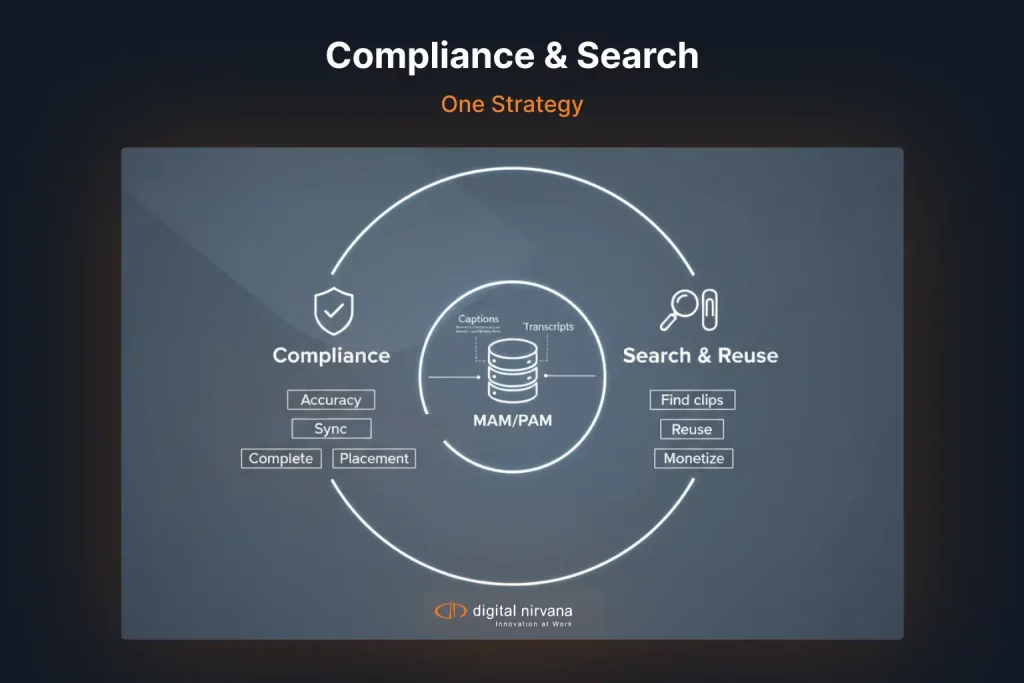
How Accurate Transcription Anchors Broadcast Caption Compliance
The foundation of compliant captioning is an accurate, time-coded transcript. Every one of the FCC’s four quality standards depends on it. Accuracy depends on the transcript capturing spoken words correctly. Synchronicity depends on the transcript being properly time-coded to the corresponding audio. Completeness depends on the transcript covering the full program from start to finish. Even placement, while primarily a formatting concern, depends on caption text being available in a form that can be positioned correctly against on-screen content.
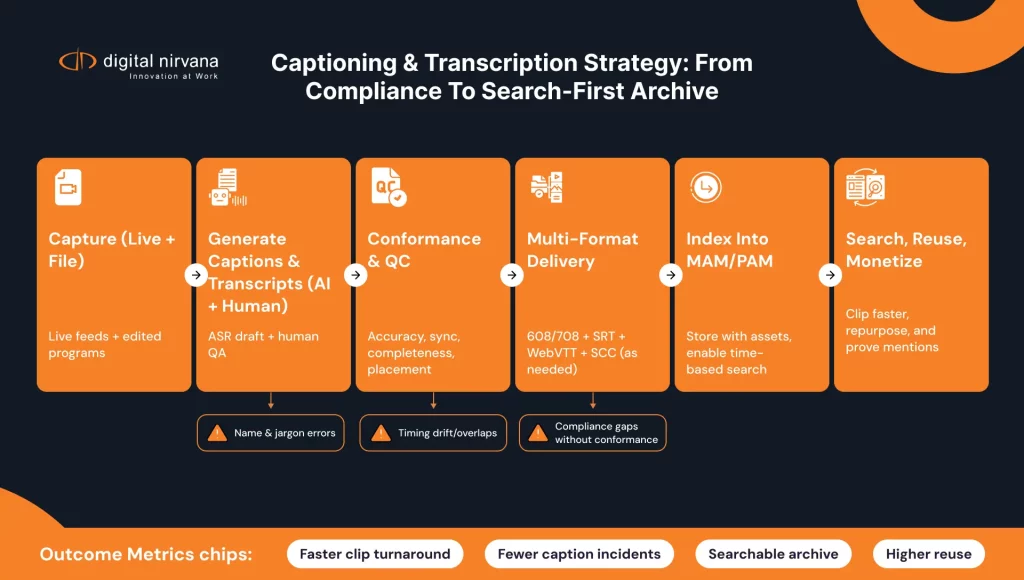
This is why broadcast teams increasingly treat transcription as the first and most important step in the captioning workflow, not a separate task handled after the fact. Automated transcription generates a fast, accurate first pass at ingest, and a human review layer, particularly for live and near-live content, closes the gap between automated output and the accuracy standard the FCC actually requires.
A Real-World Broadcast Captioning Workflow
Picture a station group running live news, syndicated programming, and live sports across multiple channels. Instead of routing each content type through a separate caption vendor with its own quality standard, a unified transcription and captioning workflow generates accurate, time-coded transcripts as content is ingested or aired.
For prerecorded segments, that transcript goes through offline QC before the program airs, meeting the stricter de minimis error standard prerecorded content requires. For live segments, real-time captioning draws on the same underlying transcription infrastructure, with post-broadcast review flagging any synchronization or accuracy issues for correction in future segments. Across the entire station group, caption quality stays consistent because it’s running through one workflow instead of several disconnected vendor relationships, and documentation of QC and evaluation steps stays centralized, ready to support a compliance response if a complaint comes in.
Measurable Impact: Unified vs. Fragmented Broadcast Captioning
| Factor | Fragmented Vendor Workflow | Unified Transcription-First Workflow |
|---|---|---|
| Consistency across channels | Varies by vendor | Consistent quality standard |
| Compliance documentation | Scattered, hard to produce | Centralized and auditable |
| Live caption error correction | Reactive, per-incident | Systematic review and improvement |
| Transcript and caption alignment | Often disconnected | Same source transcript throughout |
| Response time to complaints | Slow, requires vendor coordination | Faster, documentation readily available |
A Broadcast Captioning Compliance Checklist
- Confirm captions meet all four FCC quality standards: accuracy, synchronicity, completeness, and placement
- Maintain a documented manual of style for consistent caption presentation across all programming
- Run frequent, regular evaluations of caption quality, not just a one-time setup check
- Confirm caption display settings meet the accessibility requirement taking effect August 17, 2026
- Apply offline captioning workflows to prerecorded content to meet the stricter de minimis error standard
- Build a review process for live captioning that flags recurring accuracy or sync issues for correction
- Centralize transcription so the same accurate source feeds both captioning and any archival or compliance logging needs
- Keep documentation ready to demonstrate compliance steps in response to a caption complaint
Addressing the Common Objections
“Live captioning can’t realistically hit the same accuracy standard as prerecorded content.” That’s accounted for in the rules themselves. The FCC considers the inherent challenges of live captioning when evaluating compliance, but that doesn’t remove the obligation to maintain accuracy, synchronicity, completeness, and placement to the fullest extent possible given the format.
“We already meet caption requirements, so this isn’t urgent.” Meeting requirements today doesn’t guarantee readiness for upcoming changes, including the caption display accessibility rule taking effect in August 2026. Confirming systems are ready now avoids a last-minute scramble.
“Coordinating one workflow across multiple channels sounds harder than managing vendors separately.” In practice, fragmented vendor relationships are usually what makes consistent compliance harder to prove, not easier. A unified transcription and captioning workflow tends to reduce coordination overhead rather than add to it.
Where Digital Nirvana Fits Into Broadcast Captioning Compliance
TranceIQ generates the accurate, time-coded transcription that anchors compliant captioning, whether the content is prerecorded or live, and carries that same transcript through to caption delivery rather than treating transcription and captioning as disconnected steps. For station groups managing compliance across multiple channels, MonitorIQ brings closed caption monitoring together with loudness, QoE, and proof-of-performance tracking, giving compliance leads one place to verify caption quality against FCC standards instead of piecing documentation together across separate systems.
For high-volume or live captioning needs that require managed human review under tight turnaround windows, Media Enrichment provides 24/7 captioning and quality assurance support without requiring broadcasters to staff every shift internally. Teams looking for a deeper breakdown of the FCC’s specific caption quality requirements can also reference Digital Nirvana’s guide to FCC caption rules for TV and streaming for additional detail on each standard.
Making Compliance and Quality Work Together
Broadcast captioning compliance isn’t a box to check once during setup. It’s a standard that has to hold up across every live segment, every prerecorded program, and every channel a station group operates, with documentation ready whenever a complaint or audit calls for it. The teams that manage this well aren’t the ones treating captioning as an isolated task handled by whichever vendor is available. They’re the ones building transcription and captioning into one consistent, well-documented workflow from the start. Reviewing how broadcast teams have approached caption compliance and quality at scale is a useful next step for teams evaluating their own workflow, and Digital Nirvana’s homepage outlines how transcription, captioning, and compliance monitoring connect across the full product suite.
Conclusion
Captioning for broadcast media is a live, ongoing regulatory obligation, not a one-time production task, and the FCC’s four quality standards, accuracy, synchronicity, completeness, and placement, apply to every program a station airs. With a new accessibility requirement for caption display settings taking effect in August 2026, and live captioning carrying real compliance risk under real-time pressure, broadcast teams need a workflow built around accurate, centralized transcription rather than fragmented vendor coordination. Getting that foundation right protects viewers, protects compliance standing, and keeps caption quality consistent across every channel and every broadcast.
Key Takeaways
- FCC caption quality standards, accuracy, synchronicity, completeness, and placement, apply to nearly all US television programming under 47 CFR § 79.1(j)(2).
- Prerecorded content is held to a de minimis error standard, while live captioning gets some allowance for real-time challenges, though not a pass on quality overall.
- A new rule taking effect August 17, 2026 requires caption display settings to be readily accessible to viewers.
- Accurate, time-coded transcription is the foundation every FCC caption quality standard depends on.
- Fragmented caption vendor workflows across multiple channels make consistent compliance harder to document and prove.
- Centralizing transcription and captioning into one workflow improves both consistency and compliance response readiness.
FAQ
What are the FCC’s four closed captioning quality standards? Accuracy, synchronicity, completeness, and placement, defined under 47 CFR § 79.1(j)(2). Captions must match spoken dialogue correctly, stay synchronized to audio, run the full length of the program, and never block essential on-screen content.
Are live captions held to the same standard as prerecorded captions? The FCC accounts for the inherent challenges of live captioning when evaluating compliance, but live programming still must meet the four quality standards to the fullest extent possible given the format. Prerecorded content is held to a stricter de minimis error standard.
What new caption rule is taking effect in 2026? A rule taking effect August 17, 2026 requires that caption display settings be readily accessible to viewers, adding an accessibility requirement beyond the existing accuracy, synchronicity, completeness, and placement standards.
Why does transcription accuracy matter for caption compliance? Every FCC caption quality standard depends on an accurate underlying transcript. Errors in the source transcript carry directly into the captions that air, affecting accuracy, synchronicity, and completeness all at once.