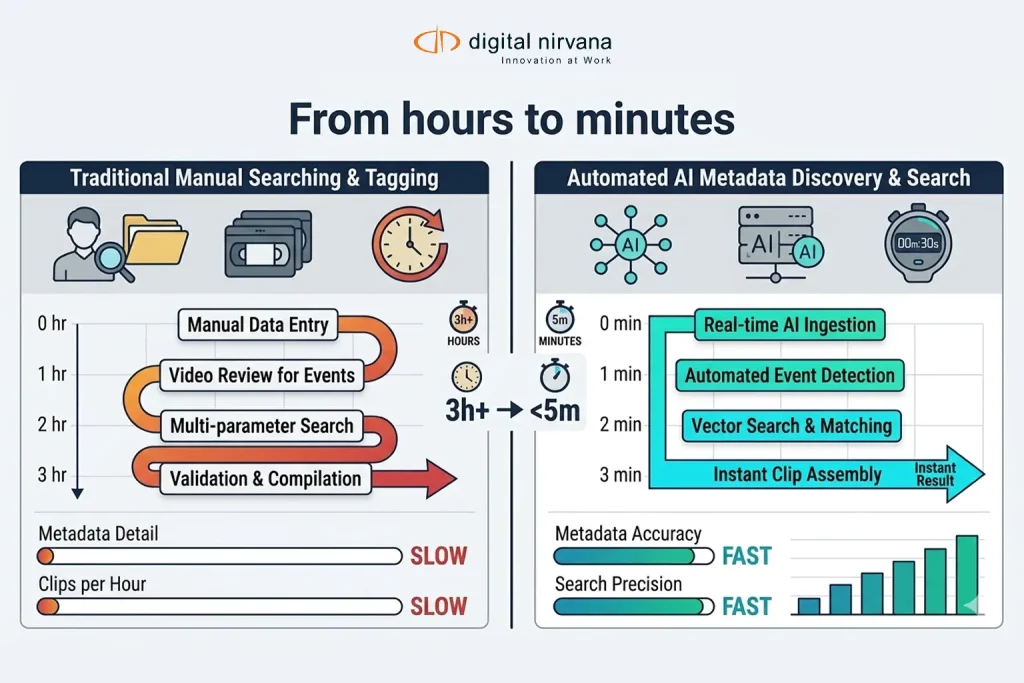
A media archive manager gets a request from a licensing team: pull every clip featuring a specific product placement across the last five years of programming. In a legacy DAM system, that request means days of manual searching, or worse, admitting the footage exists somewhere but can’t be found in a reasonable timeframe. In a metadata-driven system, that same request takes minutes.
This is the gap that separates a digital asset management platform that stores content from one that actually makes content useful. Most media organizations have plenty of storage. What they’re missing is the metadata layer that turns stored footage into searchable, licensable, reusable intelligence. That’s the specific problem MetadataIQ was built to solve, and it’s worth understanding why traditional DAM approaches fall short before looking at what a metadata-first platform does differently.
Why Storage Alone Was Never the Real Problem
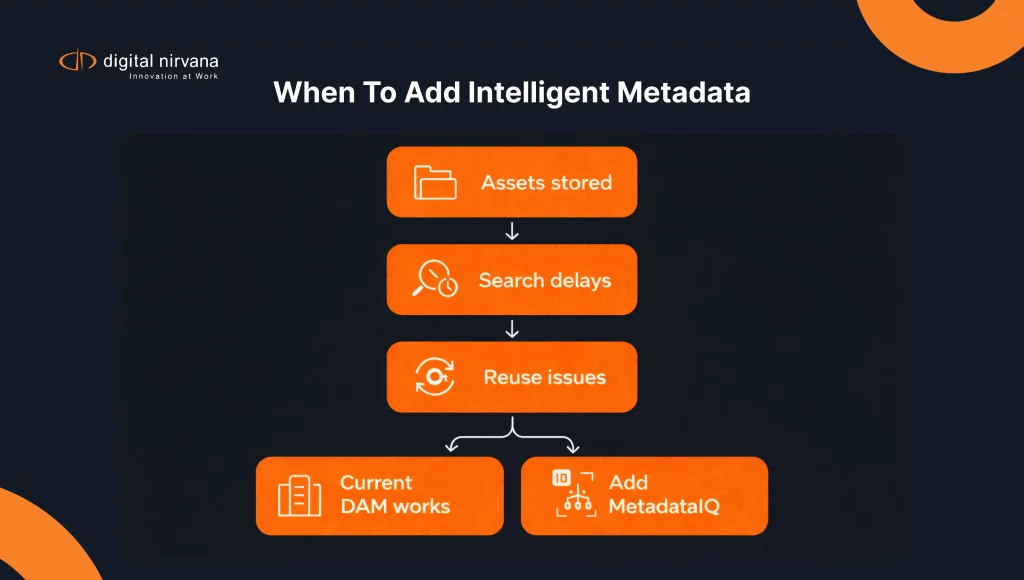
Digital asset management started as a storage and organization problem. Media companies needed a central place to keep video, audio, and image files instead of scattering them across drives, servers, and departments. That part got solved years ago.
The problem that didn’t get solved is discoverability. A DAM system with millions of assets and thin metadata is functionally the same as a warehouse with no inventory system. The content exists, but finding the right clip, at the right timestamp, for the right use case, still depends on someone remembering where they put it or manually scrubbing through hours of footage.
This is exactly where MetadataIQ diverges from a traditional DAM. Instead of treating metadata as an optional field a logger fills in after the fact, it treats metadata generation as the core function of the platform, automated at ingest and enriched continuously as content moves through a production or archive workflow.
The Core Problem With Legacy DAM and PAM Systems
Most legacy digital and production asset management systems share the same structural weakness: metadata depends on manual human input, and manual input doesn’t scale.
A logger tagging footage by hand might capture a title, a date, and a general topic. What gets missed is the granular detail that actually drives usefulness later: which specific person appears on screen, what was said and when, which logos or products are visible, what the scene actually depicts. Without that depth, search returns broad, unhelpful results, or nothing at all.
The consequences compound over time. Archives grow into unsearchable liabilities instead of monetizable assets. Editorial and production teams waste hours per week manually locating footage that technically already exists in the system. Licensing opportunities get missed because nobody can efficiently prove what content is actually available. And compliance-sensitive content, anything involving disclosures, sensitive topics, or regulatory tagging, becomes a manual audit risk instead of a searchable, governed dataset.
What Makes MetadataIQ Different From a Traditional DAM
MetadataIQ approaches digital asset management from the metadata layer outward, rather than treating metadata as a feature bolted onto a storage system.
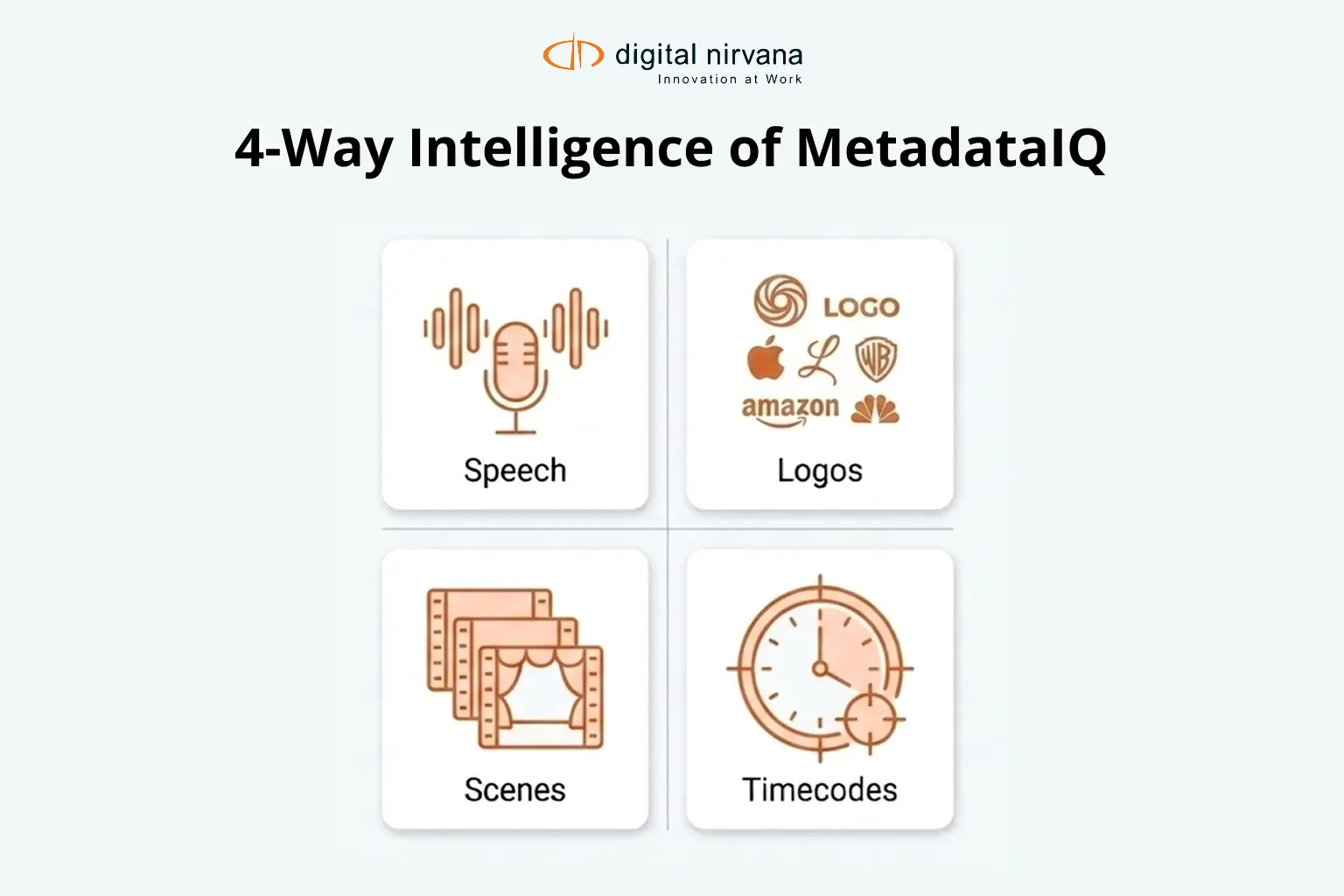
At ingest, AI-driven processing automatically generates rich, time-coded metadata: speech-to-text transcription, face and object detection, scene descriptions, and quality scoring, all without waiting for a human logger to work through the footage first. That metadata becomes immediately searchable, which means a producer, archive manager, or licensing team can query the system in plain language and get exact timestamps back, not just a list of files that might contain what they’re looking for.
Just as importantly, MetadataIQ is built to integrate with the systems media teams already use, including Avid, Grass Valley, and existing MAM and DAM environments, rather than requiring a full platform replacement. The goal isn’t to rip out infrastructure that already works. It’s to add the metadata intelligence layer that legacy systems were never built to generate on their own.
How This Plays Out in a Real Media Operations Workflow
Consider a news archive with a decade of footage that predates any structured metadata tagging. Under a traditional system, that archive is effectively dormant. Nobody has the time to manually review and tag ten years of footage, so it sits unused, even though it likely contains licensable, reusable, and newsworthy material.
With batch AI metadata processing, that same archive becomes searchable in a fraction of the time a manual review would take. Every clip gets tagged with speech content, faces, on-screen text, and scene context. An archive manager fielding a licensing request can now search by topic, person, or even a specific quote and get exact results, instead of relying on institutional memory about what might be somewhere in storage.
The same workflow applies going forward for live and newly ingested content. As footage comes in, metadata generation happens automatically, so the archive never falls back into the same unsearchable state it started in.
Measurable Impact: DAM With Metadata Versus DAM Without It
| Capability | Traditional DAM (Manual Metadata) | MetadataIQ (AI-Driven Metadata) |
| Search accuracy | Depends on manual tags, often sparse | Rich, automated, time-coded tagging |
| Archive footage utilization | Low, mostly unsearched | High, fully indexed and searchable |
| Time to locate specific clip | Hours of manual scrubbing | Minutes via metadata search |
| Licensing readiness | Manual review required | Searchable by topic, person, scene |
| Legacy content enrichment | Rarely done, too labor-intensive | Batch processing at scale |
| System integration | Standalone, often siloed | Integrates with Avid, Grass Valley, MAM/DAM |
Media organizations that shift from manual to AI-driven metadata typically see previously dormant archive footage become an active part of their content and licensing strategy, simply because it becomes findable for the first time.
Implementation Considerations for Media Operations Teams
A few things matter when planning a metadata-driven DAM rollout. Integration compatibility with your existing MAM, DAM, or NLE environment should be confirmed early, since the value of automated metadata depends on it reaching the tools your teams already use daily. Taxonomy governance still matters, since automated tagging needs a consistent structure to keep search results clean and predictable across departments. Live versus archive processing needs vary, with live tagging during broadcast requiring different latency handling than a batch enrichment project for a legacy library. And a metadata quality scoring dashboard helps teams monitor tagging accuracy and completeness over time, rather than assuming automation is working correctly without visibility into it.
Key Capabilities to Look for in a Metadata-Driven DAM Platform
- Automated time-coded transcription and speaker identification at ingest
- Face, object, logo, and on-screen text detection with searchable indexing
- Batch processing capability for enriching legacy archive footage
- Native integration with existing MAM, DAM, Avid, and Grass Valley environments
- Metadata governance dashboards for quality scoring and taxonomy consistency
- Plain-language or natural query search rather than rigid keyword-only search
Addressing the Common Objections
“We already have a DAM system in place.” A metadata-driven layer doesn’t require replacing an existing DAM. MetadataIQ is built to integrate with systems already in use, adding the search and tagging intelligence that most legacy platforms were never designed to generate automatically.
“Our archive is too large to retag.” This is exactly the scenario batch AI metadata processing was built for. Enriching years of legacy footage manually was never realistic, which is precisely why it stayed unsearchable for so long. Automated batch processing makes that backlog achievable.
“AI-generated metadata might not be as accurate as human tagging.” Automated tagging combined with a metadata quality scoring layer gives teams visibility into accuracy and consistency, and for high-stakes or compliance-sensitive content, a human review step can be layered on top rather than relying on automation alone.
Success Metrics Worth Tracking After Implementation
Once a metadata-driven DAM platform is in place, track archive search time, the percentage of previously dormant footage now being actively reused or licensed, time saved per week across editorial and production teams, and metadata quality scores across newly ingested versus legacy content. These metrics make the operational and revenue case for continued investment easy to demonstrate to leadership.
Where MetadataIQ Fits Into a Broader Media Intelligence Strategy
Metadata generation is powerful on its own, but it becomes even more valuable connected to the rest of a media operations stack. Pairing MetadataIQ with MediaServicesIQ extends metadata generation into deeper AI capabilities like scene summarization, chapter markers, and music identification through direct API access. For teams whose metadata strategy also depends on accurate transcripts and captions, TranceIQ feeds directly into the same searchable index, so transcription and metadata don’t live in separate systems.
Organizations managing high compliance-sensitive content alongside their archive can pair metadata tagging with MonitorIQ for broadcast compliance logging and proof-of-performance, keeping governance and discoverability working from the same operational foundation. And for facilities modernizing the infrastructure that supports all of this, Cloud Engineering helps teams scale metadata processing and storage without the bottlenecks legacy on-premises systems create.
Bringing It Together: DAM Is Only as Good as Its Metadata
A digital asset management platform’s real value was never just storage. It’s whether the content inside it can actually be found, reused, licensed, and governed without a manual scavenger hunt every time someone needs it. That’s the distinction that separates a legacy DAM from a metadata-first platform like MetadataIQ, and it’s the reason media organizations sitting on years of under-tagged footage often don’t realize how much value is locked inside their own archives. Reviewing real metadata implementation outcomes across Digital Nirvana’s client base is a useful way to see what this looks like applied to an actual archive, and Digital Nirvana’s homepage outlines how metadata connects across the full media intelligence product suite.
Conclusion
Storage solved the problem of keeping media assets somewhere. It never solved the problem of finding them again. MetadataIQ addresses that gap directly, generating rich, automated, time-coded metadata at ingest and applying that same intelligence to years of legacy archive footage through batch processing, all while integrating into the MAM, DAM, and production systems media teams already rely on. For organizations trying to turn stored content into a genuinely usable, monetizable asset, the metadata layer isn’t an enhancement to digital asset management. It’s the actual function DAM was always supposed to serve.
Key Takeaways
- Storage was never the hard problem in digital asset management. Discoverability is, and it depends entirely on metadata depth.
- Manual metadata tagging cannot scale with growing archive volume, which leaves most legacy footage effectively unsearchable.
- AI-driven metadata generation at ingest turns hours of manual search into minutes of query time.
- Batch processing makes enriching years of legacy archive footage realistic for the first time.
- Integration with existing MAM, DAM, Avid, and Grass Valley systems matters more than replacing what’s already in place.
- Metadata quality scoring and governance dashboards keep automated tagging accurate and consistent at scale.
FAQ
What’s the difference between a traditional DAM and a metadata-driven platform like MetadataIQ? A traditional DAM stores and organizes files, with metadata often added manually and inconsistently. MetadataIQ generates rich, automated metadata at ingest, making content searchable by speech, faces, objects, and scene context rather than relying on manual tagging alone.
Can MetadataIQ integrate with our existing MAM or DAM system? Yes. MetadataIQ is designed to integrate with existing production and asset management systems, including Avid and Grass Valley environments, rather than requiring teams to replace their current infrastructure.
Is it realistic to add metadata to years of legacy archive footage? Yes, through batch AI processing. Manually retagging a large legacy archive was never practical, which is why most archives stayed under-tagged. Automated batch processing makes that backlog achievable.
How accurate is AI-generated metadata compared to manual tagging? Modern AI metadata generation handles transcription, object detection, and scene context with strong accuracy, and pairing it with a metadata quality scoring layer, or a human review step for compliance-sensitive content, closes most remaining gaps.