Somewhere in a newsroom right now, a producer is counting down from ninety seconds, and the anchor still needs a soundbite that isn’t in the script. A source said something explosive twenty minutes ago on a live feed nobody logged in real time. It’s in there. Somewhere. In four hours of raw footage nobody has time to scrub.
This is the exact moment that separates newsrooms that break the story from newsrooms that watch someone else break it first. And in 2026, with breaking news cycles compressing to minutes instead of hours, that moment happens more often than anyone in the control room wants to admit.
Here’s the twist most newsroom leaders haven’t fully clocked yet. The technology to solve this already exists, quietly running in the background at organizations that stopped treating footage like a black box and started treating it like a searchable database. Let’s walk through exactly how that shift happens, and why it changes everything about how a newsroom operates under pressure.
The Core Problem: News Doesn’t Wait, and Neither Does the Competition
Newsrooms live inside a paradox. The content they generate is more valuable in the first hour than at any other point, and yet it’s also the hardest hour to search, because nobody has tagged anything yet.
A breaking story means live feeds, wire footage, reporter standups, and source interviews all arriving at once, with almost no time to log any of it properly. An assignment desk manager might remember roughly when a key quote happened, but “roughly” doesn’t cut it when the competing network is already running the clip.
The deeper issue isn’t a lack of urgency. Newsroom teams are plenty urgent. It’s that traditional archive and logging systems were never designed to keep pace with a news cycle that now moves in minutes, across dozens of simultaneous feeds, political mentions, and sensitive topics that all need to be found instantly and handled carefully.
Market Context: 2026 Turned Speed Into the Whole Game
Something changed in how audiences consume news, and it happened faster than most newsroom budgets could adjust to. Viewers now expect a clip within minutes of it happening, not after the evening broadcast. Social platforms reward whoever posts first, and whoever posts first usually wins the news cycle for that story entirely.
At the same time, compliance pressure hasn’t eased up. Political ad mentions, sensitive quotes, and disclosure requirements still need to be tracked accurately, and getting that wrong carries real regulatory and reputational risk. Newsrooms are being asked to move faster and be more careful at the same time, which sounds like a contradiction until you realize metadata is the thing that makes both possible at once.
Add multi-platform publishing (broadcast, streaming, social, digital archive) into the mix, and a single piece of footage now needs to serve five different destinations, each with its own deadline. Manual logging was never built for that kind of pressure.
Traditional Solutions and Their Gaps (Or, Why the Archive Room Always Smells Like Stale Coffee)
Most newsrooms have tried to manage this the hard way, and everyone in the building knows it.
Manual note-taking during live feeds. A producer jots down rough timestamps as a live event unfolds. It’s fast in the moment and nearly useless later, because handwritten shorthand rarely matches what someone else needs to search for hours afterward.
Post-broadcast archive review. After the segment airs, someone scrubs back through the footage to properly log it for future use. By then, the story has already moved on, and the labor spent logging it rarely gets reused before the next news cycle buries it.
Basic archive search by date and story name. This works only if you already know which broadcast the moment lives in. It falls apart completely the moment someone needs “every mention of this name across the last six months,” which is exactly the kind of request investigative teams make constantly.
None of these approaches were built for speed. They were built for a slower news environment that, frankly, doesn’t exist anymore.
Enter Metadata Automation: The Newsroom’s Quiet Superpower
Here’s where the story turns in the newsroom’s favor. What if every live feed, wire clip, and standup got tagged the instant it happened, automatically, without pulling a single producer off their actual job?
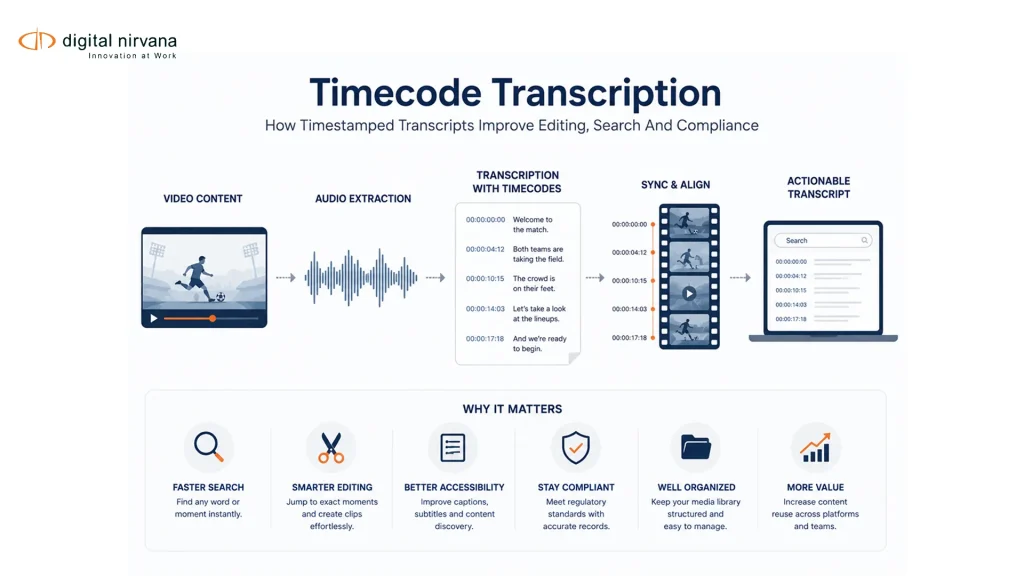
That’s what modern metadata automation does. As footage comes in, the system transcribes speech, identifies people and locations, flags scene changes, and tags sensitive content categories like political mentions, all in real time. Instead of a producer racing to remember where a quote happened, the system already knows.
Platforms like MetadataIQ are built precisely for this kind of pressure, giving newsroom teams searchable metadata the moment footage lands rather than hours after the fact. Pair that with automated transcription through TranceIQ, and a producer can search a spoken phrase and get the exact timecode back before the countdown clock even finishes.
A Day in the Newsroom: Ninety Seconds, Solved
Back to that control room. The system has been tagging the live source feed in real time since it started rolling. The moment the source said the explosive line, it was transcribed, timestamped, and flagged automatically.
The producer doesn’t scrub anything. She searches the exact phrase, the system returns the timecode instantly, and the clip is cued up with eleven seconds to spare before the anchor throws to it live. No scavenger hunt. No sweating through the commercial break.
Down the hall, an investigative reporter runs a completely different search: every mention of a specific name across the last six months of broadcasts, tied to a story that’s been building for weeks. What used to be a multi-day archive dig becomes a search query with results in seconds, using the same tagging system quietly working in the background the whole time.
Measurable Impact: What Changes When Every Second Counts
Newsrooms that move from manual logging to automated metadata tagging typically see the biggest shift in three places: time to air on breaking clips, investigative research speed, and consistency of sensitive content flagging.
Clip turnaround drops from a frantic scramble to a search query with a timecode already attached. Investigative teams stop losing days to manual archive digging and start finding patterns across months of footage in minutes. And political or sensitive content tracking becomes far more reliable, since the system flags mentions consistently instead of depending on whoever happened to be watching that particular feed.
Implementation Considerations for Newsroom Teams
Rolling this out doesn’t mean replacing the newsroom’s existing production and archive systems. Most newsrooms already run infrastructure built around specific MAM systems and editing tools, and a metadata layer needs to plug into that setup rather than force a rebuild mid-election season.
Before implementation, newsroom leadership should decide which feeds need real-time tagging (live sources, wire feeds, standups) versus what can be processed after the fact from the archive. It’s also worth building in a human review checkpoint for sensitive categories like political mentions or disclosures, since accuracy matters enormously more than speed when a flagged clip touches something legally sensitive.
Key Capabilities to Prioritize for Newsroom Metadata
- Real-time transcription with accurate speaker identification
- Automatic tagging of names, locations, and organizations as they’re mentioned
- Sensitive content flagging for political ads, disclosures, and compliance-relevant mentions
- Searchable metadata across months or years of archived broadcasts
- Integration with existing newsroom MAM and editing systems
- Support for multi-platform publishing (broadcast, social, digital) from a single tagged asset
- Human review workflows for high-stakes or legally sensitive content
Newsrooms handling live compliance concerns alongside metadata, such as caption accuracy during breaking coverage, often pair this with MonitorIQ for real-time broadcast monitoring and Media Enrichment for accessibility and multilingual delivery during major stories.
Common Objections (And Why the Newsroom Can’t Afford Them Anymore)
“Our team is already fast under pressure.” They are, and that’s exactly why this matters. Automated tagging doesn’t replace their instincts, it removes the part of the job where a talented producer wastes ninety precious seconds scrubbing footage instead of making editorial calls.
“We don’t want to disrupt our current systems mid-cycle.” Most metadata platforms integrate with existing MAM and editing infrastructure rather than replacing it, meaning newsroom teams gain searchability without a disruptive migration during an active news cycle.
“Sensitive content flagging worries us if it’s fully automated.” That’s a fair concern, and the right approach isn’t full automation without oversight. Pairing automated flagging with human review for anything politically or legally sensitive, similar to the discipline behind Managed AI review pipelines, keeps accuracy high where it matters most.
Success Metrics and KPIs for Newsroom Metadata Automation
| Metric | What It Tells You |
| Time from live feed to published clip | Speed advantage during breaking coverage |
| Investigative research time across archived footage | Efficiency of long-form and archival reporting |
| Accuracy rate of sensitive content flagging | Reliability of compliance-related tagging |
| Percentage of live feeds tagged in real time | Coverage of your metadata initiative |
| Reuse rate of archived footage across new stories | Whether your archive is becoming a working asset, not a graveyard |
Track these across a full election cycle or major breaking story, and the value of automation stops being theoretical fast.
How Digital Nirvana Supports Newsroom Metadata Automation
Digital Nirvana built MetadataIQ with exactly this pressure in mind: newsroom teams who need footage searchable the instant it lands, not after the story has already moved on. Automated transcription, speaker identification, and sensitive content tagging happen in real time, feeding directly into the searchable archive newsroom teams rely on daily.
For newsrooms managing accessibility and caption requirements alongside metadata, TranceIQ and Media Enrichment extend that same accuracy to captioning and multilingual delivery, especially during major breaking stories with global audiences. Broadcast-side compliance and signal monitoring during live coverage is covered through MonitorIQ, while organizations structuring years of archived footage into a governed, searchable system can also draw on Data Intelligence for broader data organization work. Newsrooms scaling infrastructure to handle surges in live traffic during major events often pair this with Cloud Engineering support as well.
Why This Story Doesn’t End at One Broadcast
This isn’t just about one anchor making air with eleven seconds to spare. It’s about newsrooms recognizing that the archive they’ve been sitting on for years is actually a searchable, reportable, defensible asset, if it’s tagged properly from the moment it’s captured. Real examples of this kind of AI-assisted, human-reviewed workflow across news, sports, and archive teams are documented in Digital Nirvana’s success stories, and the broader approach behind it all lives on the Digital Nirvana homepage.
Conclusion: The Quote Was Always There. Now It Doesn’t Cost You the Story.
Every newsroom has lived through the ninety-second scramble, the frantic search for a quote buried somewhere in hours of footage while the clock refuses to slow down. Metadata automation doesn’t just save time. It changes what’s even possible during a breaking story, turning a scavenger hunt into a search query and a stale archive into a living, reportable asset. In 2026, with news cycles moving faster than ever, that difference decides who breaks the story and who reports on someone else breaking it first.
Key Takeaways
- Breaking news generates footage faster than any manual logging process can keep up with.
- Real-time transcription and tagging turn a frantic scramble into a searchable timecode lookup.
- Sensitive content flagging (political mentions, disclosures) becomes more consistent with automation plus human review.
- Investigative reporting benefits enormously from searchable archives spanning months or years.
- Integration with existing newsroom MAM systems avoids disruptive mid-cycle migrations.
- Track clip turnaround time, research speed, and flagging accuracy to measure real impact.
FAQ
What is newsroom metadata automation? It’s the real-time tagging of live and archived news footage, including transcription, speaker identification, and sensitive content flagging, so producers and reporters can search footage instantly instead of manually reviewing it.
How does this help during breaking news specifically? Because footage is tagged the moment it’s captured, producers can search for a specific quote or moment and get an exact timecode back within seconds, rather than scrubbing through hours of raw feed under deadline pressure.
Can automated tagging handle sensitive content like political mentions accurately? Automated systems can flag these consistently, but pairing that automation with human review checkpoints for legally or politically sensitive content ensures accuracy where it matters most.