It is 9:40 pm. A producer needs a 45 second soundbite from a two hour panel that aired at noon. The archive confirms the file exists. It cannot say where inside the file the quote lives. So someone opens the asset and starts scrubbing.
That single scene explains most media operations problems in 2026. The content is not missing. The access to it is.
Automated transcription and metadata generation fix that gap at the source. Instead of storing a two hour video as one opaque block, your system stores it as thousands of searchable, time-coded moments. Words, speakers, topics, faces, logos, scenes, compliance flags. All of it queryable in seconds.
This is what changes the operation. Not the AI. The retrieval.
Why does manual logging quietly cost more than it looks?
Manual logging rarely shows up as a line item. It hides inside overtime, missed deadlines, duplicate shoots, and archives nobody trusts enough to search.
Think about the arithmetic. A logger working at close to real time needs roughly a full shift to properly log one four hour game feed. Multiply that by every feed, every channel, every day.
The second cost is inconsistency. Two loggers describe the same footage differently, so search results depend on who was on shift. Over five years, that turns an archive into a lottery.
The third cost is opportunity. Footage you cannot find is footage you cannot license, repurpose, or resell.
What does automated transcription and metadata generation actually mean?
It is a two layer process that runs on ingest.
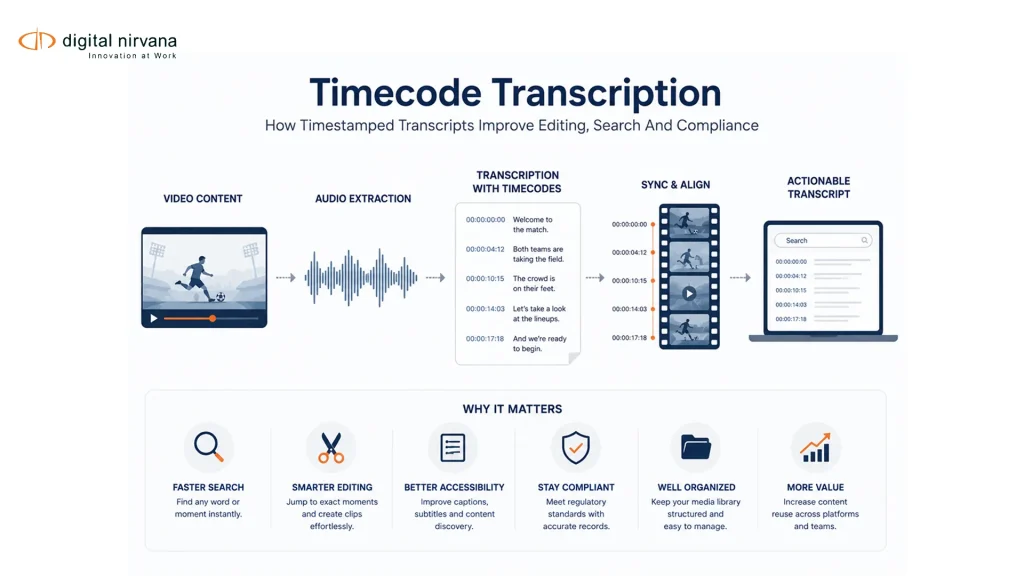
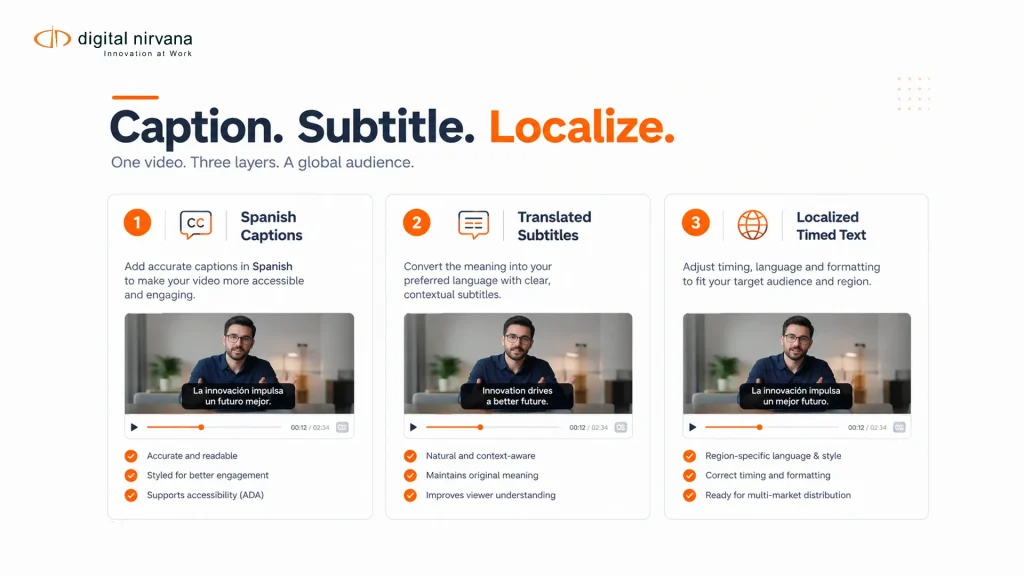
The first layer is speech to text. Automatic speech recognition converts spoken audio into a time-coded transcript, with speaker separation and, where needed, translated versions for multilingual output.
The second layer is enrichment. The system reads that transcript alongside the video itself and generates structured metadata: topic segments, IAB-style content classification, scene descriptions, object and logo recognition, on-screen text through OCR, and compliance markers for things like profanity, sensitive content, or paid disclosures.
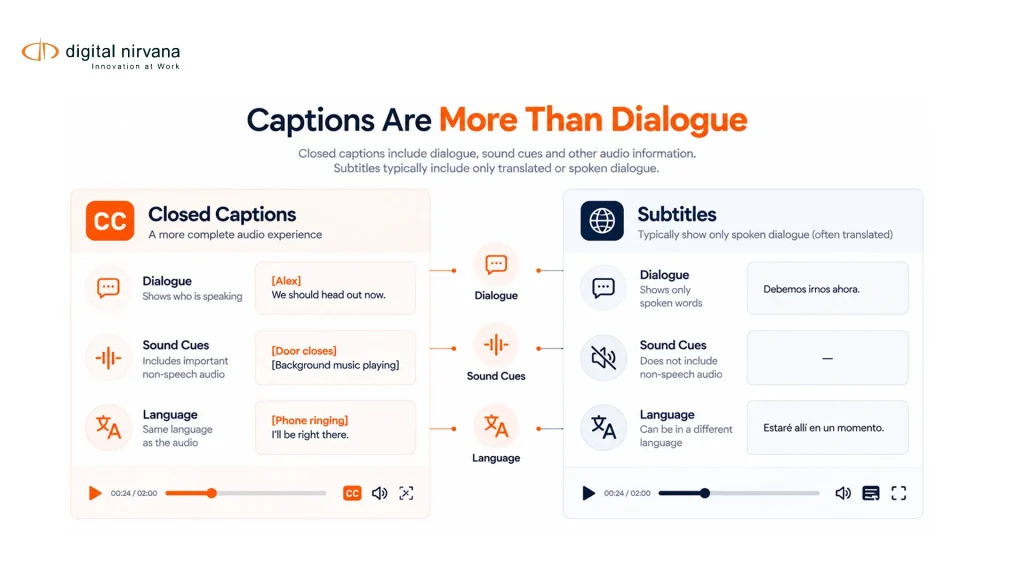
The transcript makes the content readable. The metadata makes it operational. You need both, which is why AI-driven media indexing and metadata automation and cloud transcription, captioning, and subtitling usually get deployed as one workflow rather than two projects.
What changed in the last three years?
Three things, and they arrived together.
Regulation got sharper. The FCC’s caption quality standards hold broadcasters to accuracy, synchronicity, completeness, and screen placement, not simply the presence of captions. Ofcom’s access services code sets comparable expectations in the UK.
Volume got heavier. FAST channels, social cutdowns, and regional feeds mean the same asset now gets published in far more variants than it did in 2022.
Discovery changed. AI assistants and recommendation engines both read structured metadata. Thin descriptions no longer just slow your editors down. They shrink how often your content surfaces anywhere.
Where do traditional workflows break?
| Stage | What it usually looks like | What breaks |
|---|---|---|
| Ingest | Filename plus a short slug typed by an operator | No searchable content inside the file |
| Logging | A human scrubs and writes notes into the MAM | Slow, inconsistent, capped by headcount |
| Captioning | Sent to an external vendor, returned hours later | Turnaround blocks publishing |
| Compliance | Spot checks after the fact | Issues are found after air, not before |
| Archive | Decades of assets with minimal tagging | Library is stored, not usable |
Notice that every row is the same failure. Information exists inside the media, and no system extracted it while the content was moving through the pipeline.
What does the automated workflow look like end to end?
- Ingest. Live feed or file enters your MAM, PAM, or DAM as it always did.
- Transcribe. ASR produces a time-coded transcript, with speaker labels and translations where required.
- Enrich. The engine adds topic segmentation, scene descriptions, recognition data, and compliance tags.
- Score. A governance layer checks completeness and flags gaps before the asset moves on.
- Review. Editors correct names, jargon, and anything the model marked as low confidence.
- Publish. Metadata writes back into the existing system, so editors search where they already work.
The important design point sits in step six. Metadata that lives in a separate portal creates a second workflow. Metadata written natively into Avid MediaCentral, Grass Valley, or your existing DAM removes one instead.
What does this look like on a real shift?
A news desk gets a developing story at 4:15 pm. The relevant material sits across three archived interviews and one live feed still running.
With automated metadata, the assignment editor searches a phrase, not a date range. Matching moments return with timecodes across all four assets, including the live one, because live content is indexed as it airs.
The editor pulls three segments, corrects a mispronounced surname in the transcript, and sends the cut to the 5 pm block. The archive researcher never gets a request, because there was nothing to research.
Nobody in that story used a new tool. They used the same MAM, faster.
Which benefits are actually measurable?
Skip the vague promises and track four categories.
Retrieval time. Minutes from search request to usable clip. This is the number that moves first and the easiest one to baseline before you start.
Publishing lag. Hours between ingest and a fully captioned, compliant, published asset across every destination.
Metadata completeness. The percentage of assets carrying a full tag set. Governance dashboards make this visible rather than anecdotal.
Archive activation. Assets accessed or licensed per quarter from footage older than 24 months. This is where media enrichment and localization services tend to pay for themselves, because dormant libraries become sellable inventory.
What should you check before implementation?
- Does it write metadata back into your existing MAM, DAM, or PAM natively, without a bolt-on portal?
- Can it process live streams, not just completed files?
- Does it support custom vocabulary for player names, show titles, sponsors, and domain jargon?
- Is there a human review step for low confidence output and sensitive content?
- Does it batch process archives at volume, not just new ingest?
- Are outputs audit ready, with logs you can show a regulator or a client?
- Does the caption output meet the delivery specs of every platform you publish to?
If a vendor cannot answer the first and fourth questions clearly, the workflow will create rework rather than remove it.
What about the usual objections?
“We already use an AI transcription tool.” General purpose ASR gives you words. It does not give you compliance tagging, MAM write-back, governance scoring, or platform-specific caption conformance. The gap between a transcript and an operational workflow is where most projects stall.
“AI accuracy is a risk for us.” It is, if the model is the last step. Hybrid pipelines route low confidence output to trained reviewers, which is the same principle behind human-in-the-loop AI governance and output review. Automation handles the volume. People handle the judgment calls.
“Our team already does this.” They do, at current volume. The question is what happens when you add three channels or a new language market next quarter.
Frequently asked questions
Is automated metadata accurate enough for broadcast? Broadcast-grade engines are tuned for media workflows and paired with human review on flagged segments, which is the standard model for compliance-sensitive content.
Can it handle live content? Yes. Live streams can be tagged and indexed as they air, which is what makes real-time clipping possible for news and sports.
Does this work on old archives? Yes. Batch processing applies consistent tagging retroactively, which is usually the fastest route to archive monetization.
How is this different from broadcast monitoring? Metadata tools describe what is inside content. Broadcast compliance logging and signal monitoring proves what actually went to air. Most operations need both.
Do we have to replace our MAM? No. Well-designed metadata automation integrates into the systems you already run.
Where Digital Nirvana fits into this workflow
Digital Nirvana builds this pipeline as a connected stack rather than four disconnected tools. MetadataIQ handles automated tagging, governance scoring, and native integration with Avid and Grass Valley environments. TranceIQ covers transcription, captioning, subtitles, and localization. AI microservices for ASR, OCR, scene description, and recognition are available through APIs when a team wants a single capability rather than a full platform.
The same underlying workflow supports adjacent operations. Research teams use it for fast, accurate financial transcription and earnings-call intelligence. Universities apply it to lecture captioning, transcripts, and academic accessibility.
Why the domain expertise matters here
Media workflows fail on specifics. Caption placement rules, sponsor reporting formats, MAM field mapping, and the difference between a compliance flag and an editorial note.
Digital Nirvana has been running these workflows inside large broadcast environments for years, including networks such as CBS, Fox, and Sinclair, and combines software with managed human review teams across media and broadcasting AI operations. The customer success stories show the pattern clearly: the value comes from workflow fit, not model novelty.
Conclusion
Automated transcription and metadata generation is not a content project. It is an operations decision.
When every asset arrives searchable, compliant, and described from the moment it enters your system, everything downstream gets faster. Editors stop scrubbing. Compliance stops guessing. Archives stop being storage and start being inventory.
The teams pulling ahead in 2026 are not the ones with the most footage. They are the ones who can find any second of it on demand.
Ready to see how this maps to your current stack? Book a 15 minute workflow walkthrough and bring one real bottleneck with you.
Key takeaways
- Transcription makes media readable. Metadata makes it operational. Deploy them as one workflow.
- Manual logging costs show up as overtime, missed deadlines, and unusable archives, not as a budget line.
- Native write-back into your existing MAM or DAM is the single biggest predictor of adoption.
- Live indexing is what turns metadata from an archive project into a daily production advantage.
- Track retrieval time, publishing lag, metadata completeness, and archive activation. Baseline them first.
- Human review on low confidence and compliance-sensitive output is what makes automation safe at scale.
- Structured metadata now affects discovery on AI assistants and recommendation engines, not only internal search.
Publishing notes
Meta title: Automated transcription and metadata: transform media ops (56 characters)
Meta description: See how automated transcription and metadata generation cut retrieval time, speed publishing, and make media archives searchable and compliant. (147 characters)
URL slug: /automated-transcription-metadata-generation-media-operations/
Cluster: AI Metadata and Media Search | Commercial anchor: MetadataIQ (secondary: TranceIQ) | Funnel stage: MOFU
Primary keyword: automated transcription and metadata generation Secondary keywords: metadata automation, media indexing, AI video search, time-coded transcripts, MAM integration, archive monetization, caption conformance, live metadata tagging
Schema to embed: Article, FAQPage (uses the FAQ section verbatim), BreadcrumbList, Product (MetadataIQ mention)
Suggested visual placements:
- After “What does the automated workflow look like end to end”: ingest-to-publish workflow diagram. Alt text: “Automated transcription and metadata generation workflow from ingest through ASR, enrichment, governance scoring, human review, and MAM write-back”
- After “Which benefits are actually measurable”: before and after retrieval time comparison graphic. Alt text: “Comparison of manual logging versus automated metadata generation across retrieval time, publishing lag, and metadata completeness”
- After “Where Digital Nirvana fits into this workflow”: MetadataIQ dashboard screenshot. Alt text: “MetadataIQ governance dashboard showing metadata completeness scoring and compliance tagging for broadcast assets”