If you lead operations or IT at a large organization, you’ve probably lived some version of this story. A promising AI pilot lands on the roadmap. A small team spins it up. The demo dazzles the steering committee. Everyone nods. And then… nothing ships. Six months later the pilot is quietly archived, the budget is spent, and the business is no closer to production AI than it was before.
You’re not imagining it, and you’re not alone. Industry surveys have consistently found that the majority of enterprise AI initiatives stall between proof-of-concept and production. The number moves around depending on who’s counting, but the pattern is stubborn: getting an AI model to work in a demo is easy; keeping it working in production is where projects go to die.
The instinct is to blame the technology. The model wasn’t good enough, the data was messy, the use case was wrong. Occasionally that’s true. Far more often, the model was never the problem.
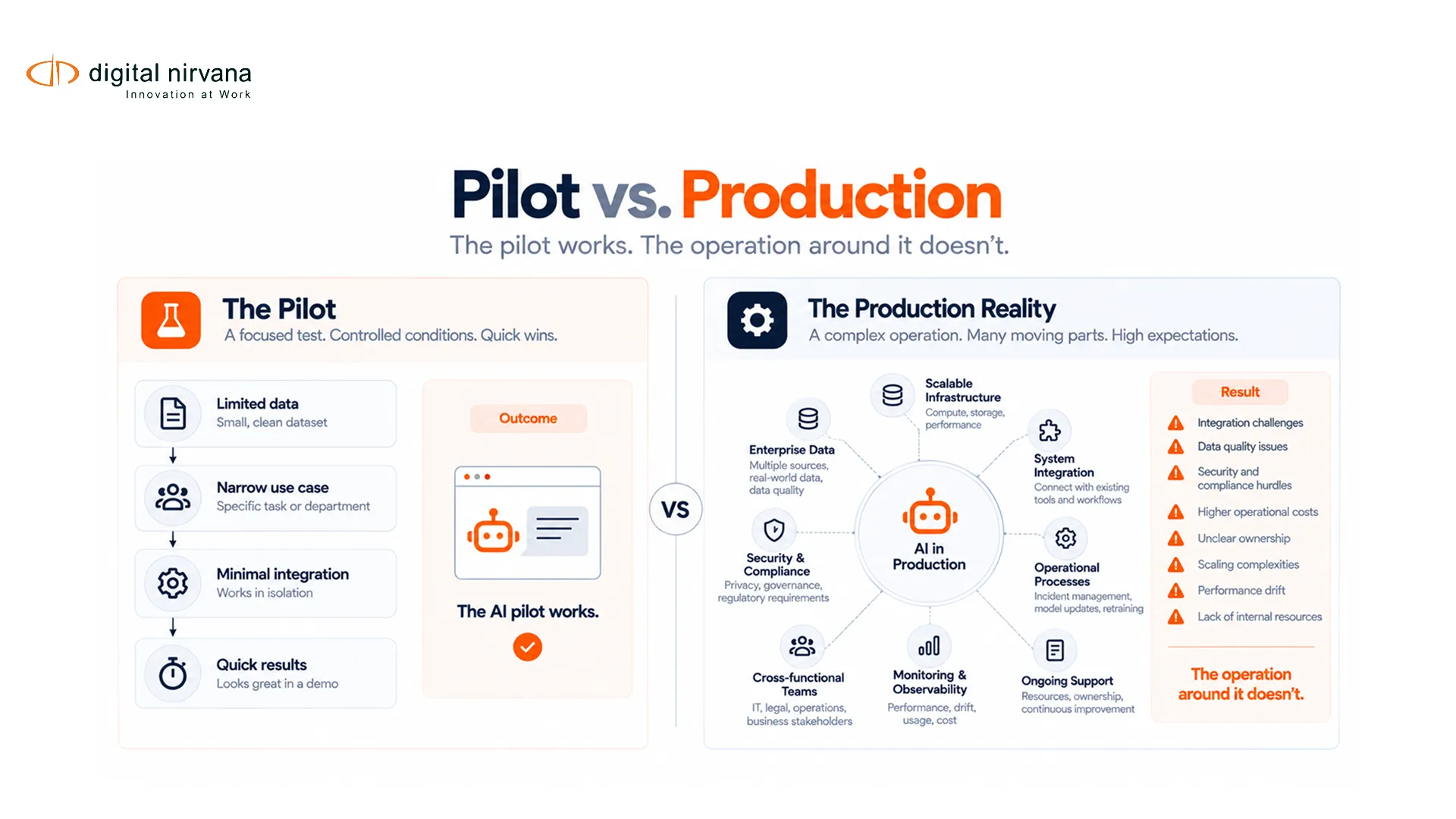
The pilot works. The operation around it doesn’t.
Here’s the uncomfortable truth most vendors won’t tell you: a modern foundation model, out of the box, is already good enough for a huge range of enterprise tasks. The gap between a slick pilot and a system your business can actually rely on isn’t intelligence. It’s operations.
Consider what a pilot conveniently ignores:
- Data pipelines. A demo runs on a clean, curated sample. Production runs on live, messy, constantly changing data, with edge cases, format drift, and gaps no one anticipated.
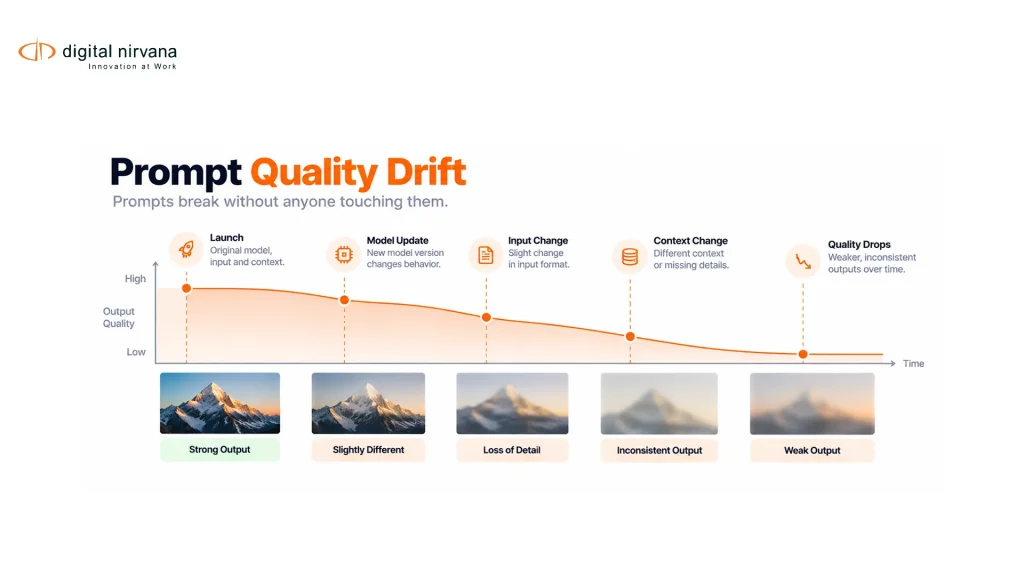
- Monitoring and drift. Models degrade silently. Accuracy that looked great in March quietly erodes by September as the world changes underneath it. Without continuous monitoring, no one notices until a customer or auditor does.
- Human-in-the-loop review. Most real workflows need a way to catch, correct, and learn from the model’s mistakes. That review loop has to be designed, staffed, and maintained.
- Governance and compliance. Who approved this output? Can you explain a decision to a regulator? Is sensitive data handled correctly? Pilots skip this. Production can’t.
- Uptime, versioning, and cost control. A pilot that runs once is not a service. A service needs reliability targets, model version management, and someone watching the spend so a runaway process doesn’t quietly burn six figures in API costs.
None of this is glamorous. None of it shows up in the demo. And all of it is exactly what separates an AI experiment from an AI capability your business can depend on.
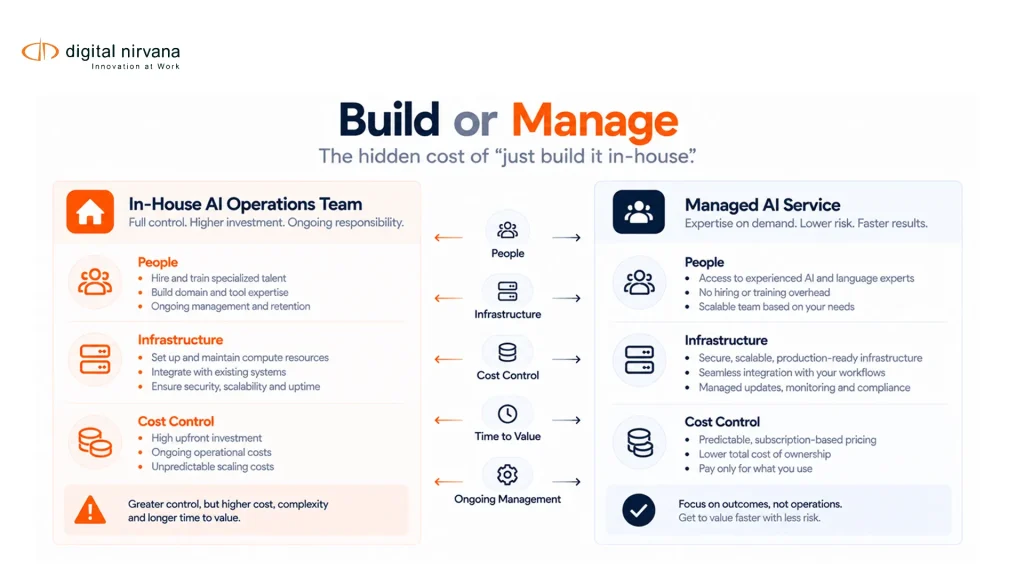
The hidden cost of “just build it in-house”
Faced with this gap, the reflexive answer is: we’ll hire an AI team. On paper it sounds like control. In practice, it’s where a lot of AI budgets quietly disappear.
Building an in-house AI operations function means recruiting scarce, expensive talent (ML engineers, data engineers, MLOps specialists) in one of the most competitive hiring markets there is. Then it means retaining them, which is harder. Then it means keeping them productive on operational maintenance work that most top engineers find tedious and will leave to avoid.
And even if you win that hiring battle, you’ve now taken on a fixed, permanent cost structure to solve what is, for most organizations, a variable and evolving need. You’re not just buying capability. You’re buying an org chart, a management burden, and a single point of failure the day a key engineer resigns.
For a handful of companies whose core product is AI, building this in-house is the right call. For most enterprises, where AI is a powerful enabler rather than the product itself, it’s an expensive way to reinvent infrastructure that already exists.
Reframe the problem: it’s an operations problem, not a model problem
The organizations succeeding with AI have made one key mental shift. They stopped asking “which model should we use?” and started asking “how do we keep AI reliably running in production?”
That reframe changes everything. Once you see AI as an ongoing operational discipline (pipelines, monitoring, review, governance, cost control), the buy-versus-build decision starts to look a lot like every other operational decision you’ve already made. You don’t run your own data center to send email. You don’t build a payroll system from scratch. You use managed infrastructure so your team can focus on the outcomes that actually differentiate your business.
Managed AI applies exactly that logic to artificial intelligence. Instead of standing up your own AI ops team, you partner with a provider who owns the unglamorous, mission-critical layer: keeping models accurate, monitored, compliant, and running, so your pilots actually make it to production and stay there.
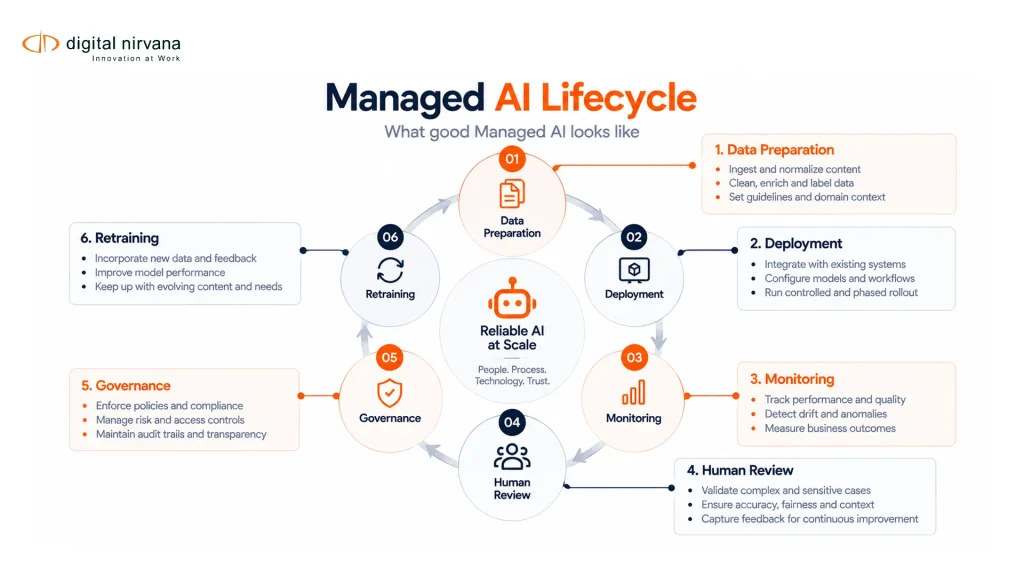
What good Managed AI looks like
Not all “managed” offerings are equal. When you evaluate a partner, look for one that:
- Takes ownership of the full lifecycle: data preparation, deployment, monitoring, and retraining, not just a one-time model handoff.
- Builds in human-in-the-loop quality control, so accuracy is a maintained commitment, not a launch-day snapshot.
- Bakes in governance and transparency from day one, so compliance isn’t a scramble later.
- Scales with your needs instead of locking you into a fixed headcount, and keeps a firm hand on cost.
- Lets your team stay focused on the business outcome while they handle the machinery underneath.
The bottom line
Your next AI pilot doesn’t have to end up in the archive. The organizations moving from experiment to impact aren’t the ones with the best models. They’re the ones who treated AI as an operational discipline and got the operations right.
If your team has a pilot that’s stuck, or you’re weighing the real cost of building an AI operations function from scratch, that’s precisely the gap Digital Nirvana’s Managed AI services are built to close. We own the production layer (the pipelines, monitoring, human review, and governance) so your AI investments actually reach production and keep delivering.
Have an AI pilot that stalled? Let’s talk about what it would take to get it into production. Explore Digital Nirvana’s Managed AI services or reach out for a conversation.
Frequently Asked Questions
Enterprise AI pilots often fail because the operational systems around the model are not ready. Production requires reliable data pipelines, continuous monitoring, human review, governance, uptime management, version control, and cost controls.
An AI pilot proves that a model can work on a limited, curated sample. Production AI must continue working with live data, changing conditions, edge cases, compliance requirements, reliability targets, and ongoing quality expectations.
Not always. A foundation model may already be capable enough for the intended task, while missing operational processes prevent the pilot from becoming a dependable business service.
Continuous monitoring helps teams detect declining accuracy, data changes, unexpected outputs, and cost issues before they affect customers, operations, or compliance.
Human-in-the-loop review gives teams a structured way to catch and correct model errors. It also creates a feedback process that helps maintain output quality over time.
No. Building in-house may make sense when AI is central to the company’s core product. For many other enterprises, it can create high fixed costs, hiring challenges, maintenance burdens, and dependency on a small number of specialists.
Look for full-lifecycle ownership, human quality control, built-in governance, transparent operations, flexible scaling, and active cost management. The provider should support the production system beyond the initial model deployment.
Managed AI can provide the operational layer needed to deploy and maintain the system, including data preparation, monitoring, human review, governance, retraining, reliability management, and cost control.