A sponsor asks a simple question that is never simple to answer fast. Did our logo appear exactly where the contract promised, and can you prove it with timecodes?
If your team is still relying on affidavits, manual spot checks, or scattered screenshots, the result is usually the same. Delays, disputes, and make-goods that cost more than the reporting ever should.
Video tagging changes the conversation. When you combine logo detection, video, timecoded metadata, and brand safety checks, you can deliver sponsor-proof that is clear, repeatable, and defensible.
What Sponsors Mean By Proof, And Why Logs Alone Fall Short
There are two common expectations, and mixing them up creates friction.
Proof Of Play
Confirms that an ad or element ran at a specific time, typically backed by logs and verification data.
Proof Of Performance For Sponsorship
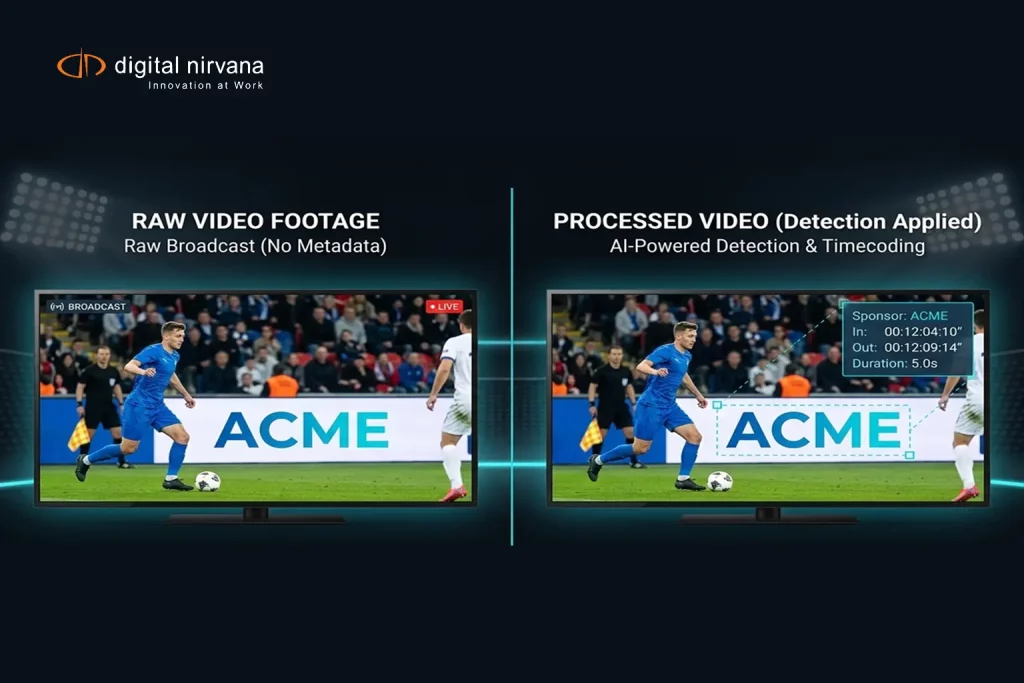
Goes further. Sponsors want evidence that branded elements actually appeared on screen, in the right context, for the promised duration, not just that a scheduled event fired. Digital Nirvana describes this as verifying sponsor logos and branded elements where contracts require them.
In regulated markets, documentation requirements can also extend into sponsorship identification and disclosure expectations, which increases pressure to keep accurate records.
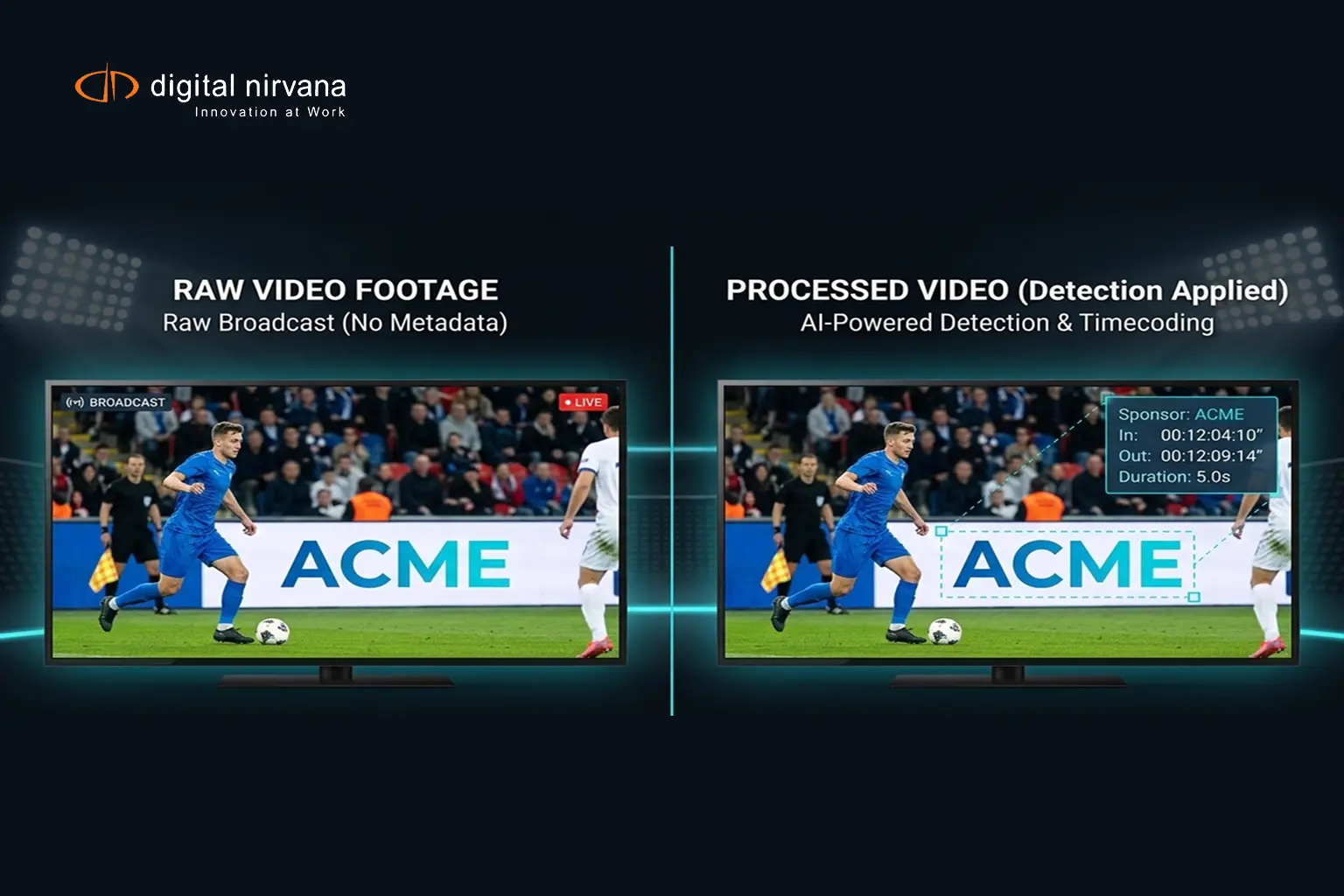
That is why video tagging matters. It turns “we ran it” into “here is the exact moment it appeared, plus the evidence.”
What Video Tagging Looks Like In A Sponsorship Workflow
Video tagging, in a sponsorship context, means attaching structured, time-aligned metadata to content so teams can search, verify, and report on what happened inside the video.
In practical terms, a modern tagging layer can include
- Timecoded markers for sponsor logos and branded overlays
- On-screen text extraction for slates, disclaimers, and sponsor IDs
- Speech to text to confirm verbal sponsor mentions
- Content classification tags that support brand safety and suitability decisions
MetadataIQ positions this as automated, time-coded metadata generation across video and audio, plus a compliance tagging and rules engine and governance controls, delivered inside existing broadcast and media workflows.
Logo Detection Video: What You Can Measure Reliably
Logo detection is often described as “did the logo appear,” but sponsorship reporting usually needs more detail.
Common measurements used in sponsorship analytics include exposure time and frequency, and reporting that aggregates visibility across a program or event.
What sponsors and ad ops teams typically care about
- First appearance timecode
- Total time visible, summed across all appearances
- Number of appearances
- Where it appeared, such as the lower third, corner bug, mid-screen overlay
- Strength of visibility, for example, size on screen, partial occlusion, motion blur, and angle, which can be reflected through configurable scoring approaches in analytics systems
Where teams get burned
- False positives, similar shapes, lookalike marks, crowd signage
- Occlusions and fast cuts that reduce detection confidence
- Regional variations, resized bugs, alternate sponsor creative, local inserts
This is why a workflow needs thresholds, review rules, and audit trails, not just detections.
Timecode Reports Sponsors Actually Accept
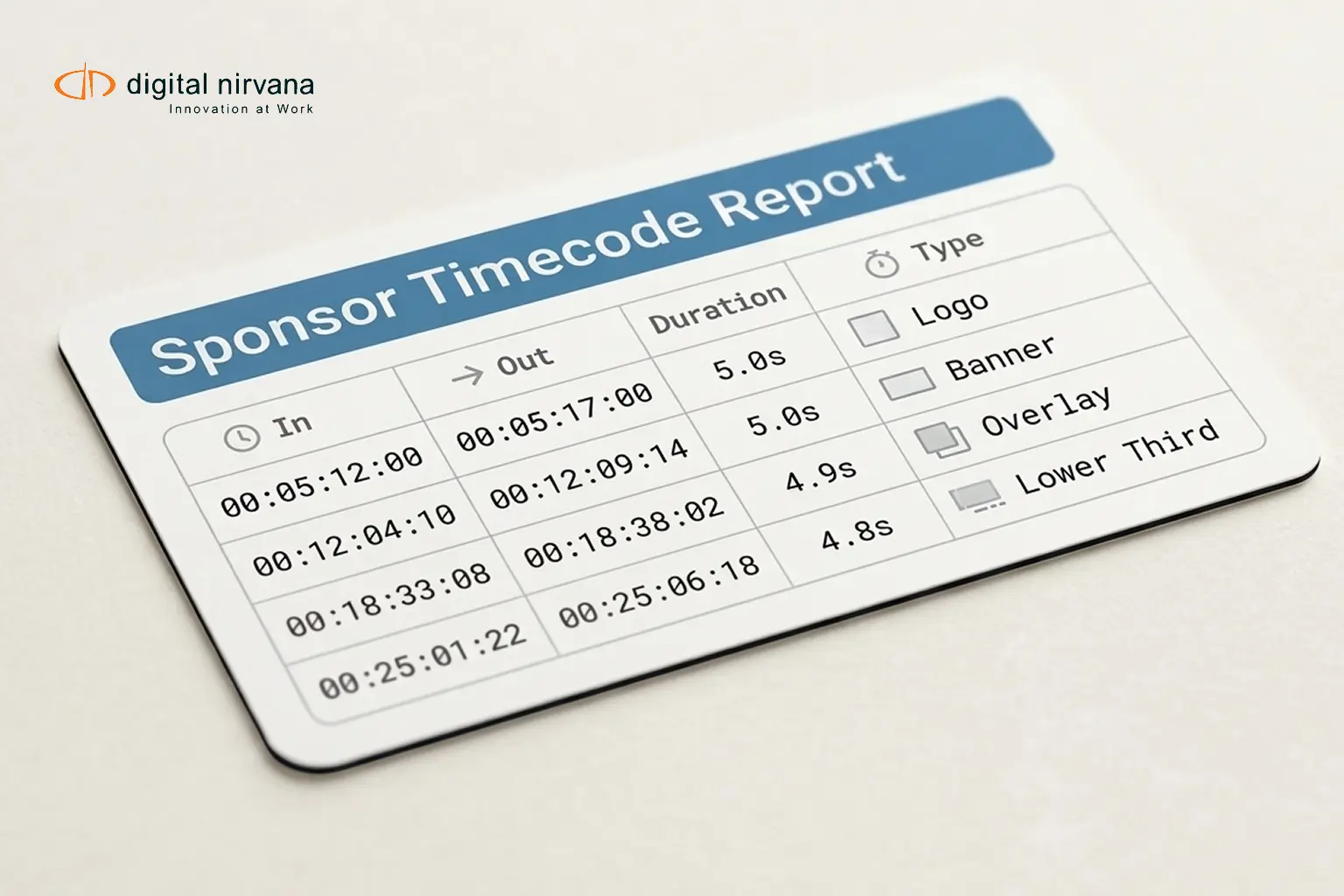
A sponsor-ready report is not a raw export of detections. It is a structured timecode report that any stakeholder can read quickly and validate.
Recommended Timecode Report Fields
| Report Section | What To Include |
| Campaign Details | Sponsor name, campaign name, contract flight dates, channels or feeds |
| Content References | Program, episode, event, asset ID, version, market or region |
| Detection Summary | Total visible time, appearance count, first and last appearance |
| Timecoded Evidence | In timecode, out timecode, duration, confidence score, frame grabs |
| Context Notes | Was it a bug, billboard, lower third, virtual signage, product placement |
| Exceptions | Missed placements, short exposure, brand safety flags, manual overrides |
| Audit Details | Who reviewed, when approved, ruleset version used, export timestamp |
Digital Nirvana’s proof-of-play guidance emphasizes time accuracy and evidence beyond basic logs, including visual verification approaches that satisfy advertisers who want indisputable confirmation.
Brand Safety Checks That Belong In The Same Report
Sponsors increasingly want two answers at once
- Did we get the exposure we paid for
- Did we appear in a context that fits our brand safety and suitability requirements
Industry definitions vary, but the IAB has published guidance on brand safety and suitability, and IAB Tech Lab materials position content taxonomies as a common language for contextual targeting and brand safety or suitability.
Brand safety is often framed as avoiding unsafe environments that can damage a brand’s reputation.
Practical Brand Safety Checks For Sponsorship Proof
- Content category classification, such as IAB-aligned taxonomies, for consistent labeling
- Sensitive content detection, for example, profanity, violence, nudity, or other restricted categories
- Placement adjacency checks, such as whether the logo appears near a sensitive segment boundary
- Manual review flags for edge cases, for example, satire, news violence, or user-generated inserts
MetadataIQ highlights content-compliance tagging capabilities, including categories such as profanity, violence, nudity, and sensitive content, along with topic classification using the IAB taxonomy, making it easier to connect sponsorship proof to brand safety requirements.
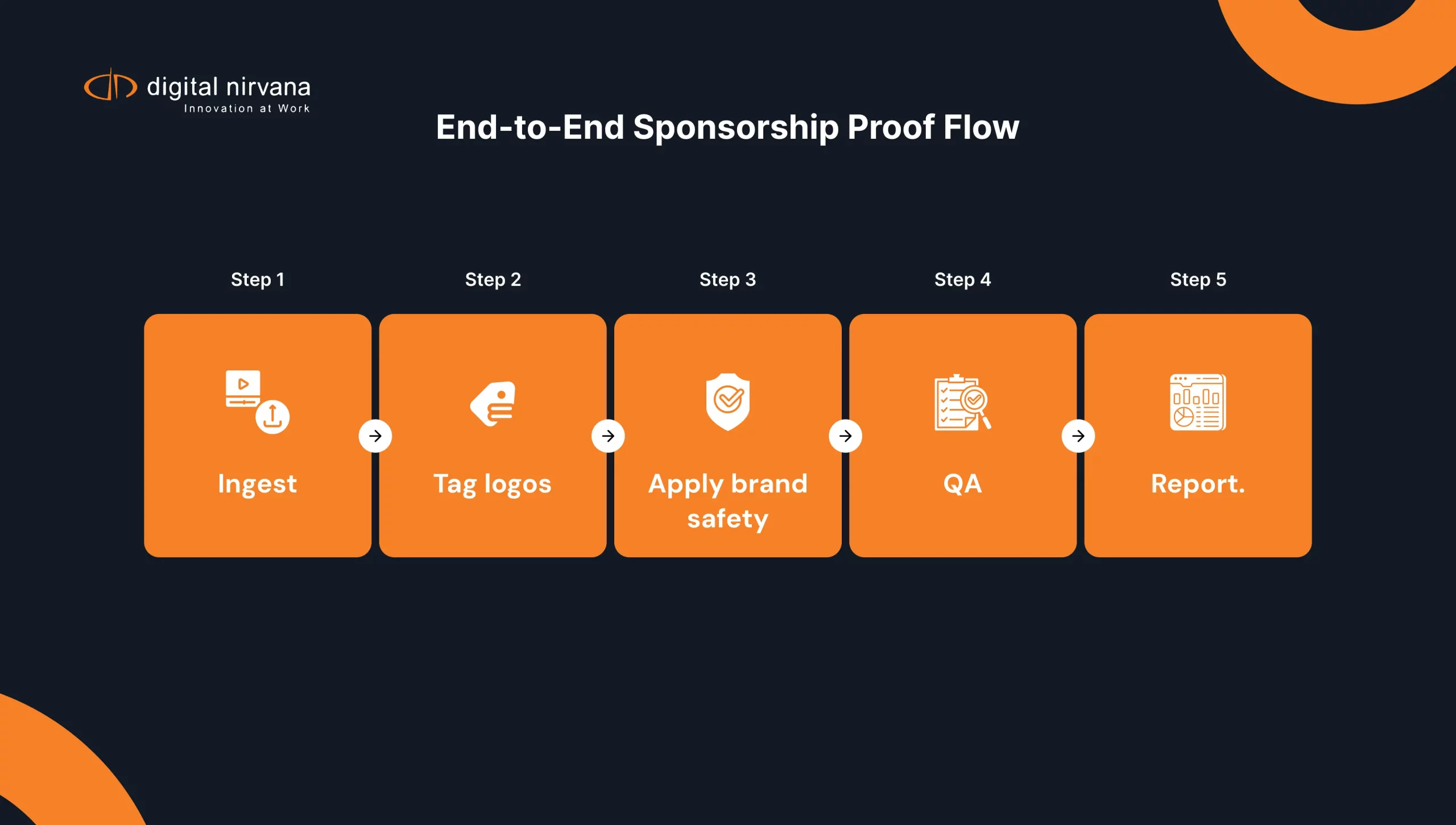
A Practical End-to-End Workflow
This workflow works for ad ops, sales support, and compliance teams without turning every report into a custom project.
Step 1: Ingest The Media, Lock The Reference
Pick the exact feed and version you will report on. Sponsorship disputes often start with version confusion, especially with regional inserts and OTT variants.
Step 2: Run Automated Video Tagging
Generate timecoded metadata so the content becomes searchable by moment, not just by file. Digital Nirvana describes live metadata as time-coded markers aligned to specific time positions.
Step 3: Detect Sponsor Logos And Branded Elements
Enable logo recognition and configure
- Sponsor logo library and variants
- Confidence thresholds
- Minimum on-screen duration rules to avoid noise
MetadataIQ includes logo recognition as part of its integrated video intelligence layer.
Step 4: Apply Brand Safety And Suitability Rules
Classify content segments, run safety checks, and capture any flags to include in the sponsor report.
Step 5: Human Review Where It Matters
Use reviewer validation for
- High-value campaigns
- Borderline confidence detections
- Any flagged brand safety segments
If you want a structured way to demonstrate accuracy, Digital Nirvana publishes guidance on running a metadata tagging accuracy bake-off using gold sets and false-positive analysis.
Step 6: Generate The Timecode Report And Evidence Exports
Export the timecode table, plus supporting thumbnails or short clips for the most important placements.
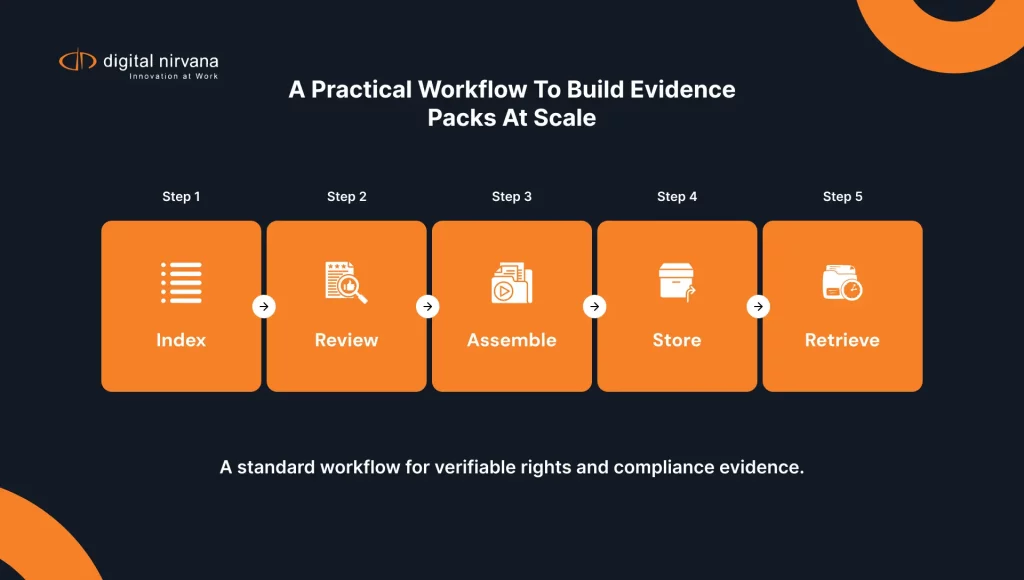
Step 7: Archive The Pack With Audit Logs
MetadataIQ highlights governance, quality scoring, and audit logs so you can track completeness, flag issues, and be ready for reviews.
Quality Control And Dispute Prevention Tips
- Standardize the timecode format across teams, including frame-rate handling for deliverables.
- Keep a “logo variants” library that includes seasonal marks, monochrome bugs, and resized overlays.
- Treat confidence thresholds like a policy decision, and document them in the report.
- Use exception reporting, not just success reporting, to show sponsors transparency.
- Align proof reporting with operational records where possible. Digital Nirvana notes that aligning traffic as-run records with recorded evidence creates a more defensible proof-of-performance package.
How MetadataIQ Supports Sponsorship Proof Workflows
MetadataIQ is built as an intelligence layer for Avid, Grass Valley, and custom MAM environments, with automated metadata tagging, logo recognition, IAB taxonomy-based classification, and a rules engine for compliance tagging.
For sponsorship proof, that translates into
- Time-coded metadata that turns sponsorship moments into searchable evidence
- Logo recognition that supports branded element verification
- Brand safety, relevant tagging categories, and topic classification
- Governance dashboards and audit logs that support repeatable reporting and dispute defense
If your use case also requires a capture-and-compliance recording layer across feeds, Digital Nirvana positions MonitorIQ as a foundation for proof-of-performance workflows, with clip export and AI metadata features, including logo detection.
Meet Digital Nirvana At NAB Show 2026
If you’re heading to NAB Show 2026, stop by to see how Digital Nirvana helps teams automatically turn live and recorded video into structured, searchable intelligence. You’ll get a workflow-focused look at how MetadataIQ supports faster review, better discovery, and smoother handoffs across production, compliance, and distribution.
You can meet the team at Booth N1555 in Las Vegas, April 19–22, 2026. If you want dedicated time, book a demo slot ahead of the show.
FAQs
It is the process of attaching time-aligned metadata to video so that sponsor moments, such as logos, overlays, and mentions, can be found, verified, and reported with timecodes.
Accuracy depends on logo quality, size, occlusion, and how you set thresholds and review rules. For high-stakes reporting, combine automated detection with a human QA step and track false positives.
At minimum, include campaign details, feed or version references, timecoded in and out ranges, duration, confidence indicators, and evidence like thumbnails or clips for key placements.
Sponsors want proof of exposure plus proof that exposure occurred in an acceptable context. Industry guidance frames brand safety and suitability as context controls, supported by consistent taxonomies for classification.
Digital Nirvana states that MetadataIQ integrates with systems like Avid MediaCentral and Grass Valley, and supports broader MAM and DAM integrations with enterprise workflows.
Conclusion
Sponsorship proof becomes easier when you stop treating it as a one-off scramble and start treating it as an indexed workflow. With video tagging, logo detection video, and timecode reports, you can show sponsors exactly when and where their brand appeared. When you add brand safety checks and audit logs, you also show that the exposure happened in the right context, using repeatable rules.
For teams building this capability inside real media operations, MetadataIQ brings automated, time-coded metadata, logo recognition, IAB taxonomy-based classification, and governance controls into the tools your teams already use.
Key Takeaways:
- Sponsors want timecoded evidence, not just affidavits or schedules.
- Logo detection is most valuable when it outputs structured timecode reports with QA and exceptions.
- Brand safety and suitability checks belong in the same sponsor proof package, supported by consistent taxonomies.
- MetadataIQ supports this workflow with logo recognition, compliance tagging, IAB taxonomy classification, and governance dashboards with audit logs.