A raw news feed runs for hours. Somewhere inside it sits a 90-second segment on a policy announcement a digital producer needs right now for a breaking web story. Nobody has time to watch the whole feed to find it, and the show rundown from that day doesn’t break down cleanly to the minute.
This is the exact scenario topic-based video segmentation exists to solve. Instead of treating a long recording as one continuous block, segmentation breaks it into meaningful, topic-defined sections a team can search, jump to, and pull from directly, without watching everything in between.
Why This Problem Is Getting Bigger, Not Smaller
Video now accounts for the overwhelming majority of global internet traffic, and broadcasters are generating more of it than ever, across news, sports, and digital-first programming, often producing several hours of raw content every single week.
That volume compounds a problem broadcasters have always had: finding a specific moment inside a long piece of footage often feels like searching for a needle in a haystack. As raw content volume keeps growing across live news, sports coverage, and digital platforms, the gap between what’s technically archived and what’s actually findable keeps widening right along with it.
What Topic-Based Segmentation Actually Does
Topic-based segmentation divides a lengthy, continuous piece of content, whether that’s a transcript, a raw video feed, or a full broadcast recording, into smaller, coherent units defined by subject matter rather than arbitrary time intervals.
Instead of chopping a four-hour feed into even 10-minute blocks that ignore what’s actually being discussed, topic-based segmentation identifies where the conversation or content genuinely shifts from one subject to another, and marks those points as segment boundaries. The result is a set of segments that each represent one coherent topic, ready to be searched, labeled, and pulled independently.
How the Underlying Technology Actually Works
It’s worth understanding the mechanics here, because they explain why topic-based segmentation produces more useful results than simple time-based chunking.
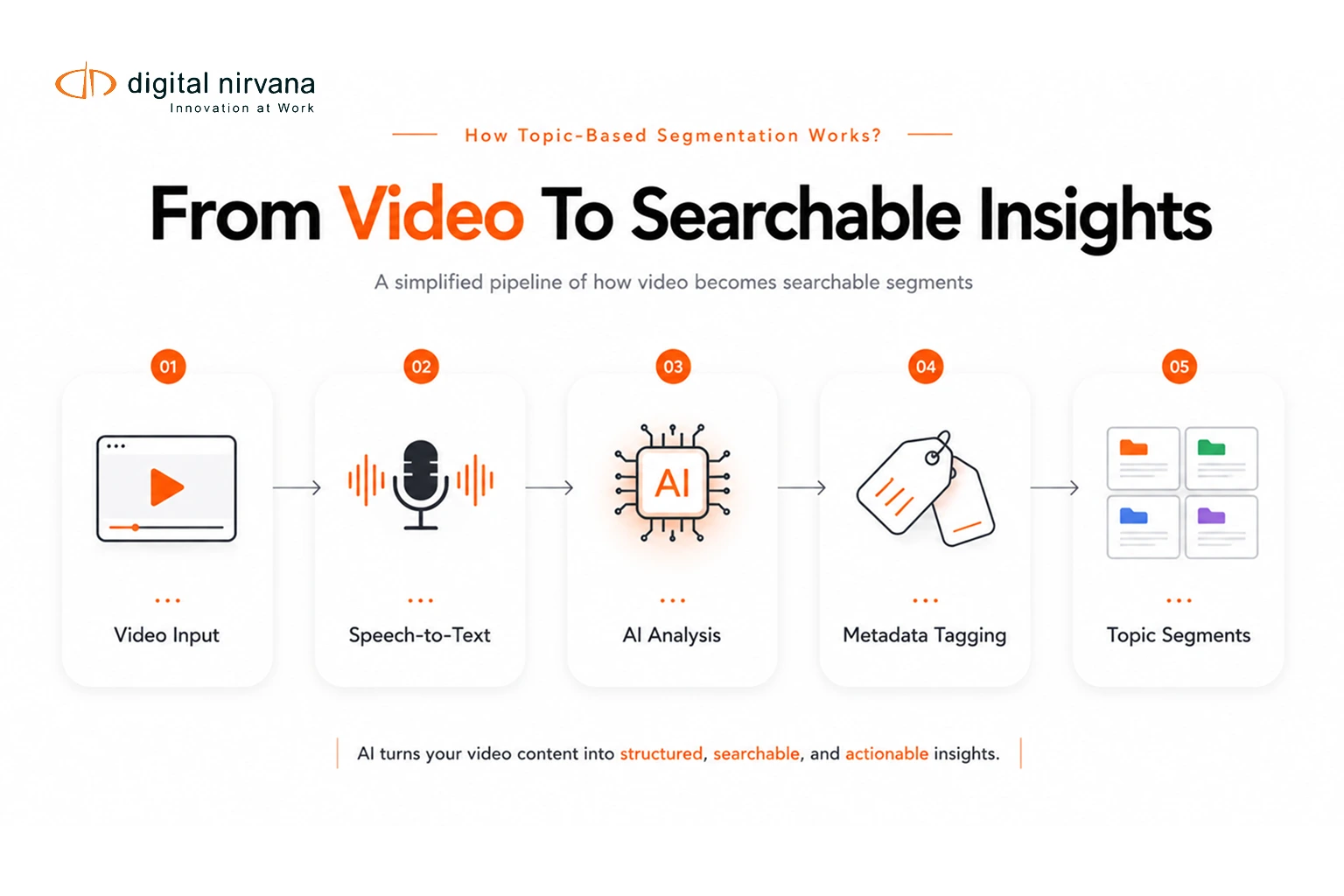
The process typically starts with a transcript, generated through automated speech recognition, since detecting a topic shift depends on understanding the words being spoken. That text gets cleaned, removing stop words, punctuation, and numbers that don’t carry topical meaning, then divided into smaller analyzable units, typically at the sentence level.
From there, the system evaluates lexical cohesion, essentially measuring how semantically related the vocabulary is within a given block of text. When cohesion is high, the content is likely still on the same topic. When cohesion drops sharply between two adjacent blocks, that’s a signal a topic shift has occurred, and the system marks a segment boundary at that point. Established approaches like the TextTiling algorithm work on exactly this principle, tracking vocabulary shifts to detect where one coherent topic ends and another begins.
Beyond Text: Adding Visual and Contextual Signals
Text-based topic detection is the foundation, but modern segmentation for broadcast content typically layers in additional signals beyond just spoken word analysis.
Computer vision adds scene-level context, detecting visual cues like scene changes, on-screen graphics, or camera angle shifts that often align with topic boundaries in produced content. Speaker changes provide another useful signal, since a shift from one speaker to another, particularly in panel or interview formats, frequently correlates with a topic transition. Combining these signals with the underlying text-based cohesion analysis produces segmentation that holds up better across the varied content types broadcasters actually work with, from tightly produced news packages to unscripted live coverage.
What This Looks Like in a Real Newsroom Workflow
A raw news feed comes in covering an hour of continuous coverage: an opening segment, a policy announcement, an interview, and a closing wrap-up. Instead of a producer scrubbing through the full hour to find the interview portion, topic-based segmentation has already broken the feed into labeled sections, each with an automatically generated title reflecting its content.
The producer searches by topic or scans the segment list directly, jumps straight to the interview, and pulls the clip needed for a digital story, all without watching a single minute of unrelated content. What used to require manually scrubbing an hour of raw footage becomes a search that takes seconds.
Where This Delivers the Most Value Across Broadcast Operations
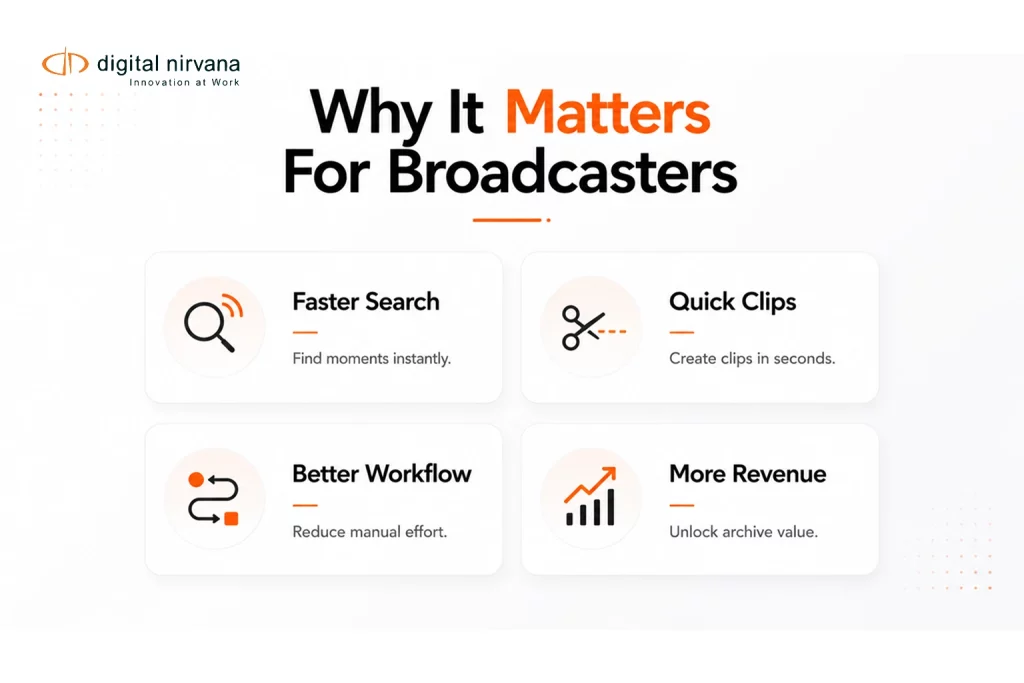
News operations benefit from the ability to identify every topic discussed within a raw feed without watching or listening to the entire thing, which matters enormously under breaking-news deadline pressure when every minute searching is a minute not spent producing.
Sports production uses topic and moment-based segmentation to auto-log key plays and moments, tagged with context, letting highlight teams pull the right clip by searching for what happened rather than scrubbing through an entire game.
Archive and licensing teams apply segmentation to legacy footage, breaking previously undifferentiated recordings into searchable, topic-labeled segments that unlock licensing potential for content that was technically stored but practically unusable before.
Post-production and editorial teams use segment boundaries as a starting structure for editing, cutting straight to relevant sections rather than building an edit from an unbroken raw timeline.
Measurable Impact of Adding Topic-Based Segmentation
Broadcasters that implement AI-driven topic segmentation typically see change across a few consistent areas.
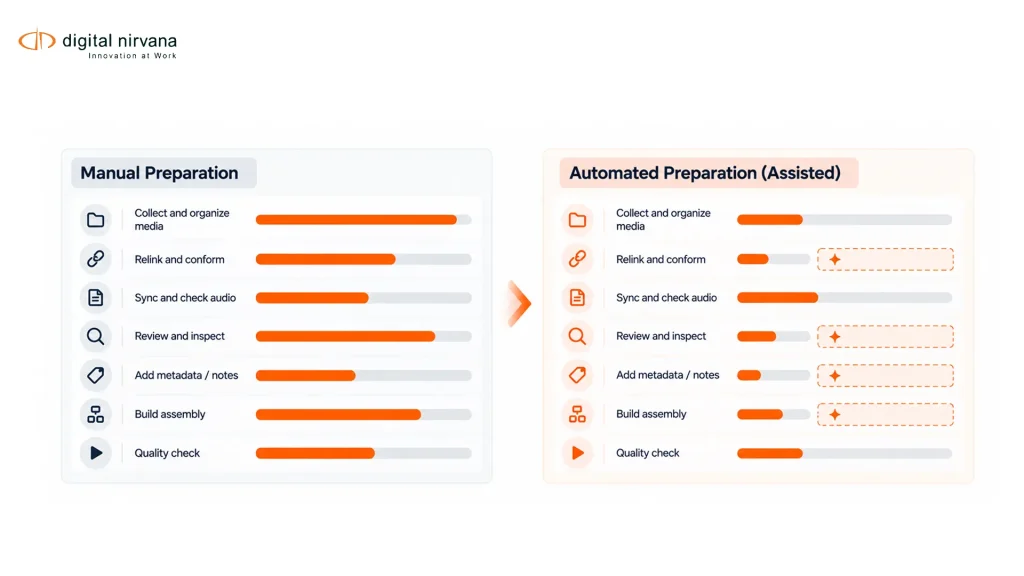
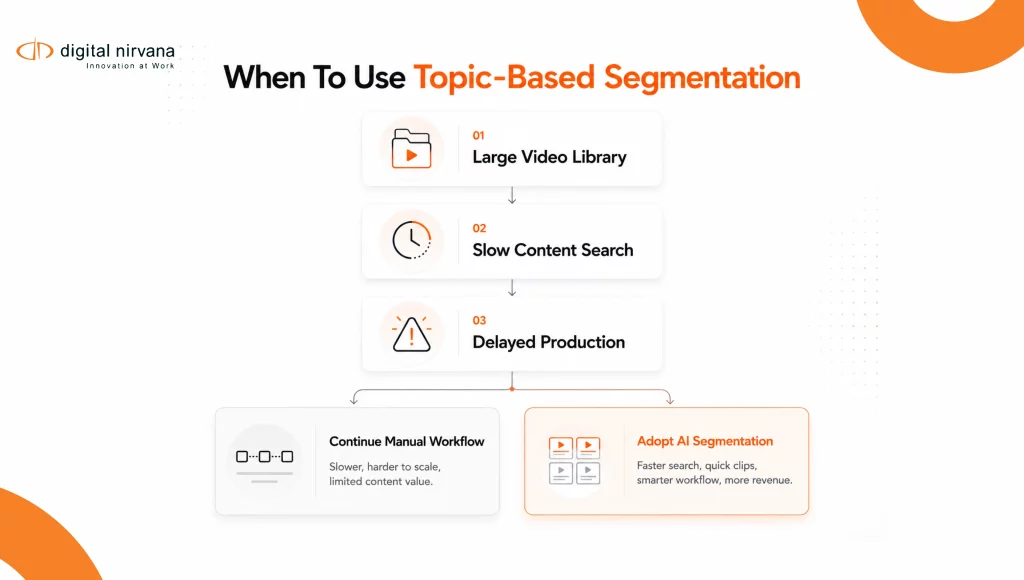
Time spent locating specific content within long-form footage drops sharply, since teams search by topic instead of scrubbing full recordings. Digital and social publishing speeds up, since relevant segments are identified and ready to cut while a broadcast is still airing or shortly after, rather than requiring a separate review pass. And archive content becomes more usable overall, since previously undifferentiated legacy footage gets restructured into searchable, topic-labeled segments that support both editorial reuse and licensing.
What to Evaluate Before Adding Segmentation to Your Workflow
A few practical questions determine whether topic-based segmentation actually improves a broadcaster’s workflow or just adds another layer of complexity.
Does the system generate segment boundaries automatically from live or near-live feeds, or only from fully processed post-production content? Does it combine text-based topic detection with visual and speaker-change signals, or rely on transcript analysis alone? Does it generate automatic titles or labels for each segment, so a team can scan results without opening every clip? And does it integrate with existing editing and MAM tools, like Avid or Grass Valley, so segmented content appears directly inside the systems editors already use?
Key Capabilities Worth Prioritizing
- Automated transcript generation as the foundation for topic detection
- Lexical cohesion analysis to identify genuine topic shifts, not arbitrary time intervals
- Combined text, visual, and speaker-change signals for more accurate segment boundaries
- Automatic title or summary generation for each detected segment
- Support for both live/near-live and archived, post-production content
- Native integration with existing NLE and MAM environments
Addressing the Common Objections
“We already break footage into time-based chunks, isn’t that similar?” Time-based chunking ignores content entirely, splitting at fixed intervals regardless of what’s actually being discussed. Topic-based segmentation identifies where the subject matter genuinely changes, which produces far more usable, coherent segments for search and reuse.
“Won’t this require re-processing our entire archive?” It can be applied retroactively to existing archives in batches, and it’s often exactly where the most untapped value in legacy footage sits, since older content is frequently the least searchable to begin with.
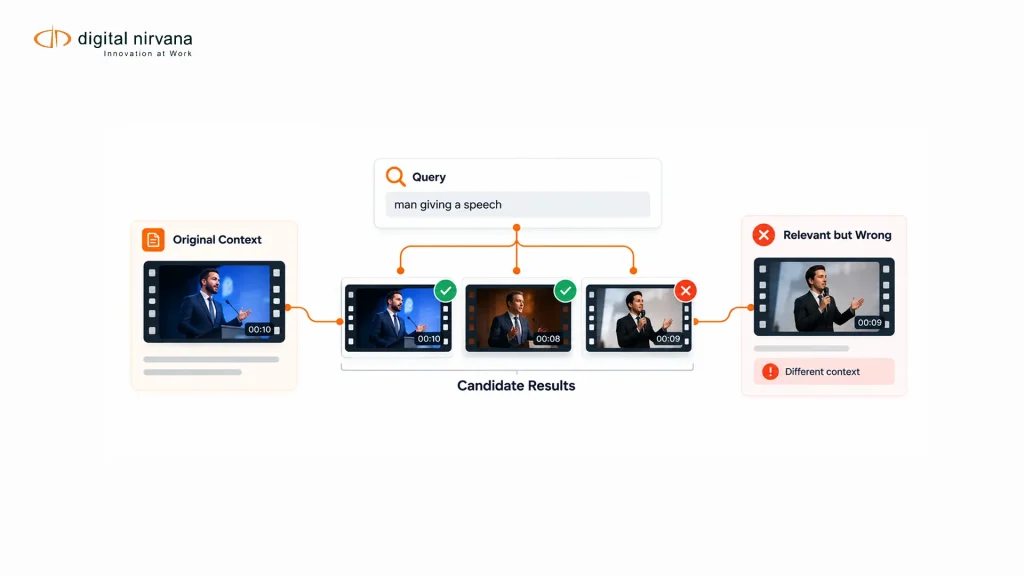
“How accurate is automated topic detection really?” Accuracy improves significantly when text-based analysis is combined with visual and speaker signals rather than relying on transcript cohesion alone, which is why the strongest implementations layer multiple signal types together.
How Digital Nirvana Approaches Topic-Based Segmentation
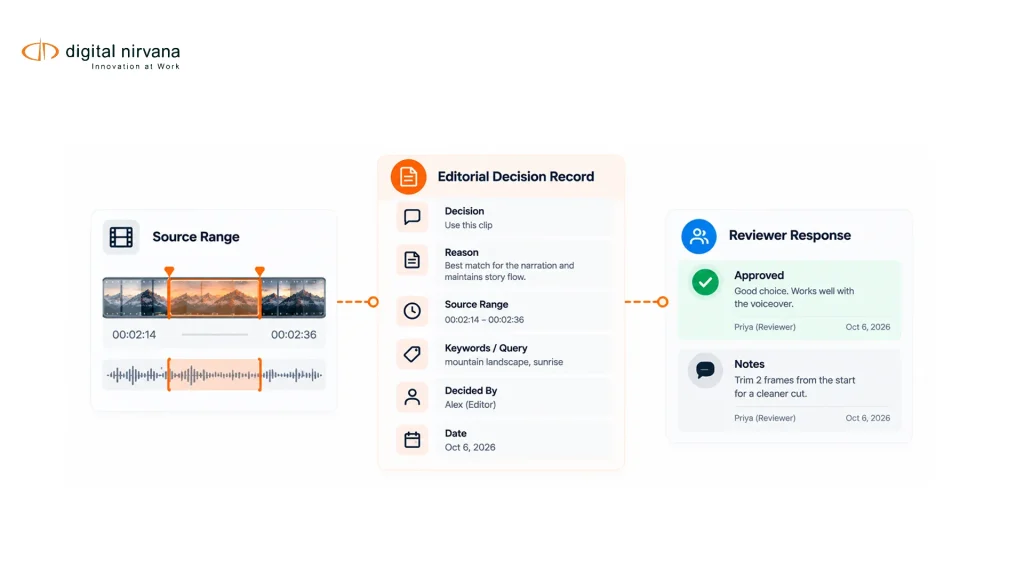
MetadataIQ generates topic-based segmentation directly from automated transcription and video intelligence, breaking raw feeds into searchable, labeled segments and integrating those markers directly into existing Avid, Grass Valley, and MAM environments, so editors see them exactly where they already work.
For newsrooms and sports teams needing the underlying transcription and speech data that powers segmentation, TranceIQ provides that foundation, while MediaServicesIQ extends the visual and object detection layer that strengthens segment boundary accuracy. Broadcasters managing compliance evidence alongside searchable content often connect this to MonitorIQ.
Why This Matters as Raw Content Volume Keeps Climbing
Broadcasters aren’t producing less raw footage each year. They’re producing more, across more platforms, with less time between capture and publish than ever before. Topic-based segmentation is what keeps that growing volume from becoming an unusable, unsearchable pile of undifferentiated content.
Teams that build segmentation into their core content workflow, rather than treating it as a nice-to-have applied selectively, are the ones turning every hour of raw feed into structured, reusable value instead of a haystack their own staff has to search manually. Digital Nirvana’s success stories show how newsrooms and sports production teams have applied exactly this approach to speed up both live turnaround and archive monetization.
Frequently Asked Questions
How is topic-based segmentation different from simple time-coded chapters? Time-coded chapters typically split content at fixed or manually chosen intervals. Topic-based segmentation detects where the actual subject matter shifts, using lexical cohesion and often visual or speaker signals, producing boundaries that reflect real content changes.
Can topic-based segmentation work on live or near-live feeds? Yes, when built on real-time transcription and video intelligence. This is particularly valuable for news and sports operations that need to identify and cut segments while a broadcast is still airing.
Does segmentation require a fully accurate transcript to work well? Transcript accuracy directly affects segmentation quality, since topic detection depends on understanding the actual words being spoken. Combining transcript analysis with visual and speaker-change signals helps offset occasional transcription errors.
Conclusion
Raw footage only becomes valuable once someone can actually find the part that matters, and topic-based segmentation is what makes that possible at the speed modern broadcast operations require. By breaking long recordings into coherent, searchable, topic-labeled segments instead of leaving teams to scrub through undifferentiated feeds, broadcasters turn hours of raw content into structured assets ready for immediate use, whether that’s a breaking digital story, a sports highlight, or a licensing opportunity buried in an old archive.
Key Takeaways
- Topic-based segmentation divides content by actual subject matter shifts, not arbitrary time intervals
- The underlying process typically starts with transcription, then analyzes lexical cohesion to detect topic boundaries
- Combining text analysis with visual and speaker-change signals produces more accurate segmentation than transcript analysis alone
- News, sports, and archive teams each get distinct, high-value use cases from the same underlying capability
- Segmentation can be applied to live and near-live feeds, not just fully processed archival content
- Legacy archives often hold the most untapped value once retroactively segmented and made searchable