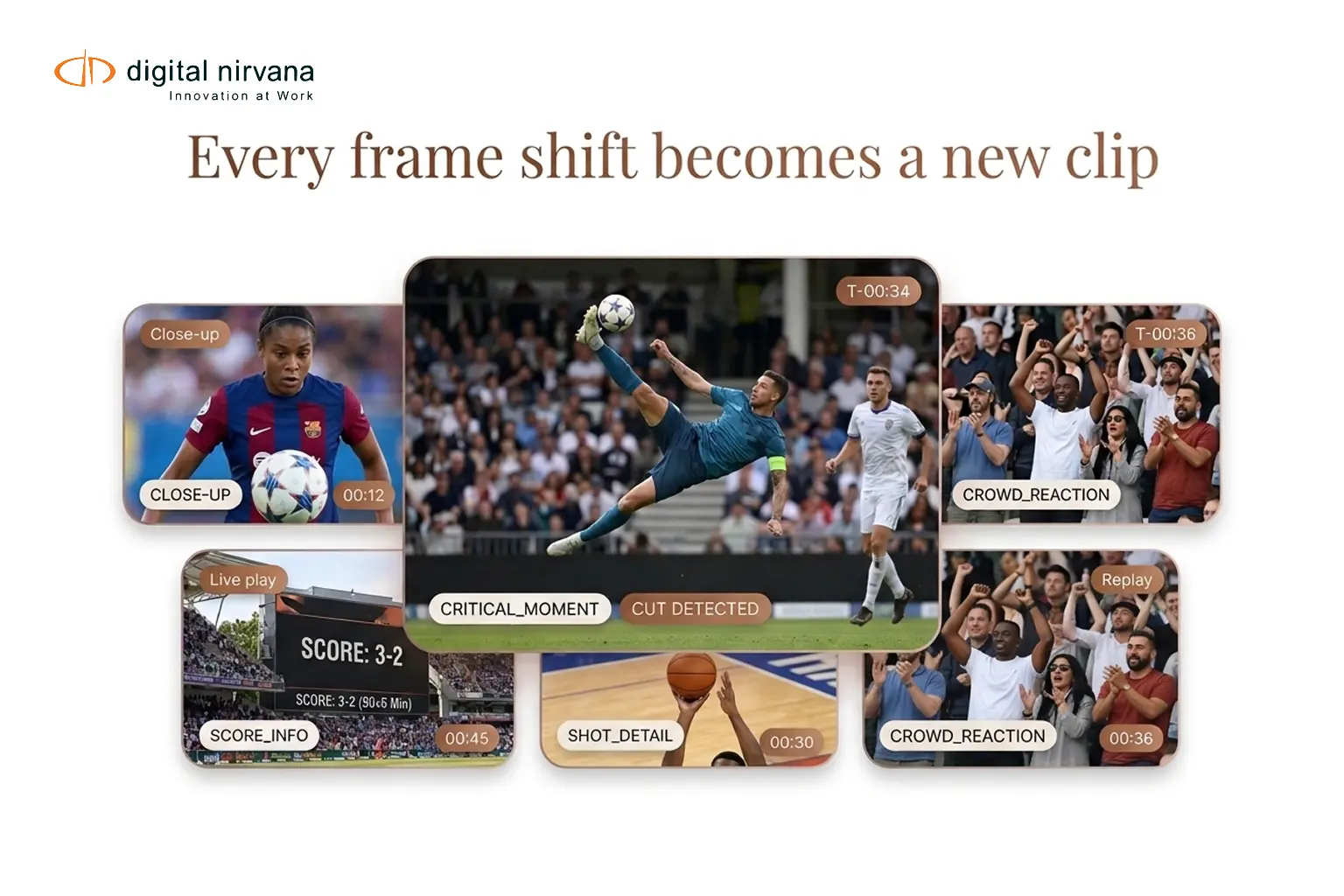
A producer needs 40 clips out of a three-hour event feed by morning. Each one has to start clean, on the cut, not two frames into the previous camera.
Nobody is going to scrub three hours to find 40 edit points. Something has to know where the shots begin and end, and it has to be right often enough that the producer stops checking.
That is shot change detection. It is one of the oldest problems in video analysis, it is widely assumed to be solved, and it still generates more downstream rework than almost any other detection task in a media pipeline.
Shot, scene, chapter: three things teams conflate
Most confusion in this area is vocabulary, and it causes real procurement mistakes.
| Unit | Definition | Determined by | Typical use |
| Shot | An uninterrupted run of a single camera between two transitions | Visual discontinuity | Clipping, keyframes, subtitle timing |
| Scene | A group of consecutive shots that hang together semantically | Meaning and context | Segmentation, summarisation, chaptering |
| Chapter | A viewer-facing division of a programme | Editorial and product decisions | Navigation, podcast and VOD players |
Shot detection is a signal problem. Scene detection is a semantic problem. A vendor demonstrating clean shot boundaries has not demonstrated scene understanding, and buying the first while specifying the second is a common and expensive mismatch.
What actually counts as a shot change
Two categories, and they are not equally difficult.
Hard cuts are instantaneous. One frame belongs to shot A, the next to shot B. Detection is close to reliable on this category across every serious method.
Gradual transitions unfold across frames. Dissolves, fades to and from black, wipes and digital transitions can run anywhere from a handful of frames to several seconds. There is no single boundary frame, only a region, which means the model must decide both that a transition occurred and where to call it.
Gradual transitions are where detection quality is actually decided, and where vendor demo reels rarely go.
How detection works
| Approach | Method | Strength | Weakness |
| Pixel and histogram differencing | Compares colour distributions between consecutive frames | Fast, cheap, easy to run at scale | Confuses lighting changes and fast motion with cuts |
| Edge and motion analysis | Tracks edge change ratios and motion vectors | Better on camera movement | Struggles with heavy action and handheld work |
| Compressed-domain detection | Reads encoded data such as frame types and macroblocks without full decode | Very fast on large archives | Tied to the encoding, less precise |
| Deep learning | Trained networks that classify transitions directly | Strongest on gradual transitions | Needs compute, and inherits training-set bias |
Modern practice is dominated by learned models. Research architectures such as TransNet V2 predict hard cuts and gradual transitions through separate outputs, precisely because treating them as one class caps performance. Open-source tooling like PySceneDetect remains widely used for straightforward content and exposes a sensitivity threshold you are expected to tune per source.
Worth stating plainly: the authors of the leading research in this field note that full accuracy remains out of reach, because the diversity of real video keeps producing both false hits and missed transitions. Treat any claim of perfect detection with suspicion.
Where real footage breaks detection
False positives, meaning boundaries reported that do not exist:
- Camera flashes at press events and red carpets
- Strobing, stadium lighting and concert effects
- Whip pans and fast handheld movement
- Explosions, fireworks, pyrotechnics
- Full-frame graphics, lower-third wipes and score bugs animating in
- Aggressive compression artefacts on low-bitrate renditions
False negatives, meaning real boundaries missed:
- Cuts between two visually similar shots, such as a two-camera interview
- Match cuts designed to be invisible
- Slow dissolves between low-contrast scenes
- Cuts inside static or near-static content, including locked-off presentations
Notice the pattern. The failure modes cluster by genre. Sports, live events and news generate false positives. Interviews, lectures and studio content generate false negatives. Which means a single global sensitivity setting across a mixed library is guaranteed to be wrong in both directions.
Where shot detection earns its keep
Keyframes and thumbnails. One representative frame per shot, so browsing a proxy takes seconds instead of scrubbing.
Clipping and highlights. Clips that start and end on the cut, without a manual trim pass.
Subtitle and caption timing. A long-standing subtitling convention holds that captions should not run across a shot change, because the eye reacquires the frame at the cut. Shot boundaries give the segmentation engine somewhere sensible to break.
Ad break placement. For content prepared for FAST and VOD, shot boundaries combined with black frame and silence detection identify natural insertion points rather than cutting mid-sentence. This connects directly to the evidence chain covered in our guide to broadcast proof of play for ad verification.
Archive segmentation. Long-form recordings become navigable units, which is the precondition for licensing anything out of them.
QC. Unexpected boundaries flag dropped frames, splice errors and conform faults before a client finds them.
Training data preparation. Shot-level segmentation is the standard granularity for downstream video AI, so boundary errors propagate into every model trained on the output.
Tuning it for your content
- Build separate detection profiles by genre rather than one global threshold
- Set a minimum shot length to suppress flicker and strobe-driven false positives
- Handle hard cuts and gradual transitions as separate outputs, not one score
- Suppress detections during known graphics events such as animated bugs and wipes
- Run detection on a consistent rendition, since bitrate changes shift results
- Define a boundary tolerance in frames, because “close enough” needs a number
- Decide whether over-segmentation or under-segmentation is cheaper for each use case
- Re-tune when the content mix changes, not only when the vendor changes
That seventh point is the one that separates teams who are happy with their detection from teams who are not. For thumbnail generation, extra boundaries are harmless. For automated ad insertion, a false boundary places a break in the wrong spot and a viewer notices. Tune toward the error your workflow can absorb.
Measuring it honestly
| Metric | What it tells you | Watch for |
| Precision | Share of reported boundaries that are real | Falls first on live and event footage |
| Recall | Share of real boundaries found | Falls on interviews and static content |
| F1 | Balance of the two | Report separately for cuts and graduals |
| Boundary tolerance | How many frames off still counts as correct | Must be agreed before testing, not after |
| Over-segmentation rate | Extra boundaries per hour | The metric editors actually feel |
Build a labelled test set from your own worst content: a live sport segment, a studio interview, a graphics-heavy promo and an archive transfer. A vendor score on a public benchmark tells you about the benchmark. The same discipline applies to every detection service, as we set out in our guide to evaluating speaker diarization in media workflows.
Common objections, answered
“This is a solved problem, any library does it.” Hard cuts are close to solved. Gradual transitions on real broadcast footage are not, and gradual transitions are what your promos and archive are full of.
“We can just tighten the threshold.” Tightening reduces false positives and creates false negatives. There is no setting that fixes both. There are profiles per genre.
“Our editors will spot the mistakes.” They will, and each spot costs a trim. At forty clips a night, the cost is the workflow.
How Digital Nirvana handles shot-level intelligence
Shot detection is most useful when it arrives alongside everything else happening in the frame, rather than as a standalone score.
MediaServicesIQ exposes scene explanation, object and face recognition, OCR, speech and summarisation as API-accessible services, so shot-level segmentation can be combined with what is being said, who is on screen and which logos appear, and triggered from the orchestration you already run.
That combination matters. A boundary tells you where a clip starts. A boundary plus a transcript, a speaker and a detected sponsor tells you which clip is worth cutting. When those outputs need to reach editors, MetadataIQ writes them back as time-coded markers inside Avid and broader PAM and MAM environments rather than leaving them in a separate interface, an approach we explain further in multimedia workflow automation with metadata.
Where segmentation feeds caption and subtitle deliverables, TranceIQ handles the output side, and Media Enrichment supplies the human review that turns first-pass detection into something safe to deliver. Deployments across broadcast, sports and post are documented in our customer success stories.
Why segmentation is an asset decision
Shot boundaries look like a technical detail. They are closer to an inventory decision.
An unsegmented three-hour recording is one asset. The same recording segmented into shots, grouped into scenes and described with metadata is hundreds of retrievable units, each of which can be searched, clipped, licensed or placed against an advertiser. That is the difference between an archive that costs money to store and one that earns, a shift we cover in media monetization with AI and in our explainer on production workflow metadata across PAM and MAM.
Segmentation is what converts duration into inventory.
Conclusion
Shot change detection is the quiet dependency underneath thumbnails, clipping, subtitle timing, ad placement, QC and every video model you might train later. When it is right, nobody mentions it. When it is wrong, the cost shows up as trims, rework and misplaced breaks that nobody traces back to the source.
Treat it as a tuned capability rather than a switch. Separate hard cuts from gradual transitions, profile by genre, decide which error your workflow can absorb, and measure against your own difficult footage rather than a public benchmark.
Get that right and the producer with 40 clips due by morning stops checking the edit points.
Key takeaways
- Shot, scene and chapter are different units. Shot detection is a signal problem, scene detection is a semantic one.
- Hard cuts are close to reliable. Gradual transitions such as dissolves, fades and wipes decide real quality.
- Failure modes cluster by genre: live and sports produce false positives, interviews and static content produce false negatives.
- A single global sensitivity threshold across a mixed library will be wrong in both directions. Build profiles per genre.
- Decide whether over-segmentation or under-segmentation is cheaper for each use case, then tune toward the tolerable error.
- Measure precision and recall separately for cuts and graduals, on a labelled set built from your own hardest footage.
Frequently asked questions
What is shot change detection? It is the automatic identification of boundaries between shots in a video, meaning the points where one continuous camera run ends and another begins, including both instantaneous cuts and gradual transitions such as dissolves and fades.
What is the difference between shot detection and scene detection? Shot detection finds visual discontinuities between camera runs. Scene detection groups consecutive shots that belong together semantically. One is a signal task, the other requires context and meaning.
Why do gradual transitions cause problems? A dissolve or fade has no single boundary frame, only a region spanning several frames or seconds. The system must decide both that a transition occurred and where to place the boundary, which is considerably harder than detecting an instantaneous cut.
How accurate is automatic shot detection? Very high on hard cuts in clean footage, noticeably lower on gradual transitions and difficult content. Leading research in the field notes that complete accuracy remains unreachable because real video is too varied, so plan for review on high-stakes output.
Want to test detection against your own hardest footage? Book a 20-minute media intelligence workflow review and bring one difficult reel. We will show you where the boundaries land.