It’s 2 PM on a Wednesday. Your AI team has spent six months building what they believe is a bulletproof system. Customer support tickets get fed into your GenAI model. The model reads the ticket, extracts the core issue, and suggests a response.
It’s working beautifully. Tickets that used to take 15 minutes to handle are now suggested answers in 30 seconds. Your support team is hitting productivity targets they’ve never hit before.
Then a customer posts on Twitter: “I asked your AI chatbot for a refund and it told me to try ‘interpretive dance.’ I’m done.”
Your team checks the logs. The AI didn’t malfunction. The system is working exactly as designed. The problem is that the prompt you wrote six months ago was incomplete. It didn’t specify that the model shouldn’t give absurd suggestions. It didn’t tell the model to prioritize accuracy over creativity. It didn’t explain the business context that makes some outputs acceptable and others catastrophic.
So the model generated a technically correct, spectacularly useless response.
By the time you fix the prompt, the thread has 47,000 views and your brand is being memed. That’s not a technical failure. That’s a prompt engineering failure. And it just cost you way more than anyone wants to admit.
The Secret That AI Teams Have Finally Started Telling Each Other
Here’s what most organizations don’t understand about GenAI in production: the model itself is almost never the problem.
You got your Claude, your GPT-4, your Gemini. These models are genuinely sophisticated. They understand nuance. They catch context. They can reason through complex problems.
What breaks is the instructions you give them.
A poorly written prompt is like giving someone brilliant directions to the wrong destination. The person can navigate beautifully. They’ll just end up in the wrong place.
Five years ago, when AI was a novelty, this didn’t matter much. Companies ran experiments. They played with models. Poor prompts generated poor results, and the company shrugged and moved on.
Now AI is production infrastructure. It’s handling customer service. It’s processing financial documents. It’s making content decisions. It’s influencing business outcomes that matter.
Bad prompts now cost money. They damage brand reputation. They create compliance issues. They undermine trust in AI systems that otherwise work beautifully.
This is why prompt engineering just went from “nice to have” to “business critical.”
Why Traditional Prompting Fails at Enterprise Scale
Let’s be specific about what goes wrong.
A junior engineer writes a prompt: “Summarize this customer feedback.”
The model does that. It summarizes. Sometimes well. Sometimes poorly. Sometimes it misses important context. Sometimes it adds interpretation that wasn’t in the original feedback.
Why? Because the prompt is incomplete. It doesn’t tell the model what “important context” means. It doesn’t specify what tone to use. It doesn’t explain what the summary is for. Is it for internal analysis? For customer communication? For training data?
Without clarity, the model makes assumptions. Those assumptions are often wrong.
Now multiply this across an enterprise. You have hundreds of prompts. Thousands of use cases. Dozens of teams writing prompts without coordination or standards. Some prompts are good. Most are mediocre. Some are actively problematic.
You end up with an AI system that’s inconsistent, unreliable, and difficult to govern.
Here’s the real problem: most organizations treat prompt engineering like documentation. Something technical people write once and never update. Something that doesn’t need quality review. Something that doesn’t require ongoing maintenance.
In reality, prompt engineering is infrastructure. It’s as important as database schemas. It requires expertise. It requires documentation. It requires testing. It requires version control.
Treat it like documentation, and your AI system will behave like poorly maintained documentation: inconsistent, full of outdated information, and impossible to debug when something breaks.
The Moment When One Company Almost Lost Everything
A fintech company spent $3 million building an AI system to process loan applications. The core model was state-of-the-art. The infrastructure was solid. The data pipeline was clean.
Then they went live.
In the first week, the system approved three loans that should have been rejected. One applicant had massive red flags in their credit history. The model somehow missed them. Another applicant had stated an annual income of $50,000 but applied for a $400,000 loan. The model approved it.
The CEO called an emergency meeting. The AI team was panicked. Was the model broken? Was the data pipeline corrupted? Was there a technical bug?
After a 12-hour investigation, they found the problem: the prompt.
The original prompt told the model to “evaluate loan applications based on standard criteria.” It didn’t specify what “standard criteria” meant. It didn’t tell the model to flag high-risk applicants for manual review. It didn’t explain the company’s actual risk tolerance.
So the model did what models do when given incomplete instructions: it made reasonable interpretations that happened to be wrong.
Fixing it took 20 minutes. Retraining the model took four hours. The damage to the CEO’s confidence in AI took weeks to recover from.
That company learned something expensive: bad prompts in high-stakes environments can cost millions.
Why Prompt Quality Determines Your AI’s Trustworthiness
Here’s something that nobody tells teams building production AI: the quality of your prompts directly determines whether your AI system is trustworthy.
Trustworthiness is the missing ingredient in most enterprise AI initiatives.
A model might be technically accurate 95% of the time. That sounds good until you realize it’s wrong 1 out of 20 times. In customer service, that’s one absurd suggestion per 20 tickets. In financial processing, that’s one bad decision per 20 applications. In content moderation, that’s one inappropriate approval per 20 submissions.
At scale, that’s unacceptable.
But here’s the thing: you can’t just flip a switch and make the model more accurate. The model is what the model is. What you can do is engineer prompts that make the model’s accuracy work for you instead of against you.
A well-engineered prompt tells the model what to do when it’s uncertain. It tells the model to flag edge cases instead of making guesses. It tells the model to prefer accuracy over creativity. It tells the model to explain its reasoning so humans can verify it.
A well-engineered prompt turns a 95% accurate model into a trustworthy production system.
How the Teams Winning Right Now Actually Do This
The workflow that’s actually working looks completely different from the “write a prompt once and ship it” approach that most companies still use.
It starts with clarity about what the model is actually supposed to do. Not abstract clarity. Specific clarity. Not “summarize customer feedback,” but “extract the customer’s core complaint in one sentence, identify the urgency level (critical/high/medium/low), and flag any mentions of potential legal concerns.”
Then comes testing. A team writes sample inputs and expected outputs. They run the prompt against those samples. They see what the model actually produces versus what they expected. They iterate on the prompt until it consistently produces the right results.
Then comes documentation. The prompt gets documented like code: what it’s supposed to do, what edge cases it handles, what assumptions it makes, who wrote it, when it was last updated.
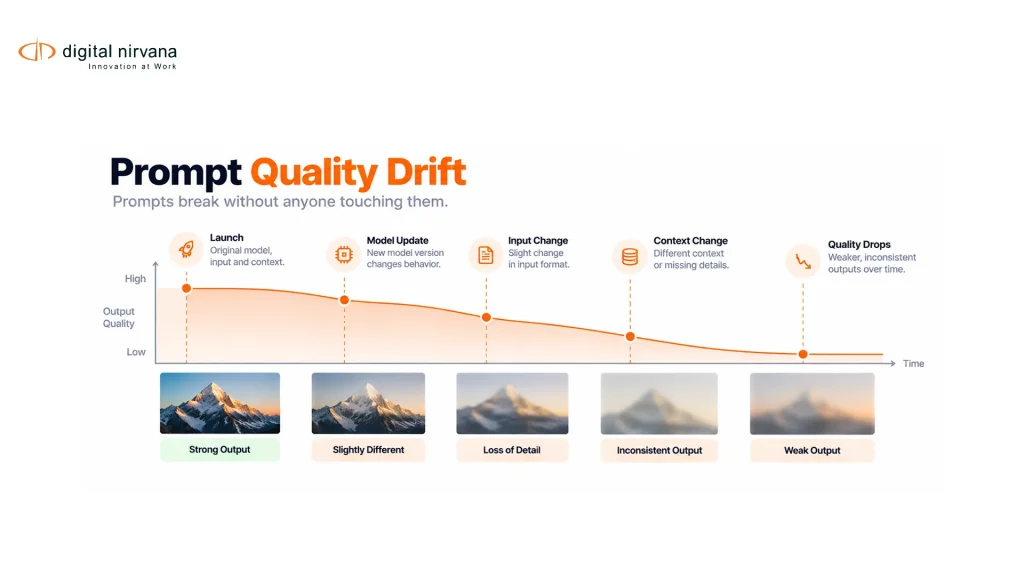
Then comes ongoing monitoring. As the model produces real outputs, the team tracks whether it’s behaving as expected. If outputs start drifting (hallucinations increasing, accuracy dropping), they know to review the prompt.
This isn’t theoretical. This is how teams operating GenAI at scale are actually doing it.
And here’s what they’ve discovered: systematic prompt engineering reduces AI output problems by 60-70%. Not perfectly, but dramatically.
Learn how human-in-the-loop AI operations and prompt QA workflows catch problems before they reach production.
The Story of One Data Team’s Transformation
A healthcare organization was using AI to review medical notes and extract billing codes. The system was 87% accurate, which sounds okay until you realize that 13% of medical codes are wrong. At scale (thousands of notes per week), that’s hundreds of wrong codes weekly.
The finance team was doing the work of fixing them manually. It was chaos.
The data engineering team decided to try systematic prompt engineering.
They spent a week documenting exactly what the model was supposed to do: extract the primary diagnosis, list secondary conditions, identify any complications, and flag any cases where the model was uncertain.
They tested the prompt against 100 historical notes and compared the model’s output to correct answers. The prompt caught 91% correctly.
They iterated. They added more specific instructions about how to handle ambiguous medical terminology. They added examples to show the model what “uncertainty” looks like. They added context about why certain codes were riskier than others.
After three weeks of systematic prompt engineering, the accuracy jumped to 96%.
More importantly, the model was now flagging uncertain cases for human review instead of guessing. The finance team went from spending two hours manually fixing mistakes to spending 30 minutes reviewing flagged cases. Time saved: roughly 80 hours per week.
That’s one team. One prompt. One month of systematic work.
Imagine doing this across dozens of prompts in an organization.
Why Your Prompts Are Probably Causing Problems You Don’t Know About
If your prompts are mostly intuitive (writing them based on what feels right), you’re missing major problems.
Your model might be hallucinating (confidently stating things that aren’t true) and you don’t know it because you haven’t written prompts that ask the model to distinguish between facts and inferences.
Your model might be drifting (outputs changing subtly over time) and you don’t know it because you haven’t set up monitoring to catch the drift.
Your model might be amplifying biases (treating certain groups differently than others) and you don’t know it because you haven’t built prompts that test for fairness.
Your model might be over-confident about edge cases (making strong predictions when it should be uncertain), and you don’t know it because you haven’t told it to flag confidence levels.
These aren’t theoretical problems. They’re happening right now in production systems at companies that think their AI is working fine.
Systematic prompt engineering makes these problems visible and fixable.
The Difference Between Treating Prompts Like Code and Treating Them Like Configuration
Here’s the mindset shift that changes everything: prompts are code, not configuration.
Configuration is static. You set it, and it doesn’t change. Configuration doesn’t need version control. It doesn’t need testing. It doesn’t need documentation.
Code is dynamic. It gets updated. It gets tested before it ships. It gets reviewed by peers. It gets documented. It gets versioned so you can roll back if something breaks.
Treat your prompts like configuration, and they’ll behave like poorly maintained configuration: unpredictable, inconsistent, and impossible to debug.
Treat your prompts like code and they’ll start improving predictably.
This isn’t about being overly rigorous. It’s about recognizing that prompts are important infrastructure that needs to be maintained like important infrastructure.
Discover how managed AI operations and prompt QA workflows establish governance for production GenAI systems.
Why Prompt Engineering Is About to Become a Competitive Advantage
Here’s what’s coming: as more companies deploy GenAI in production, most will face the same problem. Their models are good. Their prompts are mediocre. Their systems are inconsistent.
The companies that systematically engineer their prompts will start looking like geniuses by comparison. Their AI systems will be more accurate. More consistent. More trustworthy. More valuable.
Customers will notice the difference. Investors will notice the difference. Employees will notice the difference.
Right now, systematic prompt engineering is a competitive advantage. In 18 months, it will be table stakes. Companies without it will look backward.
Your Prompt Quality Is Costing You More Than You Think
If your organization is running GenAI in production, your prompt quality is either creating value or destroying it. There’s no middle ground.
Every hallucination costs you. Every inconsistent output costs you. Every flagged case that requires manual review costs you. These costs add up to real money.
Systematic prompt engineering isn’t an add-on. It’s the foundation that makes production AI viable.
Why Digital Nirvana Is Your Standard for Prompt Engineering and AI Governance
Prompt engineering sounds simple until you try to do it at scale. Most organizations treat it as an engineering afterthought: someone writes a prompt, they deploy it, and they hope it works. When it doesn’t work consistently, they blame the model instead of investigating the prompt. What you actually need is a systematic approach to prompt development, testing, validation, and ongoing governance that’s built into your operational infrastructure.
Managed AI solutions from Digital Nirvana provide domain-aware prompt QA and human-in-the-loop operations that catch prompt problems before they reach production. Instead of treating prompt engineering as a solo activity, Managed AI brings structured workflows: experts review and test prompts against real-world scenarios, document assumptions, identify edge cases, and build validation rules that catch drift or hallucinations in production. Data Intelligence services complement this with prompt validation frameworks and data labeling workflows that ensure your training examples are representative and your test cases are comprehensive.
For organizations running multiple GenAI systems across different functions (customer service, content moderation, document processing, financial analysis), the real challenge isn’t individual prompts. It’s governance. Which prompts are in production? Who wrote them? When were they last updated? What version is running right now? Are outputs drifting? Do we have an audit trail of changes?
Digital Nirvana’s Managed AI framework turns prompt engineering from a chaotic, undocumented activity into production infrastructure with version control, testing protocols, performance monitoring, and documented decision-making. The result is AI systems that improve predictably, produce consistent outputs, flag uncertainty appropriately, and create audit-ready documentation of how decisions get made. When regulators ask how your AI works, you don’t explain. You show them the prompt documentation, the test results, the validation logs, and the ongoing monitoring data.
That’s not just better AI. That’s trustworthy AI.
FAQ
Q: What’s the difference between prompt engineering and just writing good instructions?
Good instructions get the job done once. Good prompt engineering produces instructions that work consistently across thousands of inputs, handle edge cases gracefully, flag uncertainty appropriately, and work reliably over time as the model and your use case evolve.
Q: How much does prompt engineering actually improve accuracy?
It varies dramatically by use case. We’ve seen improvements ranging from 5% (already well-designed prompts) to 40% (poorly engineered prompts). The average improvement across production systems is 15-25%, which compounds to significant value at scale.
Q: Do we need specialized prompt engineers or can our existing AI team handle it?
Ideally both. Your AI engineers understand systems and infrastructure. Specialized prompt engineers understand language, context, and how to coax specific behaviors from models. The best approach combines technical infrastructure with linguistic precision.
Q: How do we test prompts before putting them in production?
Create a test set of 50-100 representative inputs and their expected outputs. Run your prompt against them. Compare actual outputs to expected outputs. Measure accuracy. Iterate on the prompt until it consistently produces the right results. Document what worked and why.
Q: How often should we update our prompts?
At minimum: whenever you notice output quality drifting. Ideally: continuously as you learn more about what works. Treat prompts like living code, not static configuration. Review and improve them regularly.
Q: Can we version control our prompts?
Yes, and you absolutely should. Use Git or another version control system. Each prompt version should be tagged with a version number, a change description, test results, and deployment information. When something breaks, you can roll back immediately.
Q: What’s the relationship between prompt engineering and hallucinations?
A well-engineered prompt can’t eliminate hallucinations, but it can dramatically reduce them by: telling the model to distinguish facts from inferences, asking it to cite sources, instructing it to flag uncertainty, and providing clear boundaries for what counts as acceptable output.
Q: Do we need different prompts for different models (Claude vs GPT vs Gemini)?
Sometimes. Different models have different strengths and quirks. A prompt optimized for one model might need adjustment for another. However, the principles of good prompt engineering (clarity, specificity, testing, iteration) work across all models.
Q: How do we audit our prompts for bias?
Test them against diverse scenarios. Feed the model inputs featuring different groups, contexts, and edge cases. Examine whether outputs treat them differently. If they do, adjust the prompt to specify fairness requirements or flag potentially biased decisions for human review.
Q: What’s the cost of bad prompts versus the cost of fixing them?
A single bad prompt in production at a mid-size organization costs $5,000-$50,000 monthly in manual correction work, missed value, and customer friction. Fixing it costs weeks of engineering time and hundreds in testing. The ROI on prompt engineering is typically 3-6 months.
Q: Can we automate prompt engineering?
Not fully. You can automate testing and measurement. You can use tools to suggest improvements. But the actual engineering (writing clear, precise, contextually appropriate instructions) still requires human expertise. The goal of tools is to make that human expertise more effective and efficient.
The Moment When Your Prompts Stop Being Guesswork
You’ve seen the examples. You know the problem exists. You’ve probably had moments where AI output was worse than no output at all.
But knowing the problem and systematically solving it are different things.
The organizations winning right now aren’t hoping their prompts work. They’re testing them. They’re documenting them. They’re monitoring them. They’re improving them continuously.
The organizations still struggling are treating prompts like afterthoughts.
The difference between these two approaches is worth millions of dollars at scale.
Schedule a 20-minute consultation to audit your current prompt engineering practices and see exactly where your AI systems might be losing accuracy or consistency. No assumptions. No estimates. Just clarity on your specific situation and what systematic prompt engineering could improve.
Your AI system is only as good as the prompts that guide it. Make those prompts matter.