Your team can generate thousands of labels and still struggle to find a usable clip. A tag that lacks timing, points to the wrong source, or cannot leave its analysis platform adds data without solving retrieval. Video tagging software should be evaluated on the searchable, correctable metadata it delivers into your media workflow.
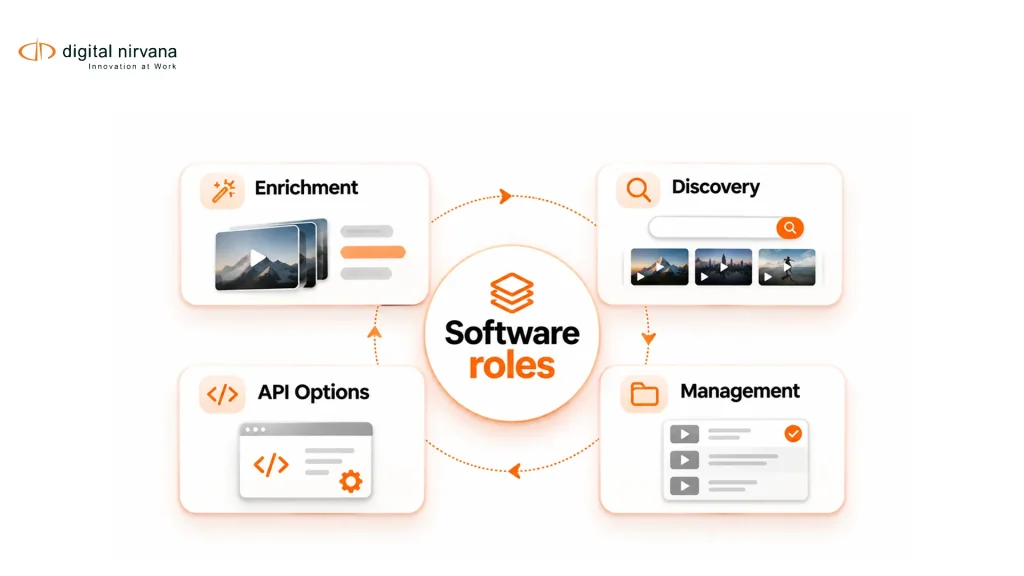
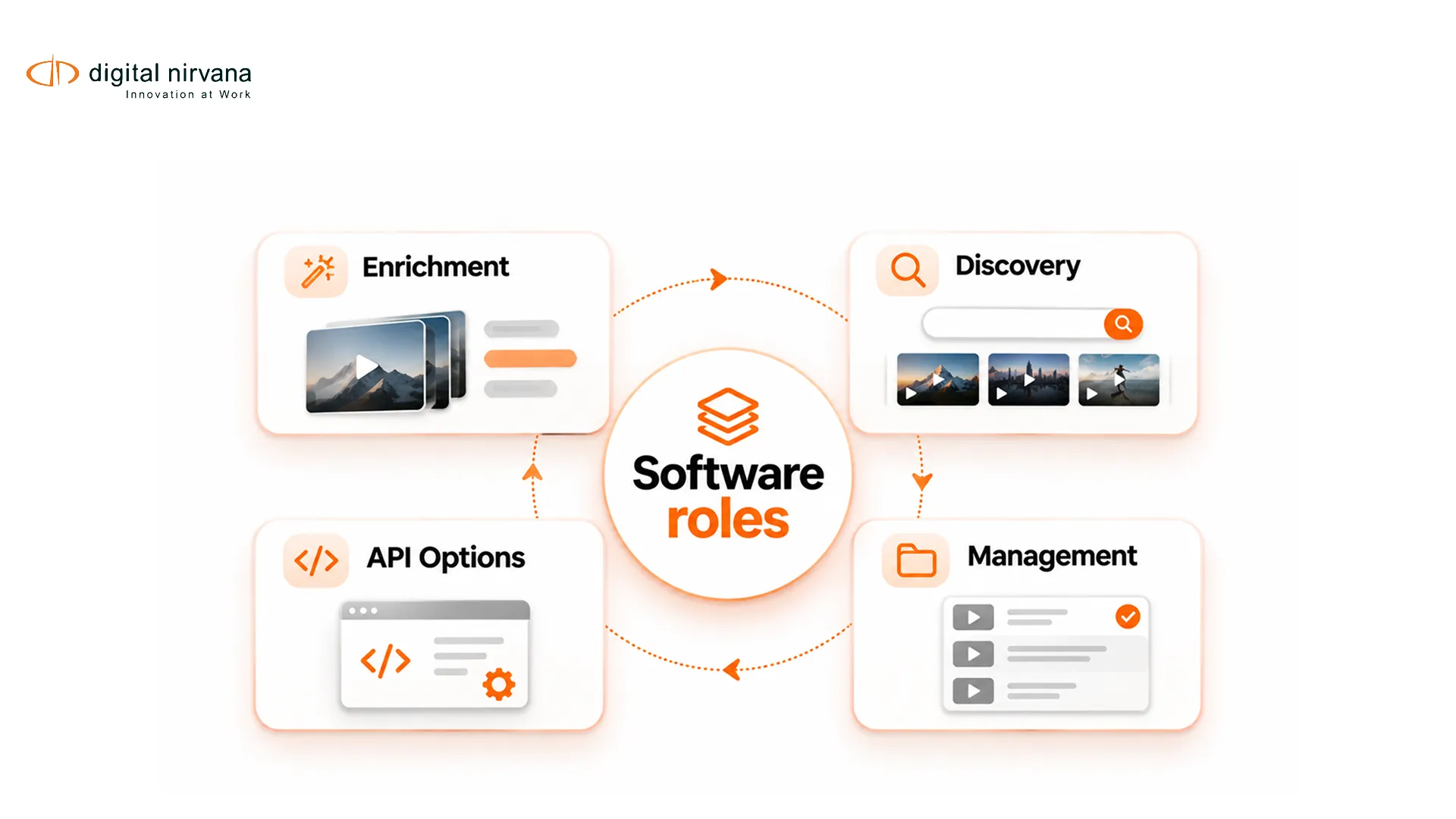
There is no justified universal ranking without testing a defined workload. A more useful shortlist separates packaged enrichment, discovery platforms, media management suites, and developer APIs, then checks which route fits your existing systems and operating capacity.
Key Takeaways
- Select a software category before comparing products with different workflow responsibilities.
- Require tags to retain source identity, useful ranges, and a correction process.
- Compare documented product roles without assuming every advertised capability exists in every configuration.
- Use representative retrieval tasks to evaluate results instead of counting generated labels.
- Test metadata portability and operating cost before expanding archive-wide analysis.
Table of Contents
- What Should Video Tagging Software Deliver?
- Which Software Categories Belong on Your Shortlist?
- How Do MetadataIQ and Other Options Differ?
- What Does a Useful Broadcast Tag Record Contain?
- How Should You Test Retrieval and Tagging Quality?
- What Must Integrations and Exports Preserve?
- How Do Governance and Rights Affect the Purchase?
- How Do You Choose and Pilot the Right Option?
- FAQs
- Conclusion
What Should Video Tagging Software Deliver?
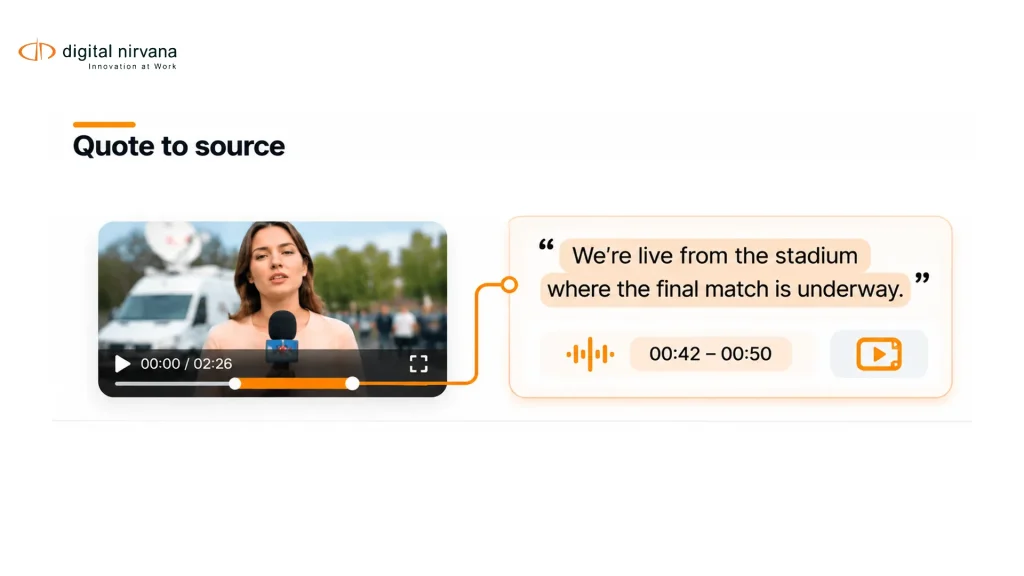
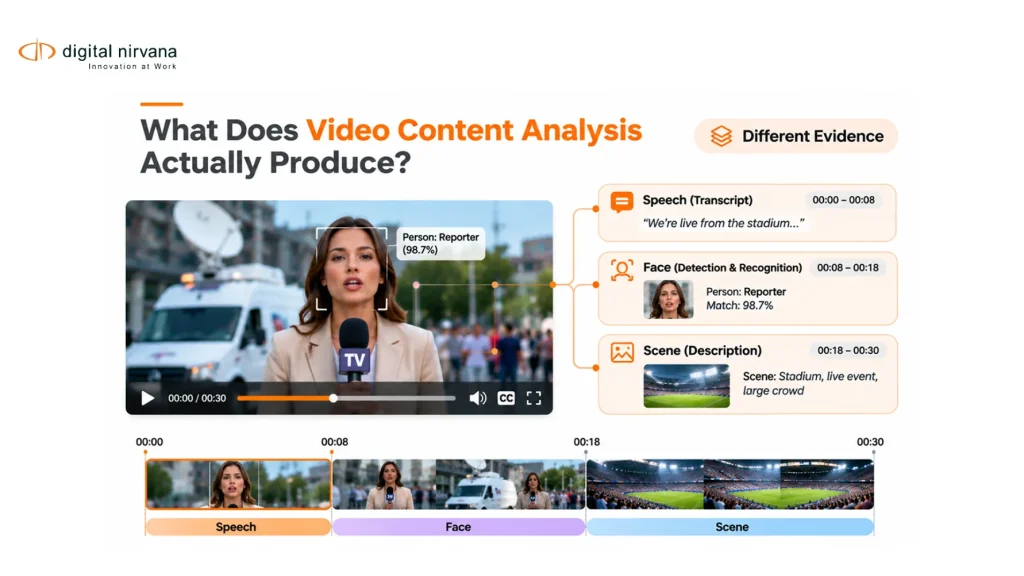
Video tagging software should produce searchable descriptions or labels connected to the correct media. For broadcast work, the useful unit is often a source range rather than a tag applied to an entire program.
The term covers different capabilities. Some tools transcribe speech and extract entities. Others recognize visual objects, detect logos, describe scenes, or let people log events manually. Ask which signals produced a tag and what the result actually means.
The Google Video Intelligence API reference documents distinct analysis functions. That separation is a useful reminder that “AI tagging” is an umbrella description, not a specific acceptance test.
Define the retrieval problem before selecting capabilities. A quote request needs trustworthy speech text and timing. A visual B-roll request may need different analysis. A rights decision needs authoritative permissions information, which recognition alone cannot provide.
Which Software Categories Belong on Your Shortlist?
Your shortlist should contain options capable of solving the same operational problem, even if their architectures differ. Do not compare a low-level API price directly with a managed platform subscription and assume the outputs cost the same.
| Category | Appropriate Starting Point | Responsibility to Examine |
| Packaged enrichment | Improve an existing MAM or PAM | Field mapping and workflow fit |
| Discovery platform | Search and review a large collection | Source access and editorial handoff |
| Media management suite | Combine management with enrichment | Repository and migration scope |
| Developer API | Build custom analysis into a product | Engineering, review, and operations |
| Manual or assisted logging | Capture specific editorial judgments | Staffing and vocabulary consistency |
Check your existing software contracts first. Some required features may already be available but poorly configured or missing source metadata.
Digital Nirvana’s guide to media system roles provides context for deciding whether you need another repository or an enrichment layer. Keep that architecture decision visible in procurement.
How Do MetadataIQ and Other Options Differ?
Compare the documented role of each option, then require evidence for your own use case. The following is a role-based shortlist, not a tested ranking or a claim of feature parity.
| Option | Publicly Described Role | Question to Resolve in Evaluation |
| Digital Nirvana MetadataIQ | Metadata intelligence around established media systems | How do accepted tags reach your configured MAM? |
| Moments Lab MXT | Video indexing with timecoded descriptions and related metadata | How will generated descriptions support your retrieval tasks? |
| Veritone media solutions | Media enrichment, discovery, management, and related workflows | Which components are included in the proposed scope? |
| Google Video Intelligence API | Individual video analysis capabilities for developers | Who builds and operates the complete tagging workflow? |
Moments Lab’s MXT product description and Veritone’s media offering support those category descriptions. They do not establish performance on your footage or prove support for your particular integration.
Digital Nirvana offers MetadataIQ for media indexing and enrichment. Evaluate its proposed configuration using the same source material and handoff tests applied to other shortlisted options.
What Does a Useful Broadcast Tag Record Contain?
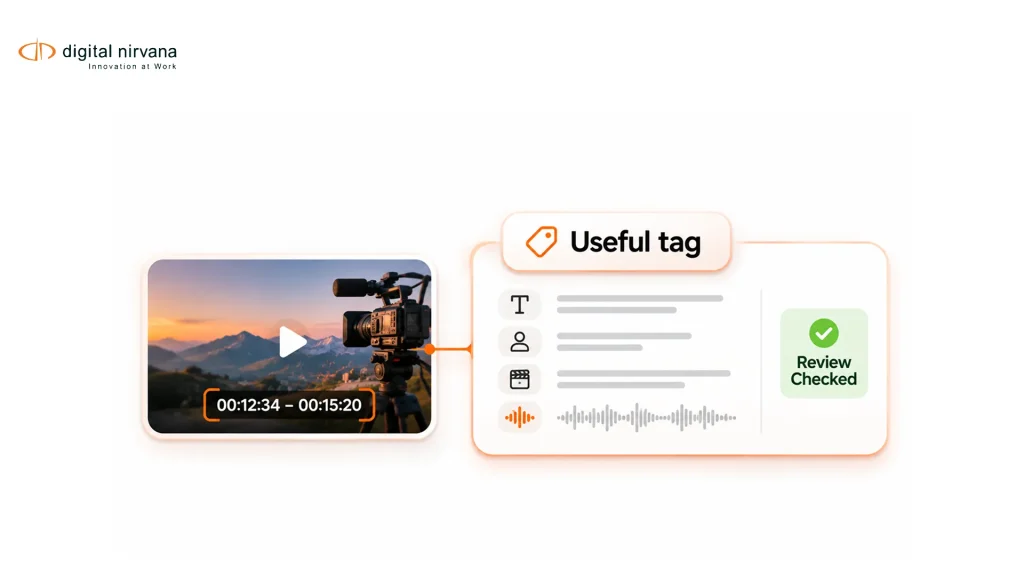
A useful tag record explains what the label refers to, where it occurs, and how much authority it carries. Store enough context for another user to inspect and correct it.
Use a proposed minimum record containing asset ID, analyzed rendition, label type, value, source range, time interpretation, provenance, and review status. Add an approved entity identifier when your workflow requires named people, teams, or organizations.
Separate raw observations from normalized terms. An OCR result may capture an abbreviated team name while your archive uses a preferred full name. Preserve the observation and the approved mapping rather than replacing both with an unexplained string.
Keep human editorial labels distinguishable from generated descriptions. An editor’s verified “approved interview excerpt” is a different kind of statement from an automatically inferred “emotional exchange.” Treating both as identical tags makes governance and later quality assessment harder.
How Should You Test Retrieval and Tagging Quality?
Test whether tags help users find correct, usable material, then investigate which analysis errors affect that result. A large tag count can reflect duplicate or irrelevant output rather than useful coverage.
Create reviewed tasks for exact quotations, visual actions, people, logos, and absent material. Use representative footage conditions, including poor audio, obscured graphics, older formats, and similar-looking events. Keep the acceptance sample separate from configuration examples.
For each task, record accepted results, important omissions, false matches, source-range quality, and reviewer effort. Measure how often an accepted result can be opened and used in the receiving workflow without repair.
Do not compare confidence values across models as if they shared one scale. Establish whether a particular score predicts usefulness for the task under test. Where a threshold is used, record why it was chosen and retest it when the content mix or analysis configuration changes.
What Must Integrations and Exports Preserve?
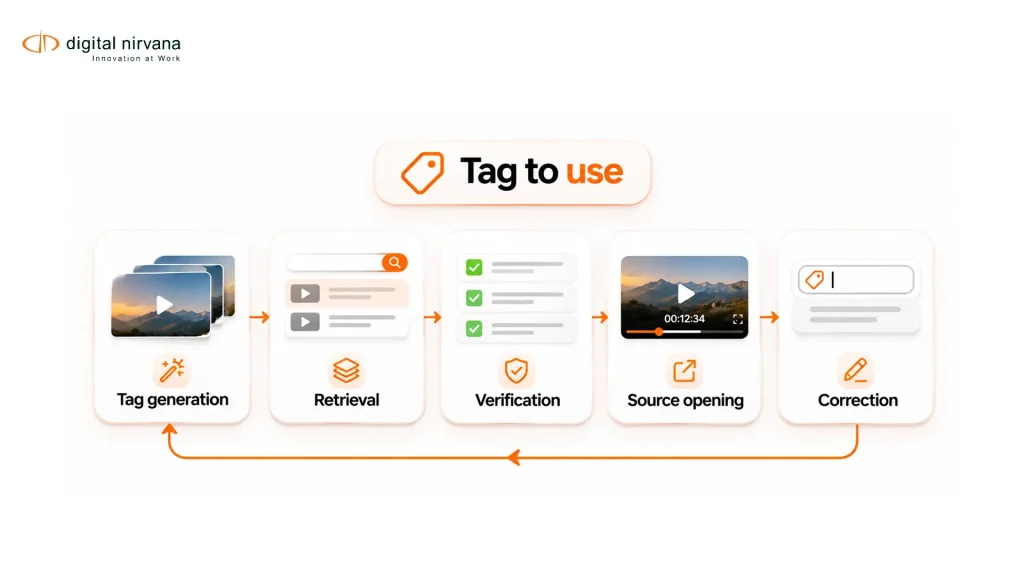
Integrations should preserve the meaning and context of metadata, not merely transfer a file containing tags. Verify the result in the receiving system used by the archive and editorial teams.
Test the movement of identifiers, time ranges, entity references, vocabulary values, restrictions, and corrections. A segment-level detection must not arrive as a claim about an entire program unless that change is deliberate and documented.
Digital Nirvana’s guidance on metadata handoffs between production and archive tools explains why that boundary deserves attention. Export support by itself does not prove correct interpretation in your destination.
Ask for an exit sample as well. Can you retrieve useful metadata and its source relationships without keeping the original analysis service active? Confirm what is portable, what is proprietary, and what work would be required to reconstruct the workflow elsewhere. Record unknowns before purchase.
How Do Governance and Rights Affect the Purchase?
Governance determines who can change tags, approve corrections, and decide how uncertain output is used. Rights control remains a separate responsibility even when tagging helps identify material needing review.
Test permissions for a reviewer, editor, archive administrator, and external collaborator. Confirm which users can see sensitive transcript text or generated descriptions, not only whether they can download the original video.
Require a correction process that survives reruns. An updated model should not silently replace accepted human metadata or republish a previously rejected identity claim. Preserve the ability to trace changes to the source and version.
A detected logo or recognizable face does not grant a license. Keep rights evidence in authoritative fields with the required review process. Similarly, a tag that indicates sensitive content should trigger a defined action rather than become an assumed legal judgment about the footage.
How Do You Choose and Pilot the Right Option?
Choose the option that passes your essential retrieval, governance, and integration conditions at an acceptable operating cost. Apply those conditions before scoring optional features.
Estimate cost using the same collection size, processing mix, user access, review effort, storage, transfer, and support assumptions. Include failed-job recovery and reprocessing when the taxonomy or model changes. Avoid quoting unverified product prices or promised savings.
Pilot a bounded collection and have operational users accept the results. Document which media types and tasks passed, which failed, and what remains untested. Expansion should follow an accepted workflow rather than enthusiasm for an isolated demo.
If your current MAM works but its content is difficult to discover, discuss the enrichment gap with Digital Nirvana. Bring failed searches, sample assets, and a receiving-system map so the discussion can focus on a measurable requirement.
FAQs
Video tagging software adds searchable labels or descriptions to footage. Its capabilities may include manual logging, speech analysis, visual recognition, and generated descriptions, depending on the product and configuration.
The best fit depends on your source material, required outputs, existing systems, and review capacity. Use a role-based shortlist and representative tests instead of relying on a universal ranking.
AI video tagging software does not necessarily replace a MAM. Enrichment can add searchable intelligence while the existing management system continues to own media, access, versions, and lifecycle workflows.
Some tools produce time-aligned tags for segments or detections within a video. Verify the exact granularity and whether those ranges remain usable after export to your receiving system.
Compare missed and incorrect results against reviewed examples, then measure retrieval usefulness and correction effort. Report results by task and content group rather than treating every type of tag as one accuracy measure.
Finding a logo provides a candidate observation that needs interpretation and validation. Sponsorship reporting may also require duration, placement, feed selection, deduplication, and contractual rules that a generic detection does not establish.
Conclusion
Define the search problem, choose the appropriate software category, and test the complete path from analysis to accepted use. Require source-linked metadata, correction controls, and an exit route before expanding the deployment. The right purchase improves retrieval without making your media history harder to trust.