A licensing manager gets a request for any footage of a specific product placement from a decade of archived commercials. The archive has thousands of hours of footage, minimal metadata, and no way to search by what actually appears on screen. The request sits unanswered for a week while someone manually scrubs through old tapes, and by the time an answer comes back, the licensing opportunity has moved on.
This is the problem AI-driven content search was built to solve. Not just tagging clips as they come in, but making an entire archive, old and new, genuinely searchable by what is actually in the footage: spoken words, faces, logos, scenes, and objects. The question for most media organizations is no longer whether they need this capability. It is which media search company actually delivers it at the depth their archive requires.
Why Basic Metadata Is Not the Same as Real Content Search
A lot of media platforms describe themselves as offering “search,” but there is a meaningful difference between searching titles, descriptions, and manually entered tags versus searching the actual content of a video or audio file.
Title and description search only works if someone already wrote accurate, detailed metadata at the time of ingest, which rarely happens consistently across a large archive. Content search, by contrast, indexes what is inside the file itself: the words spoken, the faces and logos that appear, the scenes that unfold. That means a search for a specific phrase, a sponsor’s logo, or a particular player returns results even if nobody ever manually tagged that clip.
For organizations with years of legacy footage and inconsistent historical tagging, this distinction is the entire ballgame. A search platform that only searches existing metadata will always be limited by how well that metadata was written years ago.
What an AI-Driven Media Search Platform Actually Indexes
A genuine content search platform typically layers several types of recognition on top of every asset. Automatic speech recognition transcribes spoken dialogue into searchable, time-coded text, so a search for an exact phrase jumps straight to the moment it was said. Facial and logo recognition identifies people and brands appearing on screen, which matters enormously for licensing, compliance, and sponsorship reporting. Object and scene detection break footage into searchable segments, so someone can search for a type of shot or setting rather than needing to already know which file it lives in.
All of that gets combined into a single searchable index, which is what makes it possible to type a name, a phrase, or a visual description and get a ranked list of matching moments across an entire archive, not just the assets someone happened to tag well.
Platforms like MetadataIQ build this indexing directly into MAM, DAM, and PAM environments, so search results appear inside the tools archive and editorial teams already use daily.
The Difference Between Tagging Speed and Search Depth
It is worth distinguishing two related but different capabilities. Tagging speed is about how quickly new content becomes searchable as it comes in. Search depth is about how much of an archive, including years of legacy footage, is actually searchable at all.
A media search company worth evaluating needs to deliver both. Fast tagging matters for breaking news and live sports. Search depth matters for licensing, compliance research, and unlocking the value of everything already sitting in the archive. A platform that only solves one of these leaves real value on the table.
A Real-World Search Workflow
Consider an archive team fielding a licensing request for any footage showing a specific city skyline at sunset, spanning ten years of stock and B-roll footage with minimal historical tagging.
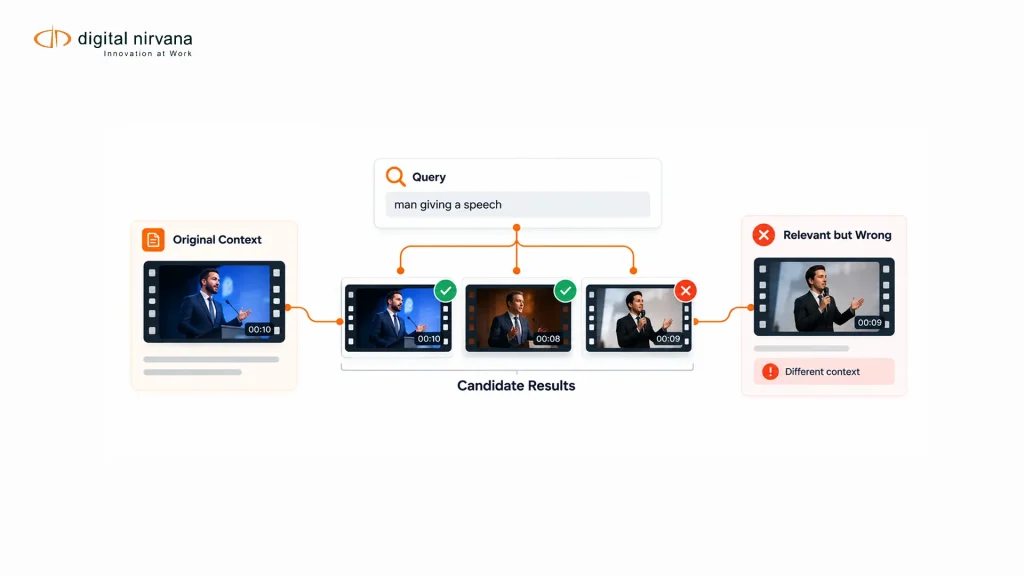
With AI-driven content search, the team runs a search combining a scene description with a rough time range, and the platform returns matching clips based on what actually appears in the footage, not on whether someone tagged “skyline” or “sunset” a decade ago. What would have taken days of manual review, if it was even findable at all, becomes a search that returns results in minutes.
The same capability applies to compliance and rights teams researching whether a specific product, logo, or phrase appeared in past broadcasts. Instead of relying on institutional memory or hoping someone remembers which archive box holds the right tape, the search runs against the actual content.
The Measurable Value of Content Search Over Basic Metadata
Organizations that move from metadata-only search to full content search typically unlock archive value that was previously invisible, since footage no longer needs to have been manually tagged well to be found.
Licensing and rights teams see faster turnaround on research requests, because search replaces manual review. Compliance and legal teams gain the ability to research historical content on demand rather than relying on staff memory of what exists where. And editorial teams stop duplicating footage requests or reshoots simply because they could not find something that already existed in the archive.
What to Evaluate in a Media Search Company
Not every platform marketed as “AI search” actually delivers full content indexing. A few questions separate the platforms worth evaluating from the ones offering basic metadata search with an AI label attached.
| Question to Ask | Why It Matters |
| Does it index spoken content, not just titles and tags? | Determines whether search actually reaches inside the footage |
| Does it recognize faces, logos, and objects? | Critical for licensing, sponsorship, and compliance research |
| Can it process legacy archive content, not just new ingest? | Determines whether years of existing footage become searchable |
| Does it integrate with your MAM, DAM, or PAM system? | Keeps search results inside the tools your team already uses |
| Does it support scene-level search, not just clip-level? | Enables finding a moment inside a long asset, not just the asset itself |
Common Hesitations About AI-Driven Search
A few concerns come up consistently when media organizations consider a new content search platform.
“Our archive is too large and too old to process.” This is precisely the use case AI-driven search is built for. Legacy footage with poor metadata benefits the most, since content indexing does not depend on how well something was tagged years ago.
“We already have a search bar in our DAM.” Most DAM search functions only search existing metadata fields, not the actual content of the file. It is worth testing whether a search for a spoken phrase or a visual element returns anything at all.
“This sounds expensive for what is effectively an old archive.” The value case here is usually archive monetization and reduced research time, both of which tend to offset the cost quickly once licensing or compliance research requests start returning results in minutes instead of days.
Measuring Whether Content Search Is Delivering Value
A few metrics make it clear whether a content search investment is working: average time to fulfill an archive research or licensing request, the percentage of archive content that returns meaningful search results, and how often previously “lost” footage gets rediscovered and reused or licensed.
If those numbers trend in the right direction, the search platform is doing exactly what it should: turning a stored archive into an active, revenue-generating asset instead of a cost center nobody can search.
Where Digital Nirvana Fits Into AI-Driven Content Search
Building a search platform that genuinely indexes what is inside media, rather than relying on whatever metadata someone happened to write years ago, requires deep expertise in media-specific AI, not just general search technology. This is the space Digital Nirvana has focused on.
MetadataIQ indexes speech, faces, logos, and scenes across both live and legacy archive content, with direct integration into existing MAM, DAM, and PAM systems. The underlying recognition capabilities, from OCR to object and scene detection, run through MediaServicesIQ, which exposes these AI microservices through APIs for teams building custom workflows. For archives that also need human review layered on top of automated search, Media Enrichment provides that managed, human-assisted quality check.
Teams weighing whether this level of search is worth the investment can look at Digital Nirvana’s success stories for examples of how archive monetization and research turnaround have played out in real broadcast and media environments.
Search Depth Is What Turns an Archive Into an Asset
A media archive without genuine content search is, functionally, a cost center. Storage fees accumulate on footage nobody can find, licensing opportunities pass by unanswered, and compliance research depends on institutional memory that eventually walks out the door with retiring staff.
AI-driven content search changes that equation. It does not just make new content searchable as it comes in. It makes years of existing footage searchable for the first time, which is often where the real, previously invisible value has been sitting all along.
Conclusion
Choosing a media search company is not really a question of which platform tags content fastest. It is a question of which platform can search what is actually inside your footage, including everything that was never tagged well to begin with.
The organizations getting the most value out of AI-driven content search are the ones treating it as an archive monetization strategy, not just a workflow efficiency tool. For teams evaluating options, the clearest test is simple: search for a spoken phrase or a visual element in your oldest, least-tagged footage, and see what comes back.
Key Takeaways
- Real content search indexes what is inside a file (speech, faces, logos, scenes), not just manually entered titles and tags.
- Legacy archive footage with poor historical metadata benefits the most from AI-driven content search.
- Search depth and tagging speed are related but different capabilities, and the strongest platforms deliver both.
- Integration with existing MAM, DAM, or PAM systems keeps search results where teams already work.
- Track research turnaround time and previously “lost” footage rediscovery to measure whether a search platform is delivering real value.
FAQ
Can AI-driven search work on footage that was never tagged when it was archived? Yes. Content search indexes what is actually inside the file, so it does not depend on how well something was manually tagged years ago.
What is the difference between a DAM search bar and AI-driven content search? A standard DAM search bar typically searches metadata fields like titles and manual tags. AI-driven content search indexes spoken words, faces, logos, and scenes inside the footage itself.
Is AI-driven content search only useful for large archives? It delivers the most dramatic value for large, inconsistently tagged archives, but it also speeds up daily search for newer content with minimal manual logging.