A streaming platform launches a true crime series in three new markets. Subtitles go out on day one, engagement looks fine for the first week, then completion rates start dropping in two of those markets while holding steady in the third. The difference wasn’t the story. It was the format. Viewers in markets with strong dubbing habits were dropping off a subtitled version they were never going to fully engage with in the first place.
This is the conversation most localization teams eventually have to face. Subtitles are fast, affordable, and often the right first move. But they are not always the right long-term move, and knowing when to invest in dubbing instead (or alongside subtitles) can be the difference between a title that performs in a new market and one that quietly underperforms without anyone knowing exactly why.
The Core Problem: Subtitles Solve Access, Not Always Engagement
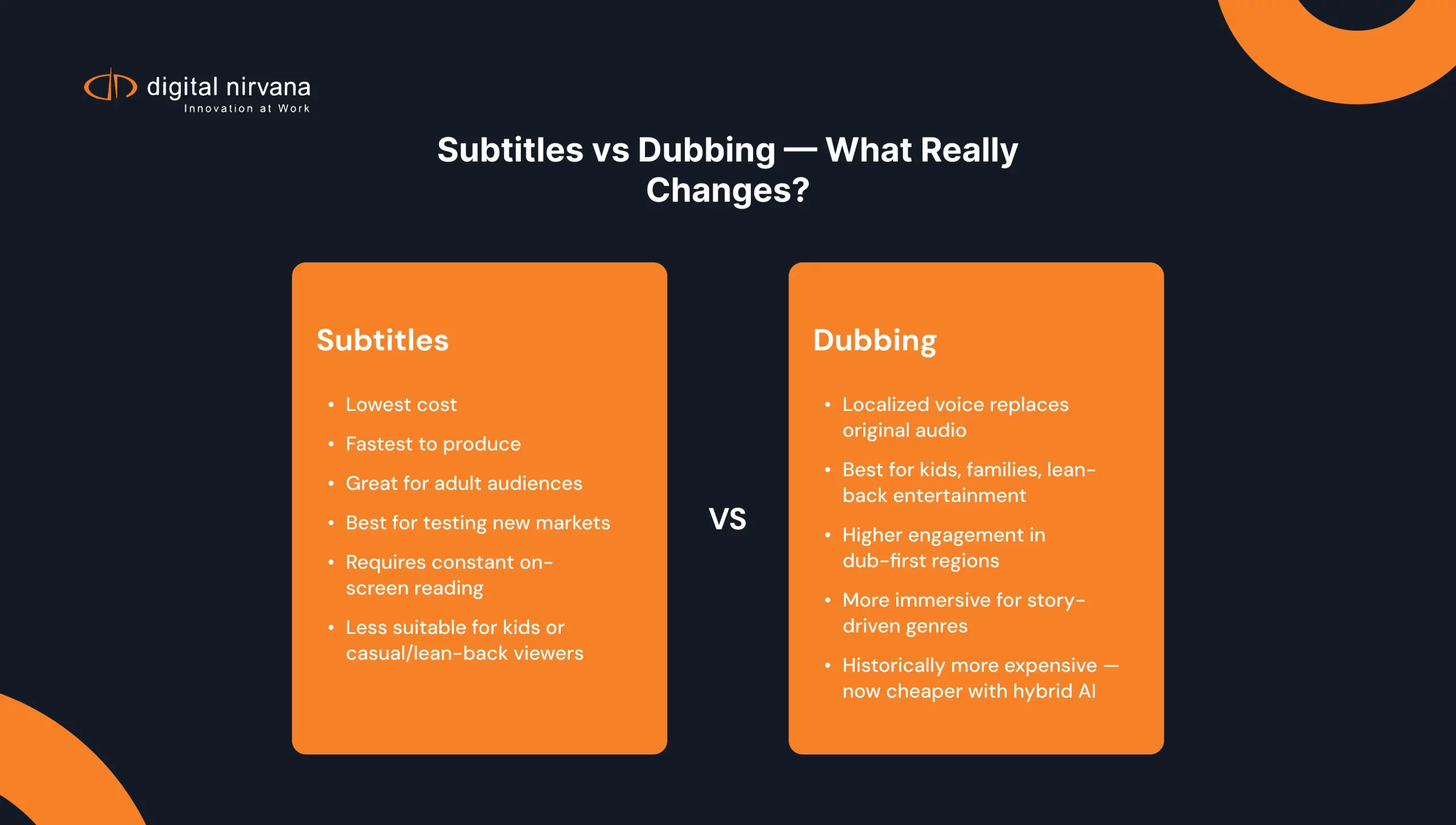
Subtitles solve a real problem. They make content accessible to viewers who don’t speak the original language, and they do it quickly and at relatively low cost. What subtitles don’t always solve is sustained engagement, especially in markets where audiences are used to dubbed content and treat subtitles as a secondary or lesser experience.
Reading subtitles also changes how people watch. Viewers spend part of their attention on text instead of the screen, which matters more for visually dense content like sports, action sequences, or anything with fast cuts. For dialogue-heavy dramas, that tradeoff is smaller. For visually driven content, it can meaningfully affect how much of the story actually lands.
Market Context: Why This Decision Matters More Now
Global streaming catalogs keep expanding into markets with very different localization expectations. Audiences in Germany, France, Italy, Spain, and much of Latin America have decades of dubbing culture built around film and television. Audiences in the Nordics, the Netherlands, and much of Southeast Asia lean toward subtitles as the default. Treating every new market the same way, either all subtitles or all dubbing, ignores this and leaves performance on the table.
Platform requirements add another layer. Many OTT platforms now specify minimum localization standards by territory as part of content delivery requirements, and caption conformance failures or missing dubbed tracks can delay a title’s publishing timeline entirely. Localization decisions aren’t just creative anymore. They’re operational gating items.
Where a Subtitles-Only Strategy Falls Short
Teams that default to subtitles for every market usually run into the same patterns over time:
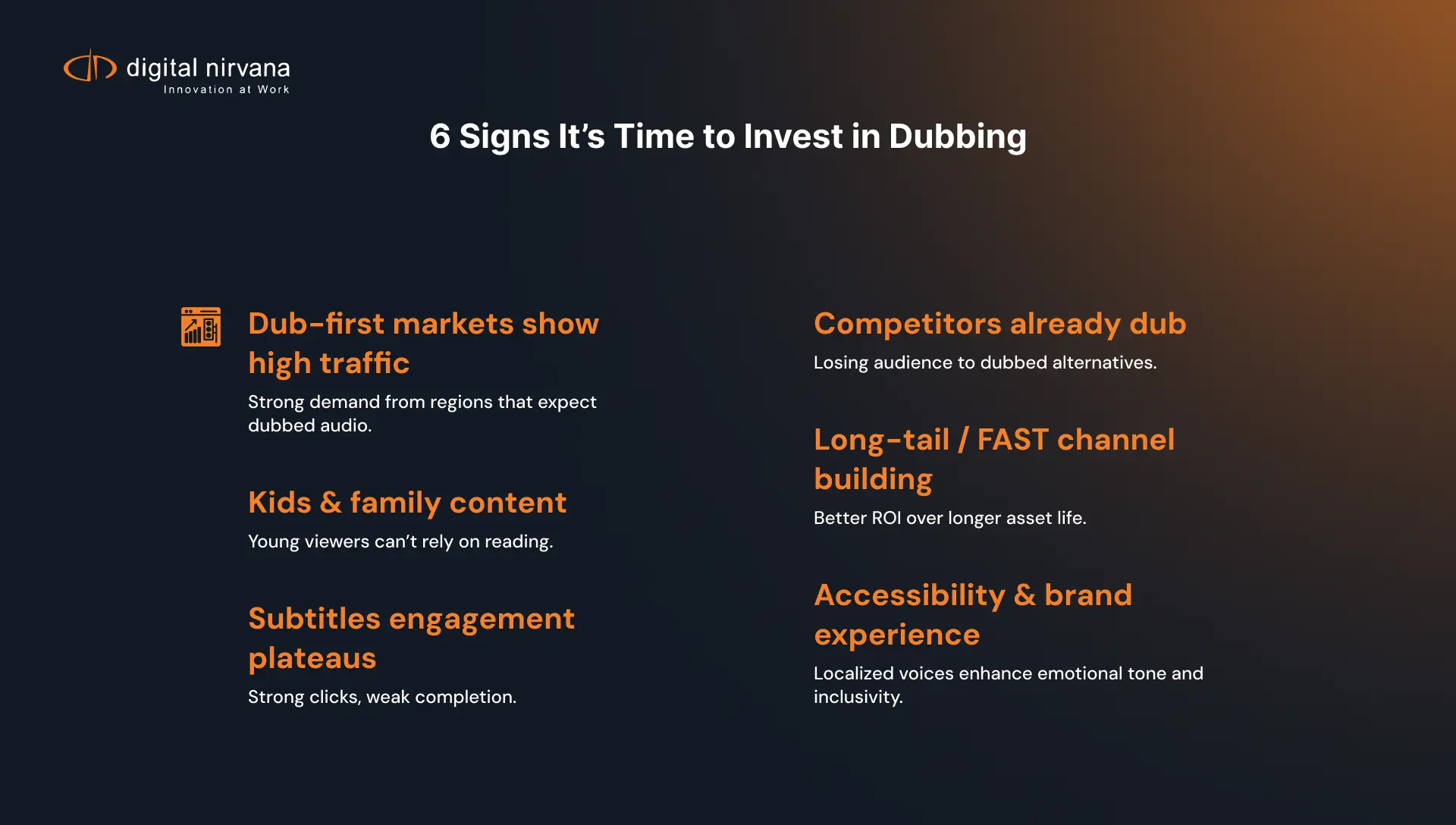
- Completion rates lag in dubbing-preference territories even when the content performs well elsewhere
- Younger audience segments in some markets show lower tolerance for subtitled long-form content
- Visually complex genres (sports, animation, action) lose narrative clarity when viewers split attention with on-screen text
- Competitive titles with dubbed tracks outperform subtitled-only releases in the same market and genre
None of this means subtitles are the wrong call broadly. It means a blanket policy across every market and every genre almost always underperforms a more deliberate, market-by-market approach.
How to Decide: Subtitles, Dubbing, or Both
The decision usually comes down to four factors, and they’re worth walking through in order rather than defaulting to whichever option is cheaper.
Market habit. Some territories have a strong cultural preference for dubbed content, particularly in western Europe and Latin America. Others default to subtitles. This is the single strongest predictor of which format will perform.
Content type. Dialogue-driven dramas and documentaries tolerate subtitles well. Fast-paced action, animation aimed at younger viewers, and sports commentary benefit more from dubbing because they demand full visual attention.
Audience age and platform. Younger viewers, particularly on mobile, are less likely to stay engaged with subtitled long-form content compared to older or more dedicated audiences.
Budget and timeline. Dubbing costs more and takes longer than subtitling, which means it’s usually reserved for titles expected to perform well in a given market or those with a longer shelf life, like a flagship series versus a single documentary.
A Real-World Localization Workflow
Consider a studio releasing an animated series across 12 markets. A subtitles-only approach would technically meet accessibility requirements everywhere, but the studio knows animation performs better dubbed in dubbing-preference territories. The workflow that actually works looks like this:
- Subtitles go out first across all markets to hit the initial release window
- Dubbing is prioritized for the five territories with the strongest dubbing culture and largest addressable audience
- Caption conformance checks run in parallel so subtitled markets aren’t delayed waiting on dub production
- Dubbed tracks are quality-checked against lip-sync and tone before final delivery
This kind of parallel workflow, subtitles fast and dubbing selectively, is far more common in practice than an all-or-nothing approach, and it requires a localization partner who can run both processes without one holding up the other. Media Enrichment services are built around exactly this kind of managed, human-assisted captioning, subtitling, and dubbing workflow, so studios and platforms can prioritize by market without stalling their release calendar.
Measurable Impact of Getting This Right
Titles that match localization format to market habit typically see stronger completion rates in dubbing-preference territories and lower drop-off in the first ten minutes, which is often where subtitled content loses viewers in markets that don’t favor reading on screen. The impact compounds over a series’ run, since early engagement numbers influence what a platform recommends to other viewers in that market.
Getting the format wrong doesn’t usually show up as an outright failure. It shows up as underperformance that’s easy to blame on the content itself rather than the delivery format.
Implementation Considerations
A few practical points matter before committing to a dubbing investment:
- Confirm platform-specific delivery requirements before production, since conformance specs vary by service
- Budget for QA on lip-sync and tone matching, not just translation accuracy
- Decide early which markets get dubbing versus subtitles only, so production timelines can be planned in parallel rather than sequentially
- Keep caption and dub tracks in sync with any content edits made after initial delivery
Teams managing this across formats and territories often lean on TranceIQ for the transcription, captioning, and subtitle generation layer, while pairing it with managed dubbing support where market data justifies the investment.
Key Capabilities to Prioritize
| Capability | Why It Matters | Common Gap |
|---|---|---|
| Market-specific localization data | Determines where dubbing actually pays off | Applying one localization policy to every territory |
| Parallel subtitle and dub workflows | Keeps release timelines on schedule | Sequential processes that delay the whole launch |
| Lip-sync and tone QA for dubbing | Prevents viewer drop-off from poor dub quality | Treating dubbing as a translation task only |
| Caption conformance by platform | Avoids publishing delays from failed specs | One-size-fits-all caption formatting |
| Scalable human review | Balances speed with quality across volume | Fully automated dubbing with no human QA layer |
Common Objections, Answered
“Dubbing costs too much to justify for every title.” It shouldn’t be applied to every title. This is exactly why a market-by-market decision matters more than a blanket policy either way.
“Our subtitles already meet accessibility requirements.” Meeting a requirement and maximizing engagement are two different goals. Subtitles can satisfy compliance while still underperforming in markets with strong dubbing preference.
“AI dubbing will get us there faster.” AI-assisted dubbing can speed up production, but lip-sync accuracy and tonal quality still benefit from human review, particularly for flagship content where viewer experience carries more weight.
Success Metrics to Track
Track completion rate by market and format, drop-off timing within the first ten minutes, and viewer feedback specific to dubbed versus subtitled versions where platforms surface that data. Comparing performance of the same title across markets with different formats is usually the clearest signal of whether the localization strategy is working.
Where This Fits Into a Broader Localization Strategy
Subtitles and dubbing shouldn’t be treated as competing strategies. They’re complementary tools that serve different markets, genres, and budgets. The teams that get the most out of global distribution are the ones that pair fast, conformant subtitling with selective, well-produced dubbing rather than picking one format company-wide. Getting captions market-ready fast through TranceIQ and then layering managed dubbing through Media Enrichment lets content teams move quickly without sacrificing the markets where dubbing genuinely changes performance. For teams also managing archive and rights considerations around localized versions, MetadataIQ helps keep dubbed and subtitled assets searchable and organized across the broader content library.
Why This Matters for Digital Nirvana Customers Specifically
Localization decisions rarely come down to a single format choice. They come down to matching the right workflow to the right market without slowing down a release calendar that’s already tight. Digital Nirvana’s approach combines AI-assisted subtitling and transcription with human-reviewed dubbing support, so studios and platforms can run both processes in parallel instead of treating dubbing as an afterthought that delays launch. Customers working across broadcast, OTT, and educational content have used this combination to expand into new markets without compromising either speed or quality, examples of which are detailed across Digital Nirvana’s success stories.
Conclusion
Subtitles will always have a place in localization strategy. They’re fast, affordable, and often exactly what a market needs. But treating subtitles as the only option, regardless of market habit, content type, or audience, leaves real engagement on the table in territories where dubbing is the format viewers actually expect. The question isn’t subtitles or dubbing. It’s knowing which markets, genres, and titles justify the added investment, and building a workflow that can deliver both without one holding up the other.
Key Takeaways
- Subtitles solve accessibility, but don’t always solve engagement, especially in dubbing-preference markets
- Market habit is the strongest predictor of whether dubbing is worth the investment for a given territory
- Visually dense content (action, animation, sports) loses more from subtitles than dialogue-driven dramas do
- Run subtitle and dub workflows in parallel rather than sequentially to protect release timelines
- Track completion rate and early drop-off by market and format to know if your localization strategy is working
FAQ
Is dubbing always better than subtitles for global content? No. Dubbing performs better in markets with a strong cultural preference for it, but subtitles remain the faster and more cost-effective choice for markets that default to reading, or for titles without the budget or timeline to support dubbing.
Which markets typically prefer dubbing over subtitles? Germany, France, Italy, Spain, and much of Latin America have strong dubbing traditions in film and television. Nordic countries, the Netherlands, and parts of Southeast Asia tend to prefer subtitles.
Can subtitles and dubbing be produced at the same time without delaying release? Yes, when the workflow is planned in parallel from the start rather than sequentially, subtitles can ship on the original release date while dubbing is prioritized for select markets.
Does content type affect whether dubbing is worth the investment? Yes. Fast-paced, visually dense content like animation, action, and sports commentary benefits more from dubbing than dialogue-heavy dramas or documentaries, where subtitles are typically well tolerated.