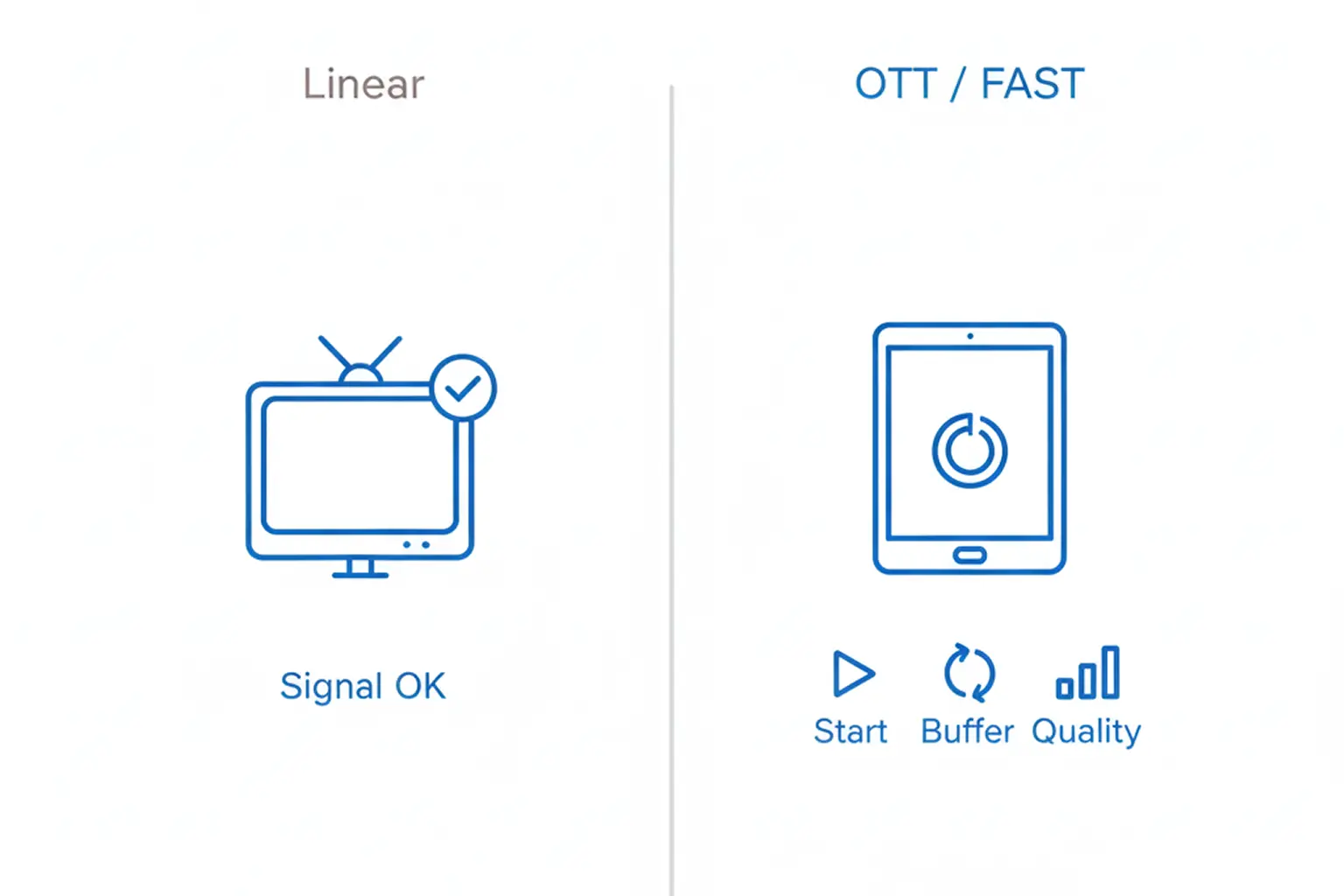
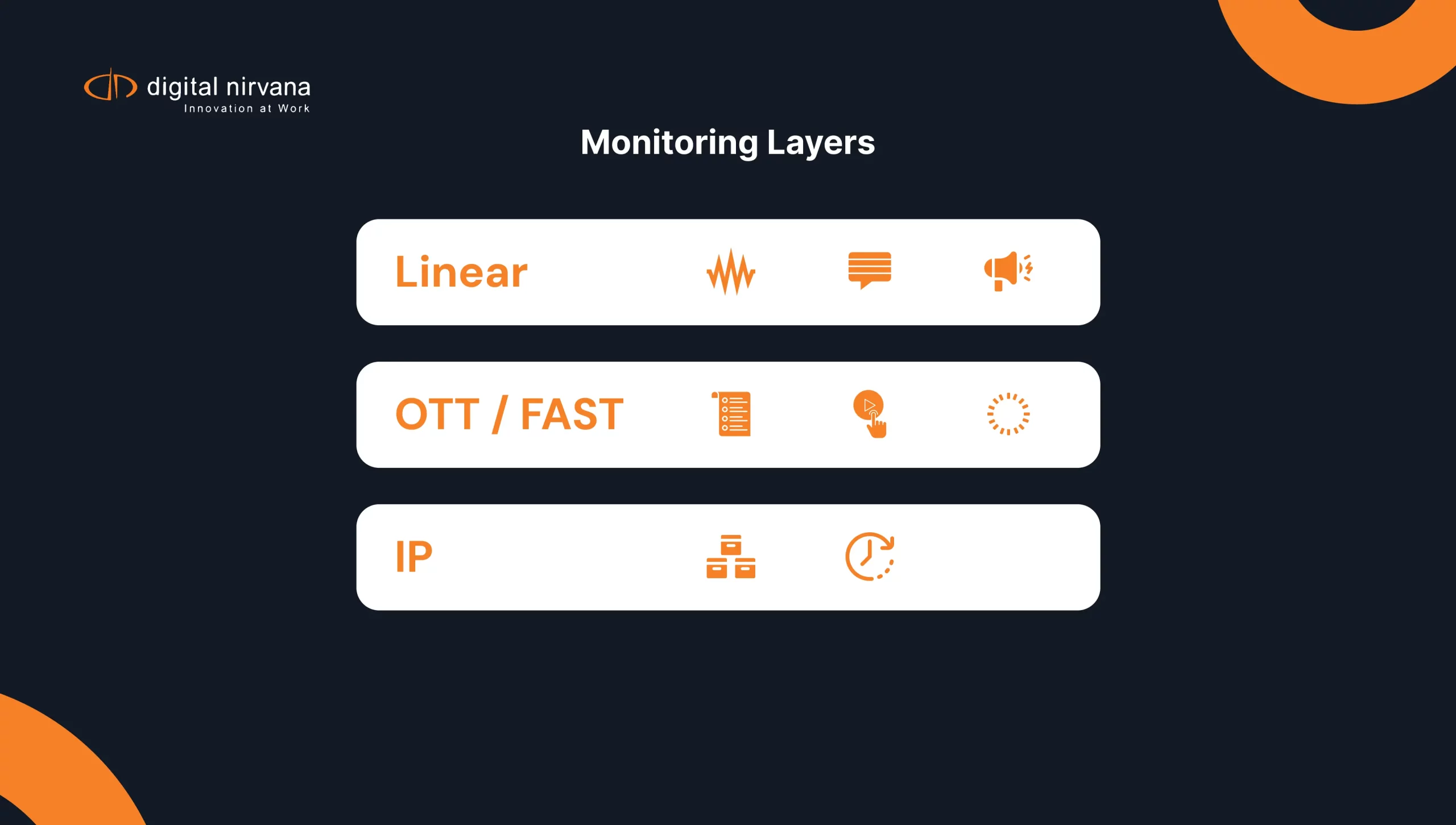
In linear, a “clean signal” is the goal. In OTT and FAST, a “clean experience” is the goal. In IP, the goal is a “clean packet and timing plane.” If you monitor all three the same way, you will miss the problems viewers actually feel, and you will get alerts that do not help your team act quickly.
This guide breaks down what truly changes when broadcast monitoring expands from linear to OTT, FAST, and IP streams, with a focus on three practical areas: alerts, QoE, and recording.
Linear Broadcast Monitoring: What It Optimizes For
Traditional broadcast monitoring is built around signal integrity and compliance. The operator asks questions like: is there video, is there audio, are captions present, is loudness within standard, did the ad break fire, and can we prove what aired.
That is also why modern monitoring platforms increasingly combine live oversight with continuous logging and timecoded evidence, so engineering, legal, and ad sales can all reference the same record.
On the product side, platforms like MonitorIQ highlight loudness compliance, caption monitoring, real-time alerting, and browser-based access to live and recorded channels.
OTT And FAST Monitoring: Why It Changes The Rules
OTT adds a long chain between your encoder and the viewer: packaging, manifests, CDNs, device players, and sometimes multiple ad decisioning layers. That is why industry commentary often calls OTT delivery more complicated to monitor than OTA, because you have less direct control over the entire path and more places where failures can occur.
FAST is a specific OTT model. It is typically defined as free, ad-supported streaming TV delivered as linear-style channels over the internet.
In practice, FAST raises the stakes for monitoring because monetization depends on ad insertion working correctly, and partners will still expect proof in the event of a dispute.
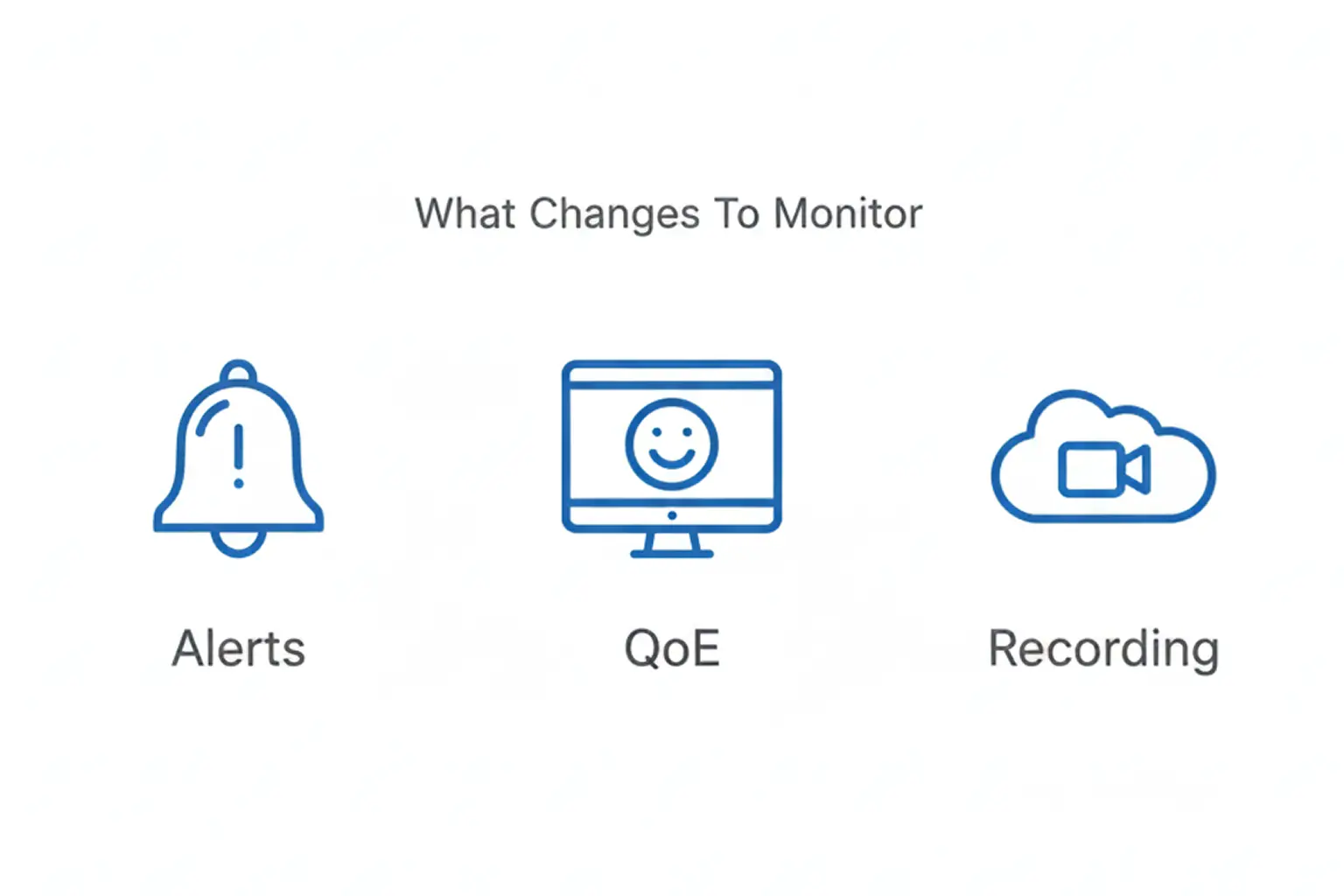
What Changes Versus Linear For Alerts
Alerts shift from signal events to workflow and experience events.
Linear Alerts Are Often Feed And Compliance Driven
Typical linear alert types include:
- Loss of signal, black video, frozen video, silence, loudness exceptions
- Captioning errors or missing captions
- SCTE message issues around ad breaks
- Critical availability checks across channels and regions
MonitorIQ, for example, emphasizes caption standards monitoring with real-time alerting and loudness compliance tracking.
OTT And FAST Alerts Must Include Manifest, Ad, And Player Failure Modes
In OTT and FAST, you still care about “is there video,” but many outages look different:
- Manifest failures, slow manifest refresh, stale playlists
- Segment retrieval failures from origin or CDN edges
- DRM and license failures that look like a black screen to users
- Ad marker problems that break monetization, such as missing cue-in or cue-out events
A useful pattern for OTT is canary monitoring to validate the data plane, especially manifests and ad-tracking data, because they can break even when encoders are still producing video.
For ad markers, HLS implementations frequently use cue tags such as EXT-X-CUE-OUT and EXT-X-CUE-IN to represent ad break boundaries, often derived from SCTE-35 signals.
Alerting Becomes Multi-Layer And Contextual
A practical alert model for OTT and FAST is layered:
- Transport and availability alerts: Is the stream reachable
- Packaging and manifest alerts, is the playlist healthy and updating
- Ad signaling alerts are present and consistent
- Viewer-impact alerts are rebuffering, and startup time is disregarded
That last layer is what often turns monitoring into revenue protection, not just technical hygiene.
What Changes Versus Linear For QoE
QoE becomes a first-class metric in streaming, because viewers interact with the experience in ways linear does not measure.
QoS describes network and system performance, while QoE describes what the viewer actually experiences. They are related, but not the same.
QoE Metrics You Need In OTT And FAST
Commonly tracked metrics include:
- Startup time: how long it takes to begin playback
- Rebuffering or buffering ratio: how often does playback stalls
- Quality changes, how often bitrate shifts, and whether quality drops
- Playback failure rates and error codes by device and geography
Streaming analytics guidance often calls out startup time, rebuffering, and quality changes as core QoE signals.
Why Linear QoE Is Different
Linear monitoring can verify confidence and compliance, but it does not naturally capture device-level pain. A feed can be “green” at the headend while thousands of viewers are buffering due to CDN or player issues. That gap is why OTT monitoring discussions emphasize measurement points and perspectives, including network-side versus client-side visibility.
What Changes Versus Linear For Recording And Proof
Recording still matters, but the “where” and “why” expand.
Linear Recording Is Traditionally About Compliance And Audit Readiness
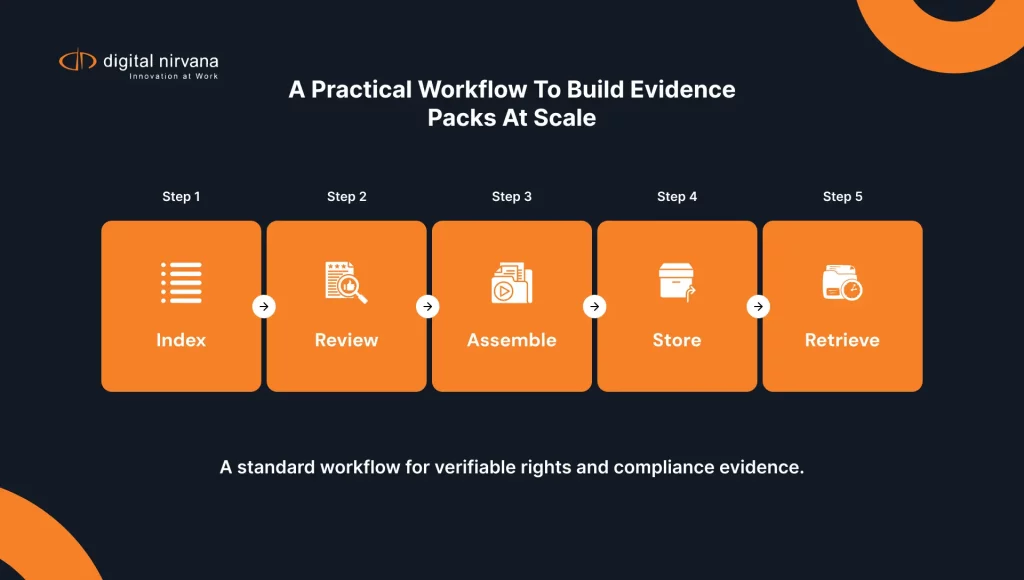
Modern compliance monitoring expectations often require timecoded recordings and easily exportable evidence for audits, disputes, and proof of performance.
OTT And FAST Recording Adds Variant, Partner, And Return Feed Reality
In streaming, the same channel may exist in multiple packaged variants, and platforms may re-encode or splice ads differently downstream. That is why a strong monitoring approach often includes recording from multiple points along the delivery chain, not just at a single output.
MonitorIQ’s brochure explicitly positions recording from production to consumption, including OTT and set-top box return scenarios, to meet compliance and regulatory needs.
Proof Becomes Clip-Based, Fast, And Shared Across Teams
A practical expectation for modern monitoring is:
- Find a moment quickly with timecoded search
- Validate it visually in context
- Export a short clip as evidence for agencies, regulators, or internal stakeholders
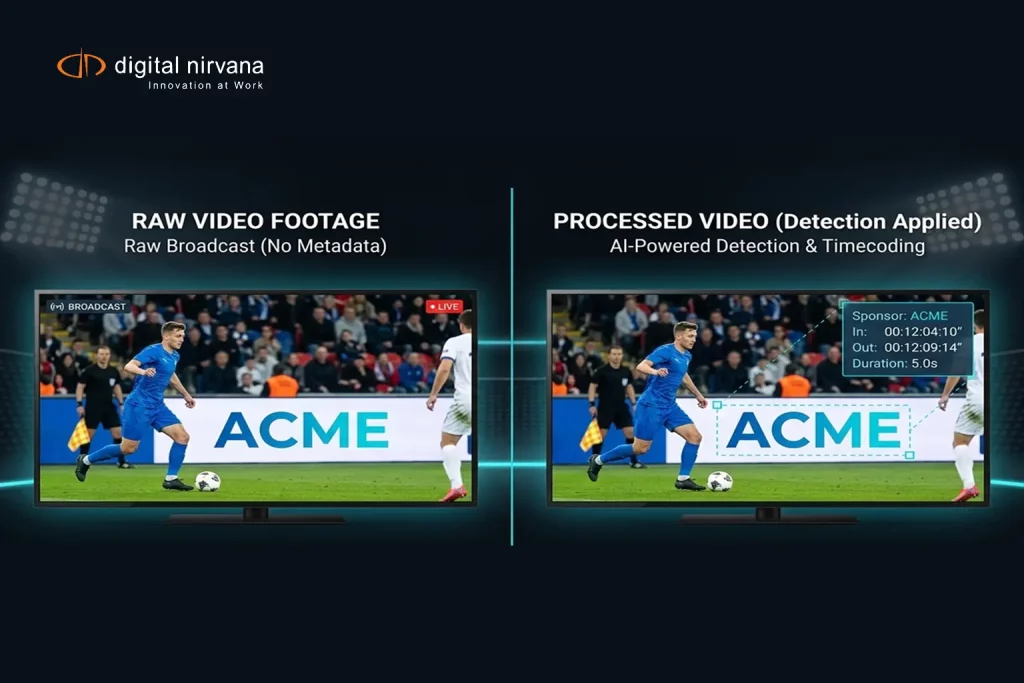
This “timecoded proof” approach is also highlighted in Digital Nirvana’s content monitoring guidance.
IP Broadcast Monitoring: What Matters In ST 2110 And Managed IP
IP broadcast monitoring is not just “monitor the stream.” It is “monitor the timing and packet reality that makes broadcast possible.”
ST 2110 Changes What A “Signal” Means
SMPTE ST 2110 breaks audio, video, and ancillary data into separate elementary streams, enabling flexible routing but also increasing the number of independent points that can go wrong.
Timing And PTP Become Non-Negotiable
Before analyzing an ST 2110 stream for conformance, it is important to verify that the sender is locked to a PTP reference, because timing underpins stream alignment.
Operationally, broadcast PTP profiles commonly reference SMPTE ST 2059 for interoperability expectations in ST 2110 ecosystems.
Packet Health Metrics Must Be In Your Alerting Layer
IP test and measurement guidance repeatedly flags packet loss, bandwidth constraints, and network overload as factors that can impact broadcast operation.
For IP broadcast monitoring, that means you should alert on:
- Packet loss, jitter, and RTP sequence continuity
- PTP offset, lock state, and grandmaster issues
- Redundancy behavior was used, such as protection switching logic
A Practical Monitoring Blueprint For Mixed Linear And Streaming
If you operate linear, OTT, FAST, and IP, the simplest winning approach is a unified monitoring layer with format-aware checks.
A useful reference point is that Digital Nirvana describes modern monitoring as capturing and recording across linear and streamed outputs, and supporting IP and OTT formats alongside traditional feeds.
Step 1: Map Your Real Outputs And Proof Obligations
List:
- Linear channels and regional variants
- OTT channel variants, HLS and DASH endpoints
- FAST channel outputs and partner returns, if applicable
- IP production flows, including ST 2110 where used
Step 2: Define Alerting In Three Tiers
Tier 1, Availability and Integrity
- Can you receive the stream, and is it continuous
Tier 2, Compliance and Signaling
- Captions, loudness, SCTE markers, and ad cue correctness
Tier 3, Experience
- Startup time, rebuffering, error rates, and geo or device hot spots
Step 3: Record Where Disputes Actually Happen
Record the points that matter for proof:
- Your output
- Key downstream returns where ad insertion or re-encoding changes the experience
- Any platform where contractual proof is routinely requested
Step 4: Make Search And Export Self-Service
The most operationally useful platforms display timecoded recordings, captions, loudness, and metadata on a single page, with fast clipping and sharing.
Where MonitorIQ Fits
MonitorIQ positions itself as a broadcast monitoring and compliance logging platform that supports recording and monitoring with fast access, storyboard-based clipping, and metadata indexed to the video, including captions, loudness, and SCTE messages.
It is also positioned as part of a broader content monitoring approach where the same evidence can support engineering response, ad verification, and audit readiness.
FAQs
It is the practice of continuously validating that your streams are available, compliant, correctly monetized, and delivering acceptable QoE, using checks that include manifests, segments, and ad signaling, not just audio and video presence.
It is a monitoring designed for broadcast-grade IP media flows, often including ST 2110 streams, where packet integrity and PTP timing must be correct for video, audio, and ancillary streams to stay aligned.
Startup time, rebuffering ratio, quality switches, and playback failures are commonly treated as core QoE metrics because they directly reflect viewer experience and churn risk.
FAST revenue depends on consistent ad insertion and correct signaling. Missing or malformed cue markers can disrupt downstream ad workflows and make proof of performance difficult during disputes.
Logs tell you what should have happened. Recordings show what actually happened, with timecoded evidence that supports compliance, audits, and proof-of-performance requests.
Conclusion
Broadcast monitoring expands in scope when you add OTT, FAST, and IP streams. Linear monitoring is still essential, but it is no longer sufficient on its own. Streaming adds manifest, CDN, and player failure modes, along with QoE metrics that reflect viewer experience. IP adds packet and timing dependencies, especially in ST 2110 environments, where PTP stability and jitter can be the difference between a clean show and an on-air incident.
Key Takeaways:
- Treat OTT and FAST monitoring as experience monitoring, not just signal monitoring, and include checks for manifest and ad signaling.
- Build alerts in tiers, availability, compliance, and QoE, so teams get fewer noisy alarms and faster diagnosis.
- Record from the points that matter for proof, including downstream returns when your channel is re-encoded or monetized externally.
- For IP broadcast monitoring, prioritize PTP health and packet integrity alongside video and audio confidence.
- Choose a unified platform that ties monitoring, timecoded evidence, and fast clipping together, so engineering, legal, and ad sales can work from the same source of truth.