A compliance officer picks up the phone. It’s an advertiser disputing whether a sponsored segment aired at all, or the FCC following up on a viewer complaint about a caption dropout during last week’s broadcast. Either way, the question is the same: can you prove what actually aired, and when?
For stations without a solid compliance recording and monitoring system, that question turns into hours of scrambling through logs, air checks, and half-remembered playout schedules. For stations with the right system in place, it’s a five-minute clip export.
That gap defines broadcast compliance in 2025, and it’s only getting wider as regulatory scrutiny, multi-platform delivery, and audience expectations all rise at once.

What Broadcast Compliance Recording Actually Covers
Broadcast compliance recording is the ongoing process of capturing, timestamping, and archiving everything that airs, so a station can prove regulatory compliance and resolve disputes when they come up. It’s not just a backup recording. It’s structured, searchable proof tied to exact air times.
That proof needs to cover several regulated areas at once: loudness compliance under the CALM Act, closed caption accuracy and timing, EAS (Emergency Alert System) participation, political advertising equal-time obligations, and content standards around indecency and children’s programming.
Regulators typically require broadcasters to retain these recordings for a defined window, often around 90 days in the US under FCC guidance, though market class, contract terms, and regional rules can extend that requirement well beyond.
Why 2025 Is Raising the Stakes
A few shifts are pushing compliance recording and monitoring from a back-office function to a front-line operational priority this year.
Multi-platform delivery complicates proof. Content no longer airs in one place. A single program might go out over linear broadcast, OTT streaming, and social clips simultaneously, and each platform can carry different compliance obligations for captions, ad timing, and content standards.
Advertisers want more than affidavits. Ad sales teams increasingly face requests for actual proof of performance, not just a signed statement that a spot aired. Raw recordings matched against traffic schedules settle disputes faster and protect revenue.
Caption enforcement has teeth. Regulators require captions to be accurate, synchronous, complete, and properly placed. Missing or delayed captions generate real complaints, and stations need to catch these issues before a regulator or viewer does.
AI-based detection is now the baseline, not the exception. Manual spot-checking of loudness and captions can’t keep pace with 24/7 multi-channel operations, which is why AI-assisted monitoring has moved from a nice-to-have to standard infrastructure.
Where Manual and Legacy Monitoring Falls Short
Older compliance workflows were built for a slower, single-platform broadcast world. The gaps show up clearly once volume and platform count increase.
| Legacy Approach | Where It Breaks Down |
| Manual spot-checks for loudness and captions | Can’t catch every violation across 24/7 multi-channel feeds |
| Air checks stored as raw files with no indexing | Takes hours to locate a specific segment during a dispute |
| Separate systems for radio, TV, and streaming | Creates inconsistent compliance coverage across platforms |
| Affidavit-only proof of performance | Doesn’t hold up against a detailed advertiser dispute |
| No connection between alerts and exportable recordings | Compliance teams know something’s wrong but can’t prove it fast |
The common thread across all of these is a gap between detecting a problem and being able to prove it happened, with a timestamp, metadata, and an exportable clip ready to hand over.
How Modern Compliance Monitoring Actually Works
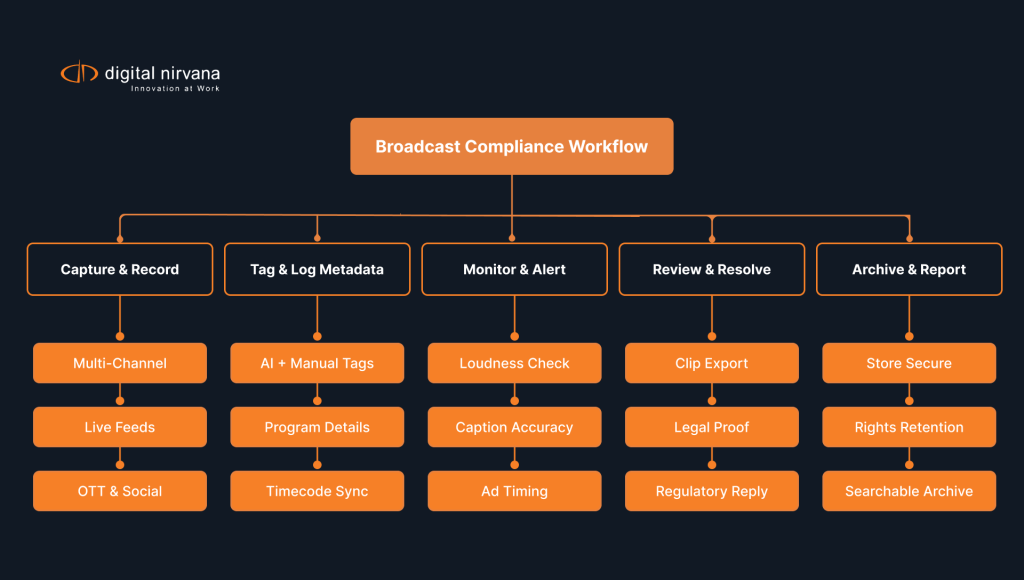
AI-powered compliance monitoring closes that gap by connecting continuous recording, real-time alerting, and searchable metadata into one system.
As content airs, the system continuously monitors loudness levels against CALM Act thresholds, checks closed captions for CC608, CC708, subtitle, and Teletext accuracy, and watches for SCTE marker errors and ad timing issues. When something goes wrong, whether it’s a loudness spike, a missing caption, or a black screen, the system generates an alert tied directly to the recorded segment, the timestamp, and relevant metadata.
That connection between alert and evidence is what actually matters to a compliance team. An alert alone tells you something happened. A linked, exportable recording lets you prove exactly what happened and when.
A Day Inside a Modern Compliance Workflow
A commercial airs louder than the program around it. The system flags a CALM Act loudness violation in real time and logs the exact timestamp. Before the compliance officer even hears about it from a viewer complaint, the alert is sitting in a dashboard with the clip attached.
Later that week, an advertiser questions whether their sponsorship read actually aired during the agreed slot. Instead of digging through raw archive files, the sales coordinator searches the traffic schedule against the compliance recording, pulls the exact clip, and exports it as a shareable file within minutes.
This is the same underlying workflow that ad verification and proof-of-performance reporting depend on, whether the dispute is about loudness, caption accuracy, or ad placement.

Measurable Impact of Getting This Right
Stations that move from manual compliance checks to AI-assisted monitoring typically see change in three places.
Dispute resolution time drops from days to hours, since proof is searchable rather than buried in raw files. Missed violations decline sharply, because continuous AI monitoring catches issues manual spot-checks would miss across 24/7 operations. And advertiser trust improves, since raw recordings settle disputes faster than affidavits ever could.
What to Evaluate Before Upgrading a Compliance System
A few practical questions determine whether a compliance monitoring rollout actually protects a station or just adds another dashboard nobody checks.
Does the system monitor loudness, captions, and ad timing together, or does it require separate tools for each? Can it handle live, multi-channel feeds without lag between detection and alert? Does every alert connect directly to an exportable, timestamped recording? And can it scale across linear, OTT, and social feeds as delivery platforms multiply?
Key Capabilities Worth Prioritizing
- Real-time loudness monitoring aligned to CALM Act thresholds
- Closed caption validation across CC608, CC708, subtitle, and Teletext formats
- SCTE marker tracking and ad verification tied to traffic schedules
- Alerts linked directly to exportable, timestamped recordings
- Multi-platform coverage across broadcast, OTT, and social feeds
- Retention policies that meet or exceed regulatory minimums
Addressing the Common Pushback
“We’ve never had a major compliance issue, so this feels unnecessary.” Most compliance problems surface after the fact, through a viewer complaint or advertiser dispute, not in the moment. The value of monitoring is having proof ready before that call comes in, not after.
“Our current logger already records everything.” Recording and monitoring aren’t the same thing. A raw archive without real-time alerting and searchable metadata still leaves teams scrambling to find the right clip when a dispute happens.
“AI monitoring sounds like it replaces our compliance team.” It doesn’t. AI monitoring surfaces issues and organizes proof faster than manual review ever could, but a human still makes the compliance judgment calls, especially around content standards and regulatory interpretation.
How Digital Nirvana Approaches Broadcast Compliance
This is the exact problem MonitorIQ is built to solve: continuous recording, real-time loudness and caption monitoring, and alerts tied directly to exportable proof, all in one platform instead of stitched together across separate tools.
For stations that also need searchable metadata tied to compliance recordings for faster archive retrieval, MetadataIQ extends that same searchability across the broader content library. Teams managing caption accuracy and accessibility obligations alongside compliance often pair this with TranceIQ for transcription and caption conformance work.
Why This Matters Beyond the Next Audit
Compliance monitoring isn’t just about avoiding fines, though that matters. It’s about protecting ad revenue through fast dispute resolution, maintaining viewer trust through consistent caption and audio quality, and giving a station’s team confidence that they can answer any compliance question in minutes rather than days.
As delivery platforms multiply and regulatory scrutiny around accessibility and content standards continues, stations that treat compliance monitoring as core infrastructure, not a once-a-quarter checklist, are the ones that stay ahead of problems instead of reacting to them. Digital Nirvana’s success stories show how broadcasters across markets have made that shift, and for teams weighing broader operational modernization alongside compliance, Cloud Engineering supports the infrastructure side of that transition.
Frequently Asked Questions
How long must broadcasters retain compliance recordings? US requirements typically point to around 90 days under FCC guidance, though market class, regional rules, and advertiser contracts can extend that retention window further.
Can compliance monitoring catch caption errors in real time? Yes. Modern systems alert operators immediately when captions drop out, fall out of sync, or fail completeness and placement standards required by regulators.
Does compliance monitoring cover streaming and social platforms, or just broadcast? Leading systems now extend monitoring across OTT and social feeds alongside traditional broadcast, since compliance obligations increasingly follow the content regardless of platform.
Conclusion
The stations that handle compliance disputes calmly aren’t the ones that never have problems. They’re the ones with proof ready before the phone rings. Broadcast compliance recording and monitoring in 2025 isn’t about ticking a regulatory box anymore. It’s about protecting revenue, defending against disputes, and giving compliance teams the evidence they need in minutes, not days.
Key Takeaways
- Compliance recording must connect alerts to exportable, timestamped proof, not just raw archived files
- Loudness, caption, and ad timing violations need continuous AI-assisted monitoring across 24/7 multi-channel operations
- Multi-platform delivery means compliance coverage has to extend across broadcast, OTT, and social feeds
- Retention requirements typically run around 90 days but vary by market and contract terms
- AI monitoring speeds detection and proof retrieval, but human judgment still drives compliance decisions
- Fast, searchable proof of performance protects advertiser trust and ad revenue, not just regulatory standing