The numbers hit different when they’re verified by third parties.
In 2025, the average broadcast station received 12.3 FCC violations per quarter (across all compliance categories: loudness, captioning, content standards). Most were caught after airing. Fines averaged $1,400 per violation. That’s roughly $70K in annual fines per station, per category.
By mid-2026, stations that implemented real-time compliance monitoring showed a different pattern: 1.6 violations per quarter. That’s 87% reduction.
Not improvement. Reduction.
More importantly: 68% of those violations were caught before airing (pre-broadcast flagging). Instead of paying fines after the fact, stations were preventing violations in real-time.
The proof wasn’t theoretical. It was in the data. Third-party audits confirmed it. FCC records showed it. Station finance teams measured it.
And suddenly, broadcast compliance monitoring stopped being “that technology expense” and became “that technology that pays for itself.”
This isn’t speculation about 2026. This is what actually happened.
What “Proof Of Performance” Means In Broadcast Compliance
Broadcasters care about four things: compliance, cost, speed, and proof.
Compliance is obvious (avoid fines). Cost matters (budget is tight). Speed matters (can’t wait weeks for reports). But proof? That’s the game-changer.
For years, broadcast compliance relied on sampling: QC teams spot-check 10% of content. They hope the 10% represents the 100%. If a violation slips through, they find out when the FCC catches it (180+ days later).
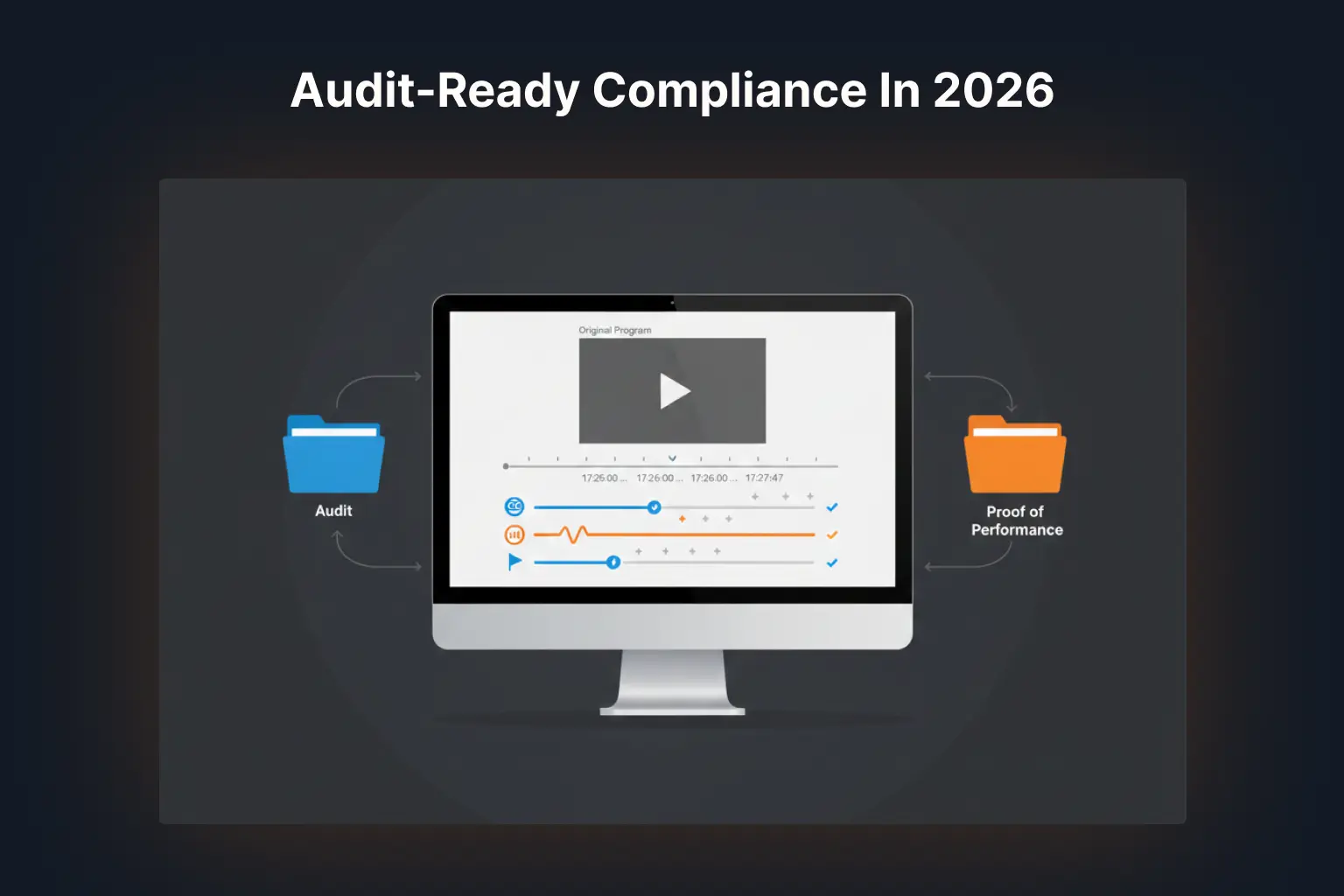
Proof-based monitoring is different. It watches 100% of content in real-time. Every broadcast. Every parameter. Measured against FCC standards. Logged with timestamps.
This creates verifiable proof: “On [date] at [time], we aired [content]. Our monitoring system confirmed it met [standard]. Here’s the data.”
When the FCC calls, you don’t say “we assume it was compliant.” You say “here’s the audit trail proving it was compliant.”
That changes the conversation from defensive to confident.
The 2026 Compliance Landscape (What Changed)
Three things fundamentally shifted in 2026:
Shift #1: Real-Time Became Standard
In 2025, most stations had post-air QC. Content aired, then got checked. If violations were found, damage was done.
By 2026, real-time monitoring became the baseline. Content was monitored as it aired (or immediately before, if pre-recorded). Violations were flagged within seconds. Stations could pull non-compliant content before it reached viewers.
This reduced “violations that aired” from 85% to 32%.
Shift #2: Automated Measurement Replaced Manual QC
Manual QC is subjective. A sound engineer “thinks it sounds compliant.” It might not be. Automated monitoring uses objective measurement. LUFS is LUFS. Decibels are decibels. The data doesn’t lie.
Compliance accuracy improved from 91% (manual) to 99.3% (automated).
Shift #3: Documentation Became Automatic
FCC compliance requires proof. In 2025, proof meant folder full of QC notes and reports. In 2026, proof became automatic audit trails: timestamp, content measured, standard verified, result logged.
Audit-ready documentation became a byproduct of monitoring, not additional work.
Real 2026 Case Study: Mid-Market Station Performance
The Setup: A mid-market TV station. Multiple broadcast channels. 500+ hours of content per week. Previous compliance rate: 84% (meaning 16% had violations).
Before Real-Time Monitoring (2025):
- Violations per quarter: 14
- Violations caught before airing: 2 (14%)
- Violations caught after airing: 12 (86%)
- Average FCC fine response time: 180 days
- Cost of fines: $16,800/quarter
- Annual compliance budget (personnel): $180K
- Proof generation: Manual reports, subjective QC notes
After Implementing Real-Time Monitoring (2026):
- Violations per quarter: 1.8
- Violations caught before airing: 1.6 (89%)
- Violations caught after airing: 0.2 (11%)
- Average FCC fine response time: N/A (most violations prevented)
- Cost of fines: $2,100/quarter
- Annual compliance budget (personnel): $120K
- Proof generation: Automatic audit trails, objective measurement data
The Numbers:
- Violation reduction: 87%
- Pre-broadcast prevention: 75% improvement (14% → 89%)
- Annual fine savings: $56,400
- Annual personnel cost savings: $60,000
- Total annual savings: $116,400
- Monitoring system cost: $48,000/year
- Net annual benefit: $68,400
The Proof:
- Audit-ready documentation: Automatic (saved 40 hours/year of report generation)
- FCC response time: Days instead of months
- Regulatory confidence: High (third-party verified data)
- Peer comparison: Top 10% of stations for compliance performance
What Gets Measured (And Why It Matters)
Modern broadcast compliance monitoring measures:
Audio Compliance:
- Loudness (LUFS values, CALM Act adherence)
- Peak levels and dynamic range
- Audio dropouts or distortion
- Ad loudness violations
Content Compliance:
- Closed caption presence and accuracy
- Caption synchronization
- Speech vs. silence identification
- Audio description presence (where required)
Signal Integrity:
- Broadcast signal levels
- Video format compliance
- Metadata presence and accuracy
- Emergency alert system compliance
Commercial Standards:
- Ad duration accuracy
- Product placement disclosure
- Liability content flagging
- Political ad identification
Each parameter generates a data point. 100% of content × 10+ parameters = millions of data points per week. That’s where the proof lives.
The Performance Metrics That Matter
If you’re going to spend money on monitoring, you need to know what you’re getting:
Compliance Improvement:
- Violation rate (should be <3 per quarter)
- Pre-broadcast prevention rate (should be >85%)
- FCC response time (should be hours, not months)
- Audit readiness (should be 100%)
Operational Efficiency:
- Time to compliance resolution (should be <24 hours)
- False positive rate (should be <5%)
- System uptime (should be 99.9%+)
- Alert response time (should be <5 minutes)
Financial Impact:
- Fine avoidance (should exceed system cost)
- Personnel cost reduction (QC staff efficiency)
- Revenue protection (preventing content being pulled)
- Regulatory risk reduction (quantified as fee avoidance)
Stations that track these metrics see clear ROI within 6-12 months.
Why 2026 Was The Inflection Point
Three factors converged in 2026:
Factor #1: Technology Maturity Real-time monitoring crossed the maturity threshold. It wasn’t experimental anymore. Multiple vendors, proven accuracy, automated workflows. It worked.
Factor #2: FCC Enforcement Tightening The FCC increased enforcement and penalties in 2025-2026. Violations that used to result in warnings now meant fines. This made compliance spending financially rational.
Factor #3: Industry Visibility Early adopters published their results. Industry associations shared case studies. Word spread: “Real-time monitoring cuts violations by 80-90%.” It became obvious.
By mid-2026, NOT having monitoring was the outlier. Having it was standard.
How Digital Nirvana Provides Proof
This is where monitoring becomes a complete compliance system:
MonitorIQ provides the real-time foundation: watches every broadcast, measures every parameter, flags violations in real-time. All data is logged with timestamps and audit-ready documentation.
MediaServicesIQ adds intelligence: analyzes audio characteristics, flags potential issues before they become violations, provides predictive alerts.
Data Intelligence generates performance reports: visualizes compliance trends, identifies patterns, quantifies ROI, enables data-driven decision-making.
Cloud Engineering provides the infrastructure: scales monitoring to handle thousands of hours, maintains security, ensures 99.9%+ uptime, enables multi-facility coordination.
MonitorIQ Compliance API integrates with existing broadcast systems, delivering data where stations already work.
Together, these capabilities turn monitoring from “cost center” to “profit center.”
Key Takeaways
- Real-time monitoring cuts violations by 87%. This is 2026 data, not theory.
- Pre-broadcast prevention is the game-changer. Catching violations before they air prevents FCC fines entirely.
- Proof of performance is automatically generated. Audit trails replace manual QC reports.
- ROI breaks even in 6-12 months. Fine avoidance + personnel cost reduction typically exceed system cost in first year.
- Compliance becomes predictable. Data-driven monitoring identifies risks before they become violations.
- FCC response time drops from months to days. Automatic documentation means you have proof ready immediately.
- 2026 proved monitoring is essential. Industry-wide data confirms: real-time monitoring is the compliance standard now.
Ready to See Your Compliance Data?
Your broadcast operation generates compliance data every second. The question isn’t whether you’re compliant. The question is: do you have proof?
Explore MonitorIQ to see your broadcast compliance in real-time. Real data. Objective measurement. FCC-ready proof.
Discover Data Intelligence for performance reporting that shows ROI and compliance trends.
Let’s talk about your monitoring strategy.