Every second your channel is on air is a promise.
A promise to regulators that you will follow the rules. A promise to advertisers that their campaigns will run as ordered. And a promise to your audience that quality, captions, and alerts will work when they matter most.
In 2026, broadcast compliance monitoring keeps all those promises intact. Regulators expect verifiable logs, recordings, captions, and loudness data for every second you transmit, across linear, cable, and increasingly OTT services. At the same time, advertisers now demand near-real-time proof of performance, not just affidavits and make-good negotiations months after the fact.
This article looks at how broadcast compliance monitoring is evolving in 2026, why proof-of-performance audits have become a strategic priority, and how Digital Nirvana’s MonitorIQ helps broadcasters simplify both regulatory audits and day-to-day proof for advertisers.
What Broadcast Compliance Monitoring Means In 2026
Broadcast compliance monitoring is the practice of continuously recording, analyzing, and archiving your output so you can prove what aired, when it aired, and under what conditions.
Modern regulators such as the FCC require broadcasters to retain aired content, political logs, EAS participation records, sponsorship disclosures, caption data, and more, often for months or years. Similar expectations exist globally for advertising standards, accessibility, and program guidelines.
In 2026, compliance monitoring is no longer limited to a single over-the-air feed. A complete view typically covers:
- Linear channels and regional variants
- Cable and satellite distribution
- OTT and streaming outputs such as HLS and DASH
- STB return feeds and IP delivery paths
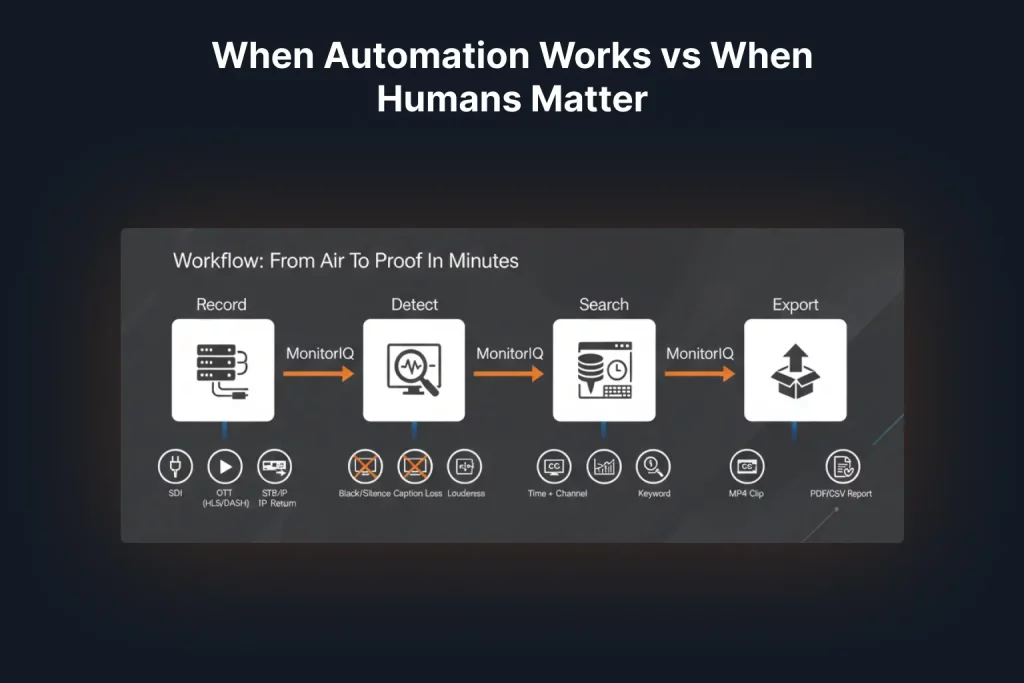
Leading platforms like MonitorIQ record content from any point in the video delivery chain, from production SDI to OTT and set-top box outputs, so broadcasters can compare what left the plant with what viewers actually saw.
Why Proof-Of-Performance Audits Matter More Than Ever
Compliance is one side of the story. The other is proof of performance for advertisers and sponsors.
Proof-of-performance audits go beyond checking that a spot ran. They confirm that ads aired in the correct programs, breaks, and dayparts, with the expected length and with all required on-screen elements intact. Media and ad industry sources now highlight proof of performance as a critical part of media governance, used to validate deliveries before releasing funds and to close the loop on campaign KPIs.
In 2026, advertisers typically expect:
- Transparent, time-stamped as-run logs
- Audio or video clips that prove exactly how their spot ran
- Quick reconciliation when there is a dispute over airing or placement
- Performance context that can be tied into their broader attribution and analytics
Radio and TV monitoring guides now explicitly call out proof-of-performance reports and clip exports as table stakes for broadcasters that want to retain advertiser trust.
Done well, proof-of-performance audits become a retention tool for ad sales, not a cost center.
Common Pain Points With Compliance And Proof Of Performance
Many operations teams know what regulators and advertisers want. The difficulty is delivering it consistently. Common pain points include:
- Fragmented monitoring stacks
Different tools for linear, OTT, radio, and digital make it difficult to assemble a complete picture for an audit. - Manual log reconciliation
Engineering relies on logs, traffic relies on a different system, and sales holds separate documentation, which slows proof-of-performance reviews. - Slow access to historical content
Older systems were not designed for hundreds of channels, multi-year retention, or remote access, so just finding the right clip becomes a project. - Limited use of AI and metadata
Many compliance loggers still treat recordings as static files rather than applying speech-to-text, logo detection, or other AI tools to make content searchable and more useful across teams.
These gaps surface during audits, when teams scramble to assemble evidence across multiple systems, and when advertisers ask for detailed performance proof on short notice.
The 2026 Compliance Monitoring Stack: What “Good” Looks Like
Top-ranking compliance monitoring and logging tools now share common characteristics. Competitive reviews highlight:
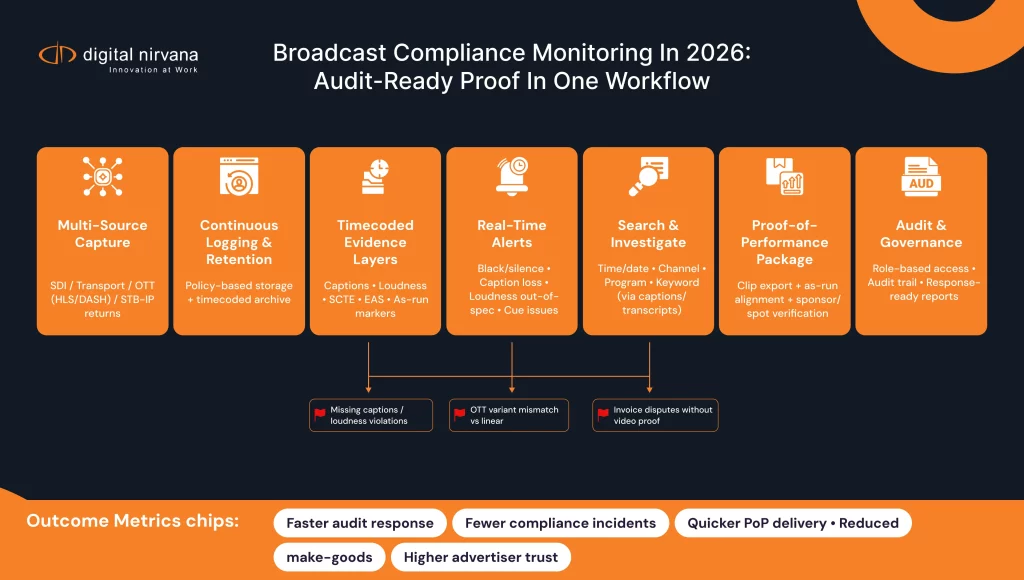
- Continuous recording from multiple sources and formats, including SDI, DVB, ATSC 3, OTT streams, and IP inputs
- Standards-based loudness monitoring and logging, often ITU 1770 and EBU R 128 compliant
- Closed caption and subtitle extraction for quality checks and accessibility audits
- Real-time alerts for outages, EAS events, missing captions, and audio anomalies
- Multi-channel, multi-site access through web interfaces and multiviewers
- Clip creation and export tools for legal teams, engineering, and ad sales
The competitive baseline is clear. What differentiates leaders is how quickly they can put usable evidence in the hands of non-technical teams, how deeply they integrate AI, and how well they support proof of performance without extra manual steps.
How MonitorIQ Simplifies Broadcast Compliance Monitoring
Digital Nirvana’s MonitorIQ is positioned as an ML-driven compliance logging and monitoring platform that focuses on speed, reliability, and cross-team access.
Key ways MonitorIQ simplifies broadcast compliance monitoring in 2026 include:
- Recording from any point in the chain
MonitorIQ natively records content from production SDI through OTT and set-top box outputs, giving you a single platform to monitor all delivery paths against regulatory and contractual requirements. - Fast access to live and historical content
The system is tuned for quick retrieval, allowing multiple departments to search, scrub, and review recent and historical content with minimal clicks, from desktop or mobile, including remote access. - Storyboard-based clip and share
MonitorIQ’s thumbnail storyboard UI lets users browse content in ten-second increments, mark in and out points, and export frame-accurate clips for review, legal, or advertiser proof without needing edit suites. - AI-powered video intelligence
Integrated machine learning can detect ads, logos, and faces, and generate transcripts from live or historical content, adding valuable metadata for compliance checks, competitor analysis, and content reuse. - Single-page view of content and metadata
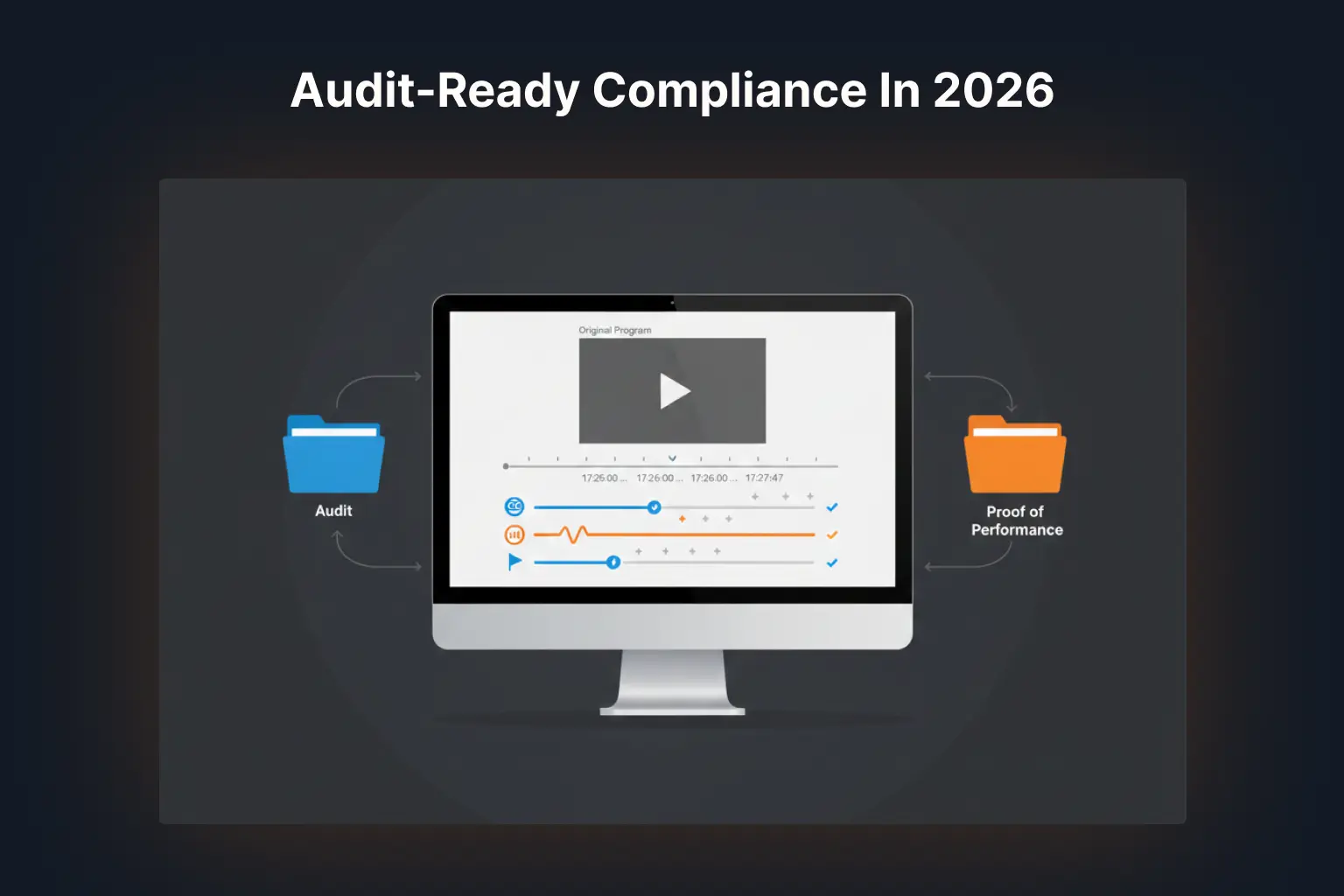
Users can view video, captions, loudness graphs, SCTE messages, run log data, and timecode-aligned watermarks on a single screen, which is particularly useful during audits and investigations.
In short, MonitorIQ turns compliance monitoring from a specialist tool into a shared reference layer for the whole organization.
Turning MonitorIQ Into A Proof-Of-Performance Engine
Because MonitorIQ records and indexes your output with metadata and timecode, it naturally becomes a foundation for proof-of-performance audits.
Here is how broadcasters typically use it in that context:
- Aligning with traffic and as-run logs
Traffic systems provide schedules and as-run records. MonitorIQ provides the actual airing. Together, they form a defensible proof-of-performance package for each campaign. - Exporting clips as evidence
Sales coordinators and account managers can search for a specific advertiser, program, or daypart, then export short MP4 or MP3 clips that demonstrate the ad exactly as aired. Digital Nirvana’s broadcast audio logger guidance describes this as a way to go beyond affidavits and provide tangible proof of performance for agencies and sponsors. - Documenting sponsorship and on-screen exposure
Using logo detection and AI metadata, teams can verify that sponsor logos and branded elements appeared where contracts require them, not just that the spot ran. - Meeting regulatory documentation needs
For political advertising, children’s programming, and other sensitive categories, MonitorIQ clips and logs can be attached to internal or regulator-facing files, providing proof that spots ran with correct disclosures and within permitted limits.
Because MonitorIQ is already in place for compliance, building proof-of-performance workflows on top of it does not require a separate system.
Designing A Cross-Team Workflow For Engineering, Legal, And Ad Sales
The most effective deployments treat broadcast compliance monitoring as a cross-team capability rather than a pure engineering tool.
A well-designed workflow in 2026 often looks like this:
- Engineering and operations
Configure channels, sources, loudness standards, and alert thresholds in MonitorIQ. Handle system health, storage, and retention policies. - Compliance and legal
Use MonitorIQ’s recordings, captions, and metadata to investigate complaints, respond to regulator inquiries, and prepare audit evidence without needing to request raw tapes or offload tasks to engineering. - Ad sales and traffic
Access channels through controlled accounts to verify campaigns, export clips, and produce proof-of-performance summaries for clients and agencies, using as-run logs for reconciliation. - Marketing and programming
Reuse the same recordings to pull quick clips for promos, social media, and competitive analysis, maximising the value of content already aired.
MonitorIQ’s multi-user design and web interface make it practical to extend access this way with appropriate governance and permissions.
Implementation Blueprint For 2026
To move from legacy logging to modern broadcast compliance monitoring and proof-of-performance, it helps to follow a structured plan.
- Map your regulatory and contractual obligations
List requirements for content retention, political advertising, captions, EAS, sponsorship disclosures, and advertiser proofs in each market you serve. - Assess current monitoring coverage
Identify which feeds you monitor today, where gaps exist across OTT, radio, and regional outputs, and which teams rely on those recordings. - Deploy MonitorIQ as a unified layer
Use MonitorIQ to record from each critical point in the delivery chain, consolidating previously separate systems into a single, searchable environment. - Standardize proof-of-performance workflows
Define how traffic, sales, and finance teams will use MonitorIQ recordings and clips to validate invoices, respond to agency audits, and resolve disputes quickly. - Integrate AI metadata where useful
Turn on AI features such as ad detection, logo discovery, and transcripts to make content easier to search and reconcile against contracts and buys. - Document procedures for regulatory audits
Create simple runbooks for how your teams will use MonitorIQ to gather evidence when a regulator, board, or internal auditor requests proof. - Track results and iterate
Measure time saved, audit outcomes, and advertiser satisfaction, then adjust coverage, retention, and reporting as your needs and regulations evolve.
KPIs For Broadcast Compliance Monitoring And Proof-Of-Performance Audits
To understand whether your 2026 compliance monitoring strategy is working, track a mix of technical, operational, and commercial KPIs, such as:
- Audit readiness and outcomes
- Time required to assemble evidence for a regulator or internal audit
- Number of findings related to incomplete logs or missing recordings
- Compliance performance
- Frequency of caption, loudness, or EAS non-conformance events
- Time to detect and resolve air quality or regulatory issues
- Proof-of-performance efficiency
- Average time to produce proof-of-performance packages for campaigns
- Reduction in disputed invoices or make-good claims after introducing clip-based proof
- Business impact
- Advertiser retention and renewal rates in markets where PoP reporting is standard
- Additional revenue from advertisers who require detailed performance documentation as a condition of larger buys
MonitorIQ’s AI-ready architecture and integrated analytics make it easier to collect these KPIs, not just for compliance, but for broader media operations.
FAQs
Broadcast compliance monitoring involves continuously recording and analyzing your output to demonstrate compliance with regulatory obligations, contractual commitments, and internal quality standards. This includes retaining aired content, captions, loudness data, EAS logs, and political advertising records for defined periods.
Proof of play confirms that a specific spot aired at a specific time. Proof of performance goes further. It adds context such as audience reach, demographic data, and creative verification, and it often includes clips or recordings to show how an ad appeared on screen. Advertisers and auditors increasingly expect proof of performance, not just schedule logs.
Trying to meet modern compliance and proof-of-performance requirements with manual recording or fragmented tools is risky and time-consuming. A purpose-built system like MonitorIQ records from multiple points in the delivery chain, aligns video with metadata, supports AI analysis, and provides fast access to evidence for multiple departments, which significantly reduces audit and reconciliation effort.
Yes. Modern compliance platforms record IP streams and OTT formats alongside traditional SDI or RF feeds, reflecting the fact that regulators and advertisers increasingly view OTT as part of the same distribution footprint. This is especially important when political advertising, emergency alerts, or accessibility rules apply across both linear and streaming.
MonitorIQ sits alongside Digital Nirvana’s broader media enrichment stack. It can act as the capture and monitoring layer, feeding recordings and metadata into solutions for captioning, transcription, translation, and AI-based enrichment, turning compliance logging into a foundation for search, content reuse, and analytics across the organization.
Conclusion
Broadcast compliance monitoring in 2026 is about more than avoiding fines. It is about having a clear, searchable, and defensible record of everything your brand puts on air, across every platform. Regulators demand detailed logs and recordings. Advertisers demand transparent proof-of-performance. Audiences expect consistent quality and accessibility.
Legacy logging systems and manual workflows struggle to keep up with this reality. The result is stress during audits, drawn-out invoice reconciliations, and missed opportunities to use your own content as a strategic asset.
By moving to an AI-ready, multi-source platform such as MonitorIQ, broadcasters can simplify both regulatory compliance and proof of performance. MonitorIQ records from each critical point in the chain, enriches content with metadata and AI, and puts fast, self-service access to evidence into the hands of engineering, legal, and ad sales teams alike.
When compliance monitoring becomes a shared operational layer instead of a silo, audits become easier, advertisers get the clarity they expect, and the same infrastructure that keeps you safe also helps you understand and improve your business.
Key takeaways:
- Broadcast compliance monitoring in 2026 must cover linear, cable, and OTT outputs, delivering verifiable logs and recordings for regulators.
- Proof-of-performance audits have become a commercial necessity, as advertisers expect transparent, clip-based confirmation of deliveries.
- Modern platforms combine continuous recording, loudness and caption checks, AI analysis, and fast clip export to support both compliance and proof-of-performance.
- MonitorIQ simplifies monitoring and audits by recording from any point in the delivery chain, aligning video with rich metadata, and enabling cross-team access.
- A structured implementation plan and clear KPIs help broadcasters turn compliance monitoring from a cost center into a strategic capability that improves trust, efficiency, and long term value.