Introduction
ADA Title II used to feel like a facilities conversation: ramps, signage, and physical access. That is changing fast. With the U.S. Department of Justice’s 2024 final rule on web and mobile accessibility, video content is now clearly in scope for Title II enforcement. State and local governments must ensure that digital channels – including websites, learning portals, livestreams, meeting recordings, and social video – are accessible to people with disabilities.
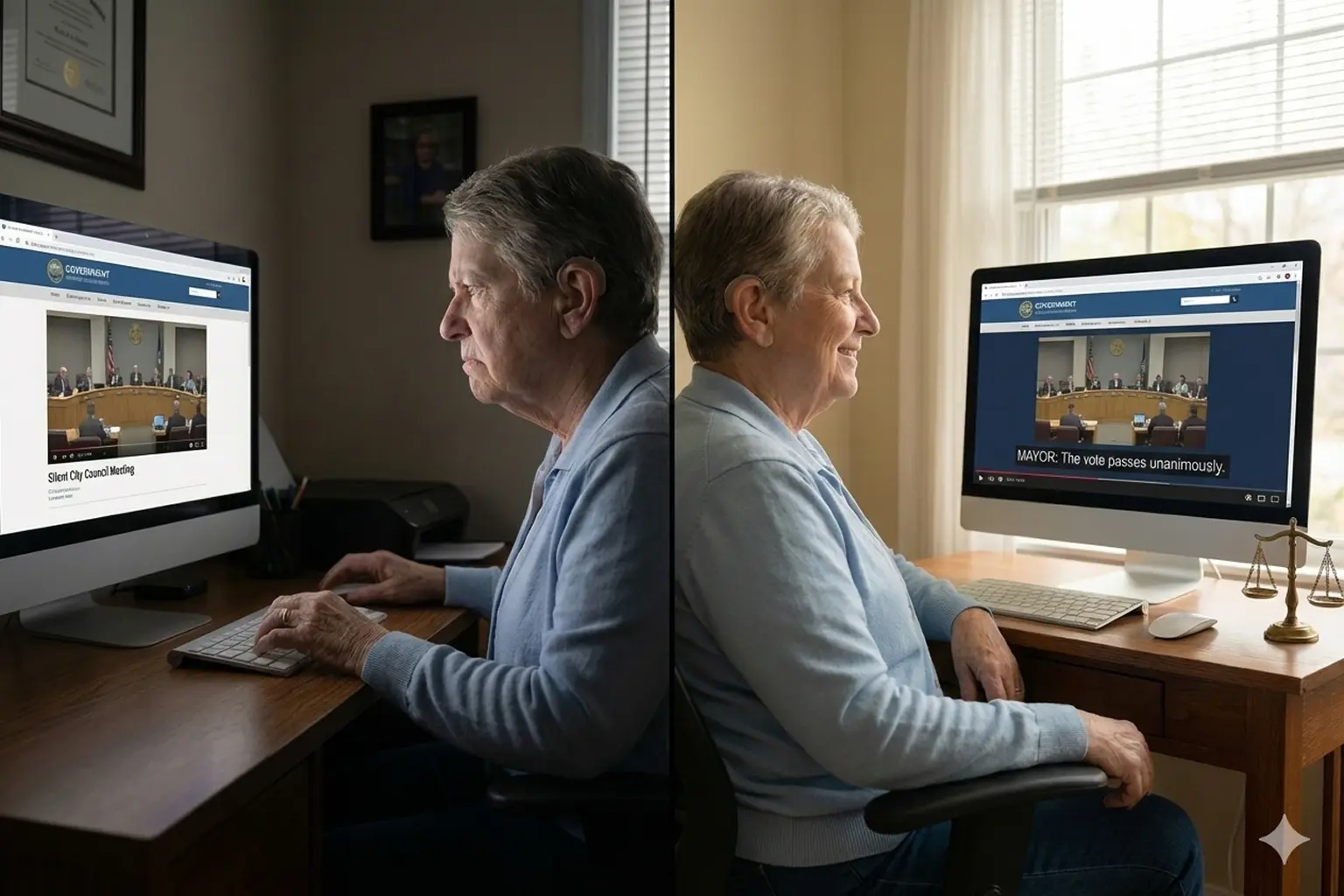
For Deaf and hard-of-hearing communities, that starts with accurate captions and transcripts. For many agencies, however, video captioning is still handled ad hoc, only for high-visibility content, or not at all. The result is legal exposure, inequitable access to services, and frustrated residents.
In this article, we unpack how ADA Title II applies to video, what captioning and transcript requirements actually look like, and how a modern media enrichment approach can reduce risk while improving communication. Along the way, we highlight how Digital Nirvana’s Media Enrichment Solutions help public entities meet Title II obligations without overwhelming already stretched teams.
What ADA Title II covers, and why video is in scope
Title II of the Americans with Disabilities Act prohibits disability-based discrimination by state and local governments and by all their departments, agencies, and instrumentalities. ,
Two core principles drive Title II:
- Equal access to programs, services, and activities
- Effective communication with people with disabilities should be as effective as communication with others.
The Department of Justice makes it clear that covered entities must provide appropriate auxiliary aids and services, which include captioning, transcripts, interpreters, and other communication supports, where needed to ensure effective communication. ,
Historically, that guidance focused on in-person interactions and broadcast TV. The 2024 final rule extends that expectation explicitly to web and mobile content provided by state and local governments, including multimedia such as videos, live streams, and audio. ,
In practical terms, that means:
- Council meetings are streamed on the city website
- Lecture recordings in a public university’s LMS
- Public health videos on a county YouTube channel embedded in a government site
- Police training videos hosted on a municipal portal
All are now clearly expected to be accessible, including the provision of appropriate captions and transcripts.
From “effective communication” to WCAG 2.1 AA
Before 2024, many public entities recognized they had an obligation to ensure “effective communication,” but lacked a single technical standard to follow. The DOJ’s 2024 Title II digital accessibility rule changes that.
Key shifts:
- The rule adopts Web Content Accessibility Guidelines (WCAG) 2.1 Level AA as the baseline standard for web and mobile app accessibility for Title II entities.
- It sets clear compliance deadlines:
- April 26, 2026, for public entities serving 50,000 or more people
- April 26, 2027, for smaller entities,
WCAG 2.1 AA includes specific success criteria for time-based media. For a pre-recorded video with audio, that means:
- Captions for all spoken content (1.2.2)
- Audio descriptions or descriptive alternatives for crucial visual information (1.2.3, 1.2.5
For audio-only and video-only content, WCAG requires transcripts or alternative formats appropriate to the media type. ,
Taken together, Title II’s effective communication mandate and WCAG 2.1’s media requirements make accurate captioning and transcripts a cornerstone of video compliance.

Video captioning requirements under ADA Title II
The legal language can feel abstract, so it helps to translate it into concrete requirements for different media types.
Pre-recorded video
For pre-recorded video with audio (for example, training videos, explainer content, recorded events), public entities should plan to:
- Provide closed captions that are:
- Accurate: reflect spoken content, sounds, and essential cues
- Synchronized: appear at the same time as the audio
- Complete: include dialogue, and relevant non-speech information such as [music], [laughter], [applause] ,
- Provide audio descriptions or descriptive transcripts where visual information is essential to understanding (for example, slides, demonstrations, maps) in line with WCAG 2.1 Level AA criteria. ,
Live video and events
For livestreamed council meetings, hearings, classroom sessions, and other real-time events, Title II entities are expected to provide real-time captioning (CART or high-quality auto-captioning plus human review where feasible) when needed for effective communication. ,
The practicality test still applies: the method must be adequate, timely, and preserve privacy and independence. For high-stakes or recurring live content, relying on accurate real-time captions is increasingly seen as best practice, and is explicitly recommended in education-focused Title II guidance.
Audio-only content
For audio-only content (podcasts, recorded phone messages, radio streams hosted on government sites), WCAG 2.1 AA requires transcripts so that Deaf and hard-of-hearing users can access the same information. ,
Audio description and descriptive transcripts
While captioning addresses hearing access, many Title II entities also need to consider blind and low-vision users:
- Provide audio description tracks or descriptive transcripts for videos that convey information not conveyed in the dialogue. ,
This is not only a WCAG requirement; it also aligns with Title II’s broader expectations for effective communication for individuals with vision disabilities.
The risk landscape: where public entities are exposed
Failing to provide accessible video content under Title II creates multiple layers of risk:
- Legal and enforcement risk
- DOJ investigations and enforcement actions
- Complaints filed through state ADA offices or directly with agencies
- Consent decrees requiring rapid remediation and ongoing reporting
- Litigation risk
- Individuals or advocacy groups may bring suits alleging unequal access to critical services, education, or civic participation when videos lack captions or transcripts.
- Programmatic risk
- Residents are unable to understand, and public briefings, emergency updates, or benefit information
- Students are unable to access instruction on an equal basis.
- Reputational and trust risk
- Perception that the entity is not serious about inclusion
- Public criticism when high-profile videos ship without accessibility
Given the 2026–2027 compliance milestones for WCAG 2.1 AA, captioning, and transcription gaps in video libraries are increasingly visible and time-sensitive.

How captioning and transcripts reduce ADA Title II risk
When done well, captioning and transcripts are not just checkboxes; they are risk-reduction tools.
They support:
- Effective communication
- Meeting Title II’s requirement that communication with people with disabilities be as effective as with others, by providing equivalent access to spoken and audio information.
- Demonstrable compliance
- Captions, transcripts, and audio descriptions provide visible evidence that the entity considered accessibility during content creation.
- Time-coded transcripts and logs help document exactly what was presented, which is valuable in audits or disputes.
- Faster remediation
- If issues arise, having a transcript makes it easier to edit, re-caption, or localize content.
- Broader benefits beyond risk
- Better search and discoverability for video libraries
- Easier translation and multilingual support
- Improved usability for people in noisy environments or those who prefer reading
When captioning and transcripts are built into your media workflow – instead of bolted on at the end – they become a protective layer across your entire video estate.
What good video compliance looks like: a practical checklist
A public entity that is serious about ADA Title II video compliance typically aims for the following state:
- Policy and governance
- Written digital accessibility policy referencing ADA Title II, and WCAG 2.1 AA
- Clear ownership for captioning and transcription workflows
- Standards, and coverage
- All new public-facing pre-recorded videos are captioned to high accuracy standards.
- Live events with anticipated Deaf/hard-of-hearing participation supported by real-time captioning
- Transcripts for audio-only content
- Audio descriptions or descriptive alternatives for visually rich content
- Quality and timeliness
- Captions synchronized with audio and were free of significant errors
- Accessibility delivered on time, not months after publication,
- Documentation
- Records showing which videos are captioned, who provided the service, and how quality is verified
- Logs of accessibility requests and how they were handled
- Continuous improvement
- Regular audits of high-traffic pages and video libraries
- Feedback channels for users to report accessibility issues
This is where many entities feel overwhelmed, and where partnering with a specialized provider can make the difference between slow, manual progress and sustainable compliance.
How Digital Nirvana’s Media Enrichment Solutions help
Digital Nirvana focuses specifically on media enrichment, compliance, and AI-assisted workflows for media and public-sector organizations.
For ADA Title II video compliance, Media Enrichment Solutions, and associated platforms support you across four key areas:
Accurate captioning and transcription at scale
Digital Nirvana’s Media Enrichment Solutions team delivers:
- Human-verified captions for pre-recorded and live content
- Time-coded transcripts aligned to your style guides and terminology
- Workflows tuned for public meetings, lectures, public health communications, and more
TranceIQ, Digital Nirvana’s AI-powered transcription and captioning platform, combines automatic speech recognition with human review, so you can scale without sacrificing accuracy.
Multi-language and translation support
For entities serving diverse communities, Media Enrichment Solutions can:
- Generate caption files in multiple languages
- Provide translation workflows that start from time-coded transcripts to accelerate localization.
- Support subtitling for outreach campaigns, community education, and tourism materials.
Integrated metadata and search
Beyond bare-minimum compliance, Digital Nirvana platforms can enrich your videos with:
- Time-coded metadata and chapter markers
- Content summaries and topic tags
- Searchable descriptors that make archives easier to manage and reuse
This helps you treat transcripts and captions as part of a broader knowledge management strategy, not just an obligation.
Compliance monitoring and proof of performance
Through solutions like MonitorIQ and related services, Digital Nirvana helps:
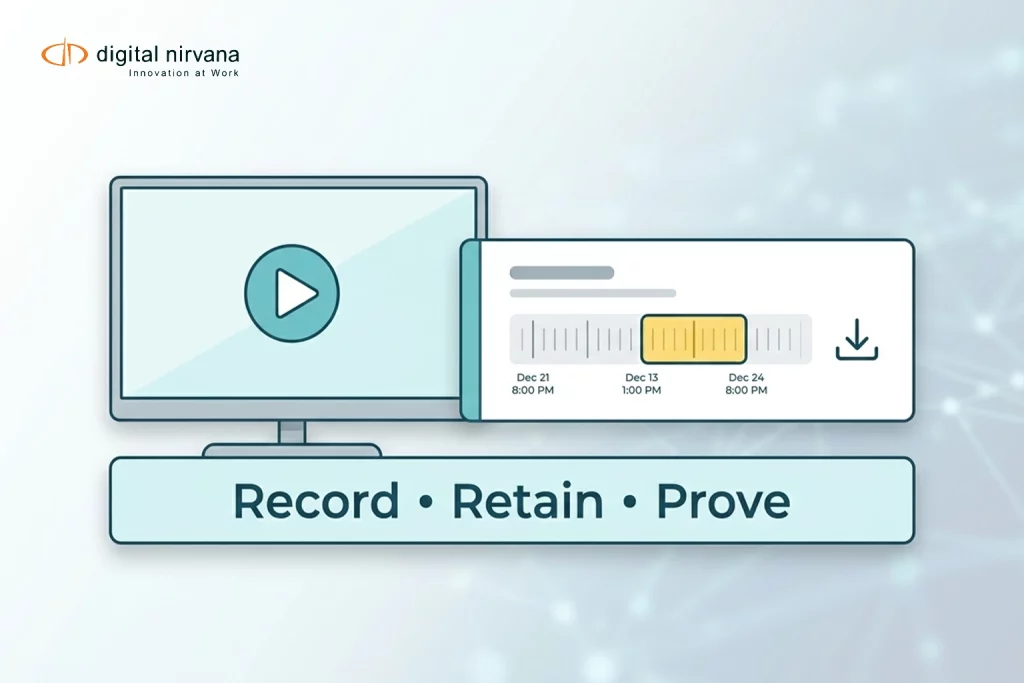
- Capture, log, broadcast, and stream content for compliance review
- Associate transcripts, captions with airchecks, and recordings
- Provide documentation that can support investigations, audits, and internal reviews.
The result is not just accessible video, but an evidence trail that shows you take ADA Title II obligations seriously.
Implementation roadmap for Title II video compliance
If you are beginning to formalize video captioning and transcript workflows for ADA Title II, a phased approach is realistic and defensible.
Step 1: Inventory and risk triage
- Map your current video footprint: websites, learning platforms, social embeds, streaming channels.
- Prioritize high-impact areas: core services, education, emergency communications, and legal or regulatory content.
Step 2: Define standards
- Adopt WCAG 2.1 AA as your technical standard for media.
- Set minimum caption accuracy thresholds and turnaround times.
- Decide which content types require audio description or descriptive transcripts. ,
Step 3: Establish workflows
- Integrate captioning and transcription into content creation, not just post-production.
- Choose tools and partners (such as Digital Nirvana) that can plug into your existing CMS, LMS, and media platforms.
Step 4: Address legacy content
- Identify high-traffic, high-risk legacy videos and bring them into compliance first.
- Use time-coded transcripts and batch captioning workflows to close the gap over time.
Step 5: Monitor, document, improve
- Track captioning coverage and quality.
- Keep records of what has been remediated and what is planned.
- Gather feedback from disability communities, and adjust processes accordingly. ,
Working with Digital Nirvana, many organizations begin with a focused pilot – for example, city council meetings or a university’s top 100 course videos –, and then scale up once workflows are proven.
FAQs
Does ADA Title II explicitly require captions on all videos?
Title II requires effective communication, and appropriate auxiliary aids and services, and the 2024 DOJ rule clarifies that web and mobile content of public entities must meet WCAG 2.1 AA. Together, these expectations effectively require captions for public-facing pre-recorded and live videos where audio conveys information. ,
Are transcripts alone enough to comply?
For video with audio, transcripts alone are usually not sufficient. WCAG 2.1 AA expects synchronized captions so users can follow along in real time. Transcripts are appropriate for audio-only content, and can supplement video, but do not replace captions.
Do social media videos posted by agencies fall under Title II?
If videos are part of a state or local government’s programs, services, or activities, they are generally considered in scope, especially when embedded on official sites or linked as primary communication channels. The DOJ’s digital accessibility rule covers public-facing web content and mobile apps, which include multimedia accessible through those channels. ,
What accuracy level is expected for captions?
The ADA does not specify a percentage, but DOJ guidance and best-practice sources emphasize that captions must be accurate enough to ensure effective communication – usually interpreted as high-quality, professional-grade captioning rather than raw, unedited auto-captions. Many institutions target 95–99 percent accuracy, particularly for instruction and official communications. ,
How does Digital Nirvana fit into our compliance strategy?
Digital Nirvana does not replace your ADA coordinator or legal guidance. Instead, Media Enrichment Solutions, TranceIQ, and related platforms provide the captioning, transcription, and media enrichment capabilities you need to meet Title II and WCAG 2.1 AA obligations at scale, with workflows tailored to public entities, education, and media-rich environments.
Conclusion
ADA Title II compliance is no longer just about physical spaces. With the DOJ’s 2024 Title II digital accessibility rule, video has moved to the center of the conversation. Accurate captions, transcripts, and descriptive alternatives are now essential to ensuring that residents, students, and stakeholders with disabilities can fully participate in public life.
The good news is that video accessibility does not have to be an all-or-nothing scramble. By building captioning and transcription into your media workflows, aligning with WCAG 2.1 AA, and partnering with specialists like Digital Nirvana, you can systematically reduce risk while making your communications stronger, more inclusive, and easier to manage.
Digital Nirvana’s Media Enrichment Solutions are designed to meet you where you are – whether you are just starting to inventory your video content or looking to scale mature captioning and transcript operations across multiple departments. With the 2026 and 2027 deadlines approaching, now is the time to turn captioning and transcripts from a reactive obligation into a proactive pillar of your ADA Title II strategy.