The same software demonstration can impress an archive producer and leave a platform engineer with unanswered questions. One needs trustworthy searchable moments; the other needs a supported output schema, job controls, and a recoverable integration. Video content analysis software should be selected around the decision its outputs will support and the team that will operate it.
Compare packaged workflows with analysis building blocks explicitly. Transcription, face detection, OCR, scene descriptions, and classification differ in what they establish. A supplier belongs on your shortlist when its proposed configuration can deliver the required evidence into your actual workflow.
Key Takeaways
- Define whether you need a user-facing workflow, packaged enrichment, or programmable analysis services.
- Compare capabilities by input, output, review requirement, and receiving-system dependency.
- Evaluate speech, visual recognition, and generated interpretation as separate tasks.
- Test partial completion and retry behavior so a failed component does not masquerade as complete analysis.
- Use task-specific reference material and report correction effort alongside detection results.
Table of Contents
- What Should Video Content Analysis Software Be Compared On?
- Which Products and Services Should You Evaluate?
- How Do Broadcast, OTT, and Archive Requirements Differ?
- What Does a Procurement-Ready Capability Matrix Contain?
- How Do You Test Quality Across Different Analysis Tasks?
- What Must an API or Workflow Integration Handle?
- How Should Deployment, Review, and Cost Be Assessed?
- Where Does MediaServicesIQ Fit?
- FAQs
- Conclusion
What Should Video Content Analysis Software Be Compared On?
Compare software on its ability to produce accepted outputs for defined media tasks. The phrase “video understanding” is too broad to establish whether a product can meet your requirements.
Start with a question such as finding named interview passages, locating visible branding, identifying candidate scenes, or classifying incoming content for review. Specify whether a person will inspect the output before it drives another action.
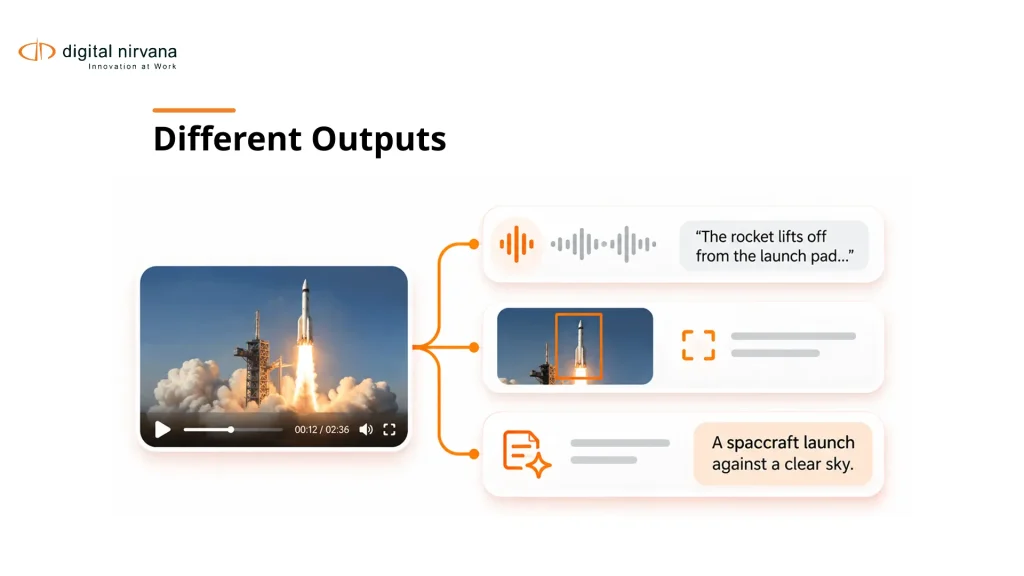
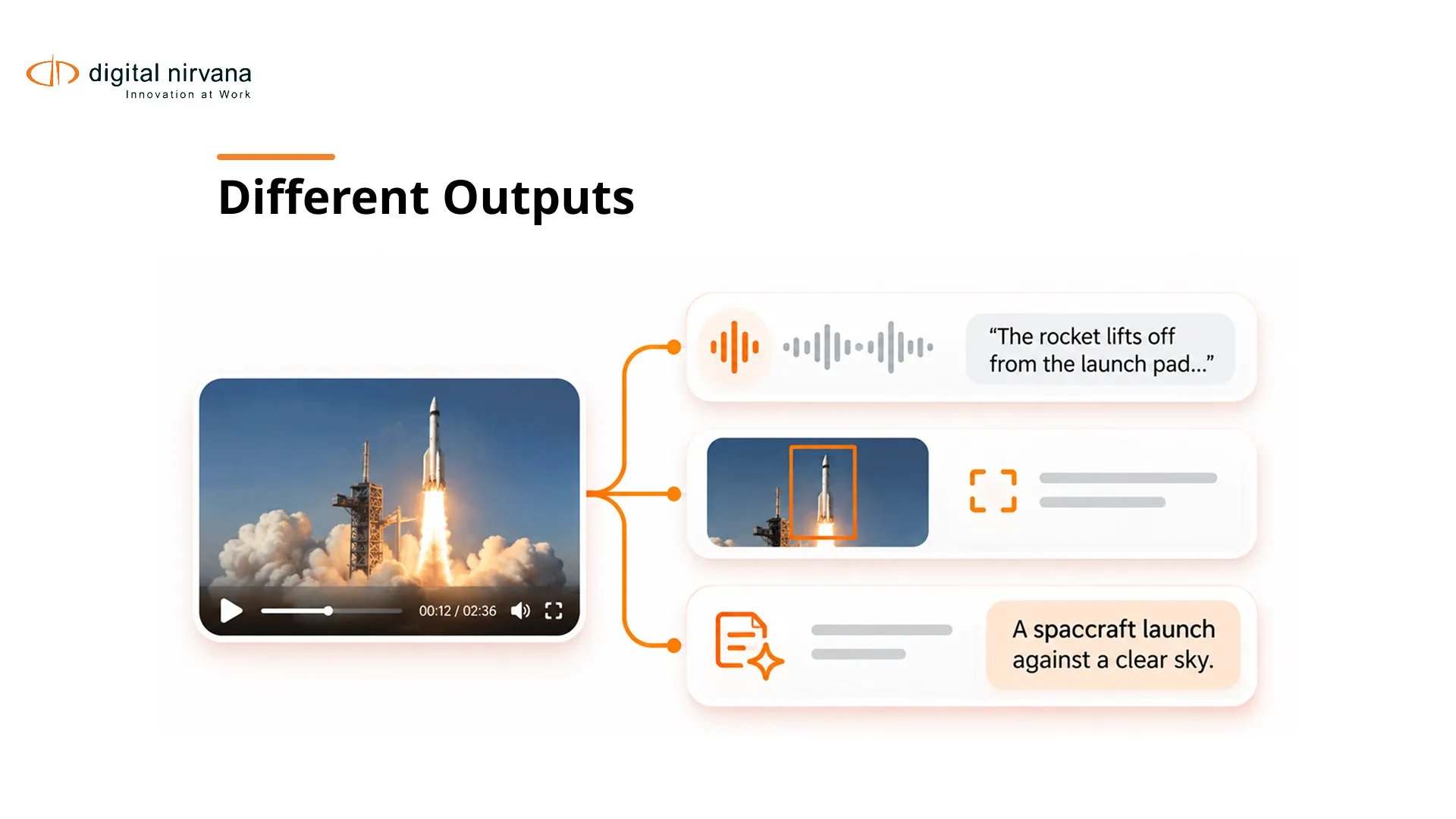
Separate observed signals from generated interpretation. A transcript represents recognized speech; a detected face indicates a visual occurrence; a scene description may infer a relationship. They need different reference answers and acceptance criteria.
Digital Nirvana’s object-analysis explainer for media metadata provides background on one analysis layer. This comparison concentrates on selecting the operating solution, including who handles data mapping, exceptions, review, and ongoing changes after the initial result is produced.
Which Products and Services Should You Evaluate?
Evaluate options whose documented capabilities can support your target workflow. The list below compares product roles, rather than presenting a universal ranking or claiming that every configuration has identical features.
| Option | Documented Role | Buying Question |
| Digital Nirvana MediaServicesIQ | Composable media AI capabilities | Which modules and integration responsibilities are included? |
| Azure AI Video Indexer | Video and audio insight extraction | Which capabilities are available in the selected offering? |
| Google Cloud Video Intelligence | Programmatic video annotation | Who provides job orchestration, normalization, and review? |
| Amazon Rekognition Video | Stored-video visual analysis operations | How will visual results connect to your other analysis layers? |
Microsoft documents differences between Video Indexer offerings. Google’s API reference describes video annotation functions, while AWS documents Rekognition’s stored-video operations and their asynchronous processing pattern.
Those descriptions establish evaluation starting points. They do not prove accuracy on your footage, availability in your proposed deployment, or compatibility with your receiving system. Obtain a configuration-specific response for each mandatory requirement.
How Do Broadcast, OTT, and Archive Requirements Differ?
The difference lies in the downstream decision, time pressure, and consequences of a wrong result. The same analysis capability may need different operating controls in each setting.
A broadcast producer may need a candidate quote while a story is being prepared. An OTT operator may need reliable descriptive metadata for a catalog workflow. An archivist may prioritize provenance, corrections, and retrieval across older material.
For each use, record the acceptable waiting time, review owner, output format, and recovery path. Distinguish internal discovery from a public-facing or automated decision. A tentative label useful to a researcher may be unsuitable as an approved catalog statement.
Also separate content analysis from delivery monitoring. Speech and scene analysis describe what is inside media. Signal and playback monitoring examine delivery conditions. Digital Nirvana’s broadcast monitoring platform belongs to that adjacent operational role; analysis outputs alone should not be treated as proof of viewer experience.
What Does a Procurement-Ready Capability Matrix Contain?
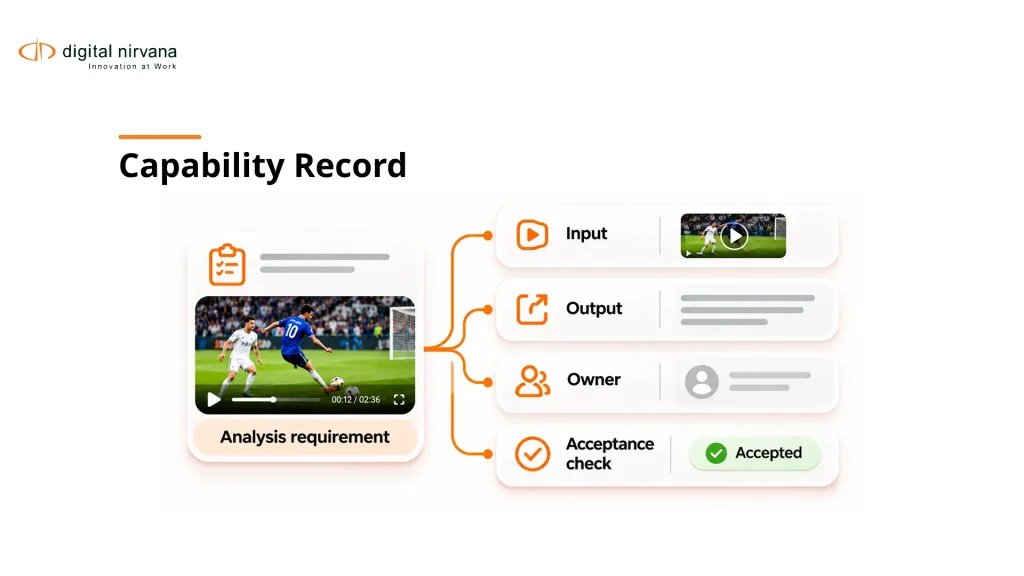
A useful capability matrix connects every requested function to an input, output, acceptance test, and accountable owner. Avoid a simple yes-or-no list that conceals conditional support.
For each capability, document the media source, audio track or visual input, expected record, timing interpretation, supported configuration, review requirement, and integration destination. Mark the evidence as documented, demonstrated, accepted, or unresolved.
For example, “recognize people” needs clarification. Is the requirement to detect faces, group appearances, compare against approved identities, or find spoken names? A demonstration of one does not accept the others.
Use a deliberate counterexample in each test. Include an unknown person, a partially obscured logo, unreadable graphics, or absent speech. Ask what the system returns when it cannot establish the requested result. A visible uncertainty or empty result is often more useful than a confident-looking description unsupported by the footage.
How Do You Test Quality Across Different Analysis Tasks?
Test each task against an appropriate reviewed reference, then assess whether the combined outputs support the intended operation. A single accuracy percentage cannot fairly summarize speech, objects, identities, timing, and interpretation.
For speech, examine text, names, meaning-changing errors, speaker assignment, and alignment. For visual tasks, examine relevant items found, important omissions, false detections, and usable ranges. For generated descriptions, assess factual support and any implied relationships the footage does not establish.
Keep configuration examples separate from acceptance examples. Include difficult material representative of your actual sources, with qualified reviewers defining the reference and noting ambiguity.
Report quality by content group and task. Track reviewer correction effort and unresolved cases alongside model output. A system can improve broad discovery while increasing the review needed for named-person assertions. Your buying decision should preserve that distinction instead of combining both into one success score.
What Must an API or Workflow Integration Handle?
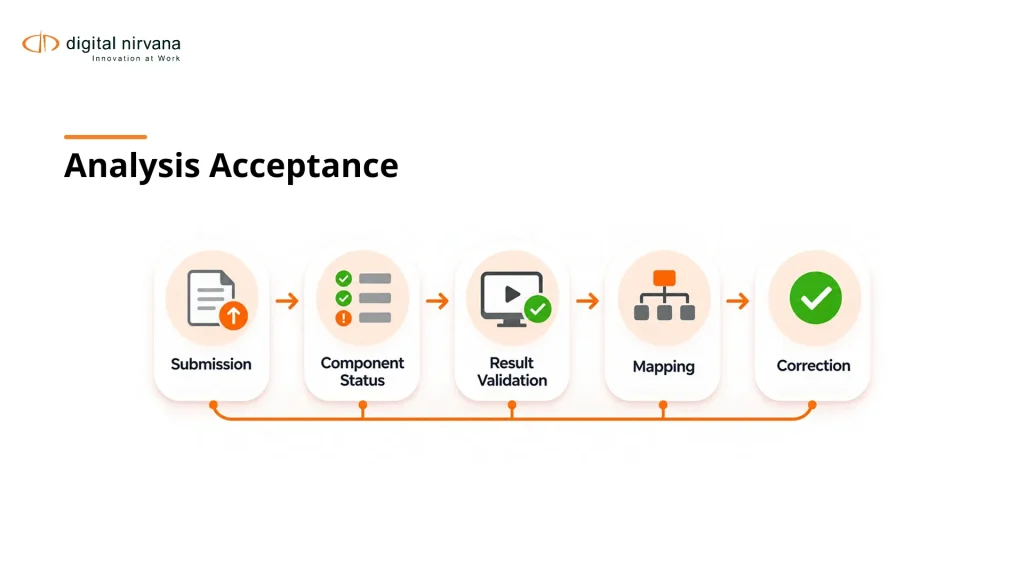
An integration must handle submission, status, results, normalization, review, and recovery while preserving source identity. Successful analysis is only one stage in that process.
Use a proposed operating sequence:
- Register the asset and analyzed rendition.
- Submit the selected analysis with a recorded configuration.
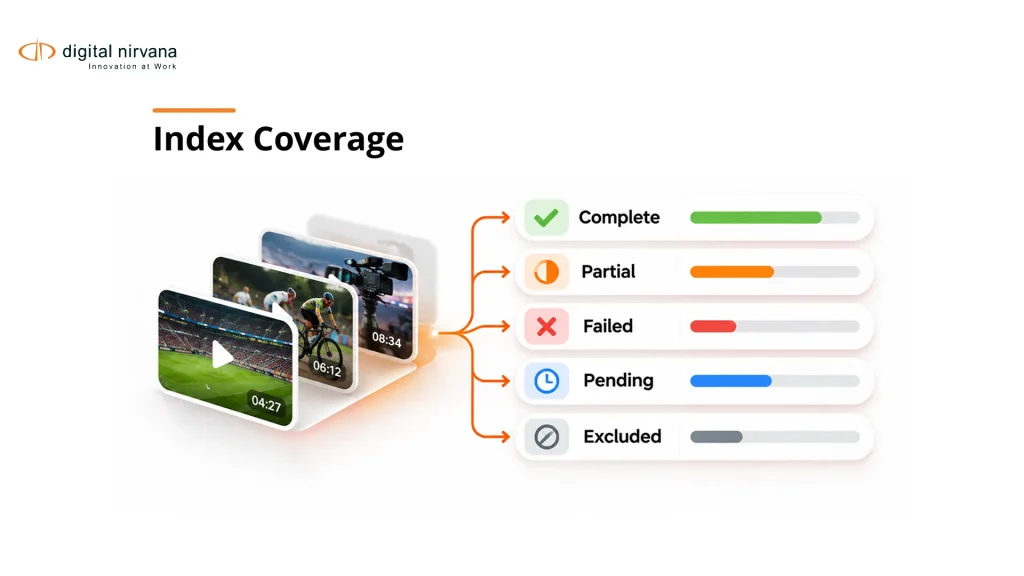
- Track each component’s completion and failure separately.
- Retrieve and validate the output schema.
- Map results to source-linked receiving fields.
- Reconcile corrections and dependent records.
In AWS’s documented stored-video pattern, a start operation and a later result retrieval are separate steps. That illustrates why engineering must design completion handling rather than assuming every request returns a finished payload immediately.
Test a component failure, repeated submission, malformed result, unavailable source, and changed schema. Establish how accepted human corrections are protected during retries or reanalysis. Require the supplier to identify which safeguards it provides and which your team must build.
How Should Deployment, Review, and Cost Be Assessed?
Assess the proposed data path and operating workload together. Deployment affects where media travels, who can inspect it, and which features are available.
Identify originals, proxies, transcripts, extracted images, analysis records, and reviewer corrections. Ask where each is processed and retained, how access is controlled, what deletion covers, and which contract terms govern any use for model improvement.
Define review responsibility before estimating cost. A service returning many uncertain labels can increase work even if inference is inexpensive. Include processing, transfer, storage, orchestration, administration, human correction, and receiving-system maintenance in the same scenario.
Make reprocessing explicit. A new model, taxonomy, or catalog requirement may justify rerunning selected material. Record which outputs must change, which accepted values remain protected, and what the quoted configuration can recover without complete reanalysis. Obtain current pricing directly for that scope rather than borrowing an unrelated public tier.
Where Does MediaServicesIQ Fit?
MediaServicesIQ fits teams seeking composable analysis capabilities within a custom media workflow. Digital Nirvana’s modular media intelligence offering describes speech, text, recognition, description, and related processing use cases.
For an established asset-management environment needing packaged enrichment, assess the corresponding MetadataIQ route separately. The underlying analysis tasks may overlap, but the ownership and delivery model are different. Choose according to who will configure, operate, review, and maintain the workflow.
Prepare a sample input and the exact output your application or team needs. Include an unacceptable result and explain why it fails. That helps the supplier answer with configuration evidence rather than a general feature demonstration.
With those materials ready, request a media-analysis workflow discussion. Require the proposed service to show a result reaching the destination, an error being corrected, and a failed component being recovered.
FAQs
Video content analysis software extracts information from video, audio, and related signals. Capabilities may include transcription, visual recognition, OCR, scene descriptions, and classification, depending on the product and configuration.
The best fit depends on the source material, required evidence, receiving systems, and operating team. Compare the proposed configurations using the same tasks and reviewed material instead of relying on a general ranking.
Analysis generates information about media, while indexing organizes searchable references that use that information. One product may provide both; an API-based implementation may require your team to connect them.
Face detection does not by itself verify a name. Confirm which identity capability is offered, what reference information it requires, and how an uncertain or incorrect identity is reviewed.
Generated summaries should carry their source and review status. Check that each factual statement is supported before using the text as an authoritative catalog description or other consequential record.
A supplier should demonstrate the required outputs, quality checks, receiving-system behavior, error recovery, and data handling for the proposed configuration. Record remaining unknowns rather than treating them as accepted capabilities.
Conclusion
Choose the evidence your workflow needs, identify the analysis tasks that can produce it, and compare complete operating solutions. Let separate quality tests expose strengths and limitations before committing to deployment. Accept the workflow only when results and corrections reach the people or systems that depend on them.