A transcript can contain every spoken word and still be difficult to search at scale. Editors need the people, teams, organizations, places, events, products, works, and topics inside it, connected to the moment where each mention occurs. An entity extraction API can convert transcript spans into structured metadata, but media teams still need timecode preservation, name normalization, confidence rules, authority records, and human review before those tags become trustworthy search keys.
This guide describes a vendor-neutral integration pattern. It does not claim that Digital Nirvana offers a public entity extraction API or supports a specific third-party endpoint.
Key Takeaways
- Named entity extraction identifies text spans and assigns types such as person, organization, location, event, or product.
- Media workflows should preserve transcript timecodes and speaker context through every extraction and normalization step.
- Mention detection and entity resolution are different: finding “United” is not the same as linking it to the correct team or company.
- The API response should retain source, model version, confidence, offsets, time range, and review state.
- Evaluate precision, recall, type accuracy, timecode accuracy, and editor correction effort on representative programs.
- Write approved entities to a governed metadata layer, not directly into authoritative archive fields without controls.
Table Of Contents
- What An Entity Extraction API Does
- How Transcript Entities Become Timecoded Metadata
- What The API Contract Should Include
- How To Normalize And Resolve Names
- How To Handle Confidence And Human Review
- How To Evaluate Named Entity Extraction
- How To Integrate Results With A MAM Or DAM
- FAQs
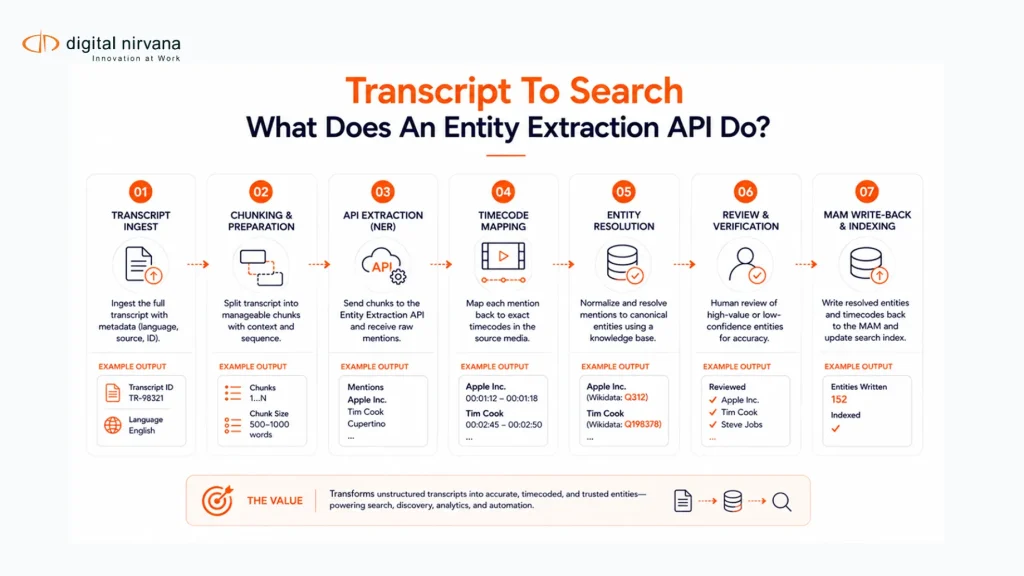
What Does An Entity Extraction API Do?
An entity extraction API receives text and returns labeled spans that represent named or meaningful things. Common types include people, organizations, locations, dates, events, products, works, quantities, and domain-specific categories.
Google Cloud’s Natural Language API documentation describes entity analysis as one of its text-understanding functions. Amazon Comprehend’s DetectEntities API returns entities from plain text and can use predefined or custom recognition models. Open-source frameworks such as spaCy’s EntityRecognizer identify labeled, non-overlapping token spans.
Those examples demonstrate common API behavior, not a recommendation for a particular provider. Media organizations should compare supported languages, entity types, custom-model options, data handling, limits, latency, batch processing, and deployment requirements.
Named entity extraction is one layer in a larger media pipeline:
- Transcribe speech with timestamps and speaker labels.
- Divide the transcript into safe processing chunks.
- Send text and context to the extraction service.
- Map character offsets back to transcript words and timecodes.
- Normalize spelling and resolve identities.
- Apply confidence and review rules.
- Write approved metadata to search and archive systems.
How Do Transcript Entities Become Timecoded Metadata?
Preserve the relationship between text offsets and transcript timestamps before calling the API. If text is cleaned, joined, or split without a mapping, a correct entity may lose its usable media location.
A practical input unit contains:
- Asset and version identifier
- Transcript segment identifier
- Language
- Speaker label when available
- Word or phrase timestamps
- Original text
- Normalized text sent to the model
- Offset map between the two forms
Chunk boundaries need overlap or sentence-aware handling so a person’s full name is not divided between requests. However, overlapping chunks can generate duplicate mentions. Deduplicate using normalized text, entity type, asset, and intersecting time ranges.
For each returned span, map its start and end offsets to the earliest and latest contributing transcript token. Retain both the precise mention time and a configurable context window. Editors may need several seconds before and after the name to understand why it matters.
Digital Nirvana’s guide to video indexing for media archives explains why timecoded metadata lets users jump to relevant moments rather than search only by filename.
What Should The API Contract Include?
Define a stable response contract that is richer than name, type, and confidence.
Recommended fields include:
- Asset ID and transcript version
- Segment and speaker ID
- Original entity mention
- Normalized display name
- Entity type and subtype
- Character start and end offsets
- Media start and end time
- Model confidence
- Resolver confidence
- Authority or knowledge-base ID
- Source model and version
- Processing timestamp
- Review state and reviewer
- Alternate names
- Error or warning codes
Separate model output from approved metadata. A raw mention may say “President Smith,” the normalized label may be “Jordan Smith,” and the authority record may contain a durable person ID. Keep the lineage so reviewers can understand and reverse a change.
Version the contract. Adding an entity type, changing offsets, or modifying confidence semantics can break downstream consumers. Use schema validation, backward-compatibility tests, idempotency keys, rate-limit handling, retries, and dead-letter processing where appropriate.
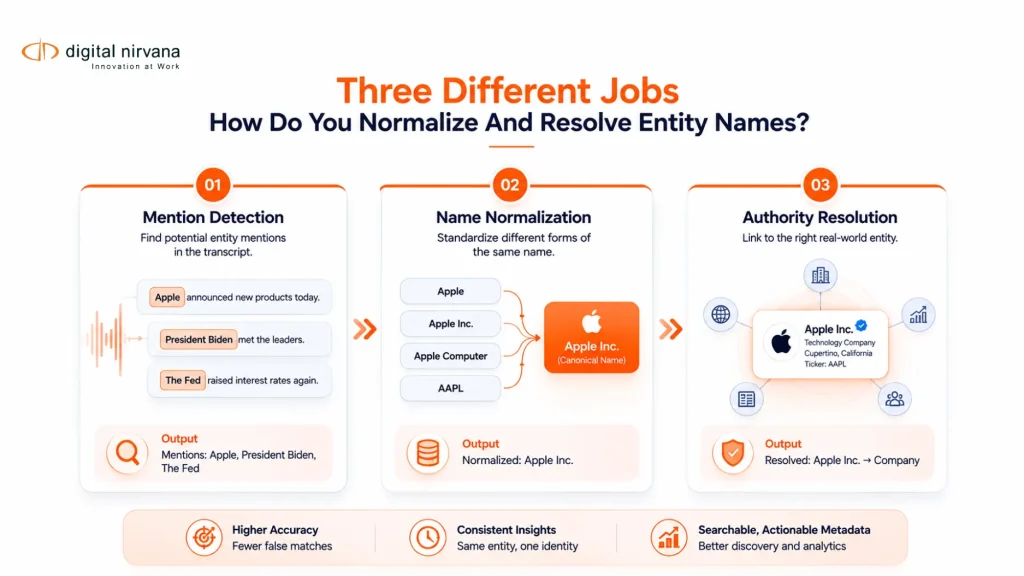
How Do You Normalize And Resolve Entity Names?
Normalization cleans a mention; resolution decides which real-world entity it represents. These steps should not be collapsed.
Normalization may:
- Standardize whitespace and punctuation
- Expand a controlled abbreviation
- Apply an approved capitalization
- Convert a known nickname to a preferred display label
- Preserve the original mention as an alias
Resolution compares the mention with context and an authority file. “Washington” might refer to a person, state, city, government, team, or institution. “United” could refer to an airline, football club, organization, or ordinary adjective.
Useful context includes:
- Program, beat, league, or series
- Nearby words and topics
- Speaker identity
- On-screen text
- Face and logo detections
- Publication date
- Existing archive entities
Do not force a resolution when evidence is weak. Store the mention as unresolved, route it for review if material, and avoid polluting the authoritative name index.
How Should Confidence And Human Review Work?
Use confidence to route decisions, not to declare every high score correct. Thresholds should vary by entity type, program, and consequence.
A workflow can use three bands:
- Auto-accept: high-confidence, low-risk mentions with a strong authority match.
- Review: ambiguous names, new entities, sensitive people, conflicting signals, or medium confidence.
- Reject or hold: low confidence, invalid offsets, unsupported language, or a failed authority match.
Reviewers need the transcript phrase, audio or video context, speaker, proposed type, possible matches, and reason for the flag. Corrections should update the record and, where appropriate, improve dictionaries or future models.
Digital Nirvana’s metadata tagging accuracy bake-off recommends gold sets, precision, recall, false-positive analysis, and timestamp scoring. The same controlled approach belongs in entity review.
How Do You Evaluate Named Entity Extraction?
Evaluate the end-to-end media result, not only whether a model found a word.
Build a gold set across:
- News bulletins and field packages
- Sports commentary and interviews
- Entertainment panels and reality programs
- Accents and supported languages
- Clean and noisy audio
- Recurring and previously unseen people
- Short names, aliases, abbreviations, and ambiguous entities
- Rapid updates where the same name changes role or team
Measure:
- Mention precision and recall
- Entity-type accuracy
- Resolution accuracy
- False positives per hour
- Missed priority entities per hour
- Median and tail timestamp error
- Duplicate rate
- Percentage auto-accepted
- Review minutes per hour
- Search success on real editorial tasks
Report results by category. An overall score can hide poor performance on the exact people, teams, or locations the newsroom searches most often.
How Do You Integrate Entities With A MAM Or DAM?
Write entity results through a governed mapping that preserves time, identity, confidence, and provenance.
Decide whether each system needs:
- Asset-level summary tags
- Time-range markers
- Transcript annotations
- Authority IDs
- Human-readable labels
- Confidence and review state
- Links to related people, organizations, or places
Use stable identifiers wherever possible. A name string changes, collides, or appears in multiple languages. An authority ID lets the display label evolve without losing relationships.
The MetadataIQ media indexing overview describes automated media metadata and search within PAM and MAM workflows. Before publication, Digital Nirvana product specialists should verify which entity, API, connector, and write-back capabilities are currently supported.
FAQs
An entity extraction API accepts text and returns labeled spans representing people, organizations, places, events, products, and other entity types.
Named entity extraction, or named entity recognition, identifies text spans and classifies them into defined categories.
It typically works on text derived from video, such as transcripts or OCR. The workflow maps extracted spans back to media timestamps.
No. Entity extraction identifies typed things, while keyword extraction usually identifies salient words or phrases without resolving their real-world identity.
Entity resolution links a mention to the correct authority record or real-world identity using context, aliases, and other evidence.
Only when approved rules support that use case. Sensitive identities, ambiguous names, and authoritative archive fields may still require review.
Character offsets from the API response are mapped to timestamped transcript tokens, producing a media start and end time for each mention.
Use representative transcripts and measure precision, recall, type accuracy, resolution, timestamp error, duplicates, and human correction effort.
Conclusion
An entity extraction API becomes useful to media teams when it preserves timecodes, resolves identities carefully, exposes provenance, and supports review. Treat raw model output as a candidate layer, then promote approved entities into searchable metadata.
Professional help is useful when transcript processing, authority files, APIs, and MAM or DAM write-back must work as one controlled pipeline. Begin with a bounded gold set and real search tasks.